







Introduction: A Historic Commitment
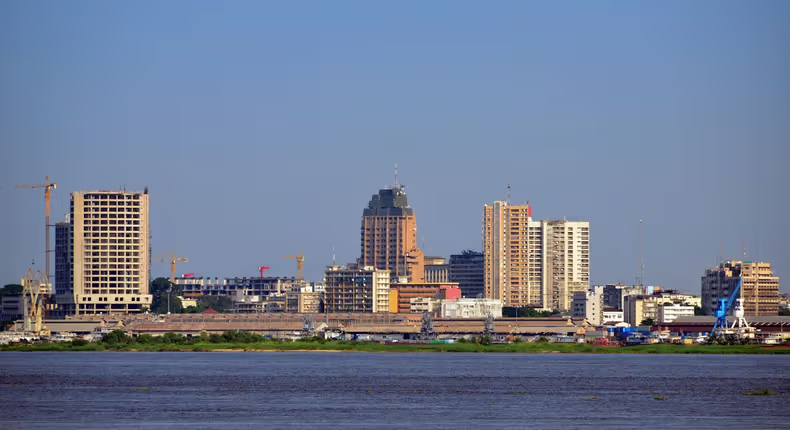
The Democratic Republic of Congo has secured a $1.882 billion tourism investment commitment from the United Arab Emirates, in one of the largest country allocations under a broader $6 billion programme targeting Africa’s travel sector . The funding, confirmed after an April 3 cabinet meeting, gives the DRC approximately 31 per cent of the total pool, underscoring growing investor interest in a country with vast but largely untapped tourism assets .
For the DRC, this deal marks a strategic shift towards positioning tourism as a potential growth driver in an economy still heavily reliant on mining . The country is home to vast rainforests, wildlife, and river systems but has struggled to attract international visitors due to poor infrastructure, limited connectivity, and weak global visibility .

This ASJ article examines the scope of the investment, the projects identified for financing, the potential economic impact, and the challenges that will determine whether this historic commitment translates into lasting transformation.
📢 GET A DETAILED ARTICLES + JOBS
Join ASJ's WhatsApp Channel and never miss a post or opportunity.

The Investment: Scope and Scale
The Broader Programme
The $1.882 billion commitment to the DRC is part of a $6 billion UAE programme targeting Africa’s travel sector . The DRC allocation represents approximately 31 per cent of the total pool, making it one of the largest single-country tourism investments ever made on the continent .
The broader programme is expected to support infrastructure upgrades, improve travel connectivity, and strengthen tourism services across participating countries. Estimates suggest it could generate at least 70,000 direct jobs and attract an additional $3.5 billion in investment if fully implemented .
| Metric | Value |
|---|---|
| Total UAE Africa Tourism Programme | $6 billion |
| DRC Allocation | $1.882 billion |
| DRC Share of Total | ~31% |
| Estimated Direct Jobs (if fully implemented) | 70,000+ |
| Estimated Additional Investment Attracted | $3.5 billion |
Deepening UAE-DRC Economic Ties
The deal reflects deepening economic ties between Kinshasa and Abu Dhabi, following a broader partnership agreement aimed at increasing Emirati investments in the DRC by the end of the decade . The UAE has been increasingly active in African investment, with a focus on infrastructure, logistics, and now tourism.
The commitment follows a high-level visit from UAE President Mohamed bin Zayed in 2025, which laid the groundwork for expanded cooperation across multiple sectors . This tourism investment is the most tangible outcome of that diplomatic engagement to date .
Projects Identified for Financing
The investment will support a diverse portfolio of projects across the DRC, including national parks, marine reserves, tourism infrastructure, and transportation corridors.
Protected Areas and National Parks
Several of the DRC’s most significant protected areas have been identified for development and upgrade :
| Site | Location | Features |
|---|---|---|
| Kinshasa Zoological and Botanical Garden | Kinshasa | Urban zoo and botanical garden; rehabilitation planned |
| Muanda Mangrove Marine Park | Coastal DRC (Congo Central province) | Mangrove ecosystem; marine biodiversity |
| Kundelungu National Park | Haut-Katanga province | Waterfalls (including the 340m Lofoi Falls), savannah, forest |
| Bombo Lumene Reserve | Plateau des Bateke, east of Kinshasa | Wildlife reserve with forest and savannah ecosystems |
The DRC is home to some of Africa’s most extraordinary natural heritage, including five UNESCO World Heritage sites: Virunga National Park, Garamba National Park, Kahuzi-Biega National Park, Salonga National Park, and the Okapi Wildlife Reserve . While these sites are not explicitly named in the initial announcement, the broader investment signals a commitment to leveraging the DRC’s natural assets for tourism development.
Tourism Infrastructure
Authorities also plan to modernise the N’sele tourist village, rehabilitate the Kitona coastal site, and develop tourism corridors linking Kinshasa to Kananga by road and to Mbandaka and Kisangani via river routes .
These corridors are significant. The DRC’s vast geography has long been a barrier to tourism development. Improving road and river connections between major population centres and tourist destinations could transform the accessibility of the country’s natural and cultural assets.
Transport Connectivity
The investment includes upgrades to transportation infrastructure, which will have benefits beyond tourism. Improved road and river networks may also have wider benefits for trade and regional integration . The development of tourism corridors is expected to stimulate economic activity in remote areas, creating opportunities for local communities.
Why the DRC? Untapped Potential
A Tourism Giant Waiting to Emerge
The DRC is Africa’s second-largest country by area and possesses extraordinary natural assets:
-
Rainforests: The Congo Basin rainforest is the second-largest tropical rainforest in the world, home to exceptional biodiversity
-
Wildlife: Mountain gorillas, okapi, forest elephants, bonobos, and countless other species found nowhere else
-
River systems: The Congo River is the second-longest in Africa and the deepest in the world
-
Waterfalls: Lofoi Falls in Kundelungu National Park drops 340 metres—one of Africa’s highest
-
Volcanoes: Mount Nyiragongo in Virunga National Park features the world’s largest lava lake
Historical Underperformance
Despite these assets, the DRC has struggled to attract international visitors. The reasons are well-documented:
-
Poor infrastructure: Roads are inadequate, and many tourist sites are difficult to access
-
Limited connectivity: Air travel options are limited, and internal transport is challenging
-
Security concerns: Conflict in eastern DRC has deterred tourism for decades
-
Weak global visibility: The DRC is not marketed effectively as a tourist destination
This combination of high potential and low performance is precisely what makes the DRC attractive to investors with a long-term horizon. The UAE is betting that with the right investment, the country’s tourism sector can be transformed .
Economic Impact: Jobs, Investment, and Diversification
Job Creation
Estimates suggest the broader $6 billion programme could generate at least 70,000 direct jobs across participating countries if fully implemented . For the DRC, which faces significant youth unemployment challenges, tourism-related employment could provide meaningful economic opportunities, particularly in rural and remote areas.
Tourism jobs are often labour-intensive and geographically dispersed, meaning benefits can reach communities that have not shared in the mineral wealth that has historically driven the DRC’s economy .
Catalysing Additional Investment
The UAE’s commitment is expected to attract an additional $3.5 billion in investment across Africa’s travel sector . This multiplier effect is typical of large-scale infrastructure investments—improved roads, ports, and tourist facilities make it easier for private investors to develop complementary services such as hotels, tour operations, and restaurants.
Economic Diversification
For the DRC, this deal marks a shift towards positioning tourism as a potential growth driver in an economy still heavily reliant on mining . Mining has long dominated the DRC’s export earnings, but it has not delivered broad-based development. Tourism offers a pathway to economic diversification, job creation, and local economic development that mining cannot provide.
If delivered effectively, the investment could help diversify the economy, create jobs, and stimulate local activity, particularly in remote areas .
The Challenges Ahead
Execution Risk
Analysts say the success of the initiative will depend on execution, including improving transport links, ensuring security around tourist sites, and building basic services needed to support visitors . The DRC has a poor track record of implementing large-scale infrastructure projects, and the risk of delays or cost overruns is significant.
Officials have cautioned that access to the funds will depend on further technical work. A detailed roadmap is expected to be finalised at a follow-up meeting in Nairobi, while several ministries are working to prepare investment plans and meet funding conditions .
Security Concerns
Eastern DRC remains volatile, with armed groups operating in and around Virunga National Park—one of the country’s most significant tourist assets. Ensuring security around tourist sites will be essential for attracting international visitors. Without meaningful improvements in security, even the most well-funded tourism projects will struggle to attract visitors.
Infrastructure Gaps
The DRC’s infrastructure deficit is severe. Roads are unpaved, bridges are unsafe, and electricity is unreliable. Building the transport links necessary to make tourism viable will require sustained investment over many years. The UAE’s commitment is a significant down payment, but much more will be needed.
Global Visibility
The DRC is not widely recognised as a tourist destination. Building global awareness will require coordinated marketing efforts, investment in branding, and engagement with international tour operators. This is a long-term undertaking that will require patience and sustained investment .
The Broader Context: UAE’s Africa Tourism Push
The DRC investment is part of a larger UAE strategy to expand its footprint in Africa’s travel sector. The UAE has been increasingly active in African investment, with a focus on infrastructure, logistics, and now tourism .
The broader $6 billion programme is expected to support infrastructure upgrades, improve travel connectivity, and strengthen tourism services across participating countries . While the DRC is the largest beneficiary to date, other African nations are also expected to receive funding under the programme.
The UAE’s interest in African tourism is strategic. As global travel recovers from pandemic-era disruptions, Africa is seen as one of the last underdeveloped tourism markets with significant growth potential. The UAE is positioning itself as a gateway to that growth, leveraging its aviation hubs (Dubai, Abu Dhabi) and financial resources to capture a share of the value chain.
What This Means for the DRC
A Turning Point
For the DRC, this investment represents a potential turning point. The country has long been overlooked by international tourists, despite possessing some of Africa’s most extraordinary natural assets. The UAE’s commitment signals confidence in the country’s potential and provides the financial resources to begin addressing the infrastructure deficits that have held the sector back .
A Long Road Ahead
Yet the road ahead is long. The investment will only be disbursed as projects meet technical and financial conditions. A detailed roadmap is expected to be finalised at a follow-up meeting in Nairobi . Several ministries are working to prepare investment plans .
While the scale of the commitment signals strong confidence in the country’s potential, its impact will ultimately depend on whether planned projects move from announcement to completion . The DRC has seen ambitious investment commitments before that have failed to materialise. This time must be different.
The Opportunity
If delivered effectively, the investment could help diversify the economy, create jobs, and stimulate local activity, particularly in remote areas. Improved road and river networks may also have wider benefits for trade and regional integration .
For a country that has long relied on mining to drive its economy—with limited success in delivering broad-based development—tourism offers an alternative pathway. It is labour-intensive, geographically dispersed, and can create economic opportunities in areas that mining has bypassed .
Key Takeaways
| Aspect | Detail |
|---|---|
| Total UAE Commitment to DRC | $1.882 billion |
| Share of $6 Billion Africa Programme | ~31% |
| Key Projects | National parks, marine reserves, tourism corridors, transport infrastructure |
| Estimated Direct Jobs (if fully implemented) | 70,000+ (across Africa) |
| Estimated Additional Investment | $3.5 billion |
| Follow-Up Meeting | Nairobi (roadmap finalisation) |
| DRC Economic Context | Mining-dependent economy seeking diversification |
Frequently Asked Questions (FAQs)
1. How much has the UAE committed to DRC tourism?
The UAE has committed $1.882 billion to develop tourism in the Democratic Republic of Congo, representing approximately 31 per cent of a broader $6 billion Africa-wide programme .
2. What projects will the investment fund?
Identified projects include the development and upgrade of the Kinshasa Zoological and Botanical Garden, Muanda Mangrove Marine Park, Kundelungu National Park, Bombo Lumene Reserve, modernisation of the N’sele tourist village, rehabilitation of the Kitona coastal site, and development of tourism corridors linking Kinshasa to Kananga, Mbandaka, and Kisangani .
3. Why is the UAE investing in DRC tourism?
The DRC possesses vast but largely untapped tourism assets, including rainforests, wildlife, and river systems. The UAE is betting that with the right investment, the country’s tourism sector can be transformed, generating returns while deepening economic ties .
4. How many jobs could the investment create?
Estimates suggest the broader $6 billion programme could generate at least 70,000 direct jobs across participating countries if fully implemented .
5. Will the investment attract additional funding?
Yes. The programme is expected to attract an additional $3.5 billion in investment as improved infrastructure makes it easier for private investors to develop complementary services .
6. What are the main challenges facing the investment?
Key challenges include execution risk, security concerns in eastern DRC, infrastructure deficits, and the need to build global awareness of the DRC as a tourist destination .
7. When will the funds be disbursed?
Access to the funds depends on further technical work. A detailed roadmap is expected to be finalised at a follow-up meeting in Nairobi .
8. How does this fit into the UAE’s broader Africa strategy?
The UAE has been increasingly active in African investment, with a focus on infrastructure, logistics, and now tourism. The DRC commitment is the largest single-country allocation under a $6 billion Africa-wide tourism programme .
9. What is the DRC’s current tourism status?
The DRC has struggled to attract international visitors due to poor infrastructure, limited connectivity, security concerns, and weak global visibility, despite possessing extraordinary natural assets .
10. Could this investment transform the DRC’s economy?
If delivered effectively, the investment could help diversify the economy away from mining dependence, create jobs, and stimulate local activity, particularly in remote areas .
Conclusion: A Historic Bet on the DRC’s Future
The UAE’s $1.882 billion commitment to DRC tourism is historic—not just in scale, but in what it represents. For a country that has long been defined by its mineral wealth and the conflicts that wealth has fuelled, tourism offers an alternative vision of development: labour-intensive, geographically dispersed, and capable of creating economic opportunities in areas that mining has bypassed .
The investment signals strong confidence in the DRC’s potential. The country’s natural assets—rainforests, wildlife, rivers, waterfalls, volcanoes—are world-class. What has been missing is the infrastructure, security, and global visibility to turn those assets into a thriving tourism sector.
The challenges are significant. Execution risk is high. Security concerns persist. Infrastructure deficits are severe. But the scale of the UAE’s commitment provides the financial resources to begin addressing these challenges.
Whether this investment transforms the DRC’s tourism sector will depend on what happens next: whether the roadmap is finalised, whether projects are implemented effectively, and whether security and infrastructure improvements materialise.
The bet has been placed. Now comes the hard part.
Frequently Asked Questions (FAQs)
1. How much has the UAE committed to DRC tourism?
$1.882 billion, representing approximately 31% of a broader $6 billion Africa-wide programme .
2. What projects will the investment fund?
National parks, marine reserves, tourist villages, coastal sites, and tourism corridors linking Kinshasa to Kananga, Mbandaka, and Kisangani .
3. Why is the UAE investing in DRC tourism?
The DRC possesses vast untapped tourism assets; the UAE is betting that investment can transform the sector and deepen bilateral ties .
4. How many jobs could the investment create?
Estimates suggest at least 70,000 direct jobs across participating countries if fully implemented .
5. Will the investment attract additional funding?
Yes, an estimated $3.5 billion in additional investment is expected .
6. What are the main challenges?
Execution risk, security concerns, infrastructure deficits, and weak global visibility .
7. When will the funds be disbursed?
Access depends on further technical work; a detailed roadmap is expected to be finalised in Nairobi .
8. How does this fit into the UAE’s broader Africa strategy?
The UAE has been increasingly active in African infrastructure, logistics, and now tourism investment .
9. What is the DRC’s current tourism status?
The DRC has struggled to attract international visitors despite possessing extraordinary natural assets .
10. Could this investment transform the DRC’s economy?
If delivered effectively, it could help diversify the economy away from mining dependence and create jobs in remote areas
Source: Accra Street Journal
Last Updated on April 7, 2026 by Samuel Kwame Boadu
Disclaimer: Some content on Accra Street Journal may be aggregated, summarized, or edited from third-party sources for informational purposes. Images and media are used under fair use or royalty-free licenses. Accra Street Journal is a subsidiary of SamBoad Publishing Hub under SamBoad Business Group Ltd, registered in Ghana since 2014.
For concerns or inquiries, please visit our Privacy Policy or Contact Page.

Samuel Kwame Boadu is a Ghanaian media entrepreneur and storyteller with a passion for amplifying urban voices and uncovering everyday truths. He is the Editor-in-Chief and Founder of Accra Street Journal, a dynamic digital platform dedicated to capturing the pulse of Ghana’s capital—its people, culture, challenges, business, sports and innovations.