








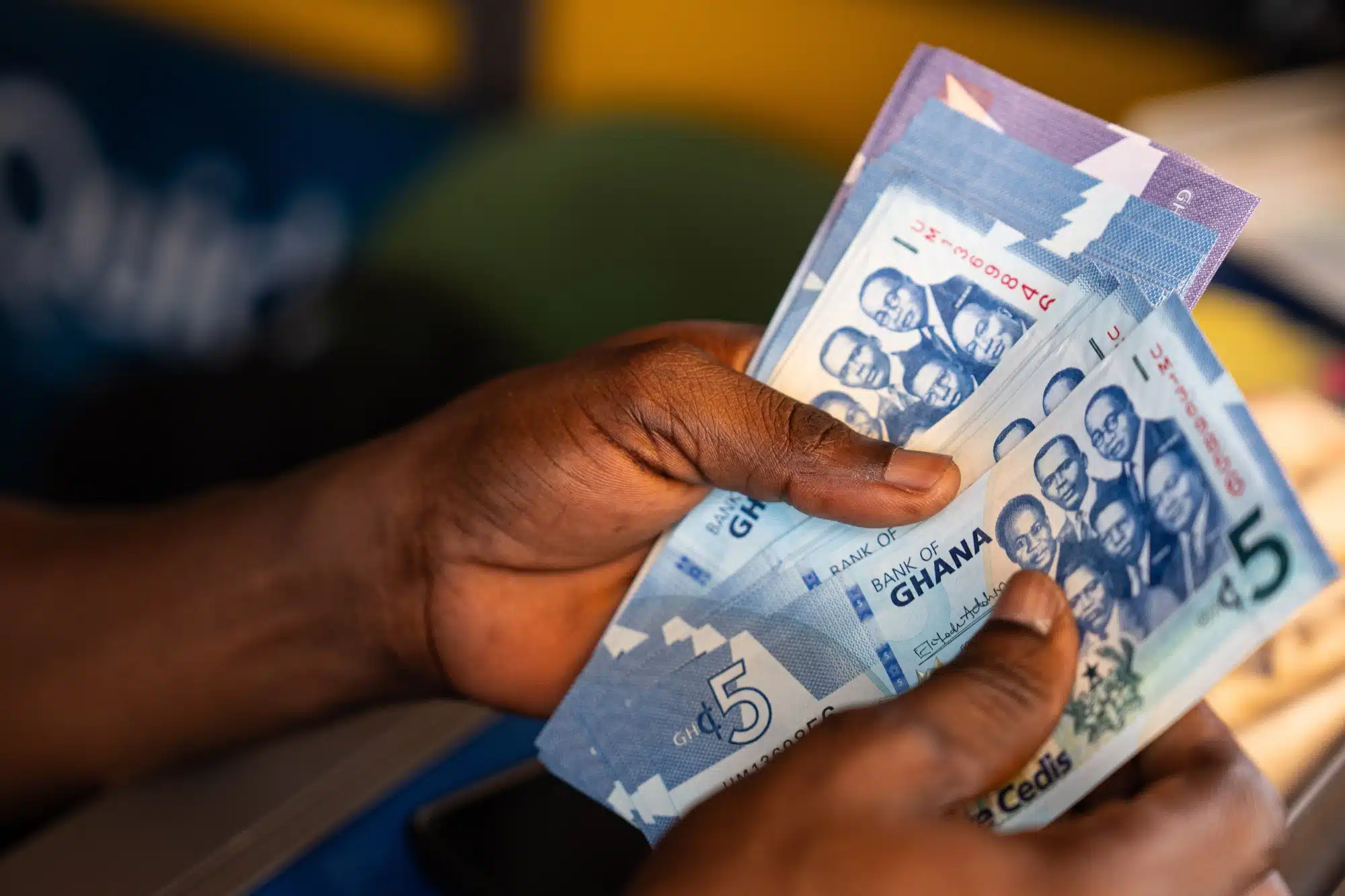
For the better part of five years, the Ghana cedi has lived a double life. By day, it is the currency of commerce—exchanged for tomatoes at Madina market, counted into envelopes for contractors at the Ministry of Finance, wired abroad for school fees in Canada and medical bills in India. By night, it is a political battering ram. Opposition leaders blame it for every price increase. Government spokespersons celebrate every plateau as a personal triumph. And the ordinary Ghanaian, caught in the middle, has learned to treat the exchange rate like the weather: unpredictable, uncontrollable, and potentially devastating.
Today, the cedi is trading at an interbank mid-rate of GH¢11.09 to the US dollar. Let that number settle. Two years ago, during the darkest stretch of the debt crisis, the same cedi was brushing against GH¢15 on the retail market, with bureaux de change in Osu and Circle quoting prices that changed faster than a trotro’s route. The fact that the currency has not only recovered but stabilized at this level for several consecutive weeks is, by any reasonable measure, a policy achievement.

Analysts are attributing the run to two anchors: the successful conclusion of the external debt restructuring, which removed the sword of Damocles hanging over Ghana’s balance of payments, and steady gold export inflows, which have padded the Bank of Ghana’s reserves to levels not seen since 2019.
📢 GET A DETAILED ARTICLES + JOBS
Join ASJ's WhatsApp Channel and never miss a post or opportunity.

But the Accra Street Journal is not in the business of publishing press releases dressed as analysis. The question that demands asking is not whether the cedi is stable today—it self-evidently is. The question is how durable that stability will prove when the political calendar flips to election season and the structural weaknesses in Ghana’s foreign exchange market reassert themselves.
This is a forward-looking analysis of what happens next. Because if there is one lesson from Ghana’s economic history, it is this: the cedi’s greatest vulnerabilities always emerge not during crisis, but during the false dawn that follows.

The Anchors That Hold: Debt and Gold
Before we look at the storm clouds, we must respect the engineering that built the shelter.
The external debt restructuring, finalized in late 2025 after tense negotiations with the Official Creditor Committee and Eurobond holders, did something that no amount of central bank intervention could achieve: it restored investor confidence in Ghana’s willingness to pay. The deal—which involved significant haircuts but preserved principal repayment schedules—allowed the IMF to disburse the next tranche of its extended credit facility. Those dollars flowed directly into the Bank of Ghana’s international reserves, which now stand at approximately $7.2 billion, representing just over three months of import cover.
Three months is not abundance. But it is a fortress compared to the $1.5 billion low of late 2022, when Ghana could barely cover two weeks of imports.
The second anchor is gold. Ghana has always mined gold. What changed is how the central bank uses it. The Gold for Oil programme, initially dismissed by skeptics as a gimmick, has matured into a structural feature of the foreign exchange market. Under the arrangement, the Bank of Ghana purchases a portion of large-scale mining output in cedis, refines it, and uses the forex proceeds to pay for oil imports directly. This removes a massive source of dollar demand from the energy sector—estimated at roughly $350 million per quarter. Without Gold for Oil, the cedi would require significantly more dollar liquidity to purchase the same volume of refined petroleum products.
These two pillars—debt resolution and gold monetization—have created a corridor of stability. The cedi has traded within a range of GH¢10.80 to GH¢12.20 for six consecutive months. Volatility has collapsed. Forward markets are quoting relatively tight spreads. For importers of rice, cooking oil, and pharmaceuticals, this predictability has been a lifeline.
The Structural Fault Lines That Remain
But corridors can collapse. And the cedi’s foundation, while improved, rests on ground that trembles in three specific places.
First, the composition of reserves. Not all dollars are created equal. A significant portion of the Bank of Ghana’s $7.2 billion in reserves is encumbered—pledged as collateral for various credit lines and swap arrangements. The truly liquid, unencumbered reserves available for emergency intervention are closer to $4.5 billion. That is still respectable, but it is not a war chest. A sudden spike in import demand—say, during the fourth quarter of an election year—could drain this liquidity faster than the central bank can replenish it.
Second, the Gold for Oil programme’s limits. The arrangement works beautifully when gold prices are high and mining output is stable. Gold is currently trading at $2,450 per ounce, near historic highs. But commodity prices are cyclical. A correction to $1,800 per ounce would slash the cedi value of mining output, reducing the supply of dollars available for oil purchases. Ghana would then revert to the open market, competing with every other import-dependent nation for scarce dollars. The Bank of Ghana has not publicly stress-tested this scenario. That silence is worrying.
Third, the remittance variable. Ghanaian diasporans sent approximately $4.6 billion home in 2025, a record figure that provided a steady stream of retail dollars into the economy. But remittances are not guaranteed. They respond to economic conditions in the diaspora—recession in the United States, stricter money transfer regulations in Europe, or simply a loss of confidence in the local banking system. If remittances contract by even 10%, the cedi would lose a critical buffer.

These are not doomsday predictions. They are risk assessments. And any credible analysis of the cedi at GH¢11.09 must acknowledge that the currency’s strength is borrowed from favorable external conditions and creative central banking—not from fundamental shifts in Ghana’s export base or industrial productivity.
What This Means for Ghana: The Importers, the Traders, and the Traveler
Let us bring this down to the pavement. What does a stable cedi at GH¢11.09 actually mean for different Ghanaians?
For the importer: This is oxygen. A stable exchange rate allows you to price goods with confidence, sign forward contracts with suppliers, and avoid the destructive cycle of holding inventory while the currency collapses. The spare parts dealer who imports from Dubai can now quote a price to a customer in Kumasi that will still be profitable when the container arrives six weeks later. That was impossible in 2022.
For the trader at the local market: The benefit is indirect but real. Because importers are not scrambling to pass through constant currency adjustments, wholesale prices have moderated. The cedi stability is one reason why inflation has fallen to 3.2%. The two numbers are connected by a chain of supply chains. When the currency holds, price shocks do not cascade.
For the parent paying school fees abroad: GH¢11.09 still hurts. Two years ago, the rate was GH¢8. That is a 38% increase in the cedi cost of a dollar-denominated fee. Stability at a high level is not the same as affordability. The parent sending a child to the United Kingdom or the United States is still paying dramatically more than they were before the crisis. Stabilization prevents further deterioration. It does not reverse past losses.
For the traveler: If you are flying to London or New York, the cedi at GH¢11.09 means you can budget with confidence. The days of arriving at the airport bureau and finding the rate 15% higher than yesterday’s newspaper are over. But you are still exchanging eleven cedis for one dollar. Travel remains an expensive proposition.
For the Bank of Ghana: This is the moment of greatest danger. Success breeds complacency. The central bank must resist the temptation to celebrate and instead double down on reserve accumulation. Every dollar earned from gold, cocoa, or remittances should be saved, not spent defending an artificial rate. The cedi is stable. The job is to keep it that way.
Wider Context: The West African Currency Map
To understand how rare Ghana’s current stability is, look at the neighbourhood.
Nigeria’s naira has lost over 65% of its value since the central bank allowed it to float more freely in 2023. The official rate is hovering near ₦1,550 to the dollar, but the parallel market tells a darker story. The cedi, by contrast, has been a model of managed flexibility—allowing depreciation when necessary, intervening when excessive, and never promising an impossible peg.
Within the West African Monetary Zone, which includes Ghana, Nigeria, Guinea, and The Gambia, Ghana is the only country that has successfully completed an IMF programme without a major currency crash. That distinction matters for foreign direct investment. Multinationals considering a West African headquarters look at currency stability as a proxy for policy competence. By that measure, Accra is currently outranking Lagos.
But the CFA franc zone, with its fixed parity to the euro and unlimited convertibility guaranteed by the French Treasury, remains the gold standard of West African currency stability. Ghana cannot compete with that guarantee—no sovereign Ghanaian government can credibly promise to back every cedi with a hard currency reserve. That is not a failure of policy; it is a reality of sovereignty.

The lesson is not to copy the CFA. The lesson is to manage expectations. A floating currency in an emerging market will always be more volatile than a pegged one. The goal is not zero volatility. The goal is manageable volatility. And by that metric, Ghana is currently succeeding.
ASJ’s Outlook: What Happens Next (The Election 2026 Test)
The Accra Street Journal projects that the cedi’s fate will be determined not by gold prices or debt ratios, but by the political behavior of the government between July and December 2026.
Ghana holds district-level elections in late 2026. These are not presidential contests, but they matter enormously for the ruling party’s ground game ahead of the 2028 general election. The incumbents will face overwhelming pressure to spend—on roads, on schools, on allowances for assembly members, on patronage distributed through district assemblies.
That spending will be in cedis. But much of it will translate into demand for dollars. Contractors who receive cedi payments will need to import equipment, vehicles, and materials. The government may also be tempted to draw down on reserves to defend a symbolic rate—perhaps GH¢11 or GH¢10.50—if the cedi faces seasonal pressure.
Here is the forecast:
Scenario One (Disciplined): The government allows the cedi to adjust gradually, trading to GH¢12.50 by December 2026. Importers absorb the increase. Inflation ticks up to 5.5% but remains manageable. The Bank of Ghana holds its nerve. Reserves remain intact for 2027.
Scenario Two (The Trap): The government orders the Bank of Ghana to burn reserves defending GH¢11 through the election. The central bank complies, spending $1.5 billion over six months. By January 2027, reserves fall to $3 billion. The cedi then snaps, trading to GH¢15 in a matter of weeks. Inflation spikes to 12%. The gains of two years are erased.
Which scenario unfolds depends on one variable: whether the Ministry of Finance has the political courage to tell the presidency that a managed, modest depreciation is better than a catastrophic collapse.
ASJ’s Verdict
The cedi at GH¢11.09 is a victory. It is a victory of restructuring, of gold monetization, of IMF discipline, and of a central bank that learned painful lessons from 2022. The traders at the forex bureaux who endured abuse from desperate customers can now point to a rate that moves slowly, predictably, and within bounds.
But a victory is not a permanent peace. The structural weaknesses in Ghana’s foreign exchange market—thin reserves, import dependence, commodity price exposure, and election cycle spending—have not been abolished. They have merely been suppressed by favorable conditions and competent management.
The true test of the Bank of Ghana’s legacy will come not when gold is at $2,450 and debt restructuring is fresh, but when gold falls, when election spending surges, and when the market tests the central bank’s resolve. On that day, the cedi will find its real level. The question is whether the Bank of Ghana will have the ammunition—and the political backing—to ensure that level is GH¢12 or GH¢13 rather than GH¢20.
For now, Ghanaians can breathe. The cedi is stable. The storm has passed. But the rainy season is not over. And the Accra Street Journal will be watching the horizon.
Last Updated on April 25, 2026 by Samuel Kwame Boadu
Disclaimer: Some content on Accra Street Journal may be aggregated, summarized, or edited from third-party sources for informational purposes. Images and media are used under fair use or royalty-free licenses. Accra Street Journal is a subsidiary of SamBoad Publishing Hub under SamBoad Business Group Ltd, registered in Ghana since 2014.
For concerns or inquiries, please visit our Privacy Policy or Contact Page.

Samuel Kwame Boadu is a Ghanaian media entrepreneur and storyteller with a passion for amplifying urban voices and uncovering everyday truths. He is the Editor-in-Chief and Founder of Accra Street Journal, a dynamic digital platform dedicated to capturing the pulse of Ghana’s capital—its people, culture, challenges, business, sports and innovations.