






10 min read
Ghana’s total export earnings hit $11.1 billion by the end of April 2025, up 20.7% from the $9.2 billion recorded during the same period in 2024, fueled by surging gold prices and strong performance across the country’s commodity exports. According to the Bank of Ghana’s latest Summary of Economic and Financial Data, gold remained the top earner, bringing in $6.8 billion—up from $5.2 billion in the first four months of 2024, marking a 30.8% year-on-year increase.
Cocoa exports held steady at 1.8 billion, unchanged from April 2024, while crude oil exports brought in 1.2 billion. Other exports totaled 1.1 billion. On the import side, Ghana spent 5.8 billion on imports between January and April 2025, up from 5 billion during the same period in 2024, driven largely by oil imports, which rose to 2 billion from 1.6 billion. Despite the higher import bill, Ghana recorded a trade surplus of $1.6 billion.
Key Takeaways
- Cocoa exports held steady at 1.8 billion, unchanged from April 2024, while crude oil exports brought in 1.2 billion.
- Despite the higher import bill, Ghana recorded a trade surplus of $1.6 billion.
- The export performance in the first four months of 2025 reflects three distinct commodity stories: gold surging, cocoa treading water, and oil maintaining baseline production.
Later, the surplus rose to $5.2 billion, slightly above the $5 billion posted in the first four months of 2024. The country’s current account balance reached $3 billion by the end of March 2025. International reserves climbed to $14.4 billion in April 2025, up from $13.8 billion in December 2024, while total gold reserves held by the Bank of Ghana increased to 22.3 tonnes from 18.6 tonnes at the end of 2024.
Key Developments: Gold’s Dominance, Cocoa’s Plateau, and Oil’s Contribution
The export performance in the first four months of 2025 reflects three distinct commodity stories: gold surging, cocoa treading water, and oil maintaining baseline production.
Gold exports of $6.8 billion were the single largest driver of the overall increase, with prices averaging about $4,600 per ounce during the period, compared to roughly $3,200 per ounce early 2024. Ghana’s gold production kept climbing, hitting an annualized rate of around 4.5 million ounces, boosted by new mines like Cardinal Namdini and expanded operations at AngloGold Ashanti’s Obuasi and Gold Fields’ Tarkwa. The sector’s share of total exports grew from about 56% in April 2024 to 61% in April 2025, highlighting gold’s growing dominance.
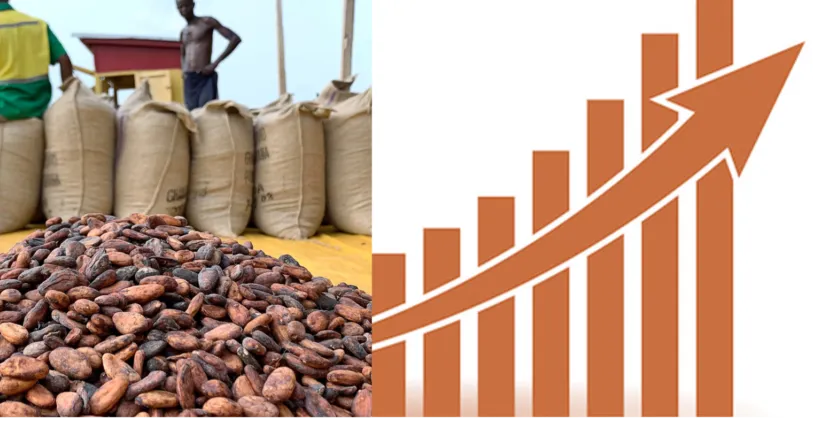
Cocoa exports of $1.8 billion were unchanged from the previous year, despite higher global prices. Cocoa futures averaged over $8,000 per tonne during the period—well above the $4,000 to $5,000 range in early 2024—but volumes stayed limited. The ginger disease that hit other farms didn’t affect cocoa, but production was still held back by aging trees, swollen shoot virus, and lingering weather-related yield losses. COCOBOD’s move to keep the producer price at 70% of FOB value protected farmer incomes but didn’t boost output. In dollar terms, earnings looked flat, but in reality Ghana shipped fewer tonnes and only maintained revenue thanks to higher prices.
Crude oil exports, valued at about $1.2 billion, were steady but showed no growth. Production from the Jubilee, TEN, and Sankofa fields has leveled off at roughly 180,000 to 200,000 barrels per day. The Sankofa gas expansion agreement, signed in May 2026, aims for 350 MMcfd by 2028, but that increase will go toward domestic power generation rather than crude exports. Oil export earnings are closely tied to global prices, which averaged above $110 per barrel during the Hormuz crisis. Without that price spike, oil exports would have been lower.
The import bill of 5.8 billion, up from 5.65 billion, reflects both higher volumes and higher prices. Oil imports climbed to 2 billion from 1.6 billion, driven by the same global price spike that boosted oil exports. Non-oil imports—like machinery, manufactured goods, and food products—also rose, showing stronger domestic demand as the economy steadies. The trade surplus of 5.2 billion is slightly higher than the 5 billion surplus in 2024, but with a shift in makeup: gold’s contribution has grown, while cocoa and oil have added less.
Analysis & Implications: Commodity Concentration and the Balance of Payments
The export data shows both strengths and weaknesses. Ghana’s trade surplus looks solid, with a current account surplus of $3 billion through March 2025—a huge turnaround from the deficits during the crisis years. However, the heavy reliance on gold exports—now at $1,613.50 per ounce—means that if prices fell by just 10%, export earnings could drop by about $2 billion a year, wiping out much of the trade surplus.
The Bank of Ghana’s reserve build-up strategy has paid off, with reserves rising from 13.8 billion in December 2024 to 14.4 billion in April 2025, despite higher oil import costs and efforts to defend the cedi. A major boost has come from the Domestic Gold Purchase Program, which lets the central bank buy gold from small-scale miners in cedis. Gold reserves have grown to over 22.3 tonnes, up from 18.6 tonnes at the end of 2024. Every tonne bought in cedis cuts the need to spend dollars on the international market, helping to support the currency.

The current account surplus of $3 billion is a measure of the country’s net international investment position. A surplus means that the country is earning more from its exports of goods and services (including remittances) than it is spending on imports and income payments. In Ghana’s case, the surplus is driven primarily by the trade surplus, as services and income flows are roughly balanced. The surplus provides a buffer against external shocks and supports reserve accumulation.
However, the import data reveals persistent vulnerabilities. Oil imports of 2billionrepresent34110 per barrel, increasing the import bill. If prices remain elevated, the trade surplus could erode even if gold prices also remain high. The government’s strategy of increasing domestic gas production (the Sankofa expansion) is intended to reduce oil import dependence, but the timeline extends to 2028.

The Accra Street Journal notes that the export data is backward-looking. The April 2025 numbers capture a period when global gold prices were high but before the full impact of the Hormuz crisis on oil prices and global trade. The May and June data will show the effect of $110-plus oil on the import bill. The outlook for the remainder of 2025 is mixed: gold prices remain supportive, but oil and cocoa prices are volatile, and global demand may soften.
What This Means for Fiscal Policy, the Cedi, and Households
Strong export performance boosts government revenues, with the mining sector contributing corporate income tax, royalties, and withholding taxes. Higher gold exports mean more tax income, cutting the need for new borrowing. The 2025 budget assumed gold prices at $4,200 per ounce, but the actual average of $4,600 has delivered a windfall that can be used to lower debt or increase spending.
For the cedi, the trade surplus and reserve accumulation are supportive. A country that earns more foreign exchange than it spends has a stronger currency. The Bank of Ghana has used the reserves to intervene in the forex market, smoothing volatility and defending the cedi. As of May 2026, the cedi was trading near GH¢11.31 per dollar—depreciated slightly from earlier in the year but stable relative to the crisis period. The reserves of $14.4 billion provide a comfortable buffer.
For households, the connection is indirect but real. Export earnings drive government revenues, which fund public services. A strong trade surplus supports the cedi, which keeps import prices (for food, fuel, manufactured goods) lower than they would otherwise be. However, the benefits of high gold prices are not evenly distributed. Mining communities see employment and business activity; urban households see the impact through the exchange rate. Rural households not connected to the mining sector may not feel the benefit.
The cocoa export performance—stuck at 1.8 billion—is a concern. Cocoa is the livelihood of over 800,000 farmers, and higher global prices should have boosted earnings, but volumes were limited. The government’s response should be to invest in cocoa rehabilitation: disease-resistant varieties, irrigation, and extension services. The current export earnings are a missed opportunity; with better volumes, cocoa could have brought in between 2.5 billion and 3 billion.
The oil export earnings of $1.2 billion are modest relative to the sector’s potential. Ghana’s oil production has plateaued, and new exploration has been limited by fiscal uncertainty and global energy transition pressures. The government’s priority should be to attract investment in new fields, particularly deepwater prospects, to reverse the production decline. Without new investment, oil exports will decline over time.
Wider Context: African Export Performance and Commodity Cycles
Ghana’s export performance compares favorably to its regional peers. Nigeria’s oil-dependent exports have been volatile, with higher prices offset by production disruptions and theft. Côte d’Ivoire’s cocoa exports have been similarly constrained by production challenges. South Africa’s exports have been buffeted by load-shedding and port inefficiencies.
The common theme across African commodity exporters is the challenge of capturing value from resource wealth. Ghana’s gold sector is dominated by foreign companies, though the government’s free-carried interest and royalty regime capture a share. The cocoa sector is more locally integrated, with COCOBOD managing the value chain. The oil sector is a mix of international oil companies and GNPC. The persistent challenge is to convert export earnings into broad-based economic development.
The shift in global commodity prices is favorable for exporters but not permanent. Gold prices are elevated due to geopolitical risk, central bank diversification, and de-dollarization. If those factors reverse—if the Hormuz crisis de-escalates, if central banks stop buying gold, if the dollar strengthens—prices could fall. Ghana must use the current windfall to build buffers (reserves, fiscal space) and invest in diversification.
The current account surplus of $3 billion is a rare achievement. Most African countries run current account deficits, meaning they spend more than they earn and must borrow or attract investment to fill the gap. Ghana’s surplus gives it policy space that deficit countries lack. The government should use that space to invest in infrastructure, education, and health—the building blocks of long-term growth.

The Bank of Ghana’s accumulation of gold reserves to 22.3 tonnes is a prudent diversification of the country’s reserve portfolio. Most central bank reserves are held in US dollars, euros, and other major currencies. Holding gold provides a hedge against dollar weakness and inflation. The Domestic Gold Purchase Program also supports the local mining sector, providing a market for small-scale miners.
Outlook / What Happens Next
The export performance for the remainder of 2025 will depend on commodity prices, production volumes, and global demand. Gold is likely to remain above $4,000 per ounce, supported by central bank buying and geopolitical risk. Cocoa prices may soften as supply from Côte d’Ivoire recovers, but Ghana’s production constraints will limit earnings. Oil prices will remain volatile, with the Hormuz crisis keeping them elevated.
The trade surplus for 2025 is expected to top $15 billion, up from around $13 billion in 2024. The current account surplus could land between $8 billion and $10 billion. By year’s end, reserves might reach about $16 billion, offering a cushion against uncertainties surrounding the December 2026 elections.
The government should use the windfall wisely. The temptation to increase spending will be strong, especially in an election year. But the lesson of past commodity booms is that they are followed by busts. The prudent approach is to save a portion of the windfall in a stabilization fund, use another portion to reduce debt, and invest the remainder in productivity-enhancing projects. The reserves buffer is already strong; the priority should be debt reduction.
For the Accra Street Journal’s readers, the export data is a reminder of Ghana’s resource wealth and its vulnerability. The country is rich in gold, cocoa, and oil, but the prices of those commodities are set in global markets beyond Ghana’s control. A trade surplus is good news, but it is not a guarantee of prosperity. The challenge is to use the current favorable conditions to build a more resilient, diversified economy. The export numbers tell a story of success. The next chapter will depend on what Ghana does with that success.
.
Source: Accra Street Journal
Last Updated on May 20, 2026 by Samuel Kwame Boadu
Disclaimer: Some content on Accra Street Journal may be aggregated, summarized, or edited from third-party sources for informational purposes. Images and media are used under fair use or royalty-free licenses. Accra Street Journal is a subsidiary of SamBoad Publishing Hub under SamBoad Business Group Ltd, registered in Ghana since 2014.
For concerns or inquiries, please visit our Privacy Policy or Contact Page.

Samuel Kwame Boadu is a Ghanaian media entrepreneur and storyteller with a passion for amplifying urban voices and uncovering everyday truths. He is the Editor-in-Chief and Founder of Accra Street Journal, a dynamic digital platform dedicated to capturing the pulse of Ghana’s capital—its people, culture, challenges, business, sports and innovations.
Use the following reference when citing or referencing this article.
Your feedback helps us improve our journalism.
Report an Error
Help us maintain accuracy. Let our editorial team know if you spot an issue in this article.
Report a problem with this article