A 2026 Intelligence Brief from Accra Street Journal
Executive Summary
Ghana’s energy transition is no longer a policy aspiration—it is a construction reality. Across the country, cranes are rising in the Dawa Industrial Enclave, solar panels are spreading across 140 acres in Yendi, and engineers are preparing the ground for the country’s second gas processing plant. The companies leading this build-out are a diverse mix: Ghanaian-owned conglomerates (First Sky Group, LMI Holdings), international engineering firms (John Murphy, CWE, Greenesol Power System), innovative financiers (CIPA Holdings), and state-owned enterprises (Bui Power Authority, VRA).

This ASJ report profiles the companies actively building Ghana’s green energy infrastructure, segmenting them by project scope and strategic positioning. The evidence suggests that Ghana is moving from policy to execution, but the race is not yet won. The 10% renewable target by 2030 requires sustained investment, grid modernisation, and—most critically—the successful commissioning of the projects profiled below.
📢 GET A DETAILED ARTICLES + JOBS
Join ASJ's WhatsApp Channel and never miss a post or opportunity.

Part 1: The Megaproject Builders—Utility-Scale Generation
First Sky Energies—The 50 MW Yendi Pioneer
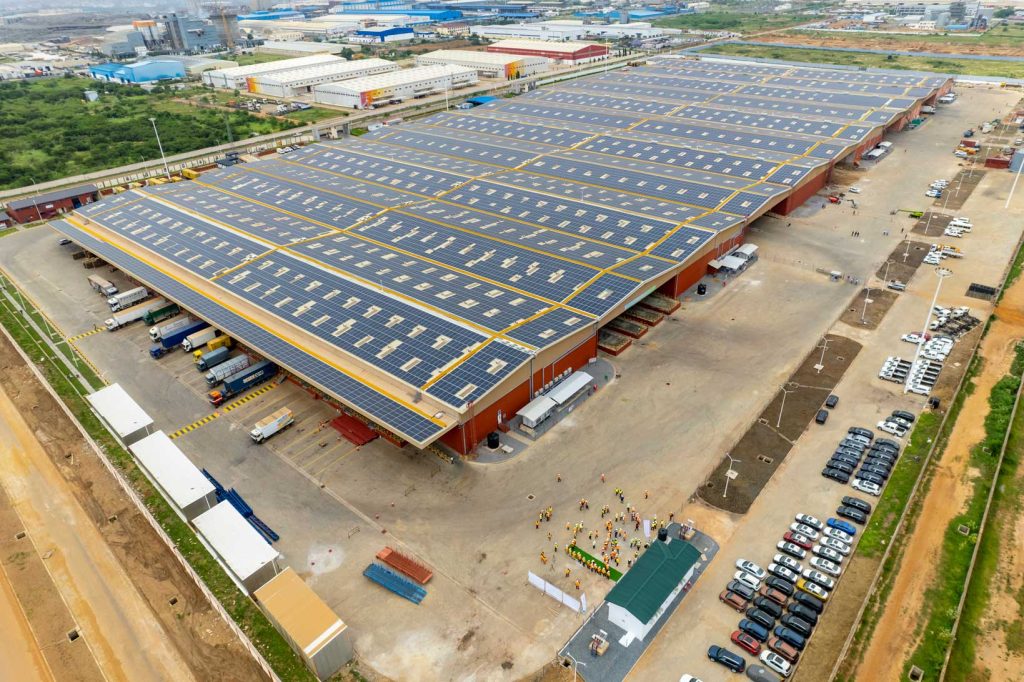
The most tangible evidence of Ghana’s green energy build-out is the First Sky Energies 50 MW Solar PV plant in Yendi. By the end of March 2026, the plant will be complete and supplying power to the national grid .
The numbers that matter:

-
Capacity: 50 MW (second largest solar installation in Ghana)
-
Land: 140 acres in the Yendi District, Northern Region
-
Investment: Fully Ghanaian-owned—“the largest fully Ghanaian-owned utility solar project of its kind”
-
Jobs: Expected to create 300 additional jobs, “providing opportunities particularly in the communities in the northern region”
-
Alignment: UN Sustainable Development Goals (affordable and clean energy, decent work, economic growth, climate action)
The Founder and Executive Chairman of First Sky Group, Eric Seddy Kutortse, framed the project as a statement of national capability: “This project represent confident in the Ghanaian entrepreneurship and ownership” .
Strategic significance: First Sky Energies is not a one-off developer. The company is part of the First Sky Group, which employs approximately 6,000 people across Ghana. The Yendi plant serves as a reference project, positioning First Sky as a lead bidder for future utility-scale renewable tenders. The company’s ability to deliver a 50 MW solar plant on schedule and on budget will determine its credibility in subsequent procurement rounds.
LMI Holdings / Solar for Industries Ltd—The 1,000 MW Norbert Anku Solar Park
The most ambitious renewable energy infrastructure project in Ghana’s history is the Norbert Anku Solar Park, being developed by LMI Holdings’ subsidiary, Solar for Industries Ltd, in the Dawa Industrial Enclave .
Phased development:
| Phase | Capacity | Expected Completion |
|---|---|---|
| Phase 1 (initial) | 100 MW | December 2026 |
| Phase 1 (remaining) | 100 MW | Nine months thereafter |
| Full target | 1,000 MW | 2032 |
President John Dramani Mahama broke ground on the project in November 2025, describing it as “a significant step toward the country’s clean industrial revolution” .
Key partners:
-
International Finance Corporation (IFC) — financing
-
Enclave Power Company — distribution within the industrial enclave
-
John Murphy Construction — engineering, procurement, and construction (EPC)
-
China International Water and Electric Corp (CWE) — EPC partner
-
SgurrEnergy — technical advisory
The off-grid model: The solar park will supply power to the Enclave Power Company network, serving industrial clients within the Dawa Industrial Enclave rather than feeding into the national grid . This model avoids transmission losses and bypasses ECG’s financial distress. Industrial clients are expected to receive a 10% discount on electricity generated .
The long-term vision: The project’s capacity is planned to grow to 1 GW by 2032, which would make it the largest solar farm in sub-Saharan Africa outside South Africa .
Kambic Industrial Partners—The 100 MW Biomass Pioneer
While solar dominates Ghana’s renewable narrative, biomass is emerging as a complementary baseload source. Kambic Industrial Partners, led by CEO John Kaku Mason, has secured a strategic partnership with India-based Greenesol Power System Pvt. Ltd. to develop biomass and waste-to-energy power projects .

The signature project: A proposed 100 MW bamboo-fired biomass power plant in Ghana.
The strategic partnership: Under a memorandum of understanding, Kambic and Greenesol will jointly develop biomass and waste-to-energy projects. Greenesol is an EPC company specialising in biomass and solid-waste-to-energy technologies, having recently completed one of the world’s largest waste-to-energy plants in Hyderabad, India .
Kambic’s broader platform: Kambic is also developing a bio-refinery complex in Ghana’s Eastern Region to produce ethanol, sustainable aviation fuel, energy pellets, and other bio-based products . This positions the company as a multi-product bioenergy developer, not merely a power generator.
Why biomass matters: Unlike solar and wind, biomass can provide baseload power—24 hours a day, not dependent on weather. For Ghana’s grid, which struggles with the intermittency of solar, biomass offers a complementary renewable source that can stabilise the system.
Thermenergy Services—The 200 MW Utility-Scale Developer
Thermenergy Services Limited has secured an Energy Commission provisional license and is in the second phase of regulatory permitting for a 200 MW utility-scale solar PV plant in the Central Region—which would be the largest in Ghana if completed .
The company’s track record:
-
Subcontractor for existing solar PV plants
-
Owner’s Engineer for commissioning
-
Associated consultant for a 150 MW wind farm’s development phase and wind speed data collection
-
Exploring mini-hydro plants along the Pra River
Strategic significance: Thermenergy’s 200 MW project, if it reaches financial close and construction, would surpass even the Norbert Anku Solar Park’s initial phases. However, the company remains in the permitting phase—a critical stage where many Ghanaian renewable projects stall .
Bui Power Authority—The Hybrid Hydro-Solar Pioneer
The Bui Power Authority (BPA) operates the Bui Dam (404 MW hydro) and has already deployed a 50 MW floating solar installation on the reservoir—one of the first hybrid hydro-solar projects in West Africa. BPA’s floating solar serves as a reference for VRA’s planned Kpong floating solar project.
Why the hybrid model matters: Hydro and solar are complementary. Solar generates during the day; hydro can be stored and released when solar is unavailable. By operating both, BPA can smooth output and reduce curtailment—a model that Ghana’s other hydro operators (notably VRA) are now seeking to replicate.
Part 2: The Midstream Enablers—Gas Processing and Transmission
The renewable energy build-out is occurring in parallel with—not in replacement of—gas infrastructure expansion. The government’s strategy recognises that gas is the bridge fuel to Ghana’s green future.
Ghana National Gas Company—The Atuabo II Gas Processing Plant
The most significant midstream announcement of 2026 is the Second Gas Processing Plant (GPP II) , to be built by the Ghana National Gas Company .

The numbers that matter:
-
Capacity: Not specified in available sources; Atuabo I (existing) processes approximately 240–270 MMscfd
-
Cost recovery: Finance Minister Dr Cassiel Ato Forson stated the plant will save the country “close to $500 million every two years, enough to pay for the project within a short period”
-
Jobs: Over 1,000 direct and indirect jobs
-
Strategic significance: Energy Minister John Jinapor noted that “little progress had been made in developing additional gas processing infrastructure since the commissioning of the Atuabo Gas Plant,” leaving Ghana dependent on costly imported liquid fuels
The urgency: Ghana currently spends more than $1 billion annually on expensive liquid fuels to power its thermal plants. GPP II will process natural gas from offshore fields, reducing this expenditure and easing foreign exchange pressures .
Implementation structure: Two committees have been inaugurated—a Technical Implementation Committee and a Communications and Social License Committee—chaired by Deputy Presidential Spokesperson Hajia Shamima Muslim. The Finance Minister charged the committees to deliver a comprehensive implementation plan within four weeks, stating: “This is too important for our country’s welfare and economic stability. Enough of the bureaucracy, let’s get it done” .
Grid Modernisation—GRIDCo and ECG Contractors
Green generation is useless without a grid to transmit it. The government is simultaneously investing in transmission and distribution infrastructure to accommodate new renewable capacity.
Ashanti Region upgrades: Energy Minister Dr John Abdulai Jinapor announced substantial investments in the Ashanti Region, including up to 700 higher-capacity transformers, upgrades to the GRIDCo Bulk Supply Point at Anwomaso, and conversion of transmission lines from three to six circuits .
New generation connection: The Cenit Energy Limited thermal plant (100 MW) is expected to connect by the end of May 2026, and the AKSA Energy plant is already connected to the national grid .
The grid constraint: The minister’s tour followed a fire at the GRIDCo substation in Akosombo, which disrupted power supply and exposed the fragility of transmission infrastructure. Without parallel investment in grid modernisation, new renewable generation cannot be fully utilised .
Part 3: The Off-Grid and Distributed Solar Companies
The utility-scale projects receive the most attention, but the off-grid and distributed solar segment is where Ghana’s green energy build-out is most visible to ordinary citizens.
The SREP Contractors
The Scaling-Up Renewable Energy Programme (SREP) , backed by the African Development Bank, the Climate Investment Fund, and the Swiss Government, is deploying :
| Component | Scale | Status |
|---|---|---|
| Mini-grids | 35 systems (47 communities) | Under construction |
| Rooftop solar PV (net-metered) | 12,000 units | Procurement underway |
| Public sector PV systems | 645 units | Procurement ongoing |
| Solar home systems | 1,450 units | Procurement underway |
The government’s role: The Ministry of Energy and Green Transition acts as the implementing agency. The 2026 Budget allocates GH¢480.8 million to the Renewable Energy Development programme, which funds these deployments .
The pipeline beyond SREP: The government has already completed feasibility studies for 150 island and lakeside communities in the Afram Plains and plans to construct additional mini-grids, targeting over 200 operational mini-grids by 2030 .
CIPA Holdings—The Financing Bridge for Distributed Solar
While not a construction company, CIPA Holdings Group is the most significant financial intermediary enabling distributed solar deployment. The company has positioned itself as “a trusted platform for deploying global capital into climate-resilient infrastructure” .
The financing gap: “Increasingly, the challenge is not the availability of capital, but the ability to structure and deploy that capital into bankable, scalable projects,” the company stated .
The solution: CIPA aggregates and structures renewable energy assets into “scalable investment platforms,” moving beyond single-project development to portfolio-based approaches. This addresses fragmentation—one of the key constraints in infrastructure investment across emerging markets .
Founder and CEO Kwaku Osei-Sarpong: “At the heart of the energy transition is capital, but more importantly, trust. Our focus has been on building platforms that investors can rely on to deploy capital into infrastructure that is both bankable and impactful” .
Why CIPA matters: The company’s recognition at the Ghana Entrepreneurs & Corporate Executives Awards 2026 reflects increasing confidence in its leadership within the renewable energy sector . By bridging global capital with local infrastructure opportunities, CIPA enables smaller-scale distributed projects to access financing that would otherwise be unavailable.
Off-Grid Solar Streetlights
The 2026 Budget commits to the distribution and installation of 23,500 solar streetlights (contracts awarded) and 10,000 all-in-one smart solar streetlights (to commence installation) . While the specific contractors are not named in the budget document, these installations represent significant procurement opportunities for local solar EPC firms.
Part 4: The International EPC Firms
Large-scale renewable projects in Ghana rely on international engineering, procurement, and construction (EPC) firms for specialised expertise and balance sheet capacity.
John Murphy Construction
John Murphy Construction is the EPC partner for the Norbert Anku Solar Park’s first 200 MW . The company brings international solar construction experience to Ghana’s largest renewable project.
China International Water and Electric Corp (CWE)
CWE is the other EPC partner for the Norbert Anku Solar Park, working alongside John Murphy . Chinese EPC firms have dominated Ghana’s thermal generation sector (Energy China delivered the Asogli 360 MW plant in 11 months). CWE’s involvement in solar signals continued Chinese interest in Ghana’s energy infrastructure.
WSP Group Africa
WSP Group Africa is a global engineering consulting firm with an office in Ghana covering the West Africa region . The company has provided Owner’s Engineer, Lender’s Technical Advisor, technical advice, tender management, construction and commissioning, and operational performance monitoring services on large-scale solar PV and wind farm projects across Africa, including Ghana .
Strategic role: WSP’s Ghana office positions the firm to provide technical advisory services to both project developers and financiers. For international investors lacking local technical expertise, WSP’s independent assessments are essential for project bankability.
Greenesol Power System (India)
Greenesol is the Indian EPC partner for Kambic’s 100 MW biomass project . The company’s completion of one of the world’s largest waste-to-energy plants in Hyderabad provides a reference for its Ghana operations.
Part 5: The Public Sector Developers
Bui Power Authority
BPA is the most experienced public sector developer of renewable energy in Ghana. Its portfolio includes:
-
Bui Dam (404 MW hydro)
-
Bui Floating Solar (50 MW)
-
Bui Solar Project (55 MW)
-
Galgu Solar Plant (50 MW, developed in partnership with First Sky Limited)
BPA’s ability to execute hybrid hydro-solar projects provides a model that the Volta River Authority (VRA) is now seeking to replicate with its planned Kpong Floating Solar project.
Volta River Authority (VRA)
VRA, the state-owned generator, is expanding into renewables. The planned Kpong Floating Solar (30 MW) is the most significant project in its renewable pipeline. However, VRA’s primary focus remains hydro and thermal generation. The pace of its renewable transition is slower than private developers.
Ministry of Energy and Green Transition
The Ministry is not a developer but the ultimate project sponsor and implementing agency. Its Renewable Energy Directorate currently has only seven civil servants working on renewable energy programmes . The government plans to establish a Renewable Energy Authority to address this capacity constraint, but the authority has not yet been operationalised.
Part 6: The Investment Landscape—Who Is Financing the Build
The construction companies cannot build without capital. Several financiers are critical to the green energy build-out.
International Finance Corporation (IFC)
The IFC has approved a $100 million facility for the first 150 MW phase of the Norbert Anku Solar Park . The IFC’s involvement signals to other lenders that the project meets international standards for bankability.
CIPA Holdings Group
As detailed above, CIPA is not a lender but a financial intermediary structuring investment platforms. The company’s role is to aggregate projects to a scale that institutional investors (pension funds, sovereign wealth funds, development finance institutions) can underwrite .
Development Finance Institutions
The SREP programme is backed by the African Development Bank, the Climate Investment Fund, and the Swiss Government . The Atuabo II Gas Processing Plant is funded through the national budget and development partner support.
Carbon Markets
The National Clean Energy Programme (NCEP), while not a construction company, is financing rooftop solar installations through Article 6.2 carbon credit revenues .
Part 7: The Build-Out by the Numbers
| Project | Capacity | Lead Developer | Status | Expected Completion |
|---|---|---|---|---|
| First Sky Energies Yendi plant | 50 MW | First Sky Group | Construction | March 2026 |
| Norbert Anku Solar Park Phase 1 | 100 MW (initial) | LMI Holdings / Solar for Industries Ltd | Groundbreaking | December 2026 |
| Norbert Anku Solar Park Phase 1 (remaining) | 100 MW | LMI Holdings | Groundbreaking | Nine months after Phase 1 |
| Norbert Anku Solar Park full target | 1,000 MW | LMI Holdings | Long-term plan | 2032 |
| Kambic biomass plant | 100 MW | Kambic Industrial Partners / Greenesol | Development | TBD |
| Thermenergy Central Region plant | 200 MW | Thermenergy Services | Permitting | TBD |
| Atuabo II Gas Processing Plant | TBD | Ghana National Gas Company | Implementation planning | TBD |
| SREP mini-grids | 35 systems | Ministry of Energy / SREP contractors | Under construction | 2027 |
| Ashanti Region transformer upgrades | 700+ units | ECG / GRIDCo | Under construction | September 2026 |
| Cenit Energy Kumasi plant | 100 MW | Cenit Power | Construction | May 2026 |
| Solar streetlights | 23,500 units | Various contractors | Contracts awarded | 2026-2027 |
Sources: The High Street Business
Part 8: What the Build-Out Reveals About Ghana’s Green Strategy
Finding 1: Solar Dominates, but Biomass and Gas Are Complementary
The renewable build-out is overwhelmingly solar. Utility-scale solar (First Sky, Norbert Anku, Thermenergy) and distributed solar (SREP rooftop, off-grid) account for the vast majority of announced capacity. However, biomass (Kambic) and gas processing (GPP II) are receiving strategic investment as complementary sources that can provide baseload power.
Finding 2: Ghanaian-Owned Developers Are Leading the Way
First Sky Energies (Ghanaian-owned) completed the 50 MW Yendi plant without a foreign EPC partner. LMI Holdings (Ghanaian-owned) is developing the 1 GW Norbert Anku Solar Park. Kambic Industrial Partners (Ghanaian-owned) is leading the biomass initiative. This is not foreign aid—it is domestic capital deployment.
Finding 3: The Financing Gap Is Being Bridged by Intermediaries
CIPA Holdings has identified the core problem: capital is available, but it is not reaching bankable projects. By aggregating fragmented renewable energy assets into scalable investment platforms, CIPA is addressing the structural constraint that has historically stalled Ghanaian renewable energy development .
Finding 4: Grid Modernisation Is the Binding Constraint
The Ashanti Region upgrades and the response to the Akosombo substation fire demonstrate that Ghana’s transmission infrastructure is fragile . New solar capacity cannot be fully utilised without parallel investment in the grid. The government’s allocation of GH¢480.8 million to renewable energy development in the 2026 Budget must be matched by transmission investment.
Finding 5: Execution Capacity Remains the Biggest Risk
The Renewable Energy Directorate has only seven civil servants . The proposed Renewable Energy Authority has not yet been established. Thermenergy’s 200 MW project remains in permitting . The gap between policy and construction is narrowing, but it has not closed.
ASJ Conclusion
Ghana’s green energy build-out is real. Cranes are in the ground in Yendi and the Dawa Industrial Enclave. Engineers are preparing the Atuabo II gas plant. Mini-grids are being constructed across island and lakeside communities. The companies building this infrastructure—First Sky Energies, LMI Holdings, Kambic Industrial Partners, Bui Power Authority, Ghana National Gas Company, and a host of contractors and financiers—are not waiting for policy perfection. They are building.
The challenges are significant: grid fragility, institutional capacity constraints, permitting delays, and the perennial gap between feasibility study and financial close. But the trajectory is unmistakable. Ghana is transitioning from a country that plans green energy to a country that builds it.
The race is not yet won. The 10% renewable target by 2030 requires sustained execution. But the starting gun has been fired. And the companies profiled in this report are the ones running.
Quick Reference: Key Companies Building Ghana’s Green Energy Infrastructure
| Company | Segment | Key Project | Status |
|---|---|---|---|
| First Sky Energies | Utility-scale solar | 50 MW Yendi plant | Complete March 2026 |
| LMI Holdings / Solar for Industries | Utility-scale solar | 1 GW Norbert Anku Solar Park | Phase 1 due Dec 2026 |
| Kambic Industrial Partners | Biomass | 100 MW bamboo-fired plant | Development |
| Thermenergy Services | Utility-scale solar | 200 MW Central Region plant | Permitting |
| Bui Power Authority | Hybrid hydro-solar | Floating solar, Galgu plant | Operating |
| Ghana National Gas Company | Gas processing | Atuabo II Gas Processing Plant | Implementation planning |
| CIPA Holdings | Renewable financing | Investment platforms | Active |
| John Murphy Construction | EPC | Norbert Anku Solar Park | Construction |
| China International Water & Electric | EPC | Norbert Anku Solar Park | Construction |
| WSP Group Africa | Technical advisory | Various projects | Active |
| Greenesol Power System | EPC (biomass) | Kambic biomass plant | Development |
Source: Accra Street Journal
Last Updated on June 6, 2026 by Samuel Kwame Boadu
Disclaimer: Some content on Accra Street Journal may be aggregated, summarized, or edited from third-party sources for informational purposes. Images and media are used under fair use or royalty-free licenses. Accra Street Journal is a subsidiary of SamBoad Publishing Hub under SamBoad Business Group Ltd, registered in Ghana since 2014.
For concerns or inquiries, please visit our Privacy Policy or Contact Page.

Samuel Kwame Boadu is a Ghanaian media entrepreneur and storyteller with a passion for amplifying urban voices and uncovering everyday truths. He is the Editor-in-Chief and Founder of Accra Street Journal, a dynamic digital platform dedicated to capturing the pulse of Ghana’s capital—its people, culture, challenges, business, sports and innovations.