A 2026 Intelligence Brief from Accra Street Journal
Executive Summary
The single most persistent barrier to solar energy adoption in Ghana is not technological—it is financial. Solar panels are available, installation expertise exists, and the resource is abundant. The constraint is upfront capital. For a rural household earning $3 per day, a $60 solar home system is an impossible expense. For a small business, a $10,000 commercial installation is out of reach. For a mini-grid developer, the $500,000 upfront cost cannot be financed through traditional bank loans at 25–30 percent interest.

Over the past decade, a sophisticated ecosystem of solar financing mechanisms has emerged to address this gap. The Pay-As-You-Go (PAYG) model, pioneered by PEG Africa and now scaled by Bboxx, has served over 500,000 first-time energy consumers by allowing daily mobile money instalments . The National Clean Energy Programme (NCEP), authorised under Article 6.2 of the Paris Agreement, is mobilising over $200 million in investment through a blend of subsidies and performance-based payments for rooftop solar . The Scaling-Up Renewable Energy Programme (SREP), backed by the African Development Bank, the Climate Investment Fund, and the Swiss Government, is deploying 35 mini-grids, 12,000 rooftop solar systems, and 645 public sector PV systems .
📢 GET A DETAILED ARTICLES + JOBS
Join ASJ's WhatsApp Channel and never miss a post or opportunity.

Yet, despite these innovations, 3.5 million Ghanaians—10.97 percent of the population—still lack access to electricity. Energy Minister John Abdulai Jinapor has acknowledged that “financing remains a hurdle—high costs and risks deter private players” . The gap between ambition and execution is real. This report examines the financing mechanisms that are working, the gaps that remain, and the path forward for expanding electricity access through solar energy.
Part 1: The PAYG Revolution—How Mobile Money Unlocked Rural Energy Access
The most transformative solar financing innovation in Ghana has been the Pay-As-You-Go (PAYG) model. Before PAYG, the only way for a rural household to acquire a solar home system was to pay cash upfront—an impossibility for families earning less than $3 per day. PAYG changed this by embedding loan repayment into the technology itself.

The PEG Africa Blueprint—A $200 Million Exit
PEG Africa, founded in Accra in 2013, was the pioneer of PAYG solar in West Africa . The company’s model was simple but brilliant: customers paid for solar home systems in small daily instalments via mobile money. The system contained a GSM chip that would lock the device if payment was missed and unlock it when payment resumed .
The results were extraordinary:
| Metric | Value |
|---|---|
| Customers served | 500,000+ first-time energy consumers |
| Installed capacity | 4.3 MW |
| Peak employees | 1,000+ |
| Total funding raised | $58.5 million |
| Acquisition value | $200 million (by Bboxx, 2022) |
Sources: The High Street Business
The customer profile reveals the depth of impact:
-
89 percent lived off-grid
-
82 percent had never received credit from a formal financial institution
-
50 percent earned less than $3 per day
By locking the asset via mobile technology, PEG eliminated the need for legal contracts or collateral. The customer’s phone became the key, and the fear of losing the light ensured high repayment rates. This created a massive database of creditworthy, previously unbanked individuals—an asset more valuable than the solar panels themselves .
The Bboxx Consolidation
In September 2022, London-based Bboxx acquired PEG Africa in a deal reported to be worth $200 million—one of the largest exits in West African tech history . As of June 2026, the PEG Africa brand is a legacy entity, subsumed into the Bboxx ecosystem. But the model lives on, and the template of PAYG financing has been replicated across the continent.
ZOLA Electric—The Rental Model Alternative
While PEG sold systems on credit, ZOLA Electric (formerly Off Grid Electric) offers a different model: customers purchase tiny amounts of solar energy as needed, paying as they go for solar power without a credit card or bank account—the same way they might top up mobile phone minutes . With over a million clients across Africa, including Ghana, Nigeria, Tanzania, Rwanda, and Côte d’Ivoire, ZOLA has demonstrated that flexible payment models can scale across diverse markets .
The key insight from both models: When payments are aligned with income patterns (daily or weekly) and the technology itself enforces repayment discipline, default rates are surprisingly low. The unbanked are not uncreditworthy—they are underserved.
Part 2: The National Clean Energy Programme (NCEP)—Blended Finance at Scale
While PAYG models focus on households, the National Clean Energy Programme (NCEP) targets a different segment: rooftop solar for residential, commercial, and industrial customers .

The Article 6.2 Innovation
NCEP is the world’s second solar PV rooftop programme authorised under Article 6.2 of the Paris Agreement, a joint initiative between Ghana and Switzerland . This is not aid—it is a carbon market mechanism. Ghana sells the emission reductions generated by the solar installations to Switzerland, and the proceeds fund subsidies for Ghanaian solar adopters.
The financing structure:
| Component | Source | Purpose |
|---|---|---|
| Installation subsidy | Carbon credit revenues | Paid after successful installation |
| Operation subsidy | Carbon credit revenues | Paid annually based on verified electricity generation |
| Remaining subsidy | Carbon credit revenues | Paid at end of crediting period (2030) |
| Mobilised investment | Private capital | $200+ million expected |
Source: The High Street Business
The scale: NCEP is expected to mobilise over $200 million in investment and deliver an additional 135 MWp of installed capacity across residential, commercial, and industrial installations, with systems capped at 1 MW capacity and designed primarily for self-consumption .
Who Can Apply
NCEP accepts applications from:
-
Individual installations (single rooftop systems)
-
Portfolios of installations (aggregated projects)
Applicants can use an online subsidy calculator to estimate their entitlement based on system size, expected generation, and commissioning date . The programme is being implemented and monitored by Econoler, a Canadian energy consultancy .
The Impact on Commercial and Industrial Sectors
For businesses, NCEP addresses a critical pain point: high electricity costs and unreliable grid supply. By subsidising rooftop solar and optional battery energy storage systems (BESS), NCEP enables businesses to:
-
Reduce grid consumption during peak tariff hours
-
Maintain operations during grid outages (diesel replacement)
-
Lower carbon footprints for export-oriented manufacturers facing CBAM pressures
Part 3: The SREP Programme—Public-Sector-Led Deployment
The Scaling-Up Renewable Energy Programme (SREP) is the government’s flagship off-grid electrification initiative, backed by the African Development Bank, the Climate Investment Fund, and the Swiss Government (SECO) .
The Components
| Component | Scale | Status |
|---|---|---|
| Mini-grids | 35 systems (47 island and lakeside communities) | Under construction |
| Rooftop net-metered solar PV | 12,000 units | In procurement |
| Public sector PV systems | 645 units (Phase 1) | Procurement ongoing |
| Solar home systems | 1,450 units | In procurement |
| Beneficiaries | 84,000+ people | Projected |
Sources: The High Street Business
The Public Sector Component
A specific call for tenders was issued on 30 March 2026 for the supply, delivery, and installation of 645 public sector PV systems under SREP Phase 1 . This represents a strategic choice to lead by example: government buildings, schools, and health centres are being equipped with solar systems, reducing public sector electricity bills and demonstrating the technology to local communities.
The Minister’s Assessment
At the National Forum on Microgrids and Minigrids in Accra (February 2026), Energy Minister John Abdulai Jinapor delivered a candid assessment. While celebrating Ghana’s 89.03 percent electricity access rate, he acknowledged that 3.5 million people—concentrated in remote, island, and lakeside communities—remain without reliable power .

“Financing remains a hurdle—high costs and risks deter private players. Ghana is addressing this hurdle with stable policies, regulations, de-risking mechanisms, capacity building and market support, while prioritising affordability and inclusion.”
The Minister emphasised that microgrids and minigrids powered by solar, biomass, and battery storage are “vital pillars” of Ghana’s energy future, describing decentralised systems as the only cost-effective means of reaching the remaining unserved population .
Part 4: The Pipeline—150 Additional Mini-Grids and the Afram Plains Expansion
The current SREP programme is only the beginning. The government has already completed feasibility studies for 150 island and lakeside communities in the Afram Plains and plans to construct additional mini-grids as part of future development .
The target: Over 200 operational mini-grids by 2030, delivering on the last-mile electrification target of 99.8 percent.
The 2026 Budget Programme Summary confirms this trajectory, with the following outputs projected :
| Output | 2026 Target | 2027–2029 |
|---|---|---|
| Mini-grid construction | Continue engineering, procurement and commence construction of 35 SREP mini-grids | Continue construction |
| Off-grid solar streetlights | 2,450 units (Ashanti Region); contracts awarded for 23,500 units | Complete installation |
| Public sector PV systems | Procurement ongoing | Installation |
| Bioenergy cooking fuels | 500,000 improved cookstoves | Scale to 1 million |
The Budget also notes that the Renewable Energy Directorate currently has only seven civil servants working on these programmes —a capacity constraint that the proposed Renewable Energy Authority is intended to address.
Part 5: The Africa Energy Parks (AEP) Initiative—Productive Use as the Key to Sustainability
One of the most innovative solar financing models in Ghana is the Africa Energy Parks (AEP) initiative, which integrates productive use of energy into mini-grid design .
The Jang Pilot
The AEP initiative has already demonstrated the model at Jang in the Savannah Region, where a renewable energy park now supplies reliable power to more than 500 households while supporting productive economic activity and climate resilience .
The productive use principle: Electricity that serves only household lighting has limited economic impact. Electricity that powers agro-processing, cold storage, irrigation, healthcare, and small-scale manufacturing transforms communities.
The European Union Delegation Team Leader for Infrastructure and Sustainable Development, Paulina Różycka, described microgrids not as optional alternatives but as a necessity for reaching isolated communities, endorsing the Africa Energy Parks model as a replicable framework .
REDAVIA—Rental Solar for Communities and Businesses
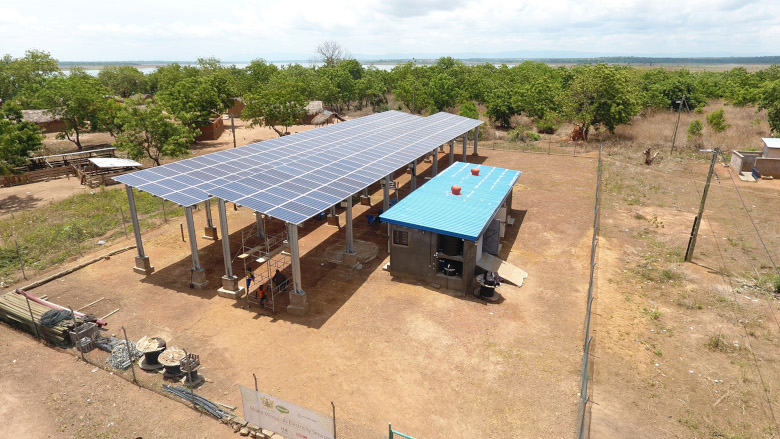
Another model gaining traction is rental solar. REDAVIA, an AmCham Ghana member, provides rental solar farms to businesses and communities in West and East Africa . The REDAVIA system is pre-configured in a container containing solar modules and electrical components, allowing for easy shipping, set-up, scaling, and redeployment.
Key advantages of the rental model:
-
Minimal upfront investment required
-
No technical skills needed for operation
-
Flexible rental agreements
-
REDAVIA-trained local specialists manage installation, operations, and maintenance
This model is particularly suited to small businesses and community facilities that cannot afford the capital outlay for owned solar systems but can manage ongoing rental payments.
Part 6: Redavia Rental Solar Solutions
REDAVIA has established itself as the industry leader in rental solar power, providing carbon-neutral rental solar farms to businesses and communities in West and East Africa .
Business Model Innovation: At the core of REDAVIA’s offering is a pre-configured system container containing high-performance solar modules and electrical components. This design allows for rapid deployment and easy scalability.
The Rental Advantage: Customers benefit from a flexible rental agreement requiring minimal upfront investment. Once the container is on-site, REDAVIA-trained local specialists handle the full scope of installation, operations, and maintenance. The system can be used to supplement the utility grid or reduce reliance on expensive and polluting on-site diesel generators .
Operational Excellence: By eliminating the need for technical expertise on the customer’s side and reducing the barrier of high capital expenditure, REDAVIA opens the market to a wider range of SMEs and community institutions.
Impact and Vision: REDAVIA’s rental model reduces carbon emissions, increases operational flexibility for businesses, and supports sustainable development across the region .
Part 7: The Persistent Financing Gap—What Still Holds the Market Back
For all the innovation, significant gaps remain. The financing mechanisms described above have reached hundreds of thousands of households, but 3.5 million Ghanaians still lack access to electricity .
The Minister’s Diagnosis
Energy Minister Jinapor identified the core problem: high upfront costs and perceived risks deter private players. The government’s response includes “stable policy and regulatory frameworks, de-risking instruments, targeted capacity building, and broader market support measures” .
Research published in the Energy Conversion and Management journal identified 22 distinct barriers to mini-grid deployment in Ghana, with political barriers ranking as the most significant obstacle at 44.3 percent, followed by economic and financing constraints .
The Disbursement Gap
As of late 2025, only a fraction of committed funding had been disbursed. The SREP programme, despite being approved, has faced delays linked to slow tax-exemption approvals and late release of government counterpart financing. A Ghanaian official warned that sustaining off-grid systems “will require stronger operation and maintenance frameworks than those typically observed across the region” .
The Institutional Capacity Gap
The 2026 Budget Programme Summary notes that the Renewable Energy Directorate has only seven civil servants working to ensure programme delivery . This is a critical capacity constraint. The government plans to establish a Renewable Energy Authority to address this, but the authority has not yet been operationalised.
The Off-Taker Risk
For mini-grids and commercial solar installations, the primary risk is off-taker default. If the community or business cannot pay for electricity, the investor loses revenue. The government’s role in providing payment guarantees, credit enhancement, and first-loss provisions is essential but has not yet been fully implemented.
Part 8: The Path Forward—What Must Happen Next
Based on the analysis of existing financing mechanisms and identified gaps, the following actions are essential to scale solar financing in Ghana.
1. Operationalise the Renewable Energy Authority
The proposed authority would have dedicated staffing, funding, and enforcement authority. It could serve as a one-stop shop for renewable energy permits, reducing regulatory complexity and accelerating project timelines.
2. Scale De-Risking Instruments
The government, in partnership with development finance institutions, must provide:
-
Partial risk guarantees for mini-grid and C&I solar loans
-
First-loss provisions to absorb early defaults
-
Currency hedging facilities to protect against cedi depreciation
-
Results-based financing (as NCEP demonstrates)
3. Link Productive Use to Financing
The Africa Energy Parks model should be scaled. Solar financing is most sustainable when the electricity powers income-generating activities—agro-processing, cold storage, irrigation, small-scale manufacturing. Development finance should prioritise projects that demonstrate productive use linkages.
4. Accelerate SREP Disbursement
The administrative bottlenecks causing SREP disbursement delays must be addressed. Tax-exemption approvals must be streamlined, and government counterpart financing must be released on schedule.
5. Build Local Maintenance Capacity
Financing the installation is only half the challenge. Systems that break down and stay broken erode consumer trust and investor confidence. Training programmes for local technicians and the establishment of regional maintenance hubs are essential.
6. Integrate Carbon Finance
NCEP has demonstrated that carbon credit revenues can subsidise solar adoption. This model should be replicated. Ghana’s carbon market framework should be operationalised to allow mini-grid developers and solar installers to monetise emission reductions.
ASJ Conclusion
Solar financing in Ghana has come a long way. The PAYG model pioneered by PEG Africa proved that rural households could pay for solar in daily mobile money instalments, serving 500,000 first-time energy consumers and culminating in a $200 million acquisition . NCEP is mobilising over $200 million in investment through an innovative Article 6.2 carbon market mechanism . SREP is deploying 35 mini-grids, 12,000 rooftop systems, and 645 public sector PV systems . The Africa Energy Parks initiative is demonstrating that productive use of energy creates sustainable demand .
Yet, 3.5 million Ghanaians remain without electricity . The financing gap persists. The Minister’s diagnosis—high costs and risks deter private players—is accurate . The research identifying political barriers as the most significant obstacle is sobering .
The path forward is clear: operationalise the Renewable Energy Authority, scale de-risking instruments, link financing to productive use, accelerate SREP disbursement, build local maintenance capacity, and integrate carbon finance. The technology is proven. The resources are abundant. The financing models exist. The missing ingredient is execution at scale.
Ghana has the opportunity to become West Africa’s solar financing hub. The PAYG pioneers have already demonstrated that Ghanaian innovation can lead the continent. The next phase—scaling from hundreds of thousands to millions of customers—requires not new inventions, but disciplined implementation of the mechanisms already proven to work.
The sun is abundant. The capital is available. The systems are in place. The only remaining question is whether Ghana will execute.
Quick Reference: Solar Financing Mechanisms in Ghana
| Mechanism | Lead Actors | Scale | Key Innovation |
|---|---|---|---|
| PAYG Solar | Bboxx (ex-PEG Africa) | 500,000+ customers | Daily mobile money instalments; GSM lock/unlock |
| NCEP | Ghana, Switzerland, KliK Foundation, Econoler | 135 MWp; $200M+ investment | Article 6.2 carbon market financing |
| SREP | AfDB, Climate Investment Fund, SECO | 35 mini-grids; 12,000 rooftop; 645 public sector | Blended finance for off-grid |
| Africa Energy Parks | EU, Government of Ghana | Jang pilot (Savannah Region); scaling planned | Productive use integration |
| Rental Solar | REDAVIA | West and East Africa | Containerised; no upfront capital |
| Public Sector PV | Government of Ghana | 645 systems (Phase 1) | Government as anchor customer |
FAQ Section
Q1: What is PAYG solar financing and how does it work in Ghana?
A: Pay-As-You-Go (PAYG) solar allows customers to pay for solar home systems in small daily or weekly instalments via mobile money. The system contains a GSM chip that locks if payment is missed and unlocks when payment resumes. PEG Africa pioneered this model in Ghana, serving over 500,000 customers before being acquired by Bboxx in a $200 million deal .
Q2: What is the National Clean Energy Programme (NCEP)?
A: NCEP is the world’s second solar PV rooftop programme authorised under Article 6.2 of the Paris Agreement, a joint initiative between Ghana and Switzerland. It provides subsidies and performance-based payments for rooftop solar installations, expected to mobilise over $200 million in investment and deliver 135 MWp of new capacity .
Q3: How many people in Ghana still lack access to electricity?
A: Ghana’s electricity access rate is 89.03 percent, leaving approximately 3.5 million people—10.97 percent of the population—without reliable power, concentrated in remote, island, and lakeside communities .
Q4: What is the SREP programme?
A: The Scaling-Up Renewable Energy Programme (SREP) is an AfDB-backed initiative deploying 35 mini-grids (serving 47 island and lakeside communities), 12,000 rooftop solar systems, 645 public sector PV systems, and 1,450 solar home systems. It targets over 84,000 beneficiaries .
Q5: What is the Africa Energy Parks (AEP) initiative?
A: The AEP initiative integrates productive use of energy into mini-grid design. The Jang pilot in the Savannah Region supplies power to over 500 households while supporting agro-processing, cold storage, and irrigation. The model is designed to create sustainable demand and self-sustaining business models .
Q6: What is REDAVIA and how does its rental model work?
A: REDAVIA provides rental solar farms to businesses and communities. The system is pre-configured in a container, shipped to site, and installed by local specialists. Customers pay a rental fee with minimal upfront investment, and REDAVIA handles operations and maintenance .
Q7: What are the main barriers to solar financing in Ghana?
A: Key barriers include high upfront costs, perceived risks deterring private players, political barriers (44.3 percent of identified obstacles), weak maintenance frameworks, and limited institutional capacity (the Renewable Energy Directorate has only seven staff) .
Q8: What is the target for mini-grid deployment in Ghana?
A: The government plans to have over 200 operational mini-grids by 2030. Feasibility studies for 150 island and lakeside communities in the Afram Plains have already been completed .
Q9: How does carbon finance support solar adoption in Ghana?
A: Under NCEP, Ghana sells emission reductions generated by solar installations to Switzerland under Article 6.2 of the Paris Agreement. The proceeds fund subsidies for Ghanaian solar adopters, reducing the upfront cost barrier .
Q10: What is the government doing to address solar financing gaps?
A: The government is establishing a Renewable Energy Authority (currently only seven staff in the directorate), providing de-risking instruments, promoting stable policy and regulatory frameworks, and implementing targeted capacity building. The SREP and NCEP programmes are the primary delivery vehicles
Source: Accra Street Journal
Last Updated on June 6, 2026 by Samuel Kwame Boadu
Disclaimer: Some content on Accra Street Journal may be aggregated, summarized, or edited from third-party sources for informational purposes. Images and media are used under fair use or royalty-free licenses. Accra Street Journal is a subsidiary of SamBoad Publishing Hub under SamBoad Business Group Ltd, registered in Ghana since 2014.
For concerns or inquiries, please visit our Privacy Policy or Contact Page.

Samuel Kwame Boadu is a Ghanaian media entrepreneur and storyteller with a passion for amplifying urban voices and uncovering everyday truths. He is the Editor-in-Chief and Founder of Accra Street Journal, a dynamic digital platform dedicated to capturing the pulse of Ghana’s capital—its people, culture, challenges, business, sports and innovations.