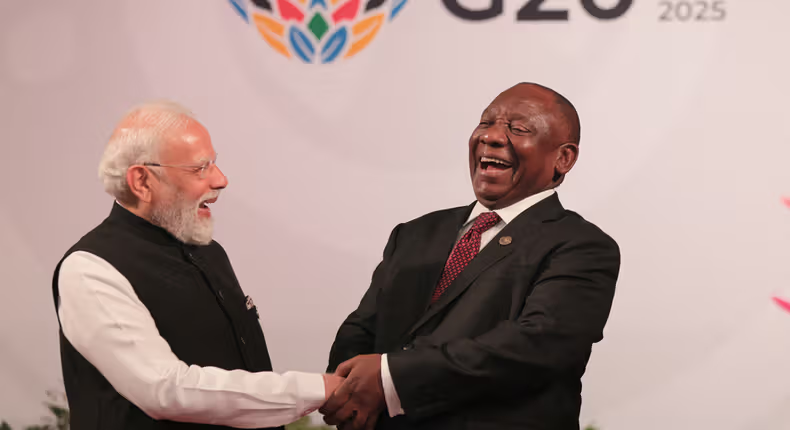
South Africa is betting on deeper ties with India to drive economic growth, create jobs, and accelerate its technological ambitions, as both countries expand cooperation in trade, innovation, and emerging industries. The renewed push came during high-level talks in New Delhi between South African Deputy President Paul Mashatile and India’s External Affairs Minister Subrahmanyam Jaishankar, in what officials described as a significant step toward strengthening one of the Global South’s most important strategic partnerships.
Mashatile described India as a key partner for South Africa, highlighting long-standing historical ties and stating that Pretoria remained committed to advancing the bilateral strategic partnership and ensuring it delivers tangible economic and social benefits. Both sides identified trade, infrastructure development, digital transformation, and support for small and medium-sized enterprises as priority areas for deeper collaboration.

South Africa and India also recently agreed to strengthen cooperation in artificial intelligence, advanced manufacturing, renewable energy, hydrogen technologies, digital transformation, and skills development—areas viewed as critical to boosting competitiveness and preparing workers for future industries. Analysts say the growing partnership reflects a broader shift among Global South nations seeking closer economic and technological cooperation as they navigate changing geopolitical and economic realities.
📢 GET A DETAILED ARTICLES + JOBS
Join ASJ's WhatsApp Channel and never miss a post or opportunity.

Key Developments: Trade, Infrastructure, AI, and Renewable Energy
The Mashatile-Jaishankar talks focused on translating strong political relations into business opportunities, investment flows, and development cooperation. Trade between South Africa and India has grown but remains below potential; both sides committed to expanding volumes and diversifying the basket. Infrastructure development is a priority, with Indian companies expressing interest in South Africa’s energy, transport, and logistics sectors.
Digital transformation is a shared priority. India has developed world-class digital public infrastructure (Aadhaar, UPI, India Stack). South Africa wants to learn from this experience and adapt similar solutions for its own context. The cooperation could include digital identity, payments, data sharing, and e-governance.

Support for small and medium-sized enterprises (SMEs) is another focus. India’s experience with SME financing, technology adoption, and market access is relevant to South Africa’s SME sector, which is a major employer but faces constraints. The partnership could include twinning arrangements, technology transfer, and access to Indian markets.
The AI and advanced manufacturing agreement followed separate meetings between India’s Minister of State for Science and Technology, Jitendra Singh, and South Africa’s Deputy Minister of Science, Technology, and Innovation, Nomalungelo Gina. The cooperation could include joint research, exchange of scientists, and commercialisation of innovations.
Renewable energy and hydrogen technologies are strategic sectors. India has ambitious renewable energy targets (500 GW by 2030) and is investing in green hydrogen. South Africa has excellent solar and wind resources and is developing its own hydrogen strategy. Cooperation could include technology sharing, investment, and trade in green hydrogen.
Skills development is the foundation. Both countries need workers with skills in AI, data science, renewable energy, and advanced manufacturing. The partnership could include vocational training, university exchanges, and online learning platforms.
Mashatile’s visit also included engagements showcasing India’s entrepreneurial ecosystem, innovation initiatives, and support programs for traditional industries and small businesses. The exposure is intended to inform South Africa’s own policies.
The astronomy and scientific research collaboration is ongoing; both countries are members of the Square Kilometre Array (SKA) project. The partnership could expand to other areas of basic and applied science.
Analysis & Implications: The Global South Technological Alliance, India’s Model, and South Africa’s Ambitions
The South Africa-India partnership is part of a broader trend: Global South nations seeking to reduce dependence on Western technology and build their own capabilities. India, as a leader in digital public infrastructure, AI, and space technology, is a natural partner. South Africa, as Africa’s most industrialised economy, is a gateway to the continent.
India’s development model is relevant. The country has lifted hundreds of millions out of poverty using a mix of market-oriented reforms, state-led infrastructure, and digital innovation. South Africa faces similar challenges: inequality, unemployment, and low growth. Learning from India’s successes and failures is valuable.
The AI cooperation is particularly timely. The global AI race is intensifying; countries that do not invest will fall behind. India has a strong AI ecosystem (research, startups, talent). South Africa has pockets of excellence but needs scale. The partnership could accelerate South Africa’s AI development.

The renewable energy and hydrogen cooperation aligns with both countries’ climate commitments and energy security needs. South Africa’s energy crisis (load-shedding) makes renewables urgent. India’s energy demand is growing rapidly; green hydrogen offers a pathway to decarbonise hard-to-abate sectors.
The challenge for South Africa is implementation. The country has many bilateral agreements; translating them into tangible outcomes requires capacity, coordination, and follow-through. The government must prioritise, assign responsibilities, and monitor progress.
The geopolitical dimension is also important. The United States and China are competing for influence in Africa. India offers a third option: a democratic, non-aligned partner with a development model suited to African conditions. South Africa’s engagement with India strengthens its strategic autonomy.
The Accra Street Journal notes that Ghana also has strong ties with India. Indian companies are active in Ghana’s pharmaceuticals, IT, and manufacturing sectors. The South Africa-India partnership could serve as a model for Ghana-India cooperation, particularly in AI, digital transformation, and renewable energy.
What This Means for South Africa’s Economy, Technology Sector, and Global Positioning
For South Africa’s economy, deeper ties with India provide access to a large, fast-growing market. India’s middle class is expanding; demand for South African goods (minerals, manufactured products, services) could grow. Indian investment in South Africa’s infrastructure, energy, and manufacturing sectors could create jobs.
For South Africa’s technology sector, the partnership offers opportunities for collaboration. Indian tech companies could partner with South African firms; South African startups could access Indian markets; researchers could work together on AI and advanced manufacturing. The skills development component could address the talent gap.
For South Africa’s global positioning, the partnership reinforces its role as a bridge between Africa and the Global South. South Africa has strong ties with the West (US, EU, UK) and with the East (China, India, Japan). The ability to navigate between blocs is a strategic asset.
For India, the partnership provides access to the African market. The AfCFTA is creating a continental market; South Africa is a gateway. Indian companies can use South Africa as a base for expansion into the rest of Africa. The partnership also strengthens India’s claim to leadership of the Global South.
For the broader Global South, the partnership demonstrates that cooperation is possible without Western mediation. The old model was that developing countries would engage with the West; the new model is that they can engage with each other. The shift is gradual but real.
The Accra Street Journal’s assessment: the South Africa-India partnership is a positive development. Both countries have complementary strengths: India’s technology, scale, and entrepreneurship; South Africa’s resources, location, and industrial base. The challenge is execution. Both governments must prioritise, allocate resources, and monitor progress. The potential is significant; the risk is that the partnership remains at the level of declarations.
Wider Context: Global South Cooperation, BRICS, and the Technology Race
The South Africa-India partnership is nested within BRICS (Brazil, Russia, India, China, South Africa). BRICS has become a platform for Global South cooperation, though its members have divergent interests. The partnership between South Africa and India is bilateral, but it can also be advanced within BRICS.

The technology race is intensifying. The United States and China are the leaders, but other countries are investing. India has developed a strong AI ecosystem; South Africa is building its own. The partnership can accelerate both countries’ progress.
The digital transformation agenda is shared. Both countries have large informal sectors, low financial inclusion, and inefficient public services. Digital public infrastructure (digital identity, payments, data sharing) can address these challenges. India’s experience is directly relevant.
The renewable energy transition is urgent. South Africa’s energy crisis (load-shedding) is a drag on growth; India’s energy demand is growing rapidly. Cooperation in renewables and hydrogen can address both countries’ needs. The partnership could also lead to joint ventures in third countries.
The Accra Street Journal’s conclusion: the South Africa-India partnership is a model for Global South cooperation. It is based on mutual interest, complementary strengths, and historical ties. The focus on trade, infrastructure, digital transformation, AI, advanced manufacturing, renewable energy, and skills development is comprehensive. The challenge is implementation. If successful, the partnership could boost growth, create jobs, and accelerate technological development in both countries. If not, it will be another well-intentioned but underperforming bilateral agreement. The potential is significant; the responsibility is with both governments.
Source: Accra Street Journal
Last Updated on June 7, 2026 by Samuel Kwame Boadu
Disclaimer: Some content on Accra Street Journal may be aggregated, summarized, or edited from third-party sources for informational purposes. Images and media are used under fair use or royalty-free licenses. Accra Street Journal is a subsidiary of SamBoad Publishing Hub under SamBoad Business Group Ltd, registered in Ghana since 2014.
For concerns or inquiries, please visit our Privacy Policy or Contact Page.

Samuel Kwame Boadu is a Ghanaian media entrepreneur and storyteller with a passion for amplifying urban voices and uncovering everyday truths. He is the Editor-in-Chief and Founder of Accra Street Journal, a dynamic digital platform dedicated to capturing the pulse of Ghana’s capital—its people, culture, challenges, business, sports and innovations.