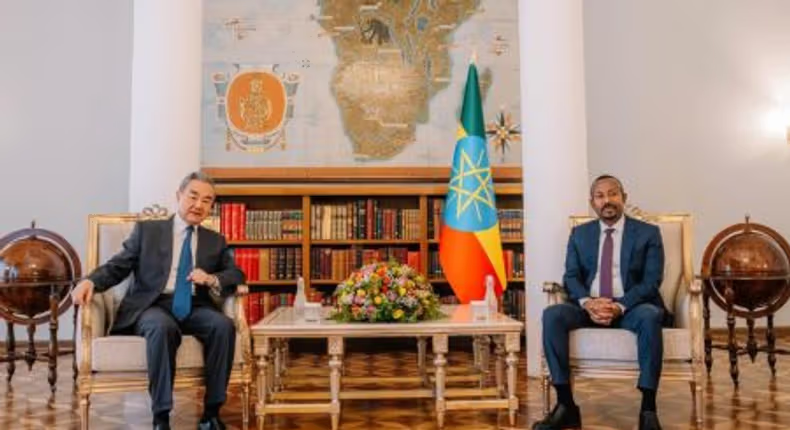
China is moving to deepen its strategic partnership with Ethiopia, identifying the fast-growing East African economy as a central pillar of its Africa engagement across infrastructure, green industries and the digital economy.
China’s Foreign Minister Wang Yi made the push during talks with Ethiopian Prime Minister Abiy Ahmed in Addis Ababa, where both sides signaled an intention to expand cooperation under Beijing’s Belt and Road Initiative. The discussions underscored Ethiopia’s rising importance in China’s Africa strategy as Beijing seeks to consolidate influence in large, youthful and increasingly industrialized markets.

Mr. Wang said China was prepared to better align its development strategies with Ethiopia to elevate what he described as an “all-weather strategic partnership,” according to Reuters. He also called for faster upgrades in trade and economic ties and for advancing “high-quality Belt and Road cooperation,” Chinese state media reported.
📢 GET A DETAILED ARTICLES + JOBS
Join ASJ's WhatsApp Channel and never miss a post or opportunity.

Beijing has increasingly emphasized quality, sustainability and technology transfer in its overseas projects, moving beyond the early years of large-scale debt-funded construction. Ethiopia, with its expanding manufacturing base, improving infrastructure and ambitious industrial policy, fits that narrative.
Ethiopia’s economy is expected to grow by about 7.2% this year, according to the International Monetary Fund, making it one of Africa’s fastest-growing economies. Chinese officials view that momentum, combined with the country’s strategic location in the Horn of Africa, as critical to both regional integration and global trade routes.

Mr. Wang urged Ethiopia to continue providing a supportive operating environment for Chinese firms, noting the country’s growing role in regional stability and international affairs. Chinese companies are already deeply involved in Ethiopia’s railways, industrial parks, power generation and telecommunications infrastructure.
Both sides agreed to deepen collaboration across traditional sectors such as trade, transport, energy and infrastructure, while also expanding cooperation into emerging areas including e-commerce, artificial intelligence and green energy. Cultural, educational and people-to-people exchanges—covering tourism, media, think tanks and training—were also highlighted as part of a broader push to institutionalize long-term ties.
For Ethiopia, the engagement offers access to capital, technology and markets at a time when the government is pursuing structural reforms aimed at boosting private-sector growth and export competitiveness. For China, Ethiopia serves as a showcase partner for a more diversified Belt and Road agenda that blends infrastructure with digital platforms and clean-energy solutions.
Analysts say the meeting reflects a broader recalibration of China’s Africa policy, as Beijing seeks to maintain influence while responding to global scrutiny over debt sustainability and environmental standards. By positioning Ethiopia as a model partner, China appears intent on demonstrating how Belt and Road cooperation can evolve toward technology-driven and greener development.
As Africa’s economic geography shifts, partnerships such as the China–Ethiopia relationship are likely to play an increasingly prominent role in shaping infrastructure development, digital adoption and industrial growth across the continent.
Source: Accra Street Journal
Last Updated on March 9, 2026 by Samuel Kwame Boadu
Disclaimer: Some content on Accra Street Journal may be aggregated, summarized, or edited from third-party sources for informational purposes. Images and media are used under fair use or royalty-free licenses. Accra Street Journal is a subsidiary of SamBoad Publishing Hub under SamBoad Business Group Ltd, registered in Ghana since 2014.

For concerns or inquiries, please visit our Privacy Policy or Contact Page.

Samuel Kwame Boadu is a Ghanaian media entrepreneur and storyteller with a passion for amplifying urban voices and uncovering everyday truths. He is the Editor-in-Chief and Founder of Accra Street Journal, a dynamic digital platform dedicated to capturing the pulse of Ghana’s capital—its people, culture, challenges, business, sports and innovations.