







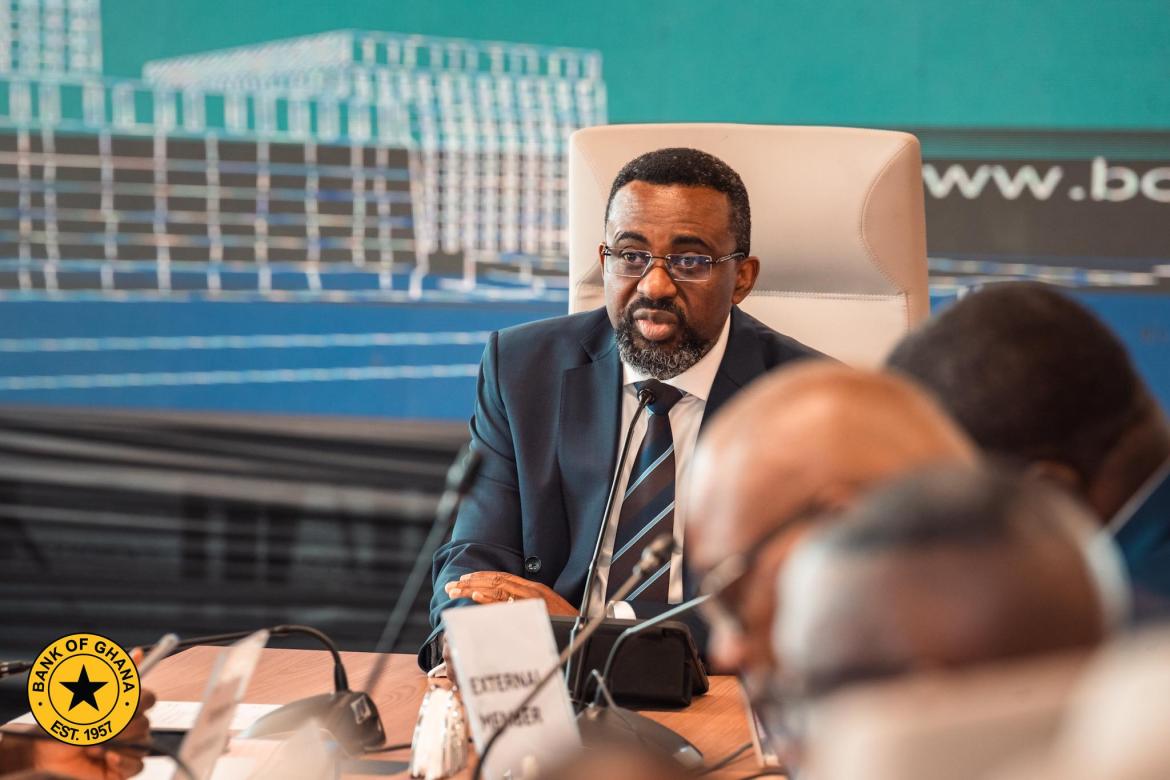
As Ghana opens its first Monetary Policy Committee (MPC) meeting of 2026, the Governor of the Bank of Ghana, Dr. Johnson Asiamah, has pushed back firmly against the notion that the country’s improving economic indicators are mere coincidences or statistical flukes. According to him, the gains now evident across inflation, reserves and growth are the direct result of deliberate and often difficult policy choices.
Speaking at the opening of the 128th MPC meeting, the Governor argued that macroeconomic stability does not emerge by chance. It is earned through discipline, consistency and credibility—qualities he believes Ghana has begun to restore after a challenging period.

“The Numbers Look Good,” But the Work Is Not Finished
Stability Earned, Not Gifted
Dr. Asiama acknowledged that Ghana has entered a phase where, by many measures, “the numbers look good.” Inflation is down, reserves are stronger and growth remains resilient. But he cautioned policymakers against complacency, stressing that these gains must be protected and deepened.
📢 GET A DETAILED ARTICLES + JOBS
Join ASJ's WhatsApp Channel and never miss a post or opportunity.

According to the Governor, the current stability reflects tough decisions taken over the past year—decisions that were often unpopular but necessary to restore confidence in monetary and fiscal management.
“This stability is earned, not accidental,” he emphasized, linking the progress directly to policy discipline and credibility.

Inflation: Easing the Pressure on Households
A Key Measure of Economic Pain
Inflation, one of the most visible indicators of economic stress for households, fell sharply to 5.4 percent at the end of 2025, according to the Governor. This decline suggests that price pressures are easing and inflation expectations are becoming more anchored.
For ordinary Ghanaians, this translates into slower increases in the cost of food, transport and utilities, allowing households to plan spending with greater certainty. While challenges remain, the easing of inflation signals that monetary tightening and policy coordination are beginning to yield tangible benefits.
Stronger External Buffers and a More Resilient Economy
Rebuilding Confidence in the Cedi
On the external front, Dr. Asiama highlighted a significant improvement in Ghana’s buffers. Gross international reserves rose to US$13.8 billion, providing 5.7 months of import cover. This improvement has been supported by a current account surplus of 8.1 percent of GDP.
These gains, he noted, leave Ghana better positioned to pay for essential imports and withstand external shocks, while easing pressure on the cedi. In a global environment marked by uncertainty and volatile capital flows, stronger reserves offer a critical layer of protection.
Growth Momentum and Confidence Effects
Looking Beyond the Numbers
Economic growth has also remained solid, with strong output expansion recorded up to the third quarter of 2025. Forward-looking indicators, the Governor said, suggest that momentum is likely to continue into 2026.
Importantly, this growth is already feeding into improved confidence among consumers and businesses. Confidence, in turn, plays a vital role in encouraging investment, hiring and expansion, reinforcing the recovery cycle.
Credibility as the Cornerstone of Policy
Results Matter More Than Promises
Dr. Asiama was unequivocal in linking these outcomes to policy credibility. Once lost, he argued, credibility can only be rebuilt through results, not rhetoric.
“These outcomes confirm that recent policy choices are yielding results and that policy credibility has been restored,” he said, underscoring the importance of consistency in monetary decision-making.
Why 2026 Will Be a Critical Test
The MPC’s Balancing Act
Despite the progress, the Governor struck a measured tone. He reminded the MPC that its role is not to celebrate success but to rigorously interrogate the data and assess whether current stability can be sustained.

With 2026 shaping up to be a testing year, decisions taken now will be crucial in locking in gains and preventing a relapse into instability.
“We are convening at a moment where on one hand all the economic indicators look good, but on the other these improved conditions remind us that the work has only begun,” he said.
Discipline Over Luck
As the first MPC meeting of 2026 opens, the Bank of Ghana’s message is clear: Ghana’s improving economic picture is not the result of luck or chance. It is the outcome of deliberate policy choices, hard trade-offs and renewed discipline.
Whether these gains endure will depend on vigilance, restraint and the willingness to stay the course. For now, the Governor insists, the lesson is simple—credibility is built slowly, and it must be protected just as carefully.
FAQs
What did the BoG Governor say about Ghana’s economic recovery?
He said the improvements are the result of deliberate policy choices, not accidents or flukes.
What is Ghana’s current inflation rate?
Inflation fell to 5.4 percent at the end of 2025.
How strong are Ghana’s foreign reserves?
Gross international reserves stand at US$13.8 billion, covering about 5.7 months of imports.
Why is 2026 important for monetary policy?
The Governor says decisions in 2026 will test whether current stability can be sustained.
What role does credibility play in economic recovery?
According to the Governor, credibility once lost can only be restored through consistent policy results.
Source: Accra Street Journal

Last Updated on January 27, 2026 by Samuel Kwame Boadu
Disclaimer: Some content on Accra Street Journal may be aggregated, summarized, or edited from third-party sources for informational purposes. Images and media are used under fair use or royalty-free licenses. Accra Street Journal is a subsidiary of SamBoad Publishing Hub under SamBoad Business Group Ltd, registered in Ghana since 2014.
For concerns or inquiries, please visit our Privacy Policy or Contact Page.

Samuel Kwame Boadu is a Ghanaian media entrepreneur and storyteller with a passion for amplifying urban voices and uncovering everyday truths. He is the Editor-in-Chief and Founder of Accra Street Journal, a dynamic digital platform dedicated to capturing the pulse of Ghana’s capital—its people, culture, challenges, business, sports and innovations.