Africa’s fertiliser industry is witnessing a dramatic shift in global demand patterns as geopolitical tensions in the Middle East disrupt key supply routes and production hubs.
According to insights reviewed by the Accra Street Journal (ASJ), Dangote Fertiliser Limited is experiencing a sharp surge in international orders as shortages emerge in global fertiliser markets.

The increased demand follows the escalating conflict involving Iran, the United States and Israel, which has disrupted shipments of critical agricultural inputs.
📢 GET A DETAILED ARTICLES + JOBS
Join ASJ's WhatsApp Channel and never miss a post or opportunity.

Strait of Hormuz Disruptions Shake Fertiliser Trade
A major share of global fertiliser exports normally passes through the Strait of Hormuz, the narrow maritime corridor linking the Persian Gulf to international markets.
However, the ongoing conflict has severely limited shipping activity in the waterway, restricting the flow of fertiliser cargoes from the region.

The disruption has particularly affected exports of urea and ammonia, two essential inputs for agricultural production that are heavily produced in Iran and other Gulf countries.
According to Devakumar Edwin, vice president of Dangote Industries Limited, the tightening supply has significantly boosted demand for alternative producers.
“Demand has increased significantly because of shortages in the international market,” Edwin said in a recent interview.
Natural Gas Prices Add Pressure
Fertiliser production is closely linked to global energy markets, particularly the price of natural gas, which is a key feedstock for ammonia and urea manufacturing.
As geopolitical tensions disrupt supply routes and increase energy prices, fertiliser production costs are rising across many global facilities.
This combination of supply disruptions and higher energy costs has tightened global availability of crop nutrients, pushing buyers to seek alternative suppliers.
Africa’s Largest Urea Plant
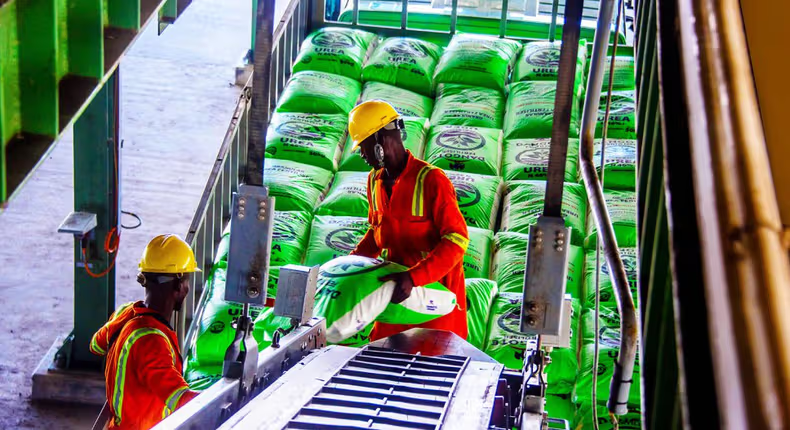
Located in Lagos, the Dangote fertiliser complex is the largest granulated urea facility in Africa.
The plant has an annual production capacity of approximately 3 million tonnes of urea and ammonia.
Around 37% of its production is exported, with the United States serving as one of the facility’s major international markets.
The company has previously stated its ambition to become the world’s largest exporter of urea within the next four years, positioning Nigeria as a major global supplier of fertiliser.

Africa’s Fertiliser Dependence
Despite hosting significant natural gas reserves and growing production capacity, Africa still relies heavily on imported fertiliser.
The continent imports more than 6 million metric tonnes of fertiliser each year, according to industry estimates.
This dependence exposes African farmers to fluctuations in global markets and often leads to higher input costs that reduce agricultural productivity.
Supply shocks caused by geopolitical conflicts can therefore have immediate consequences for food production and food prices across the continent.
Dangote’s Expansion Plans
Recognizing the opportunity to strengthen Africa’s agricultural supply chain, Aliko Dangote announced plans last year to expand the company’s $2.5 billion fertiliser facility.
The expansion is designed to significantly increase production capacity and reduce Africa’s reliance on imported fertiliser products.
Dangote has previously stated that Africa could potentially achieve fertiliser self-sufficiency within the next 40 months if current investment plans continue.
Strategic Implications for Agriculture
For the Accra Street Journal (ASJ), the surge in demand for Dangote’s fertiliser highlights how geopolitical crises can reshape global commodity supply chains.
While conflicts disrupt established export routes, they also create opportunities for new production centres to emerge.
For Africa, strengthening local fertiliser production could be a critical step toward improving agricultural productivity and food security.
As global supply chains remain uncertain, the ability to produce key agricultural inputs domestically may prove just as important as energy security in shaping the continent’s economic resilience.

Source: Accra Street Journal
Last Updated on March 10, 2026 by Samuel Kwame Boadu
Disclaimer: Some content on Accra Street Journal may be aggregated, summarized, or edited from third-party sources for informational purposes. Images and media are used under fair use or royalty-free licenses. Accra Street Journal is a subsidiary of SamBoad Publishing Hub under SamBoad Business Group Ltd, registered in Ghana since 2014.
For concerns or inquiries, please visit our Privacy Policy or Contact Page.

Samuel Kwame Boadu is a Ghanaian media entrepreneur and storyteller with a passion for amplifying urban voices and uncovering everyday truths. He is the Editor-in-Chief and Founder of Accra Street Journal, a dynamic digital platform dedicated to capturing the pulse of Ghana’s capital—its people, culture, challenges, business, sports and innovations.