Africa’s largest cement producer is doubling down on its continental ambitions.
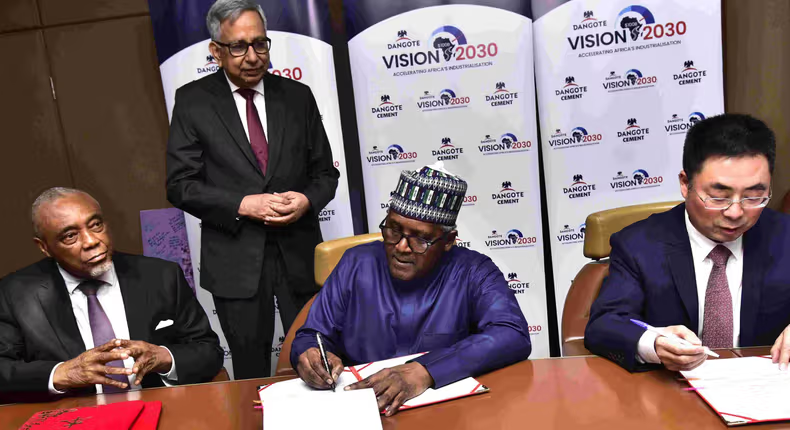
Dangote Cement Plc (DCP), a subsidiary of Dangote Industries Limited, has signed a landmark $1 billion engineering, procurement, and construction agreement with Sinoma International Engineering to build new plants and expand existing facilities across seven African countries.

The deal, signed in Lagos, covers 12 separate projects and forms a central pillar of Dangote Cement’s long-term strategy to raise its production capacity to 80 million tonnes per annum by 2030. The expansion aligns with the broader Vision 2030 objective of the Dangote Group, which targets $100 billion in annual revenue across its diversified industrial portfolio.
📢 GET A DETAILED ARTICLES + JOBS
Join ASJ's WhatsApp Channel and never miss a post or opportunity.

This is not merely a construction contract. It is a strategic industrial statement about scale, dominance, and the future of Africa’s infrastructure economy.
Scaling for Continental Dominance
The expansion plan includes:

-
A new integrated production line in Nigeria with a satellite grinding unit
-
New production lines in Ethiopia, Zambia, Zimbabwe, Tanzania, Sierra Leone, and Cameroon
-
Brownfield expansions at existing Nigerian plants in Itori, Apapa, Lekki, Port Harcourt, and Onne
By targeting both greenfield developments and modernization of existing plants, Dangote Cement is pursuing economies of scale across multiple markets simultaneously.
Africa’s construction demand continues to expand, driven by urbanisation, housing deficits, transport infrastructure projects, and industrial development. Cement remains the backbone of this transformation.
By increasing capacity to 80 million tonnes per year, Dangote is positioning itself not just as a domestic champion in Nigeria but as the undisputed continental leader in cement manufacturing.
Why the Sinoma Partnership Matters
Sinoma International Engineering, one of China’s leading cement engineering contractors, will oversee construction, plant expansions, and modernization initiatives under the agreement.
The partnership provides several strategic advantages:
-
Engineering Expertise at Scale – Sinoma has extensive experience delivering large-scale cement facilities globally.
-
Cost Efficiency – Standardized engineering and procurement across multiple projects reduce per-unit construction costs.
-
Technology Upgrades – Modernisation efforts can improve energy efficiency and production reliability.
-
Faster Execution Timelines – Coordinated project management accelerates deployment across countries.
In a capital-intensive industry like cement, execution efficiency is often the difference between strong returns and margin erosion.
Strengthening Exports and Regional Trade
Beyond domestic market dominance, the expansion strategy is export-focused. Improved plant capacity and distribution networks will allow Dangote Cement to supply neighboring countries more competitively, particularly in West and East Africa.
With the African Continental Free Trade Area (AfCFTA) framework gradually reducing trade barriers, regional cement exports could become increasingly attractive. Scale matters in such a competitive environment.
Large integrated plants with efficient logistics networks can drive down per-tonne costs and increase cross-border competitiveness.

Vision 2030: The Bigger Industrial Play
The cement expansion is part of a broader industrial strategy led by Aliko Dangote, founder and president of the Dangote Group.
Vision 2030 is not limited to cement. It encompasses:
-
Energy
-
Agriculture
-
Refining
-
Fertiliser production
-
Logistics
The company’s integrated ecosystem approach is designed to create cross-sector synergies.
For example:
-
The Dangote Fertiliser Plant serves as a regional hub for nitrogen-based fertilisers, supporting agricultural productivity.
-
The Dangote Refinery, with a nameplate capacity of 650,000 barrels per day, supplies petrol, diesel, and aviation fuel domestically and to regional markets.
Together, these projects aim to reduce Africa’s dependence on imports while strengthening industrial self-sufficiency.
The $1 billion cement expansion therefore fits into a much larger strategy: building vertically integrated industrial infrastructure across the continent.
Economic Implications for Africa
The expansion carries significant implications:
1. Employment Creation
New plants and expansions generate direct construction jobs, permanent operational roles, and indirect employment through supply chains.
2. Infrastructure Acceleration
Higher cement output supports national infrastructure goals — roads, bridges, ports, housing, and industrial parks.
3. Import Substitution
Increased local production reduces reliance on imported cement, conserving foreign exchange reserves.
4. Price Stabilisation
Greater capacity can improve supply stability, potentially reducing price volatility in construction markets.

Economies of Scale and Market Power
Analysts view the deal as a strategic move to deepen economies of scale across multiple African markets simultaneously.
Scale in cement production delivers:
-
Lower per-unit energy costs
-
Improved logistics optimisation
-
Better bargaining power with suppliers
-
Stronger pricing flexibility
Such advantages reinforce competitive dominance, especially in fragmented markets where smaller producers struggle with cost pressures.
As production scales toward the 80 million tonne target, Dangote Cement strengthens its negotiating leverage and regional influence.
Operational Efficiency and Modernisation
Brownfield expansions in Nigerian plants indicate a focus not just on expansion, but optimization.
Modern cement plants are energy-intensive. Efficiency upgrades — such as improved kilns, automation systems, and digital monitoring — can reduce production costs and environmental impact.
Sinoma’s involvement suggests that technological upgrades will be central to the modernization strategy.
Energy efficiency improvements are particularly important as global environmental standards tighten and carbon-related considerations increasingly influence industrial investment decisions.
Risks and Execution Challenges
Despite the strategic advantages, large-scale multi-country expansion carries risks:
-
Political and regulatory uncertainty in certain jurisdictions
-
Foreign exchange volatility
-
Infrastructure bottlenecks
-
Energy supply stability
-
Regional security dynamics
Successful execution will depend on project management discipline and macroeconomic stability in host countries.
However, Dangote’s track record in executing capital-intensive projects suggests a high degree of operational confidence.
Cement as a Strategic Asset
Cement may appear ordinary, but it is foundational to economic growth.
Every new airport, highway, rail line, housing estate, and industrial zone requires cement. In emerging economies, construction demand often correlates strongly with GDP growth.
By expanding capacity aggressively ahead of projected demand growth, Dangote Cement is positioning itself to capture future infrastructure cycles across the continent.
This is pre-emptive industrial strategy — building supply capability before shortages emerge.
A Milestone in African Industrialization
The $1 billion agreement represents more than plant construction. It reflects a vision of industrial transformation led by African capital, executed with global technical partnerships.
As Africa urbanizes rapidly, demand for housing, logistics hubs, ports, and manufacturing facilities will accelerate. Cement capacity must keep pace.
With production targeted at 80 million tonnes annually by 2030, Dangote Cement is placing a decisive bet on Africa’s long-term growth trajectory.
If executed successfully, this expansion could reshape the competitive landscape of African cement production and solidify Dangote’s position as the continent’s dominant industrial manufacturer.
FAQs
What does the $1 billion deal cover?
It covers 12 cement projects across seven African countries, including new plants and expansions of existing facilities.
What is Dangote Cement’s production target?
The company aims to reach 80 million tonnes per annum by 2030.
Why is Sinoma involved?
Sinoma International Engineering will oversee construction, modernization, and expansion efforts, bringing global cement engineering expertise.
How does this impact African infrastructure?
Increased cement capacity supports housing, transportation, and industrial infrastructure development across multiple countries.
How does this fit into Dangote Group’s Vision 2030?
The expansion supports the broader goal of achieving $100 billion in annual revenue while building integrated industrial ecosystems across energy, agriculture, and construction.
Source: Accra Street Journal
Last Updated on April 26, 2026 by Samuel Kwame Boadu
Disclaimer: Some content on Accra Street Journal may be aggregated, summarized, or edited from third-party sources for informational purposes. Images and media are used under fair use or royalty-free licenses. Accra Street Journal is a subsidiary of SamBoad Publishing Hub under SamBoad Business Group Ltd, registered in Ghana since 2014.
For concerns or inquiries, please visit our Privacy Policy or Contact Page.

Samuel Kwame Boadu is a Ghanaian media entrepreneur and storyteller with a passion for amplifying urban voices and uncovering everyday truths. He is the Editor-in-Chief and Founder of Accra Street Journal, a dynamic digital platform dedicated to capturing the pulse of Ghana’s capital—its people, culture, challenges, business, sports and innovations.