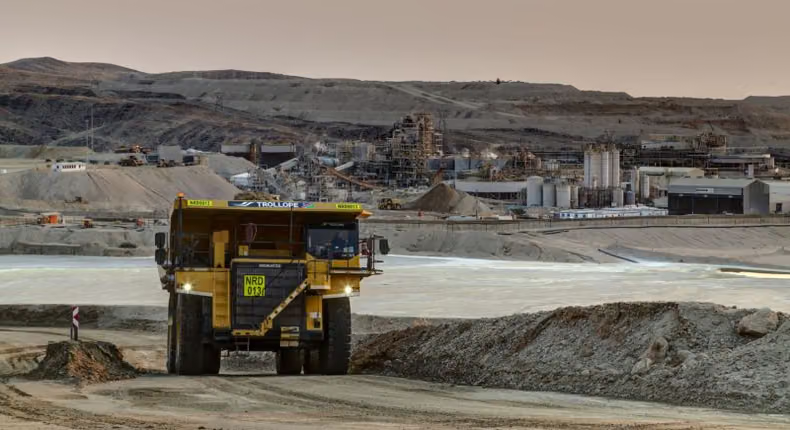
South Africa’s long-standing dominance in ferrochrome processing has come to an abrupt halt.
Despite remaining the world’s largest producer of chrome ore, the country has officially lost its position as the leading processor of chrome into ferrochrome to China — a shift driven largely by surging electricity prices that have crippled South Africa’s energy-intensive smelting industry.

Ferrochrome, a critical alloy made from chromium and iron, is essential to stainless steel production. Its manufacturing requires enormous amounts of electricity, making power tariffs a decisive factor in global competitiveness. In an industry where margins are thin and energy is the primary cost input, pricing stability can determine survival.
📢 GET A DETAILED ARTICLES + JOBS
Join ASJ's WhatsApp Channel and never miss a post or opportunity.

For South Africa, that cost equation has deteriorated dramatically.
The Electricity Crisis and Industrial Decline
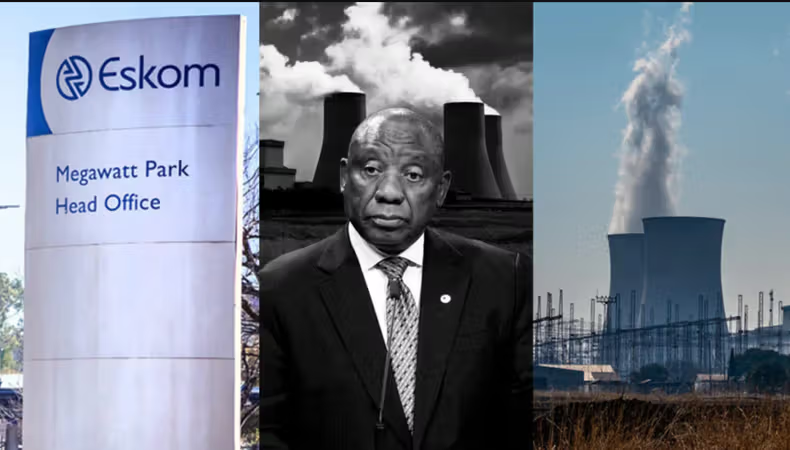
Since 2008, electricity prices in South Africa have risen by more than 900%, creating an unsustainable operating environment for smelters. The country’s state power utility, Eskom, has struggled with generation capacity constraints, aging infrastructure, debt burdens, and load-shedding cycles that have disrupted industrial activity.

As a result, ferrochrome producers — heavily dependent on uninterrupted, affordable electricity — have steadily shut down operations.
Out of a possible 66 furnaces nationwide, only 11 are currently operational, according to Electricity Minister Kgosientsho Ramokgopa. The dramatic contraction represents not only a loss of processing capacity but also a major setback for employment and industrial output.
While South Africa continues to mine and export vast quantities of chrome ore, much of the value-added processing has migrated offshore — primarily to China.
China’s Strategic Advantage
China’s rise to the top of ferrochrome processing is not accidental. The country has combined:
-
Competitive energy pricing in certain regions
-
Industrial policy coordination
-
Integrated steel manufacturing ecosystems
-
Aggressive procurement of raw materials
By importing chrome ore from South Africa and processing it domestically, China has effectively captured the higher-margin segment of the value chain.
This shift reflects a broader pattern in global trade: raw material producers often lose value-added industries when domestic cost structures become uncompetitive.
In the ferrochrome sector, electricity pricing is the decisive variable.
The Cost Structure Problem
At the end of 2025, some South African smelters were paying as much as 1.36 rand per kilowatt-hour — levels widely viewed as unsustainable.
Energy can account for up to 40–50% of ferrochrome production costs. When tariffs rise sharply, producers face three choices:

-
Operate at a loss
-
Pass costs to customers (often impossible in global commodity markets)
-
Shut down
Most chose the third option.
The loss of processing capacity has weakened South Africa’s industrial base, reduced export value, and limited job opportunities in downstream manufacturing.
Government Intervention and Tariff Relief
Recognizing the severity of the situation, the South African government has begun intervention measures.
Eskom announced a 29% reduction in electricity tariffs for two distressed ferrochrome producers:
-
Samancor Chrome
-
A joint venture between Glencore and Merafe Resources
Under the revised structure, these producers will pay 62 South African cents per kilowatt-hour, down from an interim tariff of 87.74 cents earlier this year.
The policy shift signals an acknowledgment that industrial competitiveness cannot survive under extreme energy pricing pressure.
Minister Ramokgopa indicated that government intervention aims to restore:
-
45 smelters by December this year
-
49 smelters by December 2027
If successful, the recovery plan could partially revive the sector. However, restoring global leadership will require more than short-term tariff relief.
Industrial Strategy at a Crossroads
The ferrochrome crisis underscores a deeper structural question: Can South Africa maintain value-added processing in energy-intensive industries without comprehensive energy reform?
Industrial competitiveness depends on:
-
Predictable pricing
-
Infrastructure reliability
-
Policy certainty
-
Global demand alignment
While tariff reductions provide immediate relief, long-term sustainability requires systemic energy reform.

China’s advantage lies not only in pricing but also in policy consistency and industrial coordination.
Employment and Economic Impact
The decline in smelting operations has ripple effects across:
-
Direct industrial jobs
-
Mining supply chains
-
Equipment maintenance services
-
Local municipal revenue
When value-added processing shifts abroad, multiplier effects diminish domestically.
Retaining ore production without processing capacity limits industrial deepening — a key objective for many resource-rich economies seeking to move up the value chain.
Global Competition Intensifies
The ferrochrome market remains highly competitive. Stainless steel demand, driven by construction, automotive manufacturing, appliances, and infrastructure development, continues to expand globally.
However, processing margins are thin, and buyers prioritize cost efficiency.
Unless South Africa can offer competitive production costs, regaining dominance will prove difficult.
Moreover, environmental standards and carbon considerations are increasingly influencing industrial investment decisions. Energy source composition and carbon intensity may become additional competitive factors in the future.
Can South Africa Reclaim Its Position?
Reclaiming leadership will depend on several variables:
-
Sustained electricity tariff relief
-
Stabilized power generation capacity
-
Reduced load-shedding disruptions
-
Investor confidence in policy consistency
-
Global stainless steel demand growth
If energy reforms succeed and tariff stability holds, South Africa could restore significant processing capacity by 2027.
However, global market share once lost can be difficult to reclaim. China’s integrated steel and alloy ecosystem provides structural advantages that go beyond temporary cost gaps.
A Broader Lesson for Resource Economies
The ferrochrome shift offers a broader lesson for resource-dependent economies:
Owning raw materials does not guarantee dominance in value-added industries.
Competitive processing requires:
-
Affordable energy
-
Efficient infrastructure
-
Strategic industrial policy
-
Coordinated investment frameworks
When cost structures become misaligned, value chains migrate.
South Africa’s experience highlights the fragility of energy-intensive industries in environments of rising tariffs and unstable supply.
The Road Ahead
The government’s intervention plan signals determination to protect industrial jobs and restore capacity. Whether the effort succeeds will depend on sustained reforms rather than temporary fixes.
For now, South Africa remains the world’s leading chrome ore producer — but no longer the dominant ferrochrome processor.
China’s ascent reflects the reality that energy pricing, policy coordination, and industrial efficiency determine competitiveness in modern manufacturing.
The next chapter in South Africa’s ferrochrome story will be written not only in mines and furnaces — but in power plants and policy decisions.
FAQs
Why did South Africa lose its top ferrochrome position?
Soaring electricity costs — rising over 900% since 2008 — made domestic smelting uncompetitive, forcing widespread furnace shutdowns.
Does South Africa still produce chrome ore?
Yes, it remains the world’s largest chrome ore producer, but much of the processing now occurs abroad.
How many smelters are currently operational?
Only 11 out of 66 furnaces are currently operating.
What is the government doing to help?
The government has introduced tariff reductions and aims to restore 45 smelters by year-end and 49 by 2027.
Can South Africa regain dominance?
Recovery depends on sustained electricity cost relief, stable supply, and improved industrial competitiveness.
Source: Accra Street Journal
Last Updated on April 26, 2026 by Samuel Kwame Boadu
Disclaimer: Some content on Accra Street Journal may be aggregated, summarized, or edited from third-party sources for informational purposes. Images and media are used under fair use or royalty-free licenses. Accra Street Journal is a subsidiary of SamBoad Publishing Hub under SamBoad Business Group Ltd, registered in Ghana since 2014.
For concerns or inquiries, please visit our Privacy Policy or Contact Page.

Samuel Kwame Boadu is a Ghanaian media entrepreneur and storyteller with a passion for amplifying urban voices and uncovering everyday truths. He is the Editor-in-Chief and Founder of Accra Street Journal, a dynamic digital platform dedicated to capturing the pulse of Ghana’s capital—its people, culture, challenges, business, sports and innovations.