









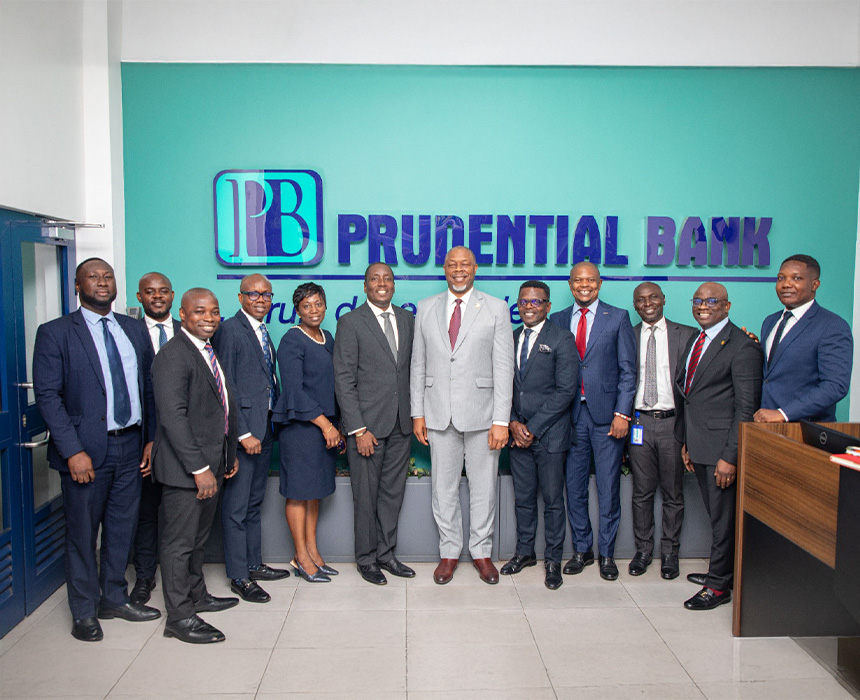

With CIMG’s highest customer satisfaction scores and a reputation for service excellence, Ghana’s most celebrated indigenous bank faces its toughest test yet: closing a capital gap while preserving the culture that made it exceptional.

Executive Introduction
In Ghana’s hyper-competitive banking sector, where brands compete on everything from interest rates to branch density, Prudential Bank Ghana has carved out a distinctive, almost counterintuitive, niche: customer happiness. While rivals chase transaction volumes and digital scale, Prudential has methodically built a reputation for service quality so consistent that it has become the most awarded bank in Ghana for customer satisfaction .
Yet, as the Bank of Ghana revealed in February 2026, Prudential finds itself in an uncomfortable spotlight. Alongside Universal Merchant Bank (UMB), it was identified as one of only two banks that remained undercapitalised as of December 2025 . This revelation—accompanied by news of a government-backed restructuring strategy—has placed a spotlight on the bank’s balance sheet that its marketing department never sought.
📢 GET A DETAILED ARTICLES + JOBS
Join ASJ's WhatsApp Channel and never miss a post or opportunity.
But to understand Prudential Bank is to understand a paradox. This is an institution that has won Best Bank in Retail Banking in the authoritative KPMG Customer Experience Survey, holds a five-star rating from CIMG for service quality, and was named Customer Happiness Leadership Award winner at the National Governance and Business Leadership Awards . Its customers genuinely love it. Its capital ratios, however, have told a different story—with Return on Assets recorded at -3.87% in 2024 following significant losses in 2022 and 2023 .
For depositors, the bank remains safe under the Ghana Deposit Protection Scheme, and the government has explicitly committed to closing its capital gap . For investors and corporate clients, the question is whether Prudential’s celebrated service culture can survive the rigours of a regulatory-mandated restructuring—or whether the bank that perfected “humanity with technology” is about to be remade into something less distinctive.
This ASJ profile examines Prudential’s business model, its dominance in customer experience metrics, its digital transformation under the leadership of Bernard Gyebi and the newly appointed Ebow Quayson, and the critical question of whether government intervention will stabilise or subsume Ghana’s most beloved indigenous bank.
Company Overview
Background: The Indigenous Service Pioneer
Prudential Bank Limited is a wholly indigenous Ghanaian bank, established to provide universal banking services with a distinct focus on retail and commercial customers. Unlike the merchant banking heritage of UMB or the state-owned identity of CBG, Prudential positioned itself early as the “customer’s bank”—an institution where service quality, not corporate scale, would be the primary competitive weapon.
Over the years, the bank has structured its operations around three dedicated business segments: Corporate and Institutional Banking, Commercial Banking, and Retail Banking, with each segment supported by a dedicated Digital Transformation team .
Ownership and Governance
Prudential Bank is privately held with a Ghanaian shareholder base. Critically, as of the 2026 Bank of Ghana disclosure, the Government of Ghana has committed to closing the bank’s capital gap under an Overarching Restructuring Strategy and Plan jointly developed by the government, the central bank, and Prudential Bank Limited . This government-backed intervention distinguishes Prudential from UMB, where state-owned enterprises SSNIT and SIC are the proposed capital providers.
The government’s role suggests that Prudential is viewed as systemically important enough to warrant direct state support—a significant vote of confidence, but also an intervention that could alter the bank’s governance dynamics.
Leadership: The Gyebi-to-Quayson Transition
Prudential’s leadership has been remarkably stable, though a transition is underway.
Bernard Gyebi (Outgoing Managing Director)
Gyebi led Prudential through its most successful period of customer experience recognition. Under his tenure, the bank won the Customer Happiness Leadership Award – Banking category at the 5th National Governance and Business Leadership Awards, while Gyebi personally was adjudged Transformational Banking CEO of the Year, 2025 . His leadership philosophy, emphasising that “exceptional service is the only sustainable differentiator,” has become institutionalised.
Gyebi also represented Prudential at major industry events, including the 18th Edition Connected Banking Summit – Innovation & Excellence Awards – West Africa in 2024 .
Ebow Quayson (Ag. CEO/MD)
More recently, LinkedIn updates from the Pan-African Payment & Settlement System (PAPSS) identify Mr. Ebow Quayson as the Ag. CEO/MD of Prudential Bank Ghana . Quayson previously served as the bank’s Executive Head of Retail and Commercial Banking, where he led customer training initiatives and merchant partner programmes .
Quayson’s appointment as Acting Managing Director signals continuity—he is an insider who understands the bank’s service culture intimately. His immediate priority, however, will be navigating the capital restructuring while maintaining the operational excellence that defines the brand.
Executive Team
The bank’s leadership includes:
-
Edward Commey – Executive Head, Corporate and Institutional Banking
-
Frederick Adomako-Ansah – Head of Commercial Banking
-
Zibrim Mohammed – Head of Transactional Banking
Operations and Footprint
Prudential operates an extensive branch network across Ghana, with locations spanning from Accra and Kumasi to Takoradi, Tamale, Sunyani, Techiman, Cape Coast, Koforidua, and Ho . Branch locations include:
| Region | Sample Branches |
|---|---|
| Greater Accra | Abeka, Accra, Adentan, Airport City, Cantonments, East Legon, Madina, Makola, Mataheko, Nungua, Odorkor, Okaishie, Ring Road Central, Spintex, Taifa, Tesano, Weija |
| Ashanti Region | Aboabo, Adum, Atonsu, Kumasi, Santasi Roundabout, Suame Maakro |
| Western Region | Takoradi Harbour, Takoradi Market Circle |
| Central Region | Cape Coast, University of Cape Coast |
| Eastern Region | Koforidua |
| Bono Region | Sunyani, Techiman |
| Northern Region | Tamale |
| Volta Region | Ho |
The bank also maintains agency banking relationships, including ATMs at the Kofi Annan International Peacekeeping Training Center and university campuses such as University of Ghana, KNUST, UCC, and Valley View University .
The bank’s headquarters are located at 8 John Harmond Street, Ring Road Central, Accra .
Business Model: The Service-First Universal Bank
Prudential operates a universal banking model with a distinctive strategic emphasis: customer experience as the primary competitive moat. While other banks compete on interest rates, branch density, or pan-African scale, Prudential has chosen to compete on how customers feel when they interact with the bank.
The Three-Segment Structure
Prudential restructured its operations into three business segments, each with dedicated leadership and tailored product sets :
-
Corporate and Institutional Banking: Serving large Ghanaian enterprises, multinationals, and public institutions. This segment focuses on trade finance, treasury services, and working capital facilities.
-
Commercial Banking: Mid-sized businesses and SMEs. This segment has been particularly active in deploying POS terminals and collection platforms to merchants .
-
Retail Banking: Individual consumers, salary earners, and mass-market depositors. This is the segment where Prudential’s customer experience accolades have been most pronounced.
How They Make Money
Based on The Banker Database figures, Prudential’s financial performance has been volatile in recent years :
| Year | Return on Assets (ROA) | Interpretation |
|---|---|---|
| 2020 | 0.84% | Modest profitability |
| 2021 | 1.98% | Strong performance |
| 2022 | -6.85% | Significant loss |
| 2023 | -7.74% | Continued losses |
| 2024 | -3.87% | Improved but still loss-making |
The 2022-2023 losses coincide with Ghana’s Domestic Debt Exchange Programme (DDEP) and broader economic crisis, which affected most banks’ profitability. However, Prudential’s losses were more severe than many peers, contributing to the capital shortfall that triggered regulatory intervention.
The bank’s revenue streams include:
-
Interest Income: From loans, advances, and investment securities
-
Fees and Commissions: From POS transactions, digital payments, trade services, and account maintenance
-
Trading Income: From treasury operations and foreign exchange
The significant improvement in ROA from -7.74% in 2023 to -3.87% in 2024 suggests that the bank’s core operations are recovering. However, the persistence of losses indicates that capital restoration cannot be achieved through retained earnings alone—hence the government-backed recapitalisation .
Market Position and Competition
The Customer Experience Crown
Prudential Bank’s market position is best understood through the lens of customer satisfaction metrics, where it has no peer in Ghana.
CIMG Recognition
The Chartered Institute of Marketing, Ghana (CIMG) has repeatedly awarded Prudential top honours:
-
CIMG 2023 Best Bank in Customer Satisfaction – Consumer Banking
-
CIMG 2023 Five-star Bank in Customer Satisfaction – Business Banking
-
CIMG 2023 Five-star Bank in Service Quality – Business Banking
-
CIMG 2021 & 2022 Five-star Quality Service Provider
KPMG Customer Experience Survey
The authoritative KPMG West Africa Banking Industry Customer Experience Survey has consistently ranked Prudential among the best:
-
Best Bank in Retail Banking – KPMG Customer Experience Survey 2024
-
3rd Best Bank in SME Banking – KPMG Customer Experience Survey 2023
National Governance and Business Leadership Awards (2025)
-
Customer Happiness Leadership Award – Banking category (Bank)
-
Transformational Banking CEO of the Year (Bernard Gyebi)
Digital Recognition
-
Emerging Digital Bank of the Year – Ghana Information Technology & Telecom Awards (GITTA)
-
Emerging Digital Bank of the Year – ICSA Connected Banking West Africa (2022)
Competitive Landscape
Prudential competes primarily in the mid-tier indigenous banking space, alongside institutions like Fidelity Bank, GCB Bank, and CalBank.
| Competitor | Where Prudential Wins | Where Prudential Loses |
|---|---|---|
| GCB Bank | Customer service, retail CX rankings | Branch network (GCB has 183 vs. Prudential’s smaller network), asset size |
| Fidelity Bank | Service quality perception, customer happiness awards | Agency banking scale (Fidelity has 9,000+ agents), fintech partnerships |
| CalBank | SME CX ranking (3rd vs. CalBank’s 5th in some segments) | Capital position, turnaround momentum |
| Ecobank | Indigenous trust, local decision-making | Pan-African scale, trade finance corridors |
Competitive Advantages
-
Unmatched Customer Loyalty: In an industry where switching banks is common, Prudential’s customer retention rates are likely industry-leading, though exact figures are proprietary.
-
Service Culture as Moat: Prudential has institutionalised a service ethos that competitors cannot easily replicate. As the bank stated: “There was a conscious strategy that was adopted by the bank to blend humanity with technology to deliver exceptional service” .
-
POS Merchant Network: Through extensive training programmes for merchants, Prudential has built a loyal base of business customers who use its POS terminals for collections. The bank’s December 2025 training sessions in Accra and Kumasi reached business owners, retail outlet managers, and shop attendants, reinforcing these relationships .
-
Security Certifications: Prudential completed ISO 27001 certification in 2019 and PCIDSS certification in 2020, providing customers with independently verified security assurances .
-
Government Backing (New): The government’s commitment to closing the capital gap, while born of necessity, provides an implicit sovereign guarantee that no purely private competitor can match .
Competitive Disadvantages
-
Undercapitalisation: The Bank of Ghana’s disclosure is a reputational challenge, regardless of the government’s intervention. Large corporate depositors may seek alternative banks while the restructuring proceeds.
-
Smaller Physical Footprint: While Prudential has an extensive branch network, it does not match the density of GCB (183 branches) or the agency network of Fidelity (9,000+ agents).
-
Brand Recognition Outside Ghana: Unlike Ecobank or Stanbic, Prudential is not a recognised brand for cross-border trade finance or diaspora banking.
Digital Strategy and Innovation: Humanity with Technology
Prudential’s digital strategy has been guided by a distinctive philosophy: blending humanity with technology. Unlike banks that pursue digitisation as a cost-cutting exercise, Prudential views digital tools as enhancements to—not replacements for—human relationships .
The *772# USSD Platform
Prudential was an early adopter of USSD banking, launching the dedicated short code *772# with remote onboarding capability. Key features include:
-
Reduced KYC requirements for a special account type, driving financial inclusion
-
Extension capabilities for merchants to receive payments via mobile money, reducing cash handling
-
Accessibility on basic feature phones, reaching customers without smartphones
POS Terminal Network and Merchant Training
Prudential has aggressively deployed POS machines with web acquiring solutions to SMEs, corporates, and merchants. The bank’s December 2025 training sessions in Accra and Kumasi demonstrated the depth of this commitment:
“Using our POS terminals gives you great relief—your customers shop conveniently, and you mobilise funds quicker and safely. We encourage your clients to support the digital transformation drive and patronise our POS—it’s a win-win for efficiency and customer satisfaction.” – Ebow Quayson, then Executive Head, Retail and Commercial Banking
The training sessions also covered:
-
Fraud prevention: As Zibrim Mohammed, Head of Transactional Banking, noted, “We want to empower you to reduce, if not eliminate, these risks and ensure smooth transactions”
-
Feedback collection: Merchants provided input on their POS experience, creating a continuous improvement loop
Bulk Payment Solutions
Prudential offers bulk payment solutions for businesses, allowing:
-
Salary payments to employees
-
Multiple/regular supplier payments
-
Payments into a combination of bank accounts and mobile money wallets
Debit and Prepaid Cards
The bank offers varied debit and prepaid card options to support the government’s cash-lite economy agenda, reducing the cost and risk of physical cash handling .
Contact Centre (6am – 10pm)
Prudential’s customer contact centre operates from 6am to 10pm daily, including weekends, with trained staff ensuring professional handling of customer queries. The bank’s conscious strategy has been to “blend humanity with technology to deliver exceptional service” .
PAPSS Integration (In Progress)
In January 2026, PAPSS CEO Mike Ogbalu III met with Ag. CEO/MD Ebow Quayson to discuss integrating the Pan-African Payment & Settlement System (PAPSS) into Prudential’s digital channels. Key objectives include:
-
Enhancing speed, security, and efficiency of customer transactions
-
Facilitating school fees payments and other cross-border payment flows
-
Supporting Ghana’s digital transformation agenda and strengthening financial inclusion
The PAPSS integration, once complete, would position Prudential to capture cross-border payment flows under the African Continental Free Trade Area (AfCFTA)—a significant opportunity for a mid-tier indigenous bank.
AfCFTA and Fintech Partnerships
Prudential is actively partnering with fintechs operating in other African countries to support SME businesses in leveraging opportunities under AfCFTA .
Challenges and Risks
Prudential Bank’s situation in 2026 is defined by a single, overriding risk: capital adequacy. But beneath that headline, several interconnected challenges demand attention.
Risk 1: Undercapitalisation and Regulatory Scrutiny
The Bank of Ghana’s February 2026 disclosure that Prudential remained undercapitalised as of December 2025 is the most significant risk factor facing the bank .
Key facts:
-
Only two banks were identified in this position: Prudential and UMB
-
The Government of Ghana has committed to closing the capital gap
-
The intervention follows an Overarching Restructuring Strategy and Plan developed jointly by the government, Bank of Ghana, and Prudential Bank Limited
Why this matters: Undercapitalisation means the bank lacks sufficient capital buffers to absorb unexpected losses or to grow its risk-weighted assets (loans). While the government’s commitment is reassuring, the process of capital injection—whether through equity infusion, asset transfers, or other mechanisms—carries execution risk and could alter the bank’s ownership structure.
The depositor perspective: Deposits remain protected under the Ghana Deposit Protection Corporation (GDPC) up to the coverage limit. The government’s explicit commitment to closing the gap adds an additional layer of security. Prudential is not a distressed bank facing liquidation; it is a fundamentally sound institution requiring capital reinforcement.
Risk 2: Persistent Losses (2022-2024)
The bank’s Return on Assets remained negative in 2024 at -3.87%, following losses of -7.74% in 2023 and -6.85% in 2022 . While the trend is improving (from -7.74% to -3.87%), the bank was still loss-making in 2024.
These losses reflect:
-
Impairments on loans and investments (including likely DDEP-related sovereign debt losses)
-
Margin compression in a high-interest-rate environment
-
Operational costs of maintaining service excellence
The capital injection will address the balance sheet, but profitability must be restored for the bank to be viable without ongoing government support.
Risk 3: Leadership Transition Uncertainty
The transition from Bernard Gyebi (Transformational Banking CEO of the Year 2025) to Ebow Quayson as Acting CEO/MD occurs at a critical juncture. While Quayson is an insider who understands the bank’s culture and operations, any leadership change carries risk, particularly during a regulatory-mandated restructuring.
Risk 4: The “Government Intervention” Stigma
Government backing is a double-edged sword. While it provides capital and implicit deposit guarantees, it may also:
-
Deter private-sector depositors who prefer arms-length relationships
-
Raise questions about long-term ownership and governance
-
Create uncertainty about whether the bank will eventually be merged, sold, or otherwise restructured
Risk 5: Economic Headwinds
Ghana’s economy continues to recover from the 2022-2024 crisis, but challenges remain:
-
High interest rates (policy rate at 18% as of 2025) make borrowing expensive for Prudential’s SME and retail customers
-
Cedi volatility affects the value of collateral and cross-border transactions
-
Consumer spending pressure may slow transaction volumes, affecting fee income
Risk 6: Competition on Digital Fronts
While Prudential’s POS network and USSD platform are strong, the bank faces intense digital competition from:
-
MTN MoMo and telco-led wallets (network effects, lower transaction costs)
-
Pan-African banks with larger digital investment budgets
-
Neobanks and fintechs with no legacy infrastructure costs
Economic and Industry Impact
SME and Merchant Ecosystem
Prudential’s extensive POS terminal network and merchant training programmes directly support Ghana’s informal retail sector. By digitising collections, Prudential helps small businesses:
-
Reduce cash handling risks (theft, counterfeit currency)
-
Mobilise funds faster for reinvestment
-
Build transaction histories that can support future credit applications
The bank’s training sessions in Accra and Kumasi reached business owners across corporate, institutional, commercial, and retail segments , reinforcing the bank’s role as an educator and enabler for Ghanaian commerce.
Financial Inclusion
Through the *772# USSD platform with reduced KYC requirements, Prudential has extended banking access to customers who:
-
Lack formal identification documents
-
Do not own smartphones
-
Live in areas without bank branches
This aligns with the Bank of Ghana’s financial inclusion agenda and brings previously unbanked Ghanaians into the formal financial system.
AfCFTA Readiness
Prudential’s ongoing integration with PAPSS positions the bank to facilitate cross-border trade under AfCFTA . For Ghanaian SMEs looking to export to other African markets, Prudential could become a gateway bank, providing settlement services in local currencies rather than requiring US dollars or euros.
Employment
Prudential directly employs a significant workforce across its branch network, headquarters, and contact centre. The bank’s continued viability—supported by the government recapitalisation—preserves these jobs and the livelihoods that depend on them.
Future Outlook
As of May 2026—the present date of this profile—Prudential Bank stands at a inflection point. The government has committed to closing the capital gap, leadership is transitioning, and the bank’s operational strengths (customer service, POS network, USSD platform) remain intact.
But the strategic questions are substantial.
The Bull Case (Optimistic)
-
Capital injection restores compliance: The government’s commitment to closing the gap is honoured within agreed timelines. Prudential returns to full regulatory compliance with no further intervention required.
-
Profitability recovers in 2025-2026: The improving ROA trend (-7.74% to -3.87% from 2023 to 2024) continues, with the bank returning to positive profitability. This would validate the core business model and demonstrate that losses were crisis-driven rather than structural.
-
New leadership builds on legacy: Ebow Quayson, as an insider, preserves the service culture while bringing fresh energy to digital expansion and the PAPSS integration.
-
PAPSS integration unlocks cross-border revenue: Once live, PAPSS positions Prudential to capture remittance and trade payment flows, diversifying revenue away from domestic interest income.
-
Customer loyalty buffers deposit outflows: Even during the capital disclosure, Prudential’s loyal customer base remains committed, preventing a deposit run that could exacerbate liquidity pressures.
The Bear Case (Pessimistic)
-
Capital injection delayed or inadequate: If the government’s capital commitment faces fiscal constraints or administrative delays, the Bank of Ghana could impose sanctions, restrict loan growth, or escalate intervention.
-
Profitability recovery stalls: If Ghana’s economic recovery falters, loan impairments could persist, preventing the return to profitability. Continued losses would erode the new capital, requiring repeated interventions.
-
Leadership transition disrupts culture: If the Gyebi-to-Quayson transition leads to strategic drift or talent departures, Prudential’s service culture—its primary competitive advantage—could erode.
-
Government intervention alters ownership: If the recapitalisation involves significant equity dilution, the government or new investors could become majority shareholders, potentially altering the bank’s indigenous, customer-first identity.
-
Competitors capitalise on uncertainty: Rival banks may aggressively target Prudential’s corporate and SME customers during the restructuring period, exploiting perceived instability to win mandates.
The Verdict
Prudential Bank is Ghana’s most beloved bank—and it is not particularly close. The CIMG awards, KPMG rankings, and Customer Happiness Leadership Award are not marketing fluff; they reflect a genuine institutional commitment to service that competitors acknowledge and customers reward.
But banking is ultimately a business of balance sheets. A bank with exceptional service but inadequate capital is a bank that cannot grow, cannot lend, and cannot fully serve its customers. The government’s intervention is therefore welcome, not threatening: it provides the capital that Prudential needs to continue doing what it does best.
The key variable is not whether the capital will arrive (the government has committed), but what it will cost in terms of governance, ownership, and strategic direction. If the restructuring preserves Prudential’s service culture while strengthening its balance sheet, the bank will emerge as a formidable competitor. If the intervention leads to cultural erosion or strategic drift, Ghana will have lost something irreplaceable.
For depositors, Prudential remains safe. For customers, the service experience remains exceptional. For investors and analysts, the coming 12–18 months will determine whether Prudential’s next chapter is one of renewed independence or permanent government stewardship.
FAQ SECTION
1. Is Prudential Bank Ghana in financial trouble?
Prudential Bank was identified by the Bank of Ghana in February 2026 as one of two banks that remained undercapitalised as of December 2025 . However, the bank is not distressed or facing liquidation. The Government of Ghana has committed to closing the capital gap under an agreed restructuring framework, and the bank continues to operate normally .
2. Is my money safe with Prudential Bank?
Yes. Deposits are protected by the Ghana Deposit Protection Corporation (GDPC) up to the coverage limit. Additionally, the Government of Ghana has explicitly committed to supporting the bank’s recapitalisation, adding an extra layer of security beyond the standard deposit insurance scheme .
3. Who is the Managing Director of Prudential Bank?
Bernard Gyebi served as Managing Director and was named Transformational Banking CEO of the Year in 2025 . More recent updates identify Ebow Quayson as the Ag. CEO/MD, who previously served as Executive Head of Retail and Commercial Banking .
4. What awards has Prudential Bank won?
Prudential has won numerous customer satisfaction awards, including:
-
Best Bank in Retail Banking – KPMG Customer Experience Survey 2024
-
Customer Happiness Leadership Award – National Governance and Business Leadership Awards 2025
-
CIMG Best Bank in Customer Satisfaction – Consumer Banking 2023
-
CIMG Five-star Bank in Service Quality – Business Banking 2023
-
Emerging Digital Bank of the Year – GITTA and ICSA Connected Banking West Africa 2022
5. What is Prudential Bank’s USSD code?
Prudential Bank’s dedicated USSD short code is *772# . The platform supports remote account onboarding with reduced KYC requirements, mobile money payments, and merchant collection services .
6. How does Prudential Bank support small businesses?
Prudential supports SMEs through:
-
POS terminal deployment with web acquiring solutions
-
Merchant training programmes on fraud prevention and operational efficiency
-
Bulk payment solutions for salaries and supplier payments
-
Commercial banking relationship management under Frederick Adomako-Ansah
7. Is Prudential Bank a government-owned bank?
No. Prudential Bank is privately held with Ghanaian shareholders. However, as of 2026, the Government of Ghana has committed to closing the bank’s capital gap under a restructuring strategy, which may affect ownership depending on the form of capital injection .
8. What is PAPSS and why is Prudential integrating with it?
PAPSS (Pan-African Payment & Settlement System) is a cross-border payment system supporting African Continental Free Trade Area (AfCFTA) transactions. Prudential is integrating PAPSS into its digital channels to facilitate faster, cheaper cross-border payments for school fees, trade, and remittances .
9. Does Prudential Bank have a mobile banking app?
Yes. Prudential offers mobile banking through both a smartphone app and the *772# USSD platform. The bank has won Emerging Digital Bank of the Year awards for its digital offerings .
10. How many branches does Prudential Bank have?
Prudential operates an extensive branch network across Ghana, including locations in Greater Accra, Ashanti Region, Western Region, Central Region, Eastern Region, Bono Region, Northern Region, and Volta Region. Specific branches include Abeka, Adum, Airport City, Cantonments, Cape Coast, Kumasi, Madina, Okaishie, Spintex, Takoradi, Tamale, Techiman, and Weija, among others .
11. What happened to Prudential Bank’s profitability in 2022-2024?
Prudential recorded losses during the 2022-2024 period, with Return on Assets at -6.85% (2022), -7.74% (2023), and -3.87% (2024) . These losses were primarily driven by the Domestic Debt Exchange Programme (DDEP) and broader economic crisis affecting Ghana’s banking sector. The improving trend (from -7.74% to -3.87%) suggests recovery is underway.
12. What is Prudential Bank’s contact centre number?
Prudential Bank’s contact centre operates from 6am to 10pm daily, including weekends. Contact options include:
-
Phone: + (233) 30 275 0420, + (233) 55 185 8585
-
Toll Free: 0800 000 772
-
Email: [email protected]
QUICK FACTS BOX
| Item | Details |
|---|---|
| Founded | 1990s (precise year undisclosed, established as indigenous Ghanaian bank) |
| Headquarters | 8 John Harmond Street, Ring Road Central, Accra, Ghana |
| Industry | Banking / Financial Services |
| Services | Corporate Banking, Commercial Banking, Retail Banking, Treasury, Transactional Banking, POS Services, USSD Banking |
| Ownership | Privately held Ghanaian shareholders; Government of Ghana committed to recapitalisation |
| CEO (MD) | Bernard Gyebi (outgoing, Transformational Banking CEO of the Year 2025); Ebow Quayson (Ag. CEO/MD as of 2026) |
| Executive Team | Edward Commey (Corporate & Institutional), Ebow Quayson (Retail & Commercial, prior to MD role), Frederick Adomako-Ansah (Commercial), Zibrim Mohammed (Transactional) |
| Market Position | Mid-tier indigenous bank; #1 in customer satisfaction metrics (CIMG, KPMG) |
| Operational Footprint | Extensive branch network across all major regions of Ghana |
| Key Digital Products | *772# USSD platform, POS terminals with web acquiring, bulk payment solutions, debit/prepaid cards, contact centre (6am-10pm) |
| Key Awards | Best Bank in Retail Banking (KPMG 2024); Customer Happiness Leadership Award (2025); CIMG Five-star Service Quality (2023); Emerging Digital Bank of the Year (2022) |
| Security Certifications | ISO 27001 (2019), PCIDSS (2020) |
| Regulatory Status | Bank of Ghana licensed; undercapitalised as of December 2025; government-backed restructuring underway |
| Financial Trend (ROA) | 2020: 0.84%; 2021: 1.98%; 2022: -6.85%; 2023: -7.74%; 2024: -3.87% |
| Contact Centre Hours | 6am – 10pm daily (including weekends) |
| Website | www.prudentialbank.com.gh |
Source: Accra Street Journal
Last Updated on May 3, 2026 by Samuel Kwame Boadu
Disclaimer: Some content on Accra Street Journal may be aggregated, summarized, or edited from third-party sources for informational purposes. Images and media are used under fair use or royalty-free licenses. Accra Street Journal is a subsidiary of SamBoad Publishing Hub under SamBoad Business Group Ltd, registered in Ghana since 2014.
For concerns or inquiries, please visit our Privacy Policy or Contact Page.

Samuel Kwame Boadu is a Ghanaian media entrepreneur and storyteller with a passion for amplifying urban voices and uncovering everyday truths. He is the Editor-in-Chief and Founder of Accra Street Journal, a dynamic digital platform dedicated to capturing the pulse of Ghana’s capital—its people, culture, challenges, business, sports and innovations.