









With a 50-year legacy of corporate banking innovation but currently navigating a publicised capital shortfall, Ghana’s oldest surviving indigenous merchant bank is betting on digital platforms and leadership renewal to write its next chapter.

Executive Introduction
In the pantheon of Ghanaian banking, few names carry the institutional weight of Universal Merchant Bank (UMB). Established in 1972 as a policy bank to help Ghanaians “seize the controlling heights of the economy,” UMB is not merely a financial institution—it is a piece of the nation’s post-independence economic architecture . It played foundational roles in establishing the Ghana Stock Exchange and managing iconic flotations like Ashanti Goldfields .
Fast forward to 2026, and the narrative has become more complex. UMB currently finds itself in the unusual position of being celebrated for industry-leading customer service and digital innovation while simultaneously navigating a publicised undercapitalisation issue that forced a regulatory deadline extension .
📢 GET A DETAILED ARTICLES + JOBS
Join ASJ's WhatsApp Channel and never miss a post or opportunity.
This dichotomy makes UMB one of the most fascinating—and closely watched—entities in Ghana’s banking sector today. It remains the go-to banking partner for 35% of Licensed Buying Companies (LBCs) in the cocoa sector and boasts an award-winning digital strategy . Yet, its ability to maintain its “indigenous giant” status without relying on a multinational parent or a purely state-owned identity is being tested by the realities of modern capital adequacy.
For corporate treasurers, the bank offers unrivalled niche expertise in commodities and “Banking-as-a-Service” (BaaS) platforms. For investors and depositors, the question of the moment is whether the bank’s “SPEED” strategy—bolstered by strategic hires and a recent digital overhaul—can outrun its balance sheet constraints. This ASJ profile examines the heritage, the financial health, and the high-stakes turnaround of Universal Merchant Bank.
Company Overview
Background: The Merchant Bank Origins
UMB opened its doors on March 15, 1972 . Unlike the retail-focused banks that emerged later, UMB was conceived as a merchant bank—a wholesale institution designed to provide corporate finance, trade finance, and investment banking services to Ghanaian-owned businesses .
Throughout the 1970s and 1980s, UMB effectively handled all investment banking in Ghana. It was instrumental in the establishment of the Ghana Stock Exchange (GSE) and managed major floats, including the privatization of Ashanti Goldfields . It also spawned institutions like the Home Finance Company (now Republic Bank), cementing its reputation as a breeding ground for banking talent . Today, it operates as a universal bank but retains its merchant banking DNA in its corporate lending philosophy.
Ownership Structure: A State-Private Hybrid
UMB is a privately held institution but with significant state-linked shareholding. Key shareholders include the Social Security and National Insurance Trust (SSNIT) and the State Insurance Company (SIC) , alongside the Ghana Amalgamated Trust (GAT) .
This hybrid ownership is a double-edged sword. It provides a stable, long-term view and access to quasi-sovereign business networks. However, as recent events have shown, coordinating capital injections from multiple state-owned enterprises (SOEs) can be administratively slower than a purely private recapitalisation, leading to regulatory friction .
Leadership: The Stabilizing Trio
UMB has strategically reshaped its executive suite to navigate the current turbulence.
-
Dr. Philip Oti-Mensah (Managing Director): A seasoned banker with a PhD, Dr. Oti-Mensah leads the “transformation journey.” Under his tenure, UMB has won continental accolades, including Digital Bank of the Year (Ghana) and the Excellence in SME Banking Award in 2026 .
-
Noble Eduamah (Group Head, Corporate Banking): Appointed in April 2026, Eduamah brings over two decades of experience, including senior roles at UBA (where he was Global Head of Mining Business), Fidelity Bank, and Stanbic Bank . He holds an Executive Masters in Strategic Client Management from the University of Cape Town. His appointment signals a sharpened focus on the Mining, Energy, and Real Estate sectors .
-
Board & Founders: While specific board details are less public, the bank operates under the strategic direction of its major shareholders, with a strong emphasis on corporate governance.
Operations and Footprint
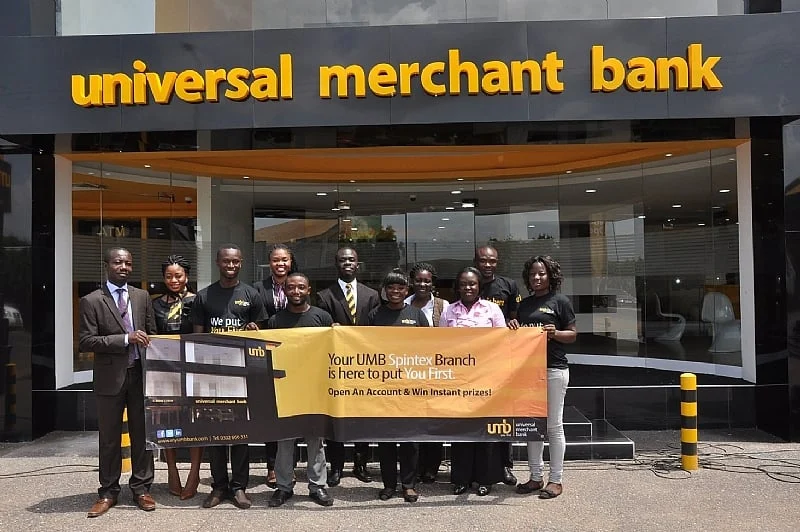
UMB operates through 35 branches and three UMB Centres for Businesses located in Accra, Kumasi, and Kasoa . The bank also maintains a vast ATM network and a state-of-the-art Digital Banking Hub. It employs between 1,001 and 5,000 people .
Business Model: The “Three-Legged Stool” of Value
UMB operates a diversified model that bridges the gap between old-school relationship banking and modern platform economics.
1. Corporate & Commodity Banking (The Heritage Engine)
This remains UMB’s crown jewel. The bank claims to bank 35% of all Licensed Buying Companies (LBCs) in Ghana’s cocoa sector—a dominant market share . It also retains strongholds in mining, energy, and real estate, leveraging the expertise of newly appointed leadership to deepen these verticals .
2. SME Banking & Platform Play (The Growth Driver)
Unlike traditional banks that lend to SMEs, UMB has focused on digitizing their operations. The UMBSpeedPay platform allows small businesses—from wax print dealers in Okaishie to logistics firms—to generate invoices, collect payments, and manage accounts via mobile phone . This “platform play” locks in customers through utility rather than just lending.
Key Differentiator: Banking-as-a-Service (BaaS)
UMB allows third parties (fintechs, NGOs, non-bank lenders) to embed banking products like account opening and payments into their own apps via APIs. This “invisible banking” strategy contributes to a 20%+ improvement in revenue collection for clients .
3. Retail & Personal Banking (The Stability Base)
For individuals, UMB offers the SpeedApp and EZUpdate for Ghana Card integration, focusing on convenience and security. However, retail banking is viewed more as a deposit-gathering mechanism to fund corporate lending rather than a primary profit centre .
How They Make Money: Revenue Diversification
UMB has successfully pivoted towards non-interest income. In 2022 (most recent detailed data available), non-interest income jumped from GHS 131 million to GHS 261 million, driven by fees, commissions, and trading income . This diversification is critical as net interest margins compress across the industry.
Market Position and Competition
The Customer Service Champion
UMB holds a near-mythical status in Ghana regarding customer service. In the 2022 CIMG Customer Satisfaction Index, UMB scored a perfect 100% , outperforming every other bank in the country . While the banking industry average for remote banking satisfaction was 88%, UMB topped the charts, validating its “Digital 1st” and “Knowing2Serve” strategy .
Competitive Landscape
| Competitor | Where UMB Wins | Where UMB Loses |
|---|---|---|
| Ecobank | Corporate client intimacy, BaaS platforms | Pan-African scale and treasury reach |
| GCB Bank | SME digital tools (SpeedPay vs. standard accounts) | Branch network (35 vs. 183) and asset size |
| Stanbic | Indigenous agility, regulatory navigation | Investment banking muscle |
| Fidelity | Commodity financing (Cocoa LBCs) | Retail agency banking network |
Competitive Advantages
-
First-Mover in BaaS: UMB has a head start in API banking, allowing fintechs to plug into its license .
-
Niche Expertise: Deep, long-standing relationships in the agricultural commodity supply chain are hard to replicate.
-
ISO & Security Certifications: It holds ISO/IEC 27001 and PCI DSS certifications, a major selling point for corporate clients concerned about cybersecurity .
Digital Strategy and Innovation: The “SPEED” Ecosystem
Under Dr. Philip Oti-Mensah, UMB has aggressively modernised its tech stack, moving beyond simple mobile banking to an integrated lifestyle platform.
The Revamped SpeedApp (2026)
In February 2026, UMB launched a revamped SpeedApp . This was not a cosmetic patch but a deep upgrade addressing speed, stability, and security after nearly a decade of the original version .
-
Features: Enhanced authentication protocols, strengthened transaction safeguards, and intuitive navigation.
-
Support Structure: This is backed by a 24/7 Contact Centre to ensure human support complements the digital experience .
UMB SpeedPay for SMEs
This is arguably UMB’s most potent weapon. It digitizes the “informal” economy. The platform provides business intelligence, revealing top customers, peak sales periods, and inventory management data, effectively turning a small retailer into a data-driven business .
Banking-as-a-Service (BaaS)
UMB allows non-banks to offer UMB’s financial products under their own brand. This strategy effectively turns potential disruptors (fintechs) into distribution partners .
Recognition
The strategy has paid off. In March 2026, UMB was named Digital Bank of the Year (Ghana) at the Africa Leadership Persons of the Year Awards and won Excellence in SME Banking at the Connected Banking Summit .
Challenges and Risks
The narrative surrounding UMB took a sharp turn in early 2026 regarding its capital position, and this is the most critical risk factor for analysts.
1. Undercapitalisation and Regulatory Scrutiny
In February 2026, the Bank of Ghana (BoG) disclosed that UMB remained undercapitalised as of December 2025 .
-
The Deadline: The recapitalisation plan was extended to end of March 2026.
-
The Shareholders: The extension was specifically to allow SSNIT and SIC to fulfil capital injection commitments .
-
The Implication: While the bank is not “distressed” in the sense of being insolvent, this situation signals that UMB lacks the capital buffer to aggressively grow its risk-weighted assets (loans). It forces the bank to focus on fee-generating services (digital) rather than interest-earning assets (lending).
2. The “Prudential Bank” Context
Significantly, UMB was listed alongside Prudential Bank as one of only two banks in this position . This positions UMB as a “tail risk” in the sector, even as the BoG maintains that the overall banking system is stable. Market watchers note that the involvement of SSNIT and SIC underscores the government’s strategic interest in keeping UMB afloat .
3. Economic Headwinds
Ghana’s post-DDEP environment remains challenging. High interest rates (policy rate at 18% as of 2025) make borrowing expensive for UMB’s SME clients, while currency depreciation affects the value of collateral held against corporate loans .
4. Competition for Talent
With the recent appointment of Noble Eduamah (a poach from UBA/Fidelity), UMB is signaling a fight for top-tier corporate bankers. However, retaining talent against the salaries offered by pan-African banks or international fintechs remains an ongoing operational risk .
Economic and Industry Impact
Cocoa Sector Financing
By banking 35% of Cocoa LBCs, UMB is a critical node in the value chain of Ghana’s single most important agricultural export. Disruptions to UMB’s lending capacity would directly impact the purchasing power of cocoa buyers during the main crop season .
Formalising the Informal Sector
UMBSpeedPay has transitioned thousands of market traders from purely cash-based operations to digital payments. This increases the tax base for the government and provides “transactional audit trails” for business owners seeking future credit .
Fintech Ecosystem Enablement
Through its BaaS model, UMB acts as the “banker to the fintechs.” By providing the regulatory license and settlement rails, UMB enables smaller tech startups to offer financial services without the multi-million dollar cost of acquiring a banking license .
Future Outlook
As of May 2026, UMB is standing at a precipice. The outcome of the March 2026 recapitalisation deadline (note: extension to end of March) is the immediate determinant of sentiment.
The Bull Case (Optimistic)
-
Capital Injection Success: If SSNIT, SIC, and GAT successfully inject the required capital, UMB will have a clean bill of health. The “regulatory risk” premium will vanish from its deposits.
-
The “Netflix of Banking” Model: UMB’s BaaS and SpeedPay platforms are scalable. They require little additional capital to generate substantial fee income. As transaction volumes grow, non-funded income could comfortably cover operating expenses, making capital constraints irrelevant.
-
Niche Domination: With Eduamah leading Corporate Banking, UMB is poised to win mandates in the “green minerals” and energy transition sectors, leveraging its existing mining expertise .
The Bear Case (Pessimistic)
-
Capital Injection Delays: If the shareholders fail to meet the extended deadline, the Bank of Ghana could impose sanctions, restrict dividend payments, or limit loan growth. This could trigger a loss of confidence among large corporate depositors.
-
The “Legacy Tech” Trap: While the SpeedApp is revamped, maintaining API integrations against leaner, born-in-the-cloud fintechs requires constant, expensive upgrades.
-
Lending Stagnation: If margins compress and capital is tight, UMB may be unable to fund new loan deals. It risks becoming a “utility” processor (earning fees) rather than a “bank” (earning interest), shrinking its balance sheet.
The Verdict
Universal Merchant Bank is a classic example of “legacy meets innovation.” It possesses the most sophisticated digital SME toolkit in Ghana (SpeedPay) and a corporate banking heritage that commands respect. However, the 2025/2026 capital adequacy cloud is impossible to ignore.
For the astute observer, UMB represents a special situation. If the state-backed shareholders finalise the recapitalisation, UMB will likely re-rate as a stable, tech-forward indigenous bank. If not, it faces a period of regulatory-induced hibernation. The leadership hires of 2026 suggest management is betting heavily on the former. For now, the bank remains safe for depositors (due to SSNIT/SIC backing), but investors are waiting for the proof of capital.
FAQ SECTION
1. What is Universal Merchant Bank (UMB) known for?
UMB is known for being one of Ghana’s oldest surviving indigenous banks, founded in 1972. It is famous for its strong corporate banking heritage (especially in cocoa and mining), its award-winning digital platform UMB SpeedPay, and its consistent top rankings in customer satisfaction surveys, including a 100% score in the 2022 CIMG Index .
2. Is UMB Bank currently in financial trouble?
As of December 2025, the Bank of Ghana identified UMB as one of two banks that remained undercapitalised . However, the bank is not distressed. A recapitalisation plan is in place, and key shareholders (SSNIT, SIC) have committed to injecting capital. The deadline was extended to end of March 2026 to facilitate this process .
3. Who owns Universal Merchant Bank (UMB)?
UMB is a privately held bank but has significant institutional shareholders, including the Social Security and National Insurance Trust (SSNIT) , the State Insurance Company (SIC) , and the Ghana Amalgamated Trust (GAT) .
4. Who is the Managing Director of UMB?
The Managing Director is Dr. Philip Oti-Mensah. He has been leading the bank’s transformation journey, which recently earned UMB the Digital Bank of the Year (Ghana) award in 2026 .
5. What is UMB SpeedPay?
UMB SpeedPay is a digital platform designed for SMEs and traders. It allows businesses to generate invoices, receive mobile money/bank payments, manage accounts, and track business intelligence (like top-selling items or customers) directly from a mobile phone, without needing a traditional physical shop .
6. Is UMB safe for deposits?
Yes, generally. As a bank licensed by the Bank of Ghana, deposits are protected by the Ghana Deposit Protection Corporation (GDPC) up to the coverage limit. Furthermore, the involvement of state-owned giants like SSNIT and SIC as major shareholders provides an additional layer of systemic stability .
7. What is the difference between UMB and a traditional bank?
Originally founded as a Merchant Bank, UMB historically focused on wholesale banking (large corporations, trade finance, investment banking) rather than retail savings. While it now operates as a universal bank, its DNA is still heavily skewed toward corporate clients and value-added services for businesses rather than micro-lending .
8. How can I contact UMB customer service?
UMB operates a 24/7 Contact Centre. Customers can reach out via phone or WhatsApp at 0266020400. They also have active social media channels on Twitter (@myumbbank), Instagram, and Facebook .
9. Does UMB offer Banking-as-a-Service (BaaS)?
Yes. UMB allows third-party companies (fintechs, NGOs, etc.) to embed banking products like account opening and payment processing into their own applications through UMB’s API infrastructure, a service known as Banking-as-a-Service (BaaS) .
10. Who is Noble Eduamah and why was he hired?
Noble Eduamah was appointed Group Head of Corporate Banking in April 2026 . He was hired to deepen UMB’s presence in the mining, energy, and real estate sectors. He brings over 20 years of experience from UBA (where he was Global Head of Mining), Fidelity Bank, and Stanbic Bank .
11. What awards has UMB won recently?
In 2026, UMB won the Digital Bank of the Year (Ghana) award and the Excellence in SME Banking Award at the Connected Banking Summit. Dr. Philip Oti-Mensah also received the Special African Banking Leadership Commendation .
12. How many branches does UMB have?
UMB operates 35 branches across Ghana, supplemented by three specialised “Centres for Businesses” in Accra, Kumasi, and Kasoa, and a network of ATMs .
QUICK FACTS BOX
| Item | Details |
|---|---|
| Founded | March 15, 1972 |
| Headquarters | SSNIT Emporium Building, Liberation Road, Airport City, Accra, Ghana |
| Industry | Banking / Financial Services |
| Services | Corporate Banking, SME Banking, Treasury, Trade Finance, Digital Banking (BaaS), Personal Banking |
| Ownership | Private (Significant holdings by SSNIT, SIC, and GAT) |
| CEO (MD) | Dr. Philip Oti-Mensah |
| Group Head Corporate Banking | Noble Eduamah (appointed April 2026) |
| Market Position | Indigenous Tier-2 Bank; Niche leader in Cocoa LBCs and BaaS |
| Operational Footprint | 35 Branches, 3 Business Centres (Accra, Kumasi, Kasoa) |
| Total Assets & Deposits | Data under review; reported GHS 4.1bn+ liabilities in 2022/23 |
| Key Digital Products | UMB SpeedApp, UMB SpeedPay, EZUpdate, API Banking (BaaS) |
| Key Award (Recent) | Digital Bank of the Year (Ghana) 2026; Excellence in SME Banking 2026 |
| Customer Service Rating | 100% in CIMG Customer Satisfaction Index 2022 |
| Certifications | ISO/IEC 27001 & PCI DSS Certified |
| Regulatory Status | BoG licensed; Recapitalisation plan in progress (as of March 2026 extension) |
| Website | https://www.myumbbank.com/ |
Source: Accra Street Journal
Last Updated on May 3, 2026 by Samuel Kwame Boadu
Disclaimer: Some content on Accra Street Journal may be aggregated, summarized, or edited from third-party sources for informational purposes. Images and media are used under fair use or royalty-free licenses. Accra Street Journal is a subsidiary of SamBoad Publishing Hub under SamBoad Business Group Ltd, registered in Ghana since 2014.
For concerns or inquiries, please visit our Privacy Policy or Contact Page.

Samuel Kwame Boadu is a Ghanaian media entrepreneur and storyteller with a passion for amplifying urban voices and uncovering everyday truths. He is the Editor-in-Chief and Founder of Accra Street Journal, a dynamic digital platform dedicated to capturing the pulse of Ghana’s capital—its people, culture, challenges, business, sports and innovations.