










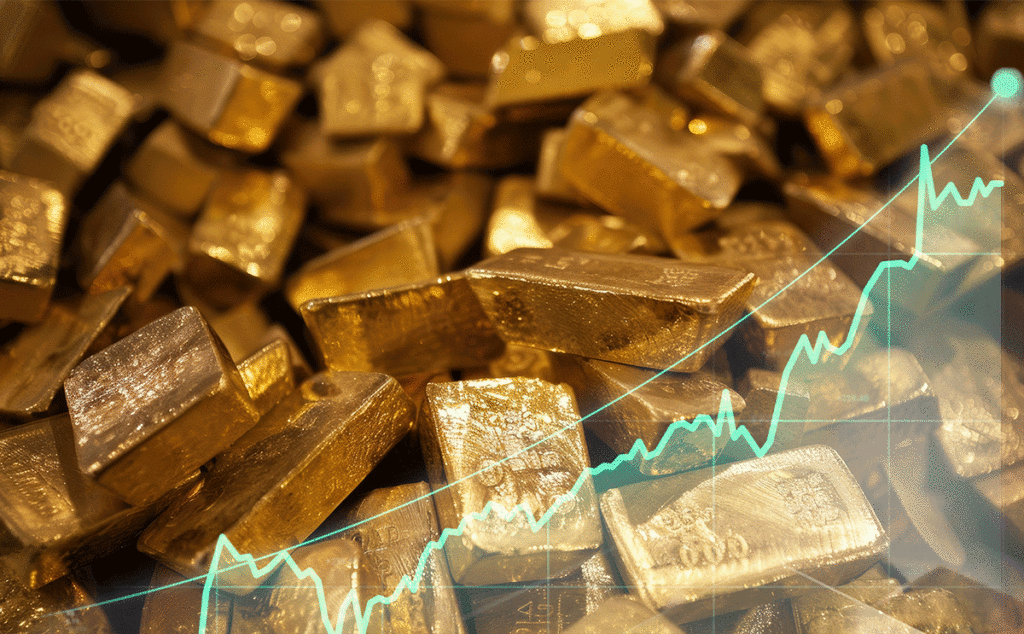
Gold prices stayed above $4,500 per ounce on Friday, holding in a tight range as investors weighed mixed signals from ongoing US–Iran negotiations against growing worries over inflation and interest rates. Spot gold traded around $4,523 per ounce, only slightly off recent highs but on track for a second straight weekly loss as markets shifted focus from safe-haven demand to inflation risks.
The geopolitical situation remains tense: Iran said the latest US proposal has partially narrowed differences, but reports that its Supreme Leader ordered enriched uranium stockpiles to remain in the country have complicated talks, with dismantling Tehran’s nuclear program still a key US demand. Concerns also rose after reports that Iran is discussing a permanent toll arrangement with Oman to formalize its control over shipping traffic through the Strait of Hormuz—a move reportedly rejected by US President Donald Trump, who insists the passage remain open.

While such tensions would normally boost gold demand, rising oil prices have instead fueled fears of a global inflation shock. Brent crude stayed above $105 a barrel this week, and analysts believe the surge in energy costs is raising expectations that central banks, especially the US Federal Reserve, may keep interest rates higher for longer or even tighten further. Higher rates generally make non-yielding assets like gold less attractive, leaving the market caught between geopolitical risks pushing prices up and monetary policy pressures pulling them down.
📢 GET A DETAILED ARTICLES + JOBS
Join ASJ's WhatsApp Channel and never miss a post or opportunity.

Key Developments: Iran Negotiations, Hormuz Tolls, and the Inflation Trade-Off
The US-Iran negotiations have reached a critical juncture. Tehran’s indication that the latest US proposal has partially narrowed differences was interpreted by some as a sign of progress. However, the reported order by Iran’s Supreme Leader to keep the country’s enriched uranium stockpile within Iranian territory represents a significant obstacle. The US has consistently demanded that Iran dismantle its nuclear programme—a position that Tehran shows no willingness to accept. The gap between the two sides remains wide.
The Strait of Hormuz toll proposal adds a new dimension. Iran is reportedly discussing a permanent framework with Oman that would formalize Tehran’s control over shipping traffic through the waterway, effectively allowing Iran to tax or restrict passage at will. Trump’s reported rejection of the proposal—insisting the passage remain open and unrestricted—sets up a potential confrontation. Even the discussion of such a framework increases uncertainty, as it suggests Iran is planning for a long-term disruption rather than a short-term negotiation tactic.

Oil prices have responded accordingly. Brent crude stayed above $105 per barrel this week, fueled by worries over potential disruptions to Middle East energy supplies. While prices have dropped from the $120-plus peaks seen during the height of the crisis, they remain historically high. For central banks, persistently elevated oil prices pose a challenge as they directly drive inflation—both headline, through energy costs, and core, through transportation and production expenses passed on to goods.
The market’s focus has shifted. Earlier in the crisis, gold rallied sharply as investors sought safety from geopolitical risk. The price exceeded $5,000 per ounce at its peak. Now, despite continued tensions, gold has drifted lower, down approximately 14% from those highs. The reason is that the inflation shock from high oil prices is forcing a repricing of monetary policy expectations. The Federal Reserve, which had been expected to cut rates later in 2026, is now seen as likely to hold steady or even hike further.
Federal Reserve Chair Jerome Powell has not commented directly on the Iran situation, but the market is drawing its own conclusions. The Fed’s dual mandate is price stability and maximum employment. Inflation, while down from its 2022 peaks, remains above the 2% target. A sustained oil price shock could push it higher. The market is now pricing in a greater than 50% probability of at least one more rate hike in 2026, and the first rate cut has been pushed back to 2027 in some forecasts.
The US dollar has strengthened as a result. Higher US interest rates attract foreign capital, increasing demand for dollars. A stronger dollar is typically negative for gold, which is priced in dollars and becomes more expensive for holders of other currencies. The dollar’s strength has offset some of the safe-haven demand that would otherwise support gold.
The Accra Street Journal notes that the gold market is sending a signal. In a pure geopolitical risk environment—such as the immediate aftermath of the Iran escalation—gold rallies. In an environment where geopolitical risk is accompanied by inflation fears and monetary policy tightening, gold is more ambiguous. The current rangebound trading above $4,500 reflects that ambiguity.
Analysis & Implications: The Competing Forces on Gold Prices
Gold is a unique asset because it responds to multiple, sometimes contradictory, drivers. The traditional driver is real interest rates (nominal rates minus inflation). When real rates are negative or falling, gold becomes attractive because it has no yield but also no counterparty risk. When real rates are positive and rising, gold becomes less attractive because investors can earn a positive return from bonds or savings accounts without taking gold’s price risk.
The current environment is mixed. Nominal interest rates are elevated (the Fed funds rate at 5.25% to 5.50%). Inflation is also elevated, but the relationship between the two determines real rates. If inflation is higher than nominal rates, real rates are negative, which is supportive of gold. If nominal rates exceed inflation, real rates are positive, which is negative for gold. The data is ambiguous; different measures of inflation give different answers.
The second driver is geopolitical risk. Gold is a safe haven. When tensions rise, demand for gold increases. The Iran-Hormuz crisis is a clear geopolitical risk event. The fact that gold is still above 4,500 despite the monetary policy headwinds is a testament to that risk premium. If the crisis were to de-escalate significantly, gold could fall below 4,000.
The third driver is central bank demand. Central banks, particularly those in emerging markets (China, Russia, Turkey, India), have been accumulating gold as a hedge against dollar-denominated assets. This demand is structural and not price-sensitive in the short term. It provides a floor for gold prices, even when other drivers are negative.

The fourth driver is retail and institutional investment demand. Gold ETFs and physical gold purchases by investors are influenced by price trends, momentum, and portfolio diversification considerations. This demand is more cyclical and can amplify price movements in either direction.
Currently, the competing forces are roughly balanced. Geopolitical risk and central bank demand are pushing prices up; monetary policy expectations and dollar strength are pushing prices down. The result is rangebound trading between 4,500and4,600. A breakout in either direction would require a significant shift in the balance of forces.
For Ghana, the gold price level matters enormously. Gold exports of $6.8 billion in the first four months of 2025 were driven by prices above $4,600. The current price of $4,523 is still excellent by historical standards—just a few years ago, gold was trading below $2,000. The government’s budget assumptions of $4,200 per ounce are being exceeded, providing a fiscal windfall. However, a sustained decline below $4,000 would reduce export earnings and royalty receipts.
The Bank of Ghana’s Domestic Gold Purchase Program has accumulated over 22 tonnes of gold. The program buys gold from small-scale miners in cedis, adding to reserves. The current price environment is favorable for the program, as the central bank can acquire gold at market prices and add it to reserves at those valuations. A price decline would reduce the cedi value of the gold reserve, but the program’s primary purpose is to support the mining sector and diversify reserves, not to generate trading profits.
What This Means for Investors, Miners, and Central Banks
For investors, the gold market is sending a signal of uncertainty. Rangebound trading above $4,500 suggests that the market does not have a clear directional view. Investors who believe that geopolitical risk will escalate and monetary policy will be forced to ease (due to a growth slowdown) would be bullish on gold. Investors who believe that the Fed will hold rates high and the dollar will strengthen would be bearish. The prudent approach is to maintain a strategic allocation to gold as a portfolio diversifier, rather than trading tactically based on short-term news.
Gold miners are enjoying a highly profitable price environment right now. The all-in sustaining cost (AISC) for major producers is around $1,200 to $1,500 per ounce, and with prices at $4,500, margins exceed $3,000 per ounce. This strong profitability is fueling expansion, exploration, and M&A activity. In Ghana, companies like Newmont, AngloGold Ashanti, Gold Fields, and smaller operators are benefiting. However, this success is also drawing government attention, with ongoing talks about boosting the fiscal take through higher royalties, taxes, or even a windfall profits tax. Miners should be ready for a potentially tougher fiscal landscape.
For central banks, the current gold price level presents a dilemma. Those that are accumulating gold (China, Russia, Turkey, India) are paying high prices. Those that are holding gold as reserves are seeing high valuations. The Bank of Ghana’s decision to accumulate gold through its Domestic Gold Purchase Program is a long-term strategic move; the purchase price is less important than the diversification benefit. However, the central bank should avoid chasing prices higher; it should maintain a disciplined purchasing program based on its reserve management objectives, not on price forecasts.
The Accra Street Journal notes that the gold price is also a barometer of global confidence. A sustained price above 4,500 reflects deep-seated anxieties about the global order—geopolitical fragmentation, de-dollarization, inflation, and uncertainty in monetary policy. A return to 3,500 would suggest these concerns have eased. For now, the world stays on edge, and gold prices remain high.
Wider Context: Gold’s Historical Role and the Current Regime
Gold has been a store of value for millennia. Its role in the modern financial system has evolved: from the gold standard (1870s to 1930s) to a fixed price ($35 per ounce) under Bretton Woods (1944 to 1971), to a freely traded commodity (1971 to present). The current regime is characterized by large price swings driven by macroeconomic and geopolitical factors.
The price of gold has increased dramatically over the past 20 years: From around $300 per ounce in the early 2000s to over $4,500 today, prices have surged. The key drivers include the end of the gold standard’s remnants, rising demand from emerging markets, the 2008–2009 financial crisis and its impact on trust in banks, the post-COVID inflation spike, and current geopolitical risks.
The current price level is not unprecedented in real terms. Adjusted for inflation, Gold’s 1980 peak of $850 would be roughly $3,000 today. This means current prices are higher than the inflation-adjusted peak from 1980. Still, gold’s purchasing power has changed over time, and today’s price reflects a mix of real factors and speculative demand.
The comparison with other assets is instructive. The S&P 500 has also appreciated significantly over the past 20 years, but with more volatility and a different risk profile. Gold is not a substitute for equities; it is a diversifier. The correlation between gold and equities is low and sometimes negative, meaning that gold can rise when equities fall. This diversification benefit is the primary reason institutional investors hold gold.
The future of gold will depend on the trajectory of the factors that drive it. If de-dollarization accelerates, central bank demand will increase, supporting prices. If the Fed returns to a low-rate environment, real rates will fall, supporting prices. If geopolitical risk recedes, the risk premium will decline, pressuring prices. The outcome is uncertain, which is why gold remains rangebound.
For Ghana, the message is clear: gold is a valuable resource that should be managed for the long term. The current high prices are a windfall, but they will not last forever. The government should use the windfall to build buffers, invest in diversification, and strengthen the mining sector’s governance. The gold price will eventually revert to a lower level. When it does, Ghana should be ready.
Outlook / What Happens Next
Gold prices will stay sensitive to updates on the Iran-US talks and the situation in the Strait of Hormuz. A breakthrough could push gold below 4,000, while a breakdown might drive it above 4,000 or even 5,000. The market is factoring in a variety of possibilities, with no single outcome standing out.
The Federal Reserve’s June meeting will be critical. If the Fed signals that it is prepared to cut rates despite elevated oil prices (because it believes the inflation shock is temporary), gold would rally. If the Fed signals that it will hold rates high or even hike further (because it believes the inflation shock is persistent), gold would fall. The Fed’s communication will be parsed carefully.
The Bank of Ghana’s Domestic Gold Purchase Program will continue. The program’s success depends on the cooperation of small-scale miners, who must sell their gold to the central bank rather than to informal buyers. The program’s impact on reserves is positive, but its impact on the mining sector is mixed; some miners prefer the higher prices offered by informal buyers.
For the Accra Street Journal’s readers, the gold price is a number to watch. It affects the exchange rate (through export earnings), the fiscal balance (through royalties), and the central bank’s reserves (through the gold purchase program). A sustained rally above 5,000 would be a bonus; a sustained drop below 5,000 wouldn’t matter much, but a fall below 4,000 would be a problem. For now, gold is holding above $4,500, and Ghana is still benefiting. Still, it’s important to stay vigilant.
Source: Accra Street Journal
Last Updated on May 22, 2026 by Samuel Kwame Boadu
Disclaimer: Some content on Accra Street Journal may be aggregated, summarized, or edited from third-party sources for informational purposes. Images and media are used under fair use or royalty-free licenses. Accra Street Journal is a subsidiary of SamBoad Publishing Hub under SamBoad Business Group Ltd, registered in Ghana since 2014.
For concerns or inquiries, please visit our Privacy Policy or Contact Page.

Samuel Kwame Boadu is a Ghanaian media entrepreneur and storyteller with a passion for amplifying urban voices and uncovering everyday truths. He is the Editor-in-Chief and Founder of Accra Street Journal, a dynamic digital platform dedicated to capturing the pulse of Ghana’s capital—its people, culture, challenges, business, sports and innovations.





