







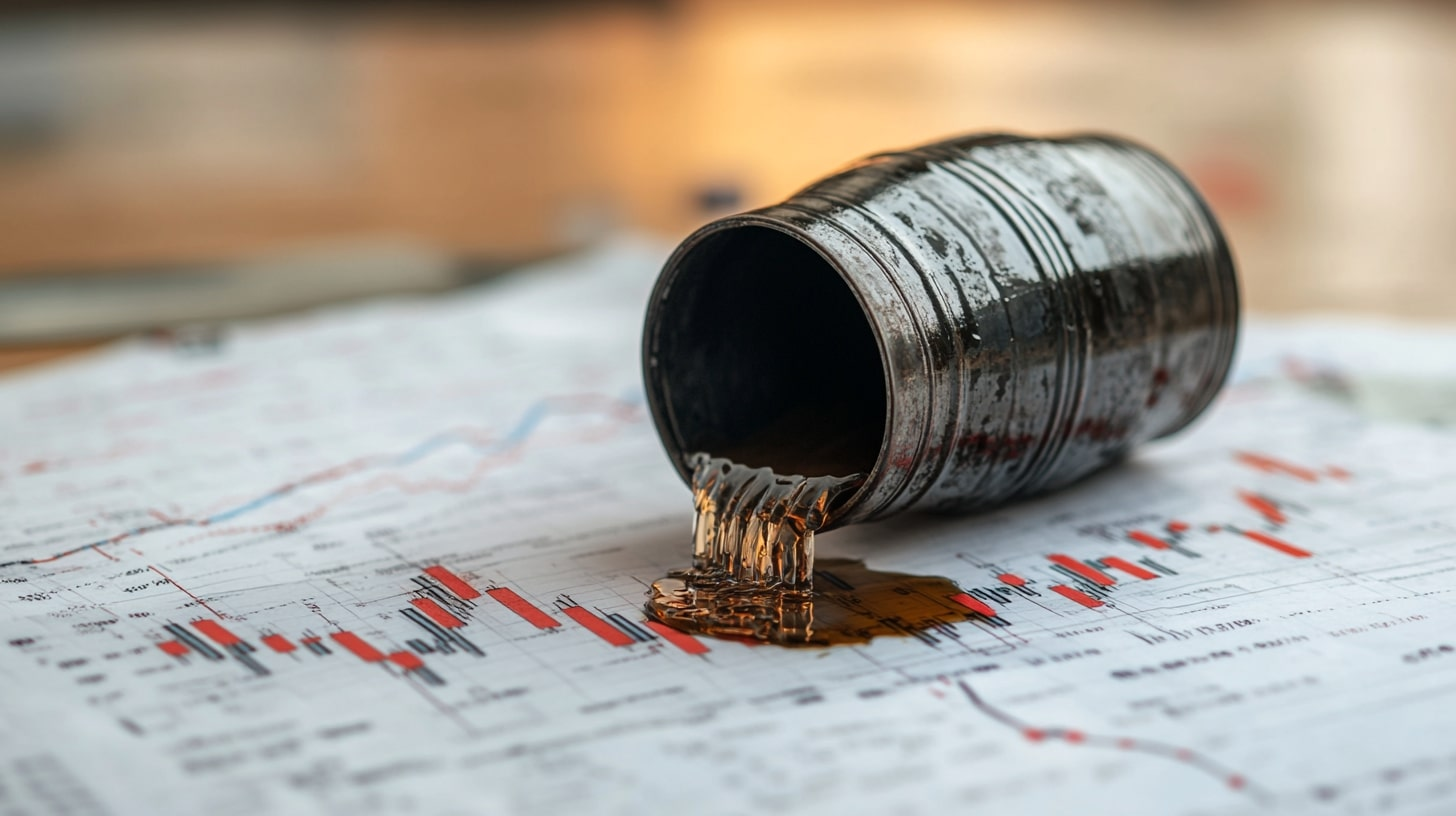
Brent crude futures climbed above $105 per barrel on Friday as renewed tensions surrounding Iran’s nuclear programme and the Strait of Hormuz unsettled global energy markets, despite continuing diplomatic efforts toward a possible agreement. Market sentiment shifted after reports indicated that Iran’s Supreme Leader had ordered the country’s enriched uranium stockpile to remain inside Iran, complicating negotiations with the United States, which continues to push for the dismantling or external transfer of Tehran’s nuclear reserves as part of any long-term settlement.
Investors were also rattled by reports that Iran is working with Oman on a framework that could formalize Tehran’s control over maritime traffic through the Strait of Hormuz via a permanent toll system—a proposal that has reportedly faced resistance from US President Donald Trump, who insisted the strategic waterway should remain open and free for international shipping.

The Strait of Hormuz remains one of the world’s most critical energy chokepoints, handling roughly one-fifth of global oil trade. Continued uncertainty surrounding shipping access and regional security has heightened fears of prolonged supply disruptions and renewed inflationary pressures globally.
📢 GET A DETAILED ARTICLES + JOBS
Join ASJ's WhatsApp Channel and never miss a post or opportunity.

Despite Friday’s rebound, Brent crude was still down more than 4% for the week as markets weighed signs that diplomatic channels remain active, with US Secretary of State Marco Rubio noting “encouraging signs” surrounding a possible agreement and Pakistani mediators expected in Tehran to continue discussions.
Key Developments: Nuclear Stockpiles, Hormuz Tolls, and Diplomatic Crosscurrents
The Iran nuclear negotiations have reached a critical inflection point. The reported order by Iran’s Supreme Leader to keep the country’s enriched uranium stockpile inside Iranian territory represents a significant hardening of Tehran’s position. The United States has consistently demanded that Iran dismantle its nuclear programme or transfer its enriched uranium stockpile out of the country—a condition Tehran has rejected. The gap between the two sides remains fundamental.
The Strait of Hormuz toll proposal adds a new layer of complexity. Iran is reportedly working with Oman on a framework that would formalize Tehran’s control over maritime traffic through the waterway via a permanent toll system. Such a framework would effectively legitimize Iran’s ability to restrict or tax shipping through the strait, transforming a de facto disruption into a de jure arrangement. President Trump’s reported rejection—insisting the passage remain open and unrestricted—sets up a potential confrontation. Even the discussion of such a framework increases uncertainty, as it suggests Iran is planning for a long-term restructuring of regional shipping governance rather than a short-term negotiation tactic.
The diplomatic channel remains active, however. US Secretary of State Marco Rubio said there were “encouraging signs” surrounding a possible agreement, though he did not provide details. Pakistani mediators were expected in Tehran to continue discussions over Washington’s latest proposal. Pakistan’s role as an intermediary is notable; the country has historical ties to both the United States and Iran and has previously mediated between Tehran and Riyadh. However, the fundamental obstacles—the nuclear stockpile and the Hormuz framework—remain unresolved.
Oil markets are highly sensitive to headlines surrounding the negotiations. Prices have swung sharply between optimism over a breakthrough and fears of deeper geopolitical escalation. The 4% weekly decline despite Friday’s rebound reflects the market’s assessment that a diplomatic resolution is still possible. But the rebound also reflects the market’s recognition that the risks remain substantial.
The Strait of Hormuz handles approximately 20% of global oil trade—about 17 million to 20 million barrels per day. Any sustained disruption would have catastrophic consequences for global oil supply. The current situation is not a complete closure; shipping continues, but at reduced volumes and with elevated risk premiums. The toll proposal, if implemented, would formalize a reduction in shipping efficiency and an increase in costs.
The Accra Street Journal notes that the oil market’s reaction to the Iran situation has evolved. Initially, prices spiked to 120+asmarketspricedinworst−casescenarios.Thecurrentpriceof105 reflects a middle ground: the crisis has not escalated to war, but it has not been resolved either. The market is pricing in a prolonged period of elevated risk, with occasional spikes and dips based on news flow.
Analysis & Implications: The Supply Disruption Calculus and Inflation Feedback Loop
The global oil market is finely balanced. Before the Iran crisis, the market was already tight, with OPEC+ production cuts and strong demand (particularly from Asia) keeping inventories below historical averages. The loss of Iranian exports (approximately 1.5 million to 2 million barrels per day) and the disruption of Hormuz shipping (additional losses) have created a significant supply deficit.
The supply deficit is being covered by strategic reserves and increased production from other producers (Saudi Arabia, UAE, United States). But strategic reserves are finite; the US Strategic Petroleum Reserve is at its lowest level since 1985. Saudi Arabia has spare capacity but is reluctant to use it aggressively, both because it wants to maintain high prices and because it does not want to antagonize Iran.
The market is in a fragile state, easily shaken by any new disruption. A military strike on Iranian facilities, a tanker attack, or a complete closure of the Strait could push prices to $150 or higher. On the other hand, a diplomatic breakthrough could bring prices down to below $90. The current price of $105 represents a probability-weighted average of these possible outcomes.
The inflation feedback loop is the second-order effect. Higher oil prices feed into headline inflation directly (through gasoline, diesel, heating oil, jet fuel) and indirectly (through transport costs, which feed into food prices and other goods). Central banks are watching closely. The Federal Reserve, the European Central Bank, and other major central banks had been planning to cut rates in late 2026 or 2027. The oil price shock has pushed those plans into question.
If oil prices remain above $100 for an extended period, inflation will remain elevated, and central banks will be forced to keep rates high. High rates slow economic growth, reducing oil demand, which eventually brings prices down. That is the classic supply shock adjustment mechanism—painful but effective. The question is how long the adjustment takes.
For import-dependent countries like Ghana, the impact is straightforward. Ghana brings in about 90% of its refined petroleum products. Every $10 increase in Brent crude adds roughly GHS 0.08 to 0.10 per litre to petrol prices. The current Brent price of $105 is around $30 above the pre-crisis baseline of $75, adding about GHS 0.24 to 0.30 per litre to fuel costs. While the government’s GHS 1.07 per litre subsidy on diesel helps reduce the impact, it doesn’t completely offset it.
The Accra Street Journal’s assessment: the oil market is in a state of heightened alert. The diplomatic channel is active, but the fundamental obstacles are significant. The most likely outcome is a prolonged period of elevated prices (100to120) with occasional spikes and dips. A full resolution—either a breakthrough agreement or a catastrophic escalation—is less likely in the near term. Markets should prepare for sustained volatility.
What This Means for Ghanaian Consumers, Businesses, and Fiscal Policy
For Ghanaian consumers, the sustained high oil prices translate into higher fuel costs. The government’s diesel subsidy of GHS1.07 per litre reduces the impact but does not eliminate it. Petrol is no longer subsidized, so consumers feel the full impact of global price increases. Transport fares are likely to rise; the Ghana Private Road Transport Union (GPRTU) has already signaled its intention to seek an increase. Higher transport fares feed into higher food prices and general inflation.
For businesses, higher energy costs squeeze margins. Manufacturing firms that rely on generators (due to grid unreliability) face higher operating costs. Logistics firms face higher fuel costs. Businesses that can pass on costs to customers will do so; those that cannot will see profits decline. The cumulative effect is a drag on economic activity.
For fiscal policy, the subsidy is a drain on the budget. The government’s diesel subsidy of GHS1.07 per litre costs approximately GHS50 million to GHS70 million per month, depending on consumption. The government has budgeted for this expenditure, but extended high oil prices would increase the cost. The government faces a trade-off: continue the subsidy and protect consumers, or allow prices to rise and use the savings for other priorities.
The Bank of Ghana faces pressure on two fronts. First, higher oil import bills increase demand for US dollars, putting downward pressure on the cedi. The central bank can intervene using its reserves (which stood at $14.4 billion in April), but intervention depletes reserves. Second, higher oil prices feed into inflation, which may force the central bank to keep interest rates high. High rates slow economic growth but are necessary to anchor inflation expectations.
The government’s medium-term strategy is to reduce dependence on imported oil through domestic gas production (Sankofa expansion) and renewable energy. The Sankofa expansion to 350 MMcfd by 2028 will reduce the need for imported diesel for power generation. Solar and wind projects are also being developed. But these solutions are years away. In the short term, Ghana remains vulnerable to global oil price shocks.
The Accra Street Journal’s advice to consumers: prepare for higher fuel prices and transport fares. To businesses: review your energy costs and consider efficiency measures. To policymakers: the subsidy is necessary but expensive; use the time to accelerate the transition to domestic energy sources.
Wider Context: The Global Oil Market’s New Reality
The Iran crisis is the latest in a series of shocks to the global oil market. The COVID-19 demand collapse (2020), the Russian invasion of Ukraine (2022), OPEC+ production cuts (2023-2024), and now the Hormuz crisis (2026) have created an environment of sustained volatility. The era of stable, predictable oil prices (2015-2019, when Brent traded in a 50to70 range) is over.
The structural factors driving volatility include: underinvestment in oil production (the energy transition has reduced investment, even as demand remains strong), geopolitical fragmentation (the world is no longer unipolar), and the decline of strategic reserves (which have been drawn down and not replenished). These factors will persist regardless of the outcome of the Iran negotiations.
For import-dependent countries, the lesson is clear: energy security requires domestic production or diversified supply. Ghana’s Sankofa gas expansion is a step in the right direction, but it is not enough. The country should also invest in renewable energy (solar, wind, hydro) and energy efficiency. Every megawatt of renewable energy is a megawatt that does not require imported fuel.
For oil-exporting African countries (Nigeria, Angola, Algeria, Libya), the high prices are a windfall. But these countries also face challenges: production decline (Nigeria, Angola), political instability (Libya), and the need to invest in refining capacity to capture more value. The current high prices are an opportunity to invest in the future; they should not be squandered on consumption.
The global energy transition adds another layer of complexity. The long-term trend is toward lower oil demand as electric vehicles, renewable energy, and energy efficiency reduce consumption. But the transition will take decades, and in the meantime, the oil market will remain volatile. Producers and consumers must navigate this volatility while planning for a lower-carbon future.
The Accra Street Journal’s conclusion: the oil market is in a new regime of sustained volatility. The Iran crisis is a symptom, not a cause. Ghana’s vulnerability to oil price shocks is a structural weakness that requires structural solutions. The Sankofa expansion is one such solution; renewable energy, energy efficiency, and regional integration (the West African Gas Pipeline) are others. The government should accelerate these investments. The next shock is always just around the corner.
Outlook / What Happens Next
The immediate trajectory of oil prices will be determined by diplomatic news. A breakthrough—even a partial one—would likely send Brent below 100.Abreakdown—oranescalation—wouldsenditabove120. The market is rangebound between these extremes, waiting for clarity.
The Federal Reserve’s June meeting will be important. If the Fed signals that it will look through the oil price shock (treating it as temporary), that would be supportive of risk assets and potentially negative for oil (as a stronger dollar would reduce prices). If the Fed signals that it will respond to the shock with tighter policy, that would be negative for risk assets and ambiguous for oil (tighter policy slows growth, reducing demand, but also strengthens the dollar).
For Ghana, the next National Petroleum Authority (NPA) pricing window will reflect the current Brent price of $105. Petrol prices are projected to reach GHS15.42 per litre, diesel GHS17.83 per litre. The government’s diesel subsidy will reduce the increase but not eliminate it. Consumers should prepare for higher prices.
The Accra Street Journal’s final word: the oil price is a reminder of Ghana’s vulnerability. The country has made progress on macroeconomic stability, but energy security remains a weak link. The Sankofa expansion is a step in the right direction, but it is not enough. The government should treat the current crisis as a wake-up call and accelerate investments in domestic energy production. The next crisis is coming; Ghana must be ready.
Source: Accra Street Journal
Last Updated on May 22, 2026 by Samuel Kwame Boadu
Disclaimer: Some content on Accra Street Journal may be aggregated, summarized, or edited from third-party sources for informational purposes. Images and media are used under fair use or royalty-free licenses. Accra Street Journal is a subsidiary of SamBoad Publishing Hub under SamBoad Business Group Ltd, registered in Ghana since 2014.
For concerns or inquiries, please visit our Privacy Policy or Contact Page.

Samuel Kwame Boadu is a Ghanaian media entrepreneur and storyteller with a passion for amplifying urban voices and uncovering everyday truths. He is the Editor-in-Chief and Founder of Accra Street Journal, a dynamic digital platform dedicated to capturing the pulse of Ghana’s capital—its people, culture, challenges, business, sports and innovations.