






18 min read
From $29.5 trillion in mineral wealth to the just transition — how global capital is reshaping the continent’s most strategic asset class
Executive Summary
Africa’s mining industry has entered a new era. The old model — short-term commodity extraction, export of raw minerals, and vulnerability to price cycles — is being replaced by a different framework: long-term, sustainability-aligned capital; domestic value addition as a policy condition; and regional integration as a competitive necessity.
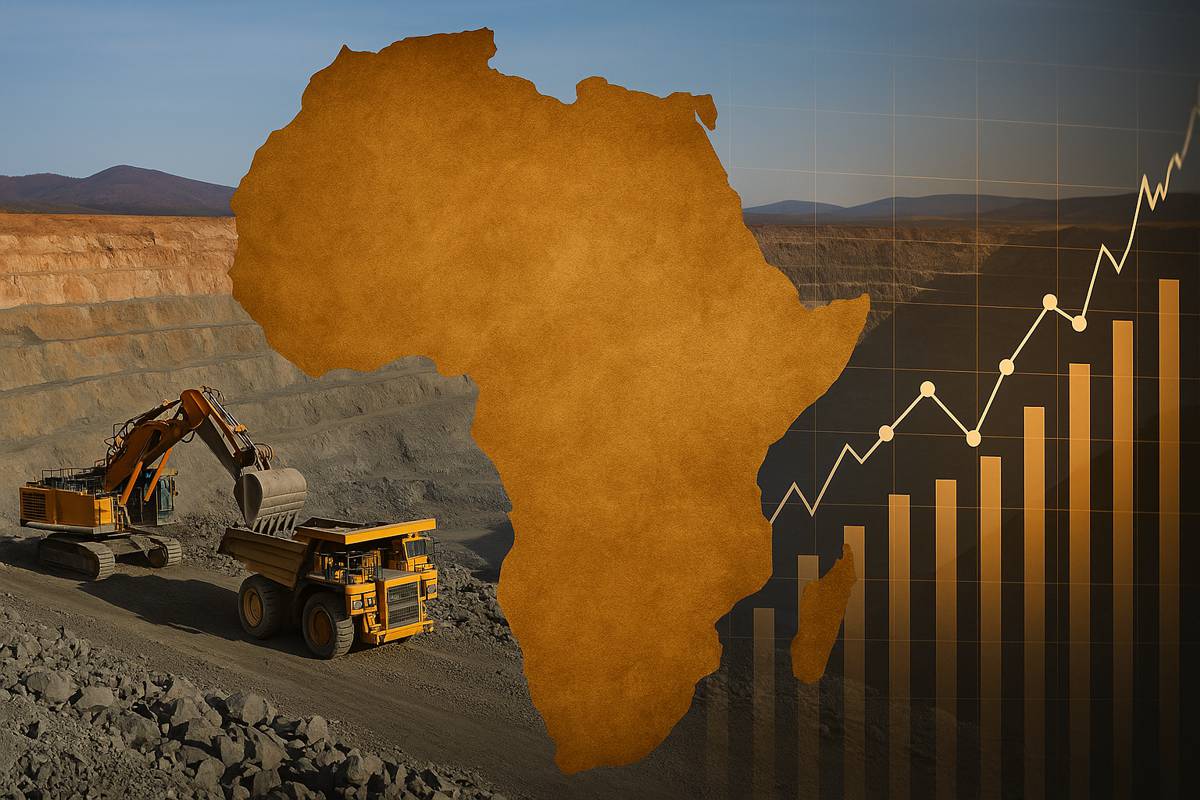
The numbers that define this shift are striking. The continent is estimated to hold around $29.5 trillion in mineral wealth, with about $208.6 trillion still untapped. Global demand for critical minerals like cobalt, lithium, graphite, and rare earths is expected to quadruple by 2040, driven by the energy transition and the shift to electric transport. Gold prices have hit record highs above $4,600 per ounce, reshaping sovereign balance sheets from Ghana to South Africa. Mining investment frameworks are now planning on 10- to 15-year timelines, making environmental, social, and governance (ESG) factors central financial metrics rather than just compliance requirements.
Key Takeaways
- Mining investment frameworks are now planning on 10- to 15-year timelines, making environmental, social, and governance (ESG) factors central financial metrics rather than just compliance requirements.
- At Mining Indaba 2026, the continent’s premier mining investment platform, a clear consensus emerged: capital is shifting toward operators that demonstrate long-term environmental stewardship, strong governance frameworks, and community-aligned value creation .
- The quantitative shift: Modern mining investment assessments now incorporate extended time horizons of 10 to 15 years, reflecting the complexity of sustainable mining development and the long lead times required for critical mineral projects .
This shift has profound implications for long-term investors. Capital flows are no longer determined solely by geological endowment. They are shaped by regulatory certainty, infrastructure readiness, community integration, and demonstrable ESG performance. Projects that align with these criteria are accessing preferential financing, expedited permitting, and premium market access. Those that do not are being priced out of institutional capital markets.
This report examines the forces reshaping African mining investment: the critical minerals supercycle, the integration of ESG into investment decisions, the shift from raw exports to local beneficiation, the infrastructure and energy revolution, and the geopolitical dimension of supply chain security. It identifies key projects and trends for investors and provides a framework for evaluating long-term mining investments in Africa’s transformed landscape.
Part 1: The New Investment Framework — Beyond Commodity Cycles
The most significant change in African mining investment is not the price of any single commodity — it is the time horizon and evaluation criteria that global capital now applies to the sector.
From Short-Term Exposure to Long-Term Partnership
At Mining Indaba 2026, the continent’s premier mining investment platform, a clear consensus emerged: capital is shifting toward operators that demonstrate long-term environmental stewardship, strong governance frameworks, and community-aligned value creation . Multilateral development banks deployed their largest mining teams to date, reflecting Africa’s growing importance in global critical mineral supply chains .
The quantitative shift: Modern mining investment assessments now incorporate extended time horizons of 10 to 15 years, reflecting the complexity of sustainable mining development and the long lead times required for critical mineral projects . This contrasts sharply with the previous focus on 3- to 5-year commodity cycles.
The ESG Integration That Reshapes Financial Models
Financial institutions are applying multi-dimensional risk frameworks that integrate environmental, social, and governance performance alongside traditional financial metrics. Typical weighting structures used by leading mining finance groups now allocate:
| Criteria | Weighting |
|---|---|
| Traditional financial metrics | 40% |
| Environmental indicators | 25% |
| Social impact | 20% |
| Governance quality | 15% |
Source: Mining Indaba 2026 investment framework analysis

This integration has increased upfront capital requirements by an estimated 10–15%, as projects must now demonstrate comprehensive environmental and social planning before financial close . However, the long-term benefits include reduced regulatory risk, operational efficiencies, and improved financing access — creating a clear return on ESG investment for developers who get it right.
The IFC Framework: Profitability and Sustainability as Complementary
Namrata Thapar, Global Head of Metals & Mining at the International Finance Corporation (IFC), articulated the institutional investor perspective at Mining Indaba 2026: “Profitability and strong environmental, social and governance practices go hand in hand” .

This is not rhetorical positioning. For development finance institutions and a growing segment of institutional capital, mining investments are evaluated not only on financial returns but also on their broader economic and social impact. Large-scale mining projects can serve as catalysts for development by generating government revenues, employment, export earnings, and infrastructure — a multiplier effect that creates value beyond the mine gate .
Thapar emphasised that proactive mitigation of ESG risks creates long-term shareholder value, noting that poor ESG performance can create operational disruptions through community conflict, environmental disputes, or regulatory interventions . Addressing these risks early protects project economics and operational continuity — a clear financial case for sustainability investment.
Part 2: The Critical Minerals Supercycle — Structural Demand, Not Cyclical Price
The most powerful driver of long-term mining investment in Africa is the global energy transition. The International Energy Agency (IEA) projects that demand for critical minerals — including lithium, cobalt, nickel, graphite, copper, and rare earths — will quadruple by 2040 .
Africa’s Strategic Endowment
Africa’s geological wealth places it at the centre of this transformation. The continent hosts the world’s largest reserves of:
-
Platinum Group Metals (South Africa) — essential for catalytic converters and hydrogen electrolysis
-
Cobalt (DRC) — critical for EV batteries
-
Manganese (South Africa, Gabon) — key for battery chemistry and steel production
-
Chromium (South Africa, Zimbabwe) — essential for stainless steel and alloys
-
Graphite (Mozambique, Madagascar, Tanzania) — critical for battery anodes
Source: IEA Global Critical Minerals Outlook 2025
According to the Africa Finance Corporation’s Compendium of Africa’s Strategic Minerals 2026, the continent boasts an estimated $29.5 trillion in mineral wealth, with $8.6 trillion still untapped. In the DRC alone, only about 10% of its estimated $24 trillion in mineral reserves has been exploited, leaving massive potential for future discovery and development.
The Geopolitical Dimension: Supply Chain Security
Global competition for African battery metals and rare earths intensified markedly in 2025–2026. At Mining Indaba 2026, the United States sent its largest technical delegation on record, while Chinese firms showcased autonomous mining systems and low-carbon technologies .
A December 2025 agreement between the US and the DRC on mineral extraction, value addition, and trade signalled that Africa’s strategic minerals are now a priority for the world’s largest economies . The EU is actively developing critical raw materials partnerships with African countries to reduce dependence on single-source suppliers.
For investors: This geopolitical dimension creates both opportunity and risk. African mineral projects now benefit from strategic support from multiple global powers, potentially accelerating permitting and infrastructure development. However, investors must also navigate competing regulatory regimes and the risk that bilateral agreements could create fragmented rather than integrated markets.
Key Critical Mineral Projects to Watch (2026)
| Country | Project | Investment | Strategic Significance |
|---|---|---|---|
| Zambia | KoBold Metals’ Mingomba Mine (copper) | $300M | AI-discovered deposit; expected to create 700+ jobs |
| Zambia | First Quantum’s Kansanshi S3 Expansion | $1.25B | Completing 1M+ tons copper output in 2026 |
| Zambia | Cobalt sulfate refinery | — | Africa’s first; commissioning in 2026 |
| Nigeria | Alumina refinery (1M tons/year) | $1.3B | $1.2B annual GDP impact; 20-year operation |
| Nigeria | Lithium processing plant (Nasarawa) | $600M | Commissioning stage; local processing required |
| DRC | Various copper-cobalt expansions | — | Ongoing; supporting 100,000+ jobs |
| Senegal | Falémé iron project | — | 15-25M tons/year peak; port/rail already in place |
Sources: Africa Finance Corporation, Energy Capital&Power, company announcements

The Lobito Corridor — backed by a $553 million US Development Finance Corporation loan for Angola’s Benguela rail link — reduces export costs across the Copperbelt and improves project bankability for both mines and processing facilities . This infrastructure investment demonstrates how coordinated support can transform regional logistics.
Part 3: ESG as Investment Discipline — From Compliance to Competitive Advantage
The integration of ESG criteria into mining investment is no longer a niche consideration. It has become central to capital allocation decisions, market access, and long-term valuation.
The ESG Weighting in Investment Decisions
As documented at Mining Indaba 2026, financial institutions now apply structured ESG frameworks that allocate significant weighting to non-financial metrics alongside traditional financial analysis . Operators demonstrating comprehensive ESG performance are accessing preferential financing terms, expedited permitting processes, and broader institutional capital pools .
Why this matters for African mining: The 10–15% increase in upfront capital requirements for ESG-compliant projects is a barrier for junior miners and smaller operators . However, it also creates a competitive advantage for well-capitalised, well-governed operators who can demonstrate comprehensive environmental and social planning. These projects are more likely to secure financing, avoid regulatory delays, and maintain social licence to operate.
Responsible Sourcing as Market Access
The downstream push for responsible sourcing is reshaping offtake agreements across African mining. The automotive sector, in particular, is exerting significant leverage on supply chains.
According to the Initiative for Responsible Mining Assurance (IRMA), 44% of the global PGM market is now represented within the IRMA system, signalling strong momentum toward supply chain transparency as OEMs push for greater ESG compliance . As due diligence regulations tighten in the European Union and elsewhere, responsible sourcing is becoming a competitive requirement rather than a reputational add-on .
For African producers: ESG is not a side conversation. It is directly linked to market access and long-term partnerships. Producers who can demonstrate verified responsible sourcing credentials will have preferential access to premium markets and long-term offtake agreements.
The Just Transition Imperative
Dorah Modise, Executive Director of South Africa’s Presidential Climate Commission, framed the challenge facing African mining at a high level: “Mining has moved from the periphery of climate debates to the core, supplying the minerals required for electrification, energy storage and green hydrogen while remaining a significant source of environmental and social risk” .
The “just transition” framework — ensuring that decarbonisation does not come at the cost of jobs, communities, and economic stability — is particularly relevant for African mining. South Africa’s mining sector directly employs approximately 475,000 people and supports hundreds of thousands of additional livelihoods through upstream and downstream value chains . Mining also plays a critical fiscal role, contributing to tax revenues and foreign exchange earnings that underpin macroeconomic stability.
The investment implication: Projects that demonstrate credible transition plans for coal regions, transparent management of closure liabilities, and alignment between climate policy and industrial development will attract capital. Projects that fail to address these dimensions will face increasing scrutiny and financing constraints.
Part 4: Local Beneficiation — From Raw Exports to Value Chains
The most significant policy shift across African mining jurisdictions is the move toward domestic value addition. Governments are increasingly requiring that minerals be processed — at least partially — within the country of origin before export.
The Policy Framework
Several African governments, including Nigeria and the DRC, have announced plans for domestic processing hubs targeting 40% local value-addition by 2030 . New mining licenses in Nigeria now require a local processing commitment covering at least 30% of output before export . South Africa has outlined plans to mobilise R2 trillion over five years to strengthen its critical minerals value chain, spanning exploration, project development, manufacturing, and skills training .
These policies are not protectionist. They are designed to capture more of the value from Africa’s mineral resources, creating jobs, building industrial capacity, and diversifying economies away from raw commodity exports.
The Economic Case for Beneficiation
The arithmetic is persuasive. South Africa exports most of its manganese and vanadium to China for processing into battery materials. If South Africa invested in domestic value addition, up to 60,000 new jobs could be created in the battery sector by 2030 .
Nigeria’s 1.3 billion alumina refinery is projected to add 951.2 billion to the GDP annually and generate about $8 billion in foreign exchange earnings over its lifespan. This single project is set to transform the country’s mining sector from exporting raw bauxite to producing processed alumina..
The Financing Constraint for Beneficiation
The biggest barrier to local beneficiation is not technology or policy — it is the cost and availability of capital. Processing facilities require significant upfront investment and are often perceived as higher risk than mining operations alone. The 10–15 year time horizons now applied to mining projects align better with processing economics, but financing for beneficiation remains less developed than for extraction.
The Africa Finance Corporation’s role: With $700 million in mining investments to date generating over 15,000 jobs, and up to 70% of funding directed toward critical minerals, the AFC is demonstrating that African-led capital can drive beneficiation . Its involvement in Nigeria’s alumina refinery and lithium processing projects provides a model for future partnerships .
Part 5: Infrastructure and Energy — The Enabling Environment
Even the most attractive mineral deposit cannot be developed without reliable infrastructure and energy. This has long been a binding constraint for African mining. It is now also an investment opportunity.
The Energy Transition Within Mining
African mining projects are increasingly adopting AI-enabled grade control, autonomous haulage, and predictive maintenance systems . Renewable energy installations — particularly solar and wind — are improving long-term cost structures and reducing carbon intensity. Many operations report potential 30–50% energy cost reductions from renewable integration, alongside significantly lower emissions profiles .
Water recycling systems achieving 60–80% usage reduction, and closed-loop processing circuits, are becoming standard in new project designs . These investments reduce operational risk, improve ESG performance, and lower long-term costs — a clear financial case for sustainability investment.
The Logistics Revolution
The Lobito Corridor rail project, supported by US development finance, demonstrates how coordinated infrastructure investment can transform regional mining economics . By reducing export costs across the Copperbelt, the corridor improves project bankability for both mines and processing facilities seeking long-term offtake commitments.
Senegal’s Falémé iron project benefits from existing port and rail infrastructure already in place, carrying lower logistics risk than comparable iron ore projects requiring greenfield corridor construction . This affects how financiers assess project bankability and timelines to first revenue.
The Remaining Gaps
Despite progress, infrastructure remains a binding constraint across many mining regions. Energy reliability, port capacity, and rail connectivity continue to limit production and increase costs. The Minerals Council South Africa noted that performance has softened in recent years, constrained by logistics bottlenecks, rising operating costs, and weak global growth in some sectors .
For investors: The infrastructure gap is both a risk and an opportunity. Projects that are located near existing infrastructure, or that can anchor new infrastructure development, have lower risk profiles. Conversely, projects that require significant greenfield infrastructure face higher costs and longer timelines — but may also offer higher returns if they become regional hubs.
Part 6: The Capital Gap and the Domestic Solution
Despite the opportunities, access to capital remains a constraint — particularly for local operators and small-scale miners seeking to scale projects. Limited financing slows development timelines and restricts employment expansion .
The Scale of the Shortfall
While global capital is increasingly available for large-scale, ESG-compliant projects, there remains a significant funding gap for:
-
Early-stage exploration and project development
-
Smaller-scale operations that do not meet institutional minimums
-
Local operators without established track records
-
Beneficiation projects with higher perceived risk profiles
Domestic Capital as the Solution
The Minerals Income Investment Fund (MIIF) CEO stressed at Mining Indaba 2026 the need for stronger collaboration, smarter regulation, and catalytic African capital to unlock the next wave of projects — moving beyond just attracting foreign capital to leveraging domestic investment vehicles .
This is not merely about substituting foreign capital with local funding. It is about creating a more stable, long-term capital base that is less sensitive to global risk sentiment and currency fluctuations. African pension funds, sovereign wealth funds, and development finance institutions hold significant capital that could be deployed into mining projects — particularly those with strong local development impact.
The AFC Model
The Africa Finance Corporation’s approach offers a model. To date, AFC’s $700 million in mining investments has generated over 15,000 jobs, with up to 70% of funding directed toward critical minerals . By taking a developer’s perspective rather than a pure financier’s role, AFC can structure projects to be bankable for commercial lenders.
The challenge is scale. Africa’s annual infrastructure financing gap remains substantial, and mining projects must compete with other sectors for limited domestic capital. Addressing this will require coordinated efforts between governments, development finance institutions, and private capital.
Part 7: The Risks — Illicit Financial Flows, Policy Uncertainty, and Social Licence
For all the opportunity, African mining remains exposed to significant risks that investors must price into their decisions.
Illicit Financial Flows
A Greenpeace Africa report warns that Africa is losing billions of dollars every year through illicit financial flows from its mineral sector, undermining the continent’s potential to benefit from the global clean energy transition . Since 1980, about $1.3 trillion has left sub-Saharan Africa through IFFs — 60% of it from the resources sector.
The scale of losses: South Africa loses over 10 billion, while Nigeria loses more than 17 billion every year due to corporate tax evasion and profit shifting in the extractives industry. These outflows represent capital that could have been used for domestic beneficiation, infrastructure, and social programs..
The investment implication: Investors must conduct thorough due diligence on ownership structures, tax arrangements, and compliance histories. Projects that cannot demonstrate transparent governance and tax compliance carry significant legal and reputational risk.
Policy Uncertainty and Resource Nationalism
Industry bodies warned at Mining Indaba 2026 that policy uncertainty, particularly around mining law reforms in South Africa, could weigh on investment decisions and tenure security . While several African countries have introduced local content legislation, enforcement remains weak, and critics argue that some requirements are unrealistic given local capacity constraints .
The balance between capturing value for host countries and maintaining an attractive investment climate is delicate. Governments that change rules retroactively, impose excessive taxes, or fail to enforce contracts will struggle to attract long-term capital — no matter how rich their mineral endowment.
The Social Licence Risk
Community-centred development models and benefit-sharing agreements are increasingly embedded into financing structures, improving social licence stability and reducing project risk . However, in mining regions from the DRC to Zambia to Zimbabwe, communities continue to face unsafe labour conditions, polluted environments, and unequal benefits from extraction .
For investors: Social licence is not a compliance checkbox. It requires ongoing engagement, transparent benefit sharing, and genuine partnership with local communities. Projects that fail on this dimension face operational disruptions, legal challenges, and reputational damage that can destroy shareholder value.
Part 8: The Path Forward — From Dialogue to Action
The real work of African mining investment begins after the conferences end. As one industry observer noted: “Africa holds extraordinary mineral potential at a time when global demand for critical resources is intensifying. The opportunity is a once-in-a-lifetime, but so is the responsibility” .
The Regional Integration Imperative
Dr. Marit Kitaw, Economic Affairs Officer at the United Nations, argued that the real inflection point for African mining lies in continental alignment: “Investors aren’t only chasing minerals; they’re chasing markets, corridors, scale, and stability. A single country cannot secure bargaining power alone. Africa must act as a unified economic bloc” .
The next decade of mining-led growth hinges on:
-
Political alignment across jurisdictions
-
Cross-border collaboration on infrastructure
-
Industrial connectivity and value chains
-
A decisive shift from dialogue to action
Key Priorities for Investors
For long-term investors evaluating African mining opportunities, the framework is clear:
| Priority | Questions to Ask |
|---|---|
| ESG integration | Does the project demonstrate comprehensive environmental and social planning? Is ESG embedded in financial models, not an add-on? |
| Local value addition | Does the project include processing or beneficiation? Are there credible local supply chains? |
| Infrastructure readiness | Is transport and energy infrastructure in place or credibly planned? What is the timeline to first revenue? |
| Governance and policy | Is the regulatory framework stable and transparent? Does the government have a track record of enforcing contracts? |
| Regional integration | Does the project benefit from cross-border corridors or harmonised policies? Is it aligned with regional industrial strategies? |
| Capital structure | Is financing sustainable and appropriately risk-adjusted? Does it include domestic capital partners? |
Conclusion: The Long Game
African mining has entered a new era defined by longer time horizons, deeper integration of ESG criteria, and a strategic shift from raw exports to local beneficiation. The critical minerals supercycle — driven by the global energy transition — has structurally shifted demand for Africa’s geological endowment.
For long-term investors, the opportunity is significant but selective. Capital will flow to projects that demonstrate regulatory certainty, infrastructure readiness, community integration, and comprehensive ESG performance. Operators that meet these criteria will access preferential financing, expedited permitting, and premium market access. Those that do not will be priced out of institutional capital markets.
The continent holds $29.5 trillion in mineral wealth . The question is not whether that wealth will be extracted — but how, by whom, and for whose benefit. The investors who understand this distinction, and who back projects aligned with the new framework, will generate returns measured not in quarters but in decades.
As the Presidential Climate Commission’s Dorah Modise concluded: “The task ahead is to convert climate responsibility into economic opportunity, and geological wealth into inclusive growth” . For African mining, that is the only investment thesis that matters.
Quick Reference: Africa’s Mining Investment Landscape (2026)
| Dimension | Current Status | Investment Implication |
|---|---|---|
| Mineral wealth | 29.5trilliontotal;8.6 trillion untapped | Vast potential for exploration and development |
| Critical minerals demand | Projected to quadruple by 2040 | Structural demand shift, not cyclical |
| ESG integration | 40/25/20/15 weighting framework | Compliance is now competitive advantage |
| Local beneficiation | 40% value-add targets by 2030 | Processing capacity as investment opportunity |
| Infrastructure | Lobito Corridor; renewable energy adoption | Logistics and energy as risk/opportunity |
| Capital availability | Selective; ESG-compliant projects preferred | Strong governance attracts preferential terms |
| Geopolitical competition | US/China/EU strategic interest | Supply chain security as investment driver |
| Employment impact | 475k (SA); 100k+ (DRC); 73k (Zambia) | Job creation as development metric |
Source: Accra Street Journal
Last Updated on May 23, 2026 by Samuel Kwame Boadu
Disclaimer: Some content on Accra Street Journal may be aggregated, summarized, or edited from third-party sources for informational purposes. Images and media are used under fair use or royalty-free licenses. Accra Street Journal is a subsidiary of SamBoad Publishing Hub under SamBoad Business Group Ltd, registered in Ghana since 2014.
For concerns or inquiries, please visit our Privacy Policy or Contact Page.

Samuel Kwame Boadu is a Ghanaian media entrepreneur and storyteller with a passion for amplifying urban voices and uncovering everyday truths. He is the Editor-in-Chief and Founder of Accra Street Journal, a dynamic digital platform dedicated to capturing the pulse of Ghana’s capital—its people, culture, challenges, business, sports and innovations.
Use the following reference when citing or referencing this article.
Your feedback helps us improve our journalism.
Report an Error
Help us maintain accuracy. Let our editorial team know if you spot an issue in this article.
Report a problem with this article