








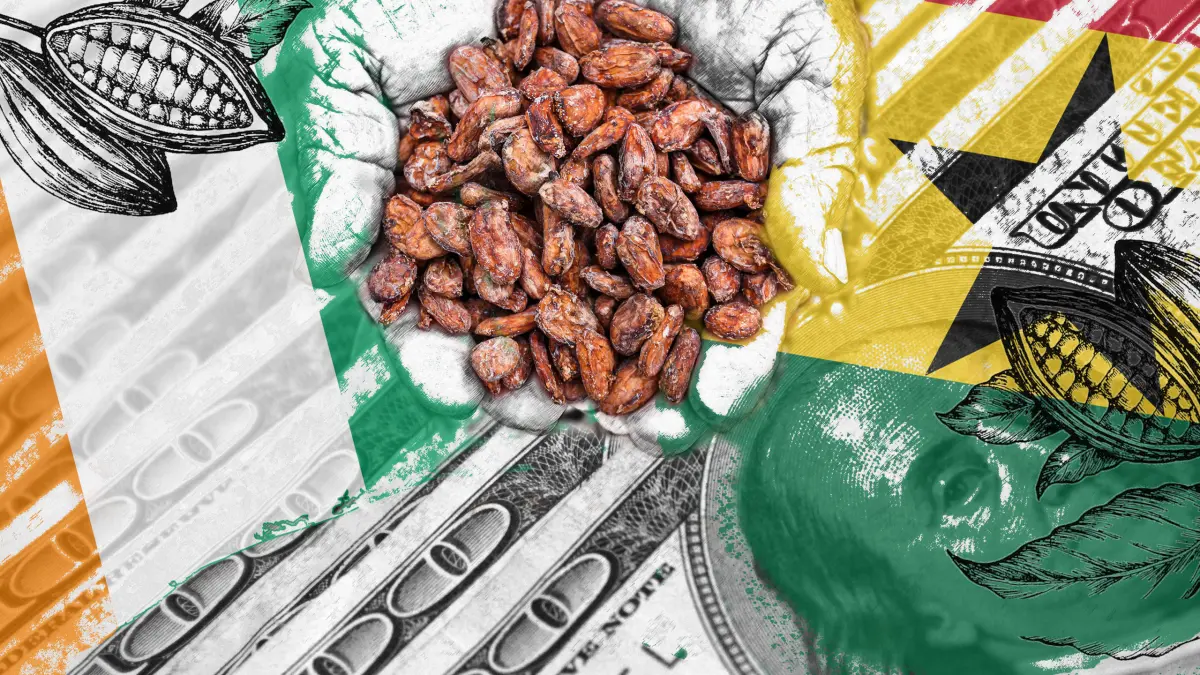
From 12,906 to 3,100 — the crash that reshaped a region’s financial landscape
Executive Introduction
The cocoa farmer in Côte d’Ivoire who watched his farmgate price fall from CFA 2,800 to CFA 1,200 per kilogram on 1 March 2026 experienced more than a personal loss of income. He witnessed the collapse of a pricing model that had defined West African agriculture for a decade. The global cocoa market, which only a year earlier was reeling from record-high prices of $12,906 per ton and severe shortages, had taken a dramatic and painful turn.

For investors, this price collapse is not merely a commodity story. It is a window into the structural forces that shape West Africa’s investment climate: The sovereign debt pressures that pushed Ghana to seek $1 billion in domestic cocoa funding [citation:1], along with the divergent policy paths that turned Ghana and Côte d’Ivoire from allies into competitors, highlight the challenges in a $130 billion global chocolate market from which Africa captures less than 10% of the value. Now, a 76% price correction has suddenly opened a narrow window of opportunity for local processing..
📢 GET A DETAILED ARTICLES + JOBS
Join ASJ's WhatsApp Channel and never miss a post or opportunity.

Cocoa remains central to West Africa’s investment climate not because the crop itself is irreplaceable—major chocolate makers are aggressively developing cocoa-free alternatives—but because the institutions built around it, the financing mechanisms that sustain it, and the reform agendas it drives continue to shape how capital flows through the region. This report examines the forces—financial, policy-driven, and structural—that keep cocoa at the centre of West Africa’s investment story.
Part 1: The Financial Architecture — Cocoa as a Sovereign Credit Story
For decades, cocoa has functioned as more than an export crop. It has been a mechanism for sovereign creditworthiness, a source of foreign exchange reserves, and a test case for domestic capital market development. The events of 2026 have thrown this architecture into sharp relief.
Ghana’s Domestic Bond Pivot
Perhaps the most significant development in West African cocoa finance in 2026 is Ghana’s decision to raise approximately $1 billion through domestic, local-currency bonds to finance cocoa purchases for the 2026/27 season. This marks a fundamental shift in how the world’s second-largest cocoa producer finances its most important export industry.
For decades, Ghana relied on foreign syndicated loans backed by international commodity traders. The Cocoa Marketing Company (CMC) and COCOBOD would secure dollar-denominated pre-export financing, using future cocoa shipments as collateral. But the 2024–2025 price rollercoaster—from 12,906pertontobelow3,100—exposed the vulnerabilities of this model.
Randy Abbey, CEO of COCOBOD, explained the logic at the Africa Cocoa Investment Forum in London: “We believe that the interest rates in Ghana now are at the right place for us to go into the market”. With the Bank of Ghana having cut the policy rate to 14% after several consecutive cuts since 2025, domestic borrowing has become more attractive.
What this means for investors: A successful domestic bond sale would demonstrate that Ghana’s capital markets can absorb large-scale sovereign issuance, potentially opening the door for corporate bonds, infrastructure financing, and deeper secondary market trading. However, failure would signal continued reliance on volatile foreign financing and expose the limits of domestic capital market depth.
The Producer Buying Company (PBC) Crisis
At the centre of Ghana’s cocoa liquidity crisis is the state-linked Producer Buying Company (PBC), the legally mandated buyer of last resort for cocoa farmers. The company has accumulated debts of approximately 673 million cedis ($60 million) and reportedly owed farmers around 24 million cedis for over 9,000 bags of cocoa already supplied.
This is not an isolated accounting problem. It is a systemic risk to the entire cocoa value chain. If PBC cannot purchase beans from farmers, production falls; if production falls, export earnings decline; if export earnings decline, sovereign creditworthiness deteriorates. The bond issuance is designed to recapitalise PBC and stabilise the farmgate purchasing system.
The Smuggler’s Paradise
The most immediate consequence of the divergent pricing policies between Ghana and Côte d’Ivoire has been the creation of a “smuggler’s paradise” across their shared border. When Ghana cut its farmgate price by approximately 29% and Côte d’Ivoire maintained its price at CFA 2,800 per kilogram, the resulting price gap approached $60 per bag.
Ghanaian beans began flowing illegally across the border to be rebranded as Ivorian and sold at the higher price. The scale of this diversion has distorted export data, undermined Ghana’s ability to service its cocoa-backed loans, and created a structural tension that neither government can ignore.
For investors: Cross-border smuggling is not merely a law enforcement problem. It signals a breakdown in regional coordination that affects everything from supply chain predictability to sovereign credit assessments. Until pricing policies align, West African cocoa will trade at a risk premium that no hedging instrument can fully eliminate.
Part 2: The Structural Reform Agenda — From Raw Exports to Value Addition
Cocoa shapes West Africa’s investment climate not only through financial mechanisms but also through the reform agendas it drives. The most ambitious of these is Ghana’s policy to process 50% of cocoa domestically, beginning in the 2026/27 season.
The Value Capture Gap
At the Africa Cocoa Finance and Investment Forum (ACFIF 2026) held at the London Stock Exchange, Wisdom Kofi Dogbey, Managing Director of Ghana’s Cocoa Marketing Company (CMC), presented a stark arithmetic that frames the entire reform agenda:
“The global chocolate market is worth around 130 billion a year, with Africa producing about 70 to 75 percent of the cocoa. That gap represents untapped value.”.
He went further, arguing that the opportunity extends beyond confectionery. Cocoa butter commands premium prices in global skincare and personal care products—moisturisers, lip products, body lotions sold by the world’s largest beauty brands. It also features in pharmaceutical manufacturing. There is a fast-growing global market for cocoa-based health and wellness products, built on naturally occurring compounds linked to cardiovascular health and anti-inflammatory properties.
“We are not talking about a better price for cocoa. We are talking about Ghana supplying the global beauty, healthcare, and food manufacturing industries, not just the confectionery trade,” Dogbey told the forum.
The Three-Point Commercial Case
To convince investors that domestic processing can be genuinely profitable at origin, the CMC MD presented a commercial case built on three pillars:
| Pillar | Description |
|---|---|
| Bean Mix Economics | The policy covers a deliberate mix including main crop beans at zero ICE discount alongside light crop grades carrying 20%+ discounts, creating a commercially viable blended margin |
| Input Cost Advantage | Domestic processors receive light crop beans at discounted international prices, yet these beans meet main crop standards in several markets—a direct cost advantage over European competitors |
| Tax Incentives | Free Zone processors enjoy a 10-year corporate income tax holiday, followed by a 15% rate thereafter—well below the standard 25% |
The Capacity Utilisation Turning Point
Perhaps the most persuasive argument for the 50% policy is operational rather than financial. Ghana has thirteen processing companies with 500,000 tonnes of combined installed capacity, yet these facilities have been running at just 30–40% of capacity. At those levels, fixed costs absorb too few tonnes, and factories bleed money even on sound margins.
A guaranteed bean allocation under the new policy would push utilisation toward 75–80%, at which point those same factories become genuinely profitable. This is not speculation. West African Mills Company (WAMCo) in Takoradi has already signalled plans to scale up production in line with the policy, with management highlighting ongoing efforts to upgrade certifications and improve operational efficiency.
The Financing Constraint
The biggest constraint for Ghanaian processors competing with their European counterparts is not technology or bean quality—it is the cost and availability of finance. Dogbey was candid at the London forum:
“A European processor borrows to buy beans at close to base rate. A Ghanaian processor pays rates several multiples higher, not because the plant is poorly run, but because Ghana’s sovereign and currency risk is priced into every loan regardless of the factory’s own creditworthiness”.
This financing premium erodes the processing margin and makes origin processing appear uneconomic when the real problem is the cost of capital, not the processing itself.
The CMC response: To address this, CMC is actively working to secure long-dated offtake agreements between selected Ghanaian processors and international buyers. A confirmed offtake from a creditworthy counterpart fundamentally transforms a processor’s risk profile and unlocks access to commercial bank financing that has not previously been available.
Part 3: The Policy Divergence — Ghana vs. Côte d’Ivoire
The coordinated pricing alliance between Ghana and Côte d’Ivoire—often referred to as the “Cocoa OPEC”—has fractured under the pressure of the 2026 price collapse. The consequences for the investment climate are significant.
Two Paths Diverged
| Policy Dimension | Ghana | Côte d’Ivoire |
|---|---|---|
| Farmgate Price (as of March 2026) | Reduced (estimated ~$2,100/tonne equivalent) | Maintained at CFA 2,800/kg (~$4,800/tonne) |
| Procurement Financing | Shifting to domestic bonds ($1bn planned) | Traditional syndicated loans |
| Processing Target | 50% domestic processing from 2026/27 | Similar target but implementation lagging |
| Price Adjustment Response | Aggressive cuts to align with spot market | Holding the line to protect farmers |
Sources: The High Street Business
The Consequences of Divergence
The immediate consequence has been smuggling, with an estimated $60 per bag arbitrage driving Ghanaian beans across the border. But the longer-term implications for investors are more structural:
-
Policy uncertainty premium: Any future coordinated pricing agreement will be viewed sceptically by investors, reducing the predictability of cocoa sector returns.
-
Supply chain fragmentation: Processors and traders must now monitor two distinct regulatory regimes, increasing transaction costs and due diligence requirements.
-
Credit rating implications: A country that cannot coordinate policy with its neighbour on its most important export is perceived as having higher sovereign risk.
Former President John Agyekum Kufuor, delivering a keynote address at ACFIF 2026, warned that Africa’s cocoa economy remains fundamentally unbalanced, with the continent capturing less than 2% of the global chocolate market despite producing about 70% of the world’s cocoa. Policy divergence, he implied, only deepens this imbalance.
Part 4: The Processing Opportunity — A Narrow Window
The 76% price correction from the December 2024 peak of 12,906toapproximately3,100 per ton in March 2026 has created a narrow window for West African cocoa processing. Understanding why requires understanding the lag in the cocoa supply chain.
The Forward Hedge Lag
Major European processors and chocolate manufacturers typically buy cocoa six to eight months ahead of processing. During the 2024–2025 price surge, they locked in forward contracts at prices between 8,000and12,000 per ton. African processors, by contrast, can source beans closer to current spot prices—now around $3,100—if they have the working capital to do so.
Stephen Butler, co-founder of commodity forecasting platform ChAI, explained the arithmetic: “As processors tend to buy six to eight months ahead, the currently low prices will only start helping them in the second half of 2026”.
For the next six months, European processors will be grinding expensive beans purchased during the peak, while African processors could potentially grind beans purchased at current prices. This is the window.
The Installed Capacity Gap
West Africa has built significant processing capacity over the past decade:
| Country | Installed Capacity (metric tons/year) | Actual Throughput (pre-correction) |
|---|---|---|
| Côte d’Ivoire | 712,000 | Underutilised during price surge |
| Ghana | 505,000 | ~210,000 (approx. 42% utilisation) |
| Cameroon | 100,000+ | 109,431 (exceeded capacity in 2024/25) |
Sources: The High Street Business
The gap between installed capacity and actual throughput represents idle capital. The 50% processing policy is designed to close this gap by guaranteeing bean supply to domestic processors, thereby improving capacity utilisation and, with it, per-unit profitability.
The Ownership Question
The most significant structural constraint to realising the processing opportunity is who controls the decision to grind. Most large processing facilities in West Africa are owned by three multinational groups—Barry Callebaut, Cargill, and Olam—whose production volumes reflect global portfolio decisions made in Zurich, Houston, and Singapore, rather than in origin countries.
The September 2025 episode at Cargill’s Yopougon facility in Côte d’Ivoire illustrates the problem. When bean quality deteriorated during the 2025 mid-crop, Cargill suspended processing operations—the first halt outside scheduled maintenance since the plant began operations. The facility had received $100 million in expansion investment from Cargill in 2021, yet the parent company made an operational decision based on global portfolio considerations.
The investor implication: African governments have offered tax incentives, structured trade finance, and preferential access to beans to attract grinding capacity, but have gained limited influence over operational decisions. For investors considering processing facilities, the terms of partnership with multinational partners matter as much as the economics of the plant itself.
Part 5: The Climate and Market Risks — Adaptation as Investment Thesis
No analysis of cocoa’s role in West Africa’s investment climate is complete without addressing the two existential risks facing the sector: climate change and demand destruction.
Climate Risk as Investment Driver
Former President Kufuor warned at ACFIF 2026 that climate change now poses a direct and escalating threat to cocoa production across West Africa. He cited rising temperatures, soil degradation, and persistent pest outbreaks as structural risks that could significantly undermine long-term productivity if urgent adaptation measures are not taken.
StoneX’s risk management consultants have noted that while current rainfall in West Africa is close to the historical average, climate projections indicate a possible transition from La Niña to a neutral scenario in the coming months, which could raise temperatures in the producing region. Climate risk therefore remains a factor of concern for the second half of 2026, especially for industries that depend on stable physical supply.
For investors: Climate adaptation in cocoa—shade-tree management, drought-resistant varietals, soil conservation—represents a distinct investment opportunity. The same international buyers who are demanding sustainability certifications are willing to pay premiums for verifiably climate-resilient cocoa.
Demand Destruction and the “Gummy Bear” Shift
Perhaps the most unexpected development in the cocoa market has been the permanent shift in consumer behaviour that industry analysts are calling the “Gummy Bear” trend. During the 2024–2025 price spike, when chocolate bars became noticeably more expensive, consumers in Europe and North America pivoted to non-chocolate confectionery—gummies, protein bars, licorice, and other products that do not contain cocoa.
The Hershey Company reported a 60% decline in annual earnings as it struggled to pass on legacy cocoa costs to consumers who increasingly preferred cheaper, non-chocolate snacks. Mondelez International warned of a potential $500 million hit to its first-quarter 2026 earnings from inventory revaluations.
The structural concern: Manufacturers are not merely waiting for demand to return. They are actively reformulating products to reduce cocoa content. Mondelez has accelerated a strategy of “product re-engineering,” launching more “filled” bars that utilise higher proportions of caramel, nuts, and nougat to reduce net cocoa content per unit. Barry Callebaut is fast-tracking its “cocoa-free” chocolate alternatives, using fermented cereals and sunflower seeds.
For West African cocoa-producing countries, the risk is not temporary price weakness—it is structural demand decline. If consumers have permanently reduced their chocolate consumption, the price floor that sustained the sector for decades may no longer exist.
The Stock-to-Grind Ratio as Leading Indicator
StoneX estimates that the global cocoa market will move into a surplus of 287 tons in 2025/26 and 267 tons in 2026/27, with the stock-to-demand ratio rising to nearly 40% by the end of 2026/27. This represents a return to the inventory levels that prevailed before the 2023–2024 supply crisis.
For investors, the stock-to-grind ratio is the single most important metric to monitor. A rising ratio indicates supply outpacing demand, which puts downward pressure on prices. A falling ratio signals tightening supply and potential price appreciation. The market is currently in the former phase, but climate shocks could rapidly reverse the trajectory.
Part 6: The African Cocoa Exchange — A Structural Game-Changer
One of the most significant proposals to emerge from ACFIF 2026 is the call for an African Cocoa Exchange, which would allow the continent to take greater control of cocoa pricing rather than remaining dependent on markets in London and New York.
The Case for an African Exchange
Michel Arrion, CEO of the International Cocoa Organization (ICCO), argued at the forum that the recent price volatility has exposed deep structural weaknesses in the global cocoa trading system. “Africa should not remain a price taker,” he said.
He proposed a warehouse receipt system to improve access to finance and strengthen transparency in cocoa trading. Such a system would allow farmers and licensed buying companies to use stored cocoa as collateral for loans, reducing the need for expensive pre-export financing.
The Investment Opportunity
An African Cocoa Exchange would not merely be a trading platform. It would require:
-
Warehousing infrastructure
-
Grading and certification facilities
-
Clearing and settlement systems
-
Risk management instruments (futures, options)
-
Regulatory frameworks for commodity trading
Each of these components represents a distinct investment opportunity. For Ghana and Côte d’Ivoire, establishing a credible exchange would also enhance their financial centres, attracting ancillary services such as commodity finance, trade insurance, and logistics.
Participants at the forum agreed that while such reforms are promising, their success will depend on strong political will, sustained investor confidence, and coordinated financial support across cocoa-producing countries.
Conclusion: The Enduring Centrality of Cocoa
Cocoa still shapes West Africa’s investment climate not because the crop itself is economically irreplaceable—the rise of cocoa-free alternatives suggests otherwise—but because the institutions, financing mechanisms, and reform agendas built around it continue to influence how capital flows through the region.
The $1 billion domestic bond issuance represents a test of Ghana’s capital market depth. The 50% processing policy is a test of whether origin countries can capture more value from their own resources. The pricing divergence between Ghana and Côte d’Ivoire is a test of regional coordination. The African Cocoa Exchange proposal is a test of whether the continent can build the financial infrastructure to price its own commodities.
For investors, the cocoa sector offers a lens through which to assess broader themes: sovereign creditworthiness, domestic capital market development, value chain integration, climate adaptation, and regional policy coordination. The returns from cocoa investments—whether in bonds, processing facilities, logistics, or exchange infrastructure—will depend on how these structural forces resolve.
As former President Kufuor noted, cocoa must be repositioned from a raw export commodity into a strategic economic asset comparable to oil and gold. Whether West Africa achieves this repositioning will determine not only the future of its cocoa sector but also the contours of its broader investment climate for decades to come.
Quick Reference: Cocoa’s Impact on West Africa’s Investment Climate
| Dimension | Current Status | Investment Implication |
|---|---|---|
| Sovereign Credit | Ghana shifting to domestic bonds ($1bn planned) | Test of domestic capital market depth |
| Processing Capacity | 505k tonnes installed (Ghana), 712k tonnes (Côte d’Ivoire) | Underutilised assets; 50% policy could improve utilisation |
| Price Environment | 3,100/tonne(down7612,906 peak) | Narrow window for African processors |
| Policy Coordination | Ghana/Ivory Coast diverging on farmgate prices | Increased smuggling; higher risk premium |
| Demand Outlook | Structural shift to non-chocolate products | Permanent demand destruction risk |
| Climate Risk | Rising temperatures, pest outbreaks | Adaptation investments needed |
| Market Infrastructure | African Cocoa Exchange proposed | New asset class opportunity |
FAQ Section
Q1: Why is Ghana shifting to domestic bonds for cocoa financing?
A: Ghana plans to raise approximately $1 billion through domestic, local-currency bonds for the 2026/27 cocoa season to reduce reliance on foreign syndicated loans and stabilise the sector following the 2024–2025 price volatility. COCOBOD CEO Randy Abbey noted that domestic interest rates are now at the right level for this shift.
Q2: What caused the 2026 cocoa price collapse?
A: A mix of bumper crops from favorable weather in West Africa, demand dropping as consumers shifted to non-chocolate products after record 2024–2025 prices, and policy differences between Ghana and Côte d’Ivoire led to a major price drop. Prices tumbled from about 12,906 per ton in December 2024 to roughly 3,100 in March 2026—a 76% decline.
Q3: What is Ghana’s 50% domestic cocoa processing policy?
A: Announced by President John Dramani Mahama, the policy mandates that 50% of Ghana’s cocoa be processed domestically starting in the 2026/27 season. The goal is to capture more value from the $130 billion global chocolate market, of which Africa currently earns less than 10%.
Q4: Why are cocoa prices diverging between Ghana and Côte d’Ivoire?
A: Ghana has aggressively cut farmgate prices to align with falling global markets (approximately 29% reduction), while Côte d’Ivoire has maintained higher prices to protect farmers. This has created a smuggling arbitrage of nearly $60 per bag, with Ghanaian beans flowing illegally across the border.
Q5: What is the “Gummy Bear” trend and why does it matter for cocoa investors?
A: The “Gummy Bear” trend refers to the permanent shift in consumer behaviour toward non-chocolate confectionery during the 2024–2025 price spike. Manufacturers like Hershey and Mondelez are now reformulating products to reduce cocoa content and marketing non-chocolate alternatives, potentially leading to structural demand decline.
Q6: What is the proposed African Cocoa Exchange?
A: Proposed by ICCO CEO Michel Arrion at ACFIF 2026, the exchange would allow Africa to take greater control of cocoa pricing rather than remaining dependent on London and New York markets. It would include a warehouse receipt system to improve access to finance and strengthen trading transparency.
Q7: How does cocoa affect sovereign credit ratings in West Africa?
A: Cocoa export earnings are a significant source of foreign exchange for Ghana and Côte d’Ivoire. When prices collapse, export revenues fall, currency pressures increase, and debt servicing becomes more difficult. Ghana’s shift to domestic bonds reflects an effort to reduce exposure to volatile foreign financing and stabilise the sector.
Q8: Is cocoa processing in West Africa profitable?
A: It can be, but profitability depends on capacity utilisation. Ghana’s processing facilities have been running at 30–40% of capacity, absorbing fixed costs across too few tonnes. The 50% processing policy aims to push utilisation toward 75–80%, at which point the same factories become genuinely profitable.
Q9: Who owns most cocoa processing facilities in West Africa?
A: Most large facilities are owned by three multinational groups: Barry Callebaut, Cargill, and Olam. While African governments have offered tax incentives and preferential bean access to attract this capacity, they have gained limited influence over operational decisions, which are made based on global portfolio considerations.
Q10: What is the outlook for cocoa prices in 2026–2027?
A: StoneX projects a global surplus of 287 tons in 2025/26 and 267 tons in 2026/27, with the stock-to-demand ratio rising to nearly 40% by end of 2026/27. However, climate risk—including possible La Niña to neutral transition—could rapidly reverse this trajectory
Source: Accra Street Journal
Last Updated on May 23, 2026 by Samuel Kwame Boadu
Disclaimer: Some content on Accra Street Journal may be aggregated, summarized, or edited from third-party sources for informational purposes. Images and media are used under fair use or royalty-free licenses. Accra Street Journal is a subsidiary of SamBoad Publishing Hub under SamBoad Business Group Ltd, registered in Ghana since 2014.
For concerns or inquiries, please visit our Privacy Policy or Contact Page.

Samuel Kwame Boadu is a Ghanaian media entrepreneur and storyteller with a passion for amplifying urban voices and uncovering everyday truths. He is the Editor-in-Chief and Founder of Accra Street Journal, a dynamic digital platform dedicated to capturing the pulse of Ghana’s capital—its people, culture, challenges, business, sports and innovations.