From a 2013 Accra startup selling solar home systems on layaway to a $200 million acquisition by London-based Bboxx, PEG Africa executed one of the most consequential exits in West African tech history. With over $58 million in lifetime equity and debt financing, 1,000 employees at its peak, 4.3MW of installed capacity, and a PAYG financing model that served over 500,000 first-time energy consumers across Ghana, Côte d’Ivoire, and Senegal, the company proved that serving the “base of the pyramid” could be both impactful and wildly profitable. Now acquired, its legacy as the template for asset financing in frontier markets remains—even as the PEG brand itself fades from view.
Executive Introduction
In the annals of African tech, the narrative of the “off-grid solar revolution” is often dominated by East African giants: M-KOPA‘s millions of customers in Kenya, d.light’s global scale, and Sun King’s $260 million funding rounds. Yet, operating in the shadows of these behemoths—and proving that West Africa was equally fertile ground—was PEG Africa, a quietly relentless Accra-based asset financier that rewrote the rules of rural electrification.

Founded in 2013 by Hugh Whalan and Nate Heller, PEG was not merely a solar company; it was a fintech-enabled asset financier. Its innovation was the Pay-As-You-Go (PAYG) model—allowing customers earning less than $3 per day to pay for solar home systems in daily installments via mobile money, unlocking the system only when a payment was made . This model solved the problem of upfront capital, turning a $60 solar kit into an affordable luxury for rural households.
📢 GET A DETAILED ARTICLES + JOBS
Join ASJ's WhatsApp Channel and never miss a post or opportunity.

For a decade, PEG grew methodically. It raised approximately $58.5 million in equity and debt, employing over 1,000 people at its peak and installing 4.3MW of solar capacity . It became the market leader in Ghana, Côte d‘Ivoire, and Senegal, serving over 500,000 first-time electricity consumers .
The climax came in September 2022. London-based Bboxx, a fellow PAYG platform, acquired PEG Africa in a deal reported to be worth $200 million . It was one of the largest exits in the West African tech ecosystem, validating the thesis that “poverty alleviation” and “venture capital returns” are not mutually exclusive.

This profile examines PEG’s founding, its innovative fintech model, its $58 million funding journey, its 500,000-customer impact, the 2022 acquisition, and the critical question: As the PEG brand is subsumed into Bboxx, what is its lasting legacy for Ghana‘s position in the global energy transition?
Company Overview: The Accra Fintech That Sold Solar
The Genesis: Solving the Credit Gap (2013)
PEG Africa (formerly Impact Energies Ghana) was founded in 2013 by Hugh Whalan and Nate Heller . The founders brought a unique blend of development finance experience and a hard-nosed commercial focus.
-
Hugh Whalan (CEO): Prior to PEG, he built distribution networks for solar products and launched one of the first crowdfunding platforms for energy .
-
Nate Heller (COO): He had extensive experience building distribution channels for poor consumers, including stints with the UN and the Peace Corps .
Their insight was simple but radical. The technology for cheap, reliable solar was already available. The barrier was financing. Traditional microfinance moved too slowly, and banks wouldn‘t touch rural customers earning $2 per day. PEG’s solution was to embed the loan repayment into the technology itself.
The M-KOPA Licence: Borrowing the Blueprint
Early on, PEG secured a licensing partnership with M-KOPA, the Kenyan pioneer of PAYG solar . While M-KOPA conquered East Africa, PEG took the proven technology and applied it to the fragmented markets of West Africa—specifically Ghana, where mobile money penetration was high but energy access remained low.
The Business Model: The Asset That Unlocks Itself
PEG‘s model was a marvel of hardware and software integration. The product line included:
-
Small solar kits powering lights and radio
-
Larger systems capable of charging televisions and multiple appliances
The Financing Loop:
-
Sale & Down payment: A rural customer makes a small deposit.
-
Usage: The system works via a GSM chip.
-
Repayment: The customer sends daily or weekly payments via mobile money.
-
Continuity: If payment is late, the system locks remotely until payment is made .
Operations and Footprint
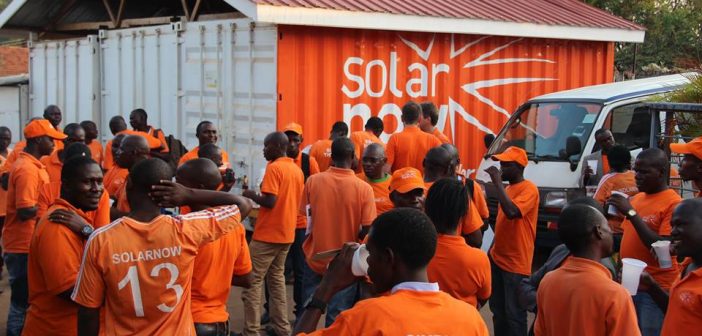
At its operational peak, PEG was a behemoth of logistical distribution.
| Metric | Value |
|---|---|
| Founded | 2013 |
| Founders | Hugh Whalan, Nate Heller |
| Headquarters | Accra, Ghana |
| Offices | Ghana, Côte d‘Ivoire, Senegal |
| Employees (Peak) | 1,000+ (full-time staff and agents) |
| Service Centers | 70+ |
| Total Funding Raised | $58.5 Million |
| Installed Capacity | 4.3 MW |
| Customers Reached | 60,000+ households / 300,000+ beneficiaries |
| Acquisition Date | September 6, 2022 |
| Acquirer | Bboxx (UK) |
PEG’s headquarters were located on Aburi Road in Accra, and its reach extended to some of the most remote villages in the Volta and Ashanti Regions .
The Funding Journey: From Grants to $58 Million
PEG‘s ascent was fueled by a sophisticated mix of catalytic grant capital, impact equity, and commercial debt.

The Financial Partners
PEG attracted a “Who‘s Who” of impact and climate finance:
-
Acumen (Early equity)
-
Energy Access Ventures (Specialist energy VC)
-
Blue Haven Initiative (Family office)
-
CDC Group (UK’s development finance institution)
-
SunFunder (Solar debt financing)
-
REPP (Renewable Energy Performance Platform)
Key Funding Milestones:
| Year | Event | Significance |
|---|---|---|
| 2018 | REPP Investment | $1.1 million equity injection to expand in Ghana |
| 2019 | Series C | $25 million raise ($20M debt, $5M equity) |
| 2022 | Acquisition | Acquired by Bboxx (reported $200M) |
By 2019, PEG had raised a total of $50 million** . The structure of the Series C round was particularly telling: it featured **$20 million in debt to finance the inventory of solar units, and $5 million in equity to fund growth . This heavy reliance on debt indicates that PEG had a very strong handle on its repayment rates (low default rates), allowing lenders to trust the model.
The Customer: Serving the “Unbankable”
PEG’s impact metrics are crucial for understanding why acquisition interest was so high.
The Demographics of Energy Poverty
Data from PEG‘s 2019 raise provides a snapshot of the West African energy gap :
-
89% of customers lived off-grid.
-
82% had never received credit from a formal financial institution.
-
50%+ earned less than $3 per day.
Why the model worked
Traditional view: High risk, low return.
PEG‘s view: High discipline, low default.
By locking the asset (the solar light) via GSM technology, PEG eliminated the need for legal contracts or collateral. The customer’s phone became the key, and the fear of losing the light ensured high repayment rates. This created a massive database of creditworthy, previously unbanked individuals—an asset more valuable than the solar panels themselves.
Verifiable Impact Metrics
-
500,000 people gained first-time energy access .
-
1,200 jobs created during operation .
-
12,750 tCO₂e emissions avoided annually .
The $200 Million Bboxx Acquisition (2022)
While PEG Africa has not released its full financial statements, the 2022 exit is well-documented in business registries.
The Transaction
On September 6, 2022, PEG Africa was formally Acquired/Merged by Bboxx, a London-based next-generation utility . The deal was reported by media outlets as being valued at approximately $200 million .
Strategic Rationale
For Bboxx, the acquisition was a land grab. Bboxx had operations across Africa and Asia but was underrepresented in Francophone West Africa. PEG brought:
-
Market Access: Instant leadership in Ghana, Senegal, and Ivory Coast.
-
The “Hardware”: Fleet of PAYG assets in the field.
-
The Talent: 1,000 staff embedded in local communities.
For PEG Investors, it represented a full liquidity event for a West African startup—a rarity at that time.
Status
The Crunchbase and PitchBook statuses were updated to “Acquired/Merged” . It is understood that the PEG brand has since been sunset or integrated into the Bboxx master brand, though local operational continuity remains.

Challenges and Risks
No analysis of PEG Africa is complete without acknowledging the risks inherent in the PAYG model.
Risk 1: The Last Mile Cost
The logistics of servicing 60,000+ households across three countries require armies of technicians and “energy entrepreneurs.” PEG employed 1,000+ people ; when revenue fluctuates due to currency devaluation (e.g., the Ghanaian Cedi crisis of 2022-2023), the cost of sales can eat the margin. This was likely a factor in the decision to exit to a larger entity like Bboxx, which could absorb those overheads.
Risk 2: Currency Devaluation
PEG imported the solar units, paying in USD. It sold the energy to customers paying in Cedis, CFA, or other West African currencies. A sharp drop in local currencies makes the cost of restocking inventory impossible to sustain without constant new equity injections.
Risk 3: Theft and Device Fraud
While the PAYG lock is effective, customers in remote areas sometimes found ways to bypass the hardware. Others simply defaulted during economic crises (COVID-19, inflation). Maintaining a high repayment rate requires constant field agent intervention.
Risk 4: The “Post-Exit” Integration Risk
For the employees and customers, the shift from PEG to Bboxx can be jarring. If the integration fails, a hard-won customer base could churn to cheaper, non-PAYG alternatives (like cheap Chinese imports).
Risk 5: The End of the PEG Brand
For the purpose of this profile, it is noted that the specific operating entity “PEG Africa” is no longer an independent entity on the Ghana Companies Register as of 2026, having been subsumed. However, the physical assets (the solar panels on roofs) remain in the field.
Economic and Industry Impact
1. Proving the West African Market
Before PEG, most investors assumed the PAYG model only worked in East Africa (M-Pesa territory). PEG proved that Mobile Money interoperability in West Africa (MTN MoMo, Orange Money) was robust enough to handle high-volume micro-transactions.
2. Creation of the “Energy Fintech” Sector
PEG demonstrated that an energy company is just a fintech company with hardware. By collecting daily repayment data, PEG built credit scores for customers who had never seen a bank. This paved the way for later startups offering multi-tier asset financing (e.g., solar now, then smartphones, then electric motorbikes).
3. Talent Incubation
PEG employed over 1,000 people at its peak . The current leadership of many West African energy and logistics startups is populated by former PEG regional managers.
4. Environmental Impact
With 4.3MW of installed solar capacity, the carbon offset of 12,750 tonnes per year is equivalent to taking thousands of cars off the road .
Future Outlook
As of June 2026, the PEG Africa brand is effectively a legacy entity. It is part of the Bboxx ecosystem.
The Legacy vs. The Future
-
The Brand: PEG Africa as a distinct consumer brand no longer exists at scale.
-
The Assets: The solar panels sold between 2013 and 2022 are still generating energy for hundreds of thousands of Ghanaians.
-
The Mission: Bboxx continues the PAYG mission, but under a different corporate banner.
What This Means for Ghana
PEG Africa’s exit was a watershed moment. It proved to global investors that:
-
Ghana is a viable destination for climate tech
-
The market can support $50 million+ funds.
-
Acquisitions are a viable exit route (rather than only IPOs or perpetual private ownership).
The Verdict
PEG Africa was not just a solar company. It was one of the most successful fintech-distribution hybrids to emerge from Accra. It took a simple idea—buy now, unlock later—and turned it into a multinational platform generating millions in revenue.
The 2022 acquisition by Bboxx was not a funeral; it was a graduation. It signified that the West African off-grid energy market had matured enough to attract a global consolidator. For the founders, Hugh Whalan and Nate Heller, it was a validation of a decade of grinding in the heat.
For the average Ghanaian, the name “PEG” may fade. But the legacy remains: a reliable light in a rural kitchen, a phone charged for work, and a continent proving that the off-grid consumer is not a charity case—they are a profitable, reliable customer.
FAQ SECTION
1. Is PEG Africa still operating as an independent company?
No. As of September 2022, PEG Africa was acquired by UK-based cleantech company Bboxx. The PEG brand has largely been integrated into the Bboxx ecosystem, though the physical assets (solar panels) remain in service across Ghana, Senegal, and Côte d‘Ivoire .
2. Who founded PEG Africa?
PEG Africa was founded in 2013 by Hugh Whalan (CEO) and Nate Heller (COO) .
3. What was the value of the PEG Africa acquisition?
Industry reports from sources like Techgist Africa valued the acquisition by Bboxx at approximately $200 million . The transaction was officially recorded as a buyout/LBO on September 6, 2022 .
4. How much money did PEG Africa raise?
PEG Africa raised a total of **$58.5 million** over its lifetime . This included a $25 million Series C round in 2019, which comprised $20 million in debt (inventory financing) and $5 million in equity .
5. Where was PEG Africa headquartered?
PEG Africa‘s corporate headquarters was located at Off Aburi Road, after Dodowa Junction, Accra, Ghana . It also maintained offices in Abidjan and Dakar .
6. How many employees did PEG Africa have?
At its peak, PEG Africa employed approximately 1,000 people, including full-time staff and commission-based sales agents .
7. How many customers did PEG Africa serve?
PEG served over 60,000 households, translating to more than 300,000 beneficiaries. REPP data also cites that the project resulted in 500,000 people gaining first-time energy access .
8. What was the PAYG (Pay-As-You-Go) model?
The PAYG model allowed users to pay for solar home systems in small daily installments via mobile money. If a payment was missed, the system would be temporarily locked via a GSM connection, and unlocked upon payment .
9. Who were the key investors in PEG Africa?
PEG‘s backers included a mix of top-tier impact and climate funds: CDC Group (UK), Acumen, Energy Access Ventures, Blue Haven Initiative, SunFunder, ResponsAbility, Total Energy Ventures, and the Renewable Energy Performance Platform (REPP) .
10. What is the Renewable Energy Performance Platform (REPP)?
REPP is a facility funded by the UK government (through ICF) that provided a $1.1 million equity investment to PEG Africa in 2018 to accelerate its expansion in Ghana .
11. What was the name of the technology partner PEG used?
PEG secured a licensing partnership with M-KOPA, the Kenyan pioneer of PAYG technology. This allowed them to deploy proven hardware and software systems in the West African market .
12. How can I contact PEG Africa?
While the legacy email [email protected] is inactive, the operational successor is Bboxx. The physical offices are located at the former PEG headquarters on Aburi Road, Accra .
QUICK FACTS BOX
| Item | Details |
|---|---|
| Founded | 2013 |
| Founders | Hugh Whalan, Nate Heller |
| Status | Acquired / Merged |
| Headquarters (Legacy) | Off Aburi Road, Accra, Ghana |
| Markets | Ghana, Côte d‘Ivoire, Senegal |
| Peak Employees | 1,000 |
| Total Funding | $58.5 Million |
| Investors | Acumen, CDC, Blue Haven, SunFunder, Energy Access Ventures, REPP |
| Acquisition Date | September 6, 2022 |
| Acquirer | Bboxx |
| Reported Valuation | $200 Million |
| Installed Capacity | 4.3 MW |
| Emissions Avoided | 12,750 tCO₂e / year |
| People Energized | 500,000 |
| Jobs Created | 1,200 |
Source: Accra Street Journal
Last Updated on June 5, 2026 by Samuel Kwame Boadu
Disclaimer: Some content on Accra Street Journal may be aggregated, summarized, or edited from third-party sources for informational purposes. Images and media are used under fair use or royalty-free licenses. Accra Street Journal is a subsidiary of SamBoad Publishing Hub under SamBoad Business Group Ltd, registered in Ghana since 2014.
For concerns or inquiries, please visit our Privacy Policy or Contact Page.

Samuel Kwame Boadu is a Ghanaian media entrepreneur and storyteller with a passion for amplifying urban voices and uncovering everyday truths. He is the Editor-in-Chief and Founder of Accra Street Journal, a dynamic digital platform dedicated to capturing the pulse of Ghana’s capital—its people, culture, challenges, business, sports and innovations.