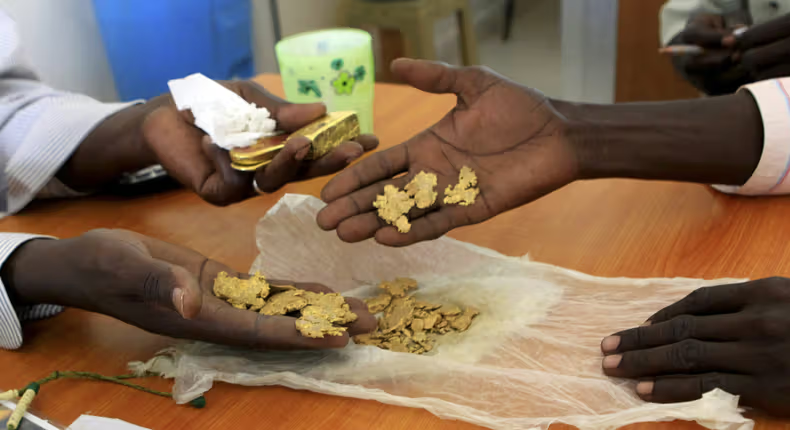
Prime Minister Kamel Idris announced mandatory ID cards for miners and increased security in mining regions after toxic chemicals from gold processing killed livestock and raised environmental alarms.
Sudan has launched an emergency regulatory crackdown on its traditional mining sector, which accounts for roughly 80 percent of the country’s gold production and employs an estimated two million people. The government ordered the immediate removal of all gold-processing mills from residential and military areas, citing escalating environmental damage and the emergence of mining camps as hubs for smuggling and illicit drug manufacturing.

The decision, reported by Sudan Tribune, followed an incident in which more than 20 sheep died after drinking water contaminated with cyanide and other chemicals used in gold processing. Prime Minister Kamel Idris directed the relocations as part of a broader package of measures aimed at bringing the vast informal mining sector under state control.
📢 GET A DETAILED ARTICLES + JOBS
Join ASJ's WhatsApp Channel and never miss a post or opportunity.

Authorities will introduce mandatory identification cards for miners and boost security across mining regions to combat smuggling networks that have flourished during the country’s ongoing conflict. Criminal groups operating from unregulated mining camps have been linked to gold smuggling and the production of Captagon, an illicit amphetamine-type drug.
The Sudanese government’s move reflects a challenge familiar across African mining jurisdictions. While countries including Ghana, the Democratic Republic of the Congo, and Zimbabwe have implemented licensing systems, mineral traceability programs, and enforcement operations against illegal mining, enforcement remains persistently weak. Illegal extraction, smuggling, environmental degradation, and conflict financing continue to undermine regulatory efforts across the continent.

Earlier reporting by Accra Street Journal highlighted that Sudan’s traditional mining sector has become increasingly difficult to police as the country’s civil war has diverted state resources and attention. The government’s latest package signals an attempt to reassert control over an industry that represents a critical source of foreign exchange and informal employment.
The success of Sudan’s crackdown will depend on whether authorities can translate new rules into on-the-ground enforcement. Relocating processing mills, issuing miner IDs, and securing remote mining camps require administrative capacity and security resources that are stretched thin during the ongoing conflict. For now, the government has made its intent clear. Whether that intent translates into lasting change remains an open question across Africa’s artisanal mining landscape.
Source: Accra Street Journal
Last Updated on June 8, 2026 by Samuel Kwame Boadu
Disclaimer: Some content on Accra Street Journal may be aggregated, summarized, or edited from third-party sources for informational purposes. Images and media are used under fair use or royalty-free licenses. Accra Street Journal is a subsidiary of SamBoad Publishing Hub under SamBoad Business Group Ltd, registered in Ghana since 2014.
For concerns or inquiries, please visit our Privacy Policy or Contact Page.

Samuel Kwame Boadu is a Ghanaian media entrepreneur and storyteller with a passion for amplifying urban voices and uncovering everyday truths. He is the Editor-in-Chief and Founder of Accra Street Journal, a dynamic digital platform dedicated to capturing the pulse of Ghana’s capital—its people, culture, challenges, business, sports and innovations.