








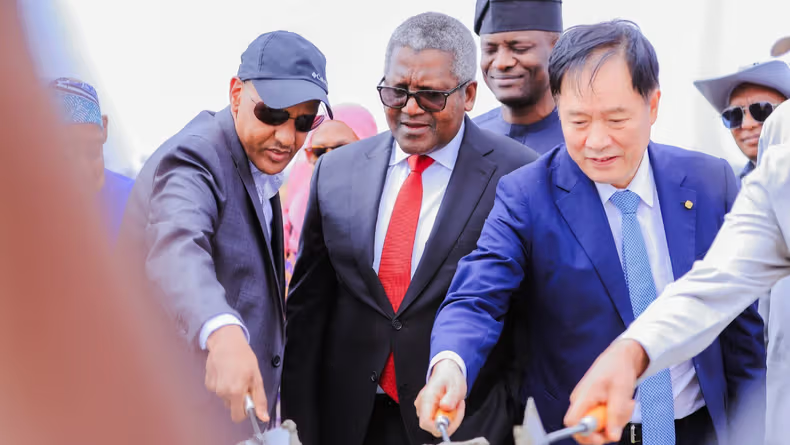
In a major move for East African energy infrastructure, the Dangote Group and Ethiopian Investment Holdings (EIH) have received approval from Djibouti President Ismail Omar Guelleh to install a series of oil and gas pipelines running through the small but strategically vital Horn of Africa nation.
The project, approved during a high-profile meeting that included EIH CEO Brook Taye, aims to connect landlocked Ethiopia directly to international shipping lanes, overcoming a logistical barrier that has long constrained the country’s economic potential. The proposed pipeline project is divided into two major phases: the first phase will construct a refined petroleum products pipeline linking the port of Djibouti to Dawale in southeastern Ethiopia; the second phase will involve laying pipelines for natural gas and crude oil to transport resources from Ethiopia’s Somali region through Djibouti to international markets. The agreement builds on an existing collaboration between EIH and the Dangote Group, which is already mid-construction on a $4 billion fertilizer complex in Ethiopia’s Somali region—a facility that will include its own dedicated natural gas pipeline and a 120-megawatt power plant. For Aliko Dangote, Africa’s richest man, the venture is part of a broader five-year strategy in which Ethiopia is slated to receive approximately 9% of his total planned investment, making it his second-largest focus area after Nigeria.

The Nigerian billionaire is reportedly looking to replicate the success of his massive 650,000-barrel-per-day refinery in Nigeria by establishing at least one crude refinery on Africa’s east coast, and this latest agreement provides the essential infrastructure to make that vision a reality.
📢 GET A DETAILED ARTICLES + JOBS
Join ASJ's WhatsApp Channel and never miss a post or opportunity.

Key Developments: Two-Phase Pipeline, Fertilizer Complex Integration, and Strategic Rationale
The pipeline project addresses Ethiopia’s most fundamental economic vulnerability: its landlocked status. With a population exceeding 120 million and one of Africa’s fastest-growing economies, Ethiopia has long relied on neighboring Djibouti for access to maritime trade, with over 95% of its foreign trade passing through Djibouti’s ports. However, reliance on trucking and existing rail lines has created bottlenecks, increased costs, and limited Ethiopia’s ability to import refined products and export natural resources. The proposed pipelines will provide a dedicated, high-capacity, low-cost transport solution.
Phase one will focus on refined petroleum products. The pipeline from Djibouti’s port to Dawale will transport petrol, diesel, jet fuel, and other refined products directly into Ethiopia’s consumption centers. This will reduce the need for trucking, lower transport costs, and improve supply security. For Djibouti, it will generate transit fees and solidify its position as Ethiopia’s primary trade gateway.

Phase two is more ambitious and transformative. The pipelines for natural gas and crude oil will transport resources from Ethiopia’s Somali region—an area with significant but undeveloped hydrocarbon potential—through Djibouti to international markets. This will enable Ethiopia to monetize its natural gas reserves, which are estimated at trillions of cubic feet, and potentially its crude oil resources. For Dangote, the natural gas pipeline will feed his planned east coast refinery, providing a dedicated supply of feedstock.
The fertilizer complex in Ethiopia’s Gode region is the anchor investment. Originally estimated at about 2.5 billion, the project scope has grown to over 4 billion with the addition of infrastructure like pipelines, power generation, and downstream processing facilities. The complex will produce urea and other nitrogen-based fertilizers, helping reduce Ethiopia’s reliance on imports and boosting its agricultural sector. A 120-megawatt power plant will supply electricity to the complex and possibly feed into the local grid.
The broader strategic rationale for Dangote is clear. The Nigerian refinery (650,000 bpd, expanding to 1.4 million bpd) serves West Africa. A proposed refinery in Mombasa, Kenya (650,000 bpd) would serve East Africa. The Ethiopian pipeline network would supply that refinery with crude oil or natural gas, creating an integrated system from resource extraction (Ethiopia) to refining (Kenya) to distribution (landlocked neighbors via pipelines). Dangote’s five-year plan, in which Ethiopia receives approximately 9% of total investment, reflects the strategic importance of the country as both a market and a resource base.
The involvement of Ethiopian Investment Holdings (EIH) is significant. EIH is Ethiopia’s sovereign wealth fund, established in 2022 to manage the country’s state-owned assets and attract strategic investment. Its partnership with Dangote provides political cover and financial credibility. Djibouti’s approval, secured through high-level meetings, reflects the alignment of interests among the three parties.
Analysis & Implications: Landlocked Logistics, Resource Monetization, and Regional Integration
The pipeline project addresses a fundamental economic constraint: the high cost of landlocked logistics. Landlocked countries face transport costs that are, on average, 50% higher than coastal countries. For Ethiopia, the lack of direct sea access has been a persistent drag on competitiveness. The pipelines will reduce transport costs for refined products (imported) and for natural gas and crude oil (exported). The savings will flow through to consumers and producers, improving overall economic efficiency.
The resource monetization potential is significant. Ethiopia’s Somali region (also known as the Ogaden) has known natural gas reserves estimated at 4 to 6 trillion cubic feet, with potential for more. Current production is minimal; most gas is flared or reinjected. The pipeline to Djibouti would enable gas exports, generating foreign exchange earnings for Ethiopia and feedstock for Dangote’s east coast refinery. The crude oil potential is less certain but promising; exploration has identified several basins with hydrocarbon potential.
The regional integration dimension is equally important. East Africa lacks a regional energy infrastructure network. Pipelines, refineries, and power grids are national in scope, with limited cross-border connectivity. The Dangote-EIH project, combined with the proposed Mombasa refinery and the existing Kenya-Uganda pipeline, could begin to knit together a regional energy system. This would support the African Continental Free Trade Area (AfCFTA) by facilitating energy trade.
The geopolitical implications are also notable. Djibouti is a small country (population under 1 million) with outsized strategic importance. It hosts military bases for China, France, Japan, Italy, and the United States. Its ports serve as the primary trade gateway for Ethiopia. The pipeline project will deepen Djibouti’s dependence on Ethiopian transit trade while generating transit fees and reinforcing its strategic relevance. For Dangote, Djibouti’s stable political environment and well-developed port infrastructure make it an ideal export hub.
The fertilizer complex is a parallel strategic investment. Ethiopia’s agricultural sector is the backbone of its economy, employing over 70% of the workforce. Fertilizer use is low (approximately 30 kilograms per hectare, compared to the African average of 60 kg/ha and the global average of 140 kg/ha). Domestic fertilizer production would reduce import dependence (Ethiopia currently imports all its fertilizer), lower costs for farmers, and increase agricultural productivity. The complex’s location in the Somali region also supports regional development in a historically marginalized area.

The Accra Street Journal notes that Dangote’s east Africa strategy mirrors his west Africa strategy: build a refinery (Nigeria), build pipelines to supply it (Nigeria’s domestic gas network), and build fertilizer plants to capture downstream value. The difference is that in east Africa, Dangote is starting with the fertilizer plant and pipelines, with the refinery to follow. The sequence reflects the different resource endowments and infrastructure gaps of the two regions.
What This Means for Ethiopia, Djibouti, and the Dangote Group
For Ethiopia, the pipeline project is a strategic breakthrough. It will reduce transport costs for refined products, generate export revenue from natural gas, and support the development of the Somali region’s hydrocarbon potential. The fertilizer complex will improve agricultural productivity, reduce import dependence, and create jobs. The projects align with Ethiopia’s Homegrown Economic Reform Agenda, which prioritizes infrastructure, industrialization, and foreign direct investment.
The financing of the projects is a question mark. The $4 billion fertilizer complex is a major investment, and the pipelines will add billions more. Dangote Group has deep pockets, with an estimated net worth of over $20 billion, but even it can’t fund such massive projects solely from equity. The group will likely turn to development finance institutions like AfDB, IFC, and Proparco, as well as export credit agencies from China and Europe, and commercial banks. The participation of EIH, Ethiopia’s sovereign wealth fund, adds some equity and helps mitigate political risk.
For Djibouti, the pipeline project will generate transit fees and reinforce its position as Ethiopia’s primary trade gateway. The country’s economy is heavily dependent on port services; the pipelines will add a new revenue stream. However, Djibouti must also manage the environmental and social impacts of pipeline construction, as well as the security risks associated with energy infrastructure in a volatile region.
For the Dangote Group, the East African expansion is a logical extension of its pan-African strategy. Dangote Cement is already present in over 10 African countries. Dangote Refinery serves West Africa. The East African refinery, fertilizer complex, and pipelines will create an integrated business that captures value from resource extraction to refining to distribution. The five-year plan, with Ethiopia receiving 9% of investment, signals that Dangote is serious about the region.
The competition for East African energy markets is intensifying. The proposed Mombasa refinery (Kenya) and the Dangote pipeline project are complementary, not competitive. The Mombasa refinery would process crude oil; the Ethiopian pipelines would supply natural gas to that refinery. However, other players—including Chinese, Turkish, and Gulf investors—are also eyeing the region. Dangote’s first-mover advantage is significant, but execution risk remains.
The Accra Street Journal’s assessment: the pipeline project is a win-win-win for Ethiopia, Djibouti, and Dangote. Ethiopia gets cheaper energy and export revenue. Djibouti gets transit fees and strategic relevance. Dangote gets a foothold in one of Africa’s most promising growth markets. However, the projects are complex, capital-intensive, and subject to political and security risks. The approval from Djibouti is a milestone, not a finish line. The real work—financing, construction, and operation—lies ahead.
Wider Context: Landlocked Africa’s Infrastructure Deficit and the Pipeline Solution
Africa has 16 landlocked countries, more than any other continent. These countries face higher transport costs, lower trade volumes, and reduced competitiveness compared to their coastal neighbors. The lack of direct sea access is a structural impediment to development.
Pipelines are a solution for energy products. Unlike roads or railways, pipelines can transport large volumes of liquids and gases over long distances at low cost. They are also less vulnerable to theft, vandalism, and border delays. For landlocked countries with hydrocarbon resources, pipelines are essential for monetization.
The Dangote-EIH pipeline is not the first cross-border pipeline in Africa, but it is one of the largest privately financed projects. The West African Gas Pipeline (connecting Nigeria, Benin, Togo, and Ghana) is a precedent; the East African Crude Oil Pipeline (connecting Uganda to Tanzania) is another. The Dangote project differs in its scope (refined products, natural gas, and crude oil) and its private sector leadership.
The geopolitical landscape is shifting. Traditional donors (Western governments, the World Bank) are scaling back fossil fuel infrastructure financing due to climate concerns. Private investors like Dangote are stepping into the gap. The trend is likely to continue: as Western DFIs pivot to green energy, African infrastructure will be financed by African capital, Chinese capital, and Gulf capital.
The climate implications are real but nuanced. Natural gas is a fossil fuel, and its combustion emits CO2. However, gas is less carbon-intensive than coal or oil. For Ethiopia, which currently relies on hydropower (renewable) and imports refined products (oil-based), natural gas could displace oil in power generation, reducing emissions. The net impact depends on the counterfactual. The Dangote project has not been assessed by climate finance standards; investors should press for transparency.
The Accra Street Journal’s final word: the Dangote-EIH pipeline project is a landmark for East African energy infrastructure. It addresses a critical constraint (landlocked logistics), monetizes natural resources (gas and oil), and supports industrial development (fertilizer, refining). The risks are significant, but so are the rewards. For Ethiopia, Djibouti, and Dangote, the project is a bet on a more integrated, more prosperous East Africa. The bet is bold. The execution will determine its success.
Source: Accra Street Journal
Last Updated on May 24, 2026 by Samuel Kwame Boadu
Disclaimer: Some content on Accra Street Journal may be aggregated, summarized, or edited from third-party sources for informational purposes. Images and media are used under fair use or royalty-free licenses. Accra Street Journal is a subsidiary of SamBoad Publishing Hub under SamBoad Business Group Ltd, registered in Ghana since 2014.
For concerns or inquiries, please visit our Privacy Policy or Contact Page.

Samuel Kwame Boadu is a Ghanaian media entrepreneur and storyteller with a passion for amplifying urban voices and uncovering everyday truths. He is the Editor-in-Chief and Founder of Accra Street Journal, a dynamic digital platform dedicated to capturing the pulse of Ghana’s capital—its people, culture, challenges, business, sports and innovations.