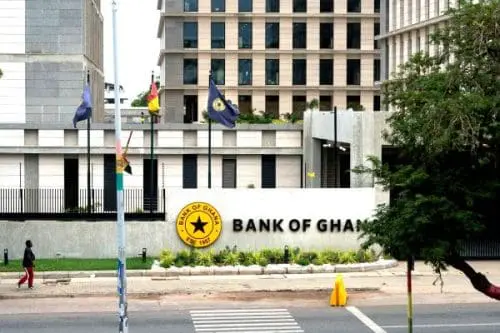
From mandatory biometrics to a six-pillar cyber defence — the central bank’s evolving anti-fraud architecture
Executive Summary
The Bank of Ghana (BoG) has moved decisively beyond its traditional mandate of price stability and banking supervision into the frontline of financial fraud prevention. In 2025-2026, the central bank has deployed an integrated anti-fraud framework built on four strategic pillars: biometric identity enforcement (the Ghana Card as the sole identification for all financial transactions), cybersecurity regulation (the revised Cyber and Information Security Directive with six strategic pillars), anti-money laundering compliance (revised AML/CFT Guidelines with enhanced due diligence for agency banking), and inter-agency coordination (COCLAB and working-level collaboration with law enforcement).
The scale of the challenge is significant. In 2024 alone, BoG received over 50 complaints related to unregulated savings, investment, and lending schemes . The central bank’s 2024 Fraud Report recorded 16,733 fraud cases—a 5% increase—with GH¢99 million at risk . Payment Service Providers experienced a 7% rise in case volumes and an 18% increase in exposure to GH¢19 million .

This ASJ report examines the Bank of Ghana’s statutory anti-fraud powers, its regulatory instruments, its enforcement actions, and its collaborative framework with other agencies. The evidence suggests that while the central bank has developed substantial legal and technical capacity to combat financial fraud, its effectiveness depends on coordinated implementation across the financial sector, robust international cooperation, and consistent judicial support for regulatory actions.
📢 GET A DETAILED ARTICLES + JOBS
Join ASJ's WhatsApp Channel and never miss a post or opportunity.

Part 1: The Statutory Foundation — BoG’s Legal Anti-Fraud Mandate
The Banks and Specialised Deposit-Taking Institutions Act, 2016 (Act 930)
Act 930 is the primary legislation empowering the Bank of Ghana to regulate banks and specialised deposit-taking institutions (SDIs). Under Section 123 (1) of Act 930, the Bank of Ghana is required to revoke the licence of a bank or SDI where it determines that the institution is insolvent . This power has been exercised in the context of the financial sector clean-up, where the BoG revoked the licences of 23 insolvent institutions on August 16, 2019, including GN Savings and Loans Limited .
The legal standard for revocation under Act 930 requires that the institution be insolvent, that a reasonable period has been allowed for recapitalisation, and that there are no reasonable prospects of recovery . The BoG’s assessment in 2019 concluded that the affected institutions “have no reasonable prospects of recovery, and that their continued existence poses severe risks to the stability of the financial system and to the interests of their depositors” .

The Court of Appeal’s May 2026 judgment in the GN Savings and Loans case clarified the limits of this power: while the BoG has the statutory authority to revoke licences, it must exercise this power “fairly and reasonably” under Article 23 of the 1992 Constitution . The court found that the BoG had acted “unfairly and unreasonably” by ignoring recommendations from its own appointed supervisor without providing any convincing explanation . The court described the BoG’s conduct as “irrational, unfair, unreasonable, and unjust” .
Key implication for fraud enforcement: The central bank’s anti-fraud powers must be exercised with procedural fairness. The Court of Appeal’s decision does not question the BoG’s authority to revoke licences for insolvency—it affirms that such decisions must be based on complete evidence and properly justified.
The Anti-Money Laundering Act, 2020 (Act 1044)
Act 1044 is the primary anti-money laundering law in Ghana. It imposes obligations on financial institutions including:
| Obligation | Key Requirement |
|---|---|
| Customer Due Diligence (CDD) | Identify and verify customers before establishing business relationships |
| Suspicious Transaction Reports (STRs) | Report any transaction that appears linked to money laundering or terrorist financing |
| Cash Transaction Reports (CTRs) | Report cash transactions exceeding GH¢10,000 in a single day |
| AMLRO Appointment | Designate an Anti-Money Laundering Reporting Officer |
| Record-Keeping | Maintain transaction records for at least six years |
| Tipping-off prohibition | It is a criminal offence to disclose that an STR has been filed |
Under Section 53 of Act 1044, any bank employee who knows or suspects that a transaction is linked to money laundering must report immediately to the Financial Intelligence Centre (FIC) via the goAML portal. Delays of more than five working days from the date of suspicion may attract enforcement action .
The Financial Intelligence Centre Act, 2020 (Act 1048)
Act 1048 established the Financial Intelligence Centre (FIC) as Ghana’s national centre for receiving, analysing, and disseminating financial intelligence. The FIC operates the goAML reporting portal, through which all STRs and CTRs must be filed . The Bank of Ghana works closely with the FIC in the enforcement of AML/CFT requirements.
The Cybersecurity Act, 2020 (Act 1038)
Act 1038 designates the Bank of Ghana’s Financial Industry Command Security Operations Centre (FICSOC) as the Sectoral Computer Emergency Response Team for the financial industry . This designation gives the BoG a statutory role in coordinating cyber incident response across the financial sector.
The Virtual Asset Service Providers Act, 2025 (Act 1154)
The most recent addition to the anti-fraud legislative framework, Act 1154 brought virtual asset service providers (VASPs) under joint BoG and SEC oversight. Virtual asset advocacy is now classified as a “regulated activity” requiring registration with both regulators [citation:1 of SEC document]. The Act gives the BoG authority to regulate and supervise entities dealing in cryptocurrencies and other virtual assets—a critical power given the use of crypto in investment fraud schemes [citation:2 of SEC document].
Part 2: The Ghana Card Mandate — Identity as the First Line of Defence
The Bank of Ghana has positioned the Ghana Card as the cornerstone of its anti-fraud strategy. A revised Supervisory Guidance Note, issued in January 2026, makes the Ghana Card mandatory for all financial transactions across the country .
Key Provisions of the Mandate
| Requirement | Detail |
|---|---|
| Sole identification document | The Ghana Card is now the only identification document for onboarding customers at all BoG-licensed financial institutions |
| Biometric verification | Institutions must biometrically verify customers using features embedded in the Ghana Card and update records directly from the National Identification Authority (NIA) database |
| Digital onboarding | Full biometric verification, including liveness checks, is required for all digital onboarding processes |
| Third-party transactions | Third-party and non-face-to-face transactions also require mandatory biometric verification |
| Foreign exchange bureaux | Forex bureau operators must demand the Ghana Card from all customers before conducting transactions |
The Forex Bureau Enforcement
In a significant expansion of the mandate, the BoG and FIC issued AML/CFT/CPF Guidelines for Foreign Exchange Bureaux in September 2025, which took immediate effect in January 2026 . Under the new rules:

-
Forex bureaux must display a notice requiring customers to present a valid Ghana Card
-
For transactions of US$10,000 or more, bureaux must capture Ghana Card details and biometrically verify customers’ identities
-
Each forex bureau must appoint an Anti-Money Laundering Reporting Officer (AMLRO), whose approval by the Bank of Ghana is mandatory
-
An independent annual audit of each bureau’s AML/CFT programme is compulsory
The Authentication Gap
Despite these measures, the BoG has warned that weak authentication systems remain a vulnerability. At the 3i Africa Summit in May 2026, Governor Dr Johnson Pandit Asiama stated: “Confidence will depend on the strength of our digital identity and KYC frameworks. Weak authentication increases fraud risk, affects credit quality, and undermines trust in digital financial services” .
The Governor noted that as Ghana’s digital finance sector grows—particularly through mobile money—there is an urgent need to build safe and reliable systems to support sustainable expansion. He called for stronger collaboration among financial institutions, regulators, and technology providers to address security challenges .
Part 3: The Revised Cyber and Information Security Directive (CISD 2026)
In March 2026, the Bank of Ghana launched the revised Cyber and Information Security Directive (CISD 2026), replacing the 2018 framework. Governor Asiama explained the rationale: “A framework designed for the challenges of 2018 cannot adequately solve the problems of 2026. The threat landscape has changed, and so must we” .
The Six Strategic Pillars
The CISD 2026 is built around six key pillars designed to future-proof the financial sector against cyber threats :
| Pillar | Description |
|---|---|
| AI and Machine Learning Governance | Ensuring transparency, fairness, and security as financial institutions increasingly adopt AI for fraud detection, credit scoring, and customer service |
| Cloud Computing Security | Promoting the responsible and risk-based adoption of cloud technologies while maintaining data sovereignty for sensitive financial information |
| Proportionality Framework | Tailoring cybersecurity requirements to the size and risk profile of institutions, preventing undue burden on smaller banks and fintechs |
| Board-Level Accountability | Mandating at least one board member with verified cyber risk expertise, embedding security considerations at the highest strategic level |
| Inclusive Oversight | Expanding coverage beyond universal banks to include micro-finance institutions, savings and loans companies, fintechs, and partner regulators, creating a unified defence across the sector |
| Proactive Defence and Preparedness | Strengthening systems to anticipate, prevent, and respond to evolving cyber threats |
The Shift from Compliance to Resilience
Governor Asiama emphasised that the directive moves beyond “simple compliance toward a posture of active and collective cyber resilience” . The BoG has borne the initial cost of the FICSOC—the Financial Industry Command Security Operations Centre—as “critical national infrastructure” . However, the Governor noted that sustaining this capability will require a shared responsibility model with financial institutions .
Second Deputy Governor Dr Zakari Mumuni added that the directive “provides a clear regulatory framework to strengthen cyber defence and enhance the overall stability of the financial ecosystem” . He emphasised that cybersecurity must be treated as “a national and economic security priority” .
Part 4: AML/CFT Guidelines — Enhanced Due Diligence and Transaction Monitoring
The Bank of Ghana’s AML/CFT/CPF Guidelines were revised in January 2026, introducing two significant changes .
Key Changes in the 2026 Revision
| Change | Requirement |
|---|---|
| Agency banking EDD | Banks must apply Enhanced Due Diligence (EDD) on agents who handle transactions above GH¢10,000 in a single session or GH¢50,000 cumulatively within a month |
| Transaction monitoring systems | Static, rule-based transaction monitoring systems are no longer considered adequate by the BoG |
Reporting Obligations
Under the AML/CFT framework, financial institutions must:
-
File Suspicious Transaction Reports (STRs) via the goAML portal. There is no minimum transaction threshold for STR filing — any suspicious transaction, regardless of amount, must be reported
-
File Cash Transaction Reports (CTRs) for all cash transactions exceeding GH¢10,000 in a single day
-
Maintain records for at least six years
-
Designate an AMLRO whose appointment must be approved by the BoG
Ghana-Specific AML Risk Typologies
The BoG’s guidelines highlight Ghana-specific risk typologies that transaction monitoring systems must address, including:
-
Proceeds from illegal small-scale mining (galamsey)
-
Advance fee fraud
-
Mobile money structuring
Generic, rule-based transaction monitoring systems are no longer considered adequate; institutions must deploy more sophisticated detection capabilities .
Part 5: Intelligence Gathering and Analysis — ORASS and Fraud Reporting
The Bank of Ghana operates the Online Regulatory and Analytical Surveillance System (ORASS), which acts as a supervisory tool and a repository for fraud reports from banks and specialised deposit-taking institutions .

How ORASS Works
| Feature | Description |
|---|---|
| Reporting channel | Financial institutions submit fraud reports through ORASS |
| Surveillance function | The system monitors industry trends and tracks the sophistication and frequency of financial crimes |
| Limitation | ORASS functions as a reporting bridge rather than a real-time protective measure |
According to analysts, the BoG increasingly relies on ORASS to monitor industry trends, but the system primarily functions after incidents occur . By digitising submissions, the regulator can track financial crimes’ sophistication and frequency, offering insight into systemic risks.
The Fraud Data (2024)
The BoG’s 2024 Fraud Report documented:
| Metric | Value |
|---|---|
| Total fraud cases | 16,733 (5% increase from 2023) |
| Value at risk | GH¢99 million (13% increase) |
| Payment Service Provider cases | 7% increase |
| Payment Service Provider exposure | 18% increase to GH¢19 million |
| Unlicensed scheme complaints (2024 alone) | Over 50 |
The data demonstrates that financial fraud is not decreasing—it is evolving. The BoG’s response has been to strengthen reporting mechanisms while acknowledging that prevention requires more than post-incident surveillance .
Part 6: Inter-Agency Collaboration — COCLAB and Law Enforcement Partnerships
The Bank of Ghana recognises that it cannot fight financial fraud alone. It has established formal collaboration mechanisms with law enforcement agencies, telecommunications companies, and other regulators.
COCLAB — The Committee for Cooperation Between Law Enforcement Agencies and the Banking Community
At the opening of the second Technical Committee workshop of COCLAB in December 2025, Second Deputy Governor Matilda Asante Asiedu called for “deeper, action-oriented collaboration between regulators, law-enforcement agencies and the banking industry” as “the panacea to combat illicit financial activities” .
Key proposals from the Deputy Governor:
| Proposal | Purpose |
|---|---|
| Structured multi-agency working groups | To analyse the tactics of unlicensed financial operators and recommend joint enforcement and preventive measures |
| Elevated engagements | Bringing COCLAB discussions to the level of heads of institutions to strengthen implementation and accountability |
| Unified approach | Involving regulators, security agencies, banks, telecommunications companies, and the media |
The scale of the problem: “In 2024 alone, the Bank of Ghana received over 50 complaints related to unregulated savings, investment, and lending schemes. These entities often mimic legitimate financial products while imposing exorbitant charges and engaging in abusive practices that erode public confidence” .
Enforcement actions taken: The Deputy Governor noted that “in collaboration with the Economic and Organised Crime Office (EOCO), arrests have been made. However, it is evident that these measures are not sufficient on their own. The persistence of these operators calls for new strategies, deeper intelligence sharing, and stronger institutional coordination” .
Coordination with the Cyber Security Authority (CSA)
The Cyber Security Authority operates the National Computer Emergency Response Team (CERT-GH) as a technical nerve centre, issuing rapid-response advisories on threats like AI-driven social engineering . The CSA’s short code 292 allows public reporting of incidents .
The BoG works with the CSA on cyber incident response, with the FICSOC serving as the financial sector’s CERT under Act 1038 .
Intelligence Sharing Gaps
Despite these mechanisms, analysts have warned that fraud intelligence is not currently shared among service providers. When an incident occurs at one telco, it can easily affect another. The same issue exists in banking; fraud detected at one institution often appears at others .
The challenge lies in the fact that necessary intelligence is still siloed. This systemic vulnerability persists despite oversight mechanisms managed by the state . Experts argue that evolution must focus on cross-institutional data pooling to prevent fraud before it happens, particularly as Ghana’s digital payments infrastructure processes over eight billion mobile money transactions annually .
Part 7: Enforcement Actions — The GN Savings and Loans Case
The most significant recent legal case involving the Bank of Ghana’s enforcement powers is the Court of Appeal’s May 2026 judgment in the GN Savings and Loans matter. The case has important implications for how the BoG must exercise its anti-fraud and insolvency powers.
Background
On August 16, 2019, the Bank of Ghana revoked the operating licence of GN Savings and Loans Limited and 22 other institutions during the financial sector clean-up exercise. The BoG declared the company insolvent and subsequently placed it under receivership .
The BoG explained: “The revocation of the licences of these institutions has become necessary because they are insolvent even after a reasonable period within which the Bank of Ghana has engaged with them in the hope that they would be recapitalised by their shareholders to return them to solvency” .
Displeased with the decision, Dr Papa Kwesi Nduom, Chairperson of Groupe Nduom, challenged the revocation in the High Court, arguing that the decision violated constitutional rights to administrative justice, property, equality, and non-discrimination . The High Court ruled that the BoG had acted lawfully .
The Court of Appeal’s Decision (May 21, 2026)
The Court of Appeal overturned the High Court decision and ordered the Bank of Ghana to restore GN Savings and Loans’ licence . The court identified several failings in the BoG’s process:
| Finding | Detail |
|---|---|
| Failure to consider government debt | The BoG failed to properly account for debts owed by the Government of Ghana to Groupe Nduom entities before concluding that GN Savings and Loans was insolvent |
| Reliance on inaccurate information | The BoG relied on inaccurate financial information supplied by government officials |
| Ignoring supervisor’s recommendations | The BoG ignored recommendations from its own appointed supervisor without providing any convincing explanation |
| Irrational conduct | The court described the BoG’s conduct as “irrational, unfair, unreasonable, and unjust” |
Justice Francis A. Achibonga, delivering the lead judgment, stated that if a regulator appoints a supervisor to investigate and submit recommendations, it cannot simply ignore those recommendations without justification . The court concluded that the BoG failed to establish that the revocation was justified .
Key Implications for Anti-Fraud Enforcement
| Implication | Explanation |
|---|---|
| Fairness requirement | The BoG must exercise its statutory powers fairly and reasonably under Article 23 of the 1992 Constitution |
| Burden of proof | The party making a positive assertion (the BoG, claiming its actions were fair and lawful) bears the burden of proving it |
| Complete evidence | The BoG cannot ignore material evidence, including government debt obligations, when assessing solvency |
| Supervisor’s recommendations | The BoG cannot disregard recommendations from its own appointed experts without justification |
Justice Mariama Sammo, in her concurring opinion, stressed that “public institutions exercising administrative powers must act transparently, fairly, and reasonably under Article 23 of the Constitution” .
Importantly for fraud victims: The decision does not prevent the BoG from revoking licences for insolvency. It requires that such decisions be made fairly, based on complete evidence, and properly justified. The BoG retains its statutory powers under Act 930; it must simply exercise them with procedural rigour.
Part 8: International Coordination — GIABA and the 2026 Mutual Evaluation
Ghana is preparing for its third-round Mutual Evaluation by the Inter-Governmental Action Group Against Money Laundering in West Africa (GIABA) , scheduled for the first quarter of 2026 . The evaluation will assess Ghana’s compliance with international anti-money laundering and counter-terrorist financing standards.
Second Deputy Governor Asante Asiedu noted that “demonstrating effective inter-agency cooperation and a strong national response to unlicensed financial institutions will be critical to Ghana’s assessment” .
The outcome of this evaluation will affect Ghana’s reputation in the international financial system and could influence correspondent banking relationships and cross-border payment arrangements.
Part 9: Public Awareness and Reporting Channels
The Bank of Ghana has established public-facing channels for reporting suspected financial fraud.
Reporting Channels
| Channel | Contact |
|---|---|
| Phone (Financial Stability Department) | 030 266 5005; 059 691 2354; 050 150 2270 |
| 0593974486 | |
| [email protected] | |
| Walk-in | 4th Floor, Urban Block, Bank Square, Accra (or any Regional Office) |
Public Warnings
The BoG has issued multiple public warnings about specific fraud schemes. In May 2025, the BoG warned against “illegal foreign investors” scams, noting that these operations constitute illegal deposit-taking under Act 930 . Only entities licensed by the Bank of Ghana may take deposits.
The Bank of Ghana has also blacklisted unlicensed Money Transfer Organisations, including ACE Money Transfer, Remit Union, Remit Home, Roze Remit, Monty Global, Nairagram, i-Transfer, Hurupay, Eversend, and Izi Send [citation:4 of SEC document]. The BoG warned that unapproved MTOs “not only break the law but also undermine public trust and expose users to the risk of fraud, data misuse, or loss of funds” .
Conclusion: The Bank of Ghana’s Evolving Anti-Fraud Role
The Bank of Ghana has developed a comprehensive anti-fraud architecture that operates on multiple fronts: mandatory biometric identity verification, a revised cybersecurity directive, enhanced AML/CFT requirements, intelligence gathering through ORASS, and collaborative enforcement through COCLAB.
The Ghana Card mandate has made identity verification uniform across the financial sector, closing a significant loophole that fraudsters exploited . The CISD 2026 has moved the financial sector from reactive compliance to “active and collective cyber resilience,” with AI governance and board-level accountability as new requirements . The AML/CFT Guidelines now require enhanced due diligence for agency banking and more sophisticated transaction monitoring systems .
The BoG’s enforcement powers, however, are subject to legal limits. The GN Savings and Loans case establishes that the central bank must exercise its statutory powers “fairly and reasonably,” with due consideration of all material evidence . This does not weaken the BoG’s anti-fraud mandate—it strengthens it by requiring procedural rigour that will withstand judicial scrutiny.
The central bank cannot fight financial fraud alone. Its effectiveness depends on:
-
Financial institutions implementing robust CDD, transaction monitoring, and cyber defences
-
Law enforcement agencies (EOCO, Police CID) acting on BoG referrals
-
Telecommunications companies sharing fraud intelligence across networks
-
The public reporting suspicious schemes through established channels
The 2024 fraud data—16,733 cases, GH¢99 million at risk—demonstrates that financial fraud remains a persistent threat . But the BoG’s 2025-2026 reforms have closed vulnerabilities and created new enforcement tools. The question is whether coordinated implementation will match the scale of the challenge.
For the public, the BoG’s complaint channels exist—030 266 5005, 059 691 2354, 050 150 2270, [email protected] . The cost of reporting is zero. The cost of not reporting—for individuals and for the financial system—is far higher.
Quick Reference: Bank of Ghana Anti-Fraud Framework
| Pillar | Key Instrument | Key Requirement |
|---|---|---|
| Identity | Ghana Card Supervisory Guidance (Jan 2026) | Ghana Card mandatory for all financial transactions |
| Cybersecurity | CISD 2026 (Mar 2026) | Six-pillar framework: AI governance, cloud security, proportionality, board accountability, inclusive oversight, proactive defence |
| Anti-Money Laundering | AML/CFT Guidelines (revised Jan 2026) | Enhanced due diligence for agency banking; sophisticated transaction monitoring |
| Intelligence | ORASS | Central fraud reporting repository |
| Collaboration | COCLAB | Inter-agency cooperation with law enforcement |
| International | GIABA Mutual Evaluation (Q1 2026) | Compliance with global AML/CFT standards |
Source: Accra Street Journal
Last Updated on June 11, 2026 by Samuel Kwame Boadu
Disclaimer: Some content on Accra Street Journal may be aggregated, summarized, or edited from third-party sources for informational purposes. Images and media are used under fair use or royalty-free licenses. Accra Street Journal is a subsidiary of SamBoad Publishing Hub under SamBoad Business Group Ltd, registered in Ghana since 2014.
For concerns or inquiries, please visit our Privacy Policy or Contact Page.

Samuel Kwame Boadu is a Ghanaian media entrepreneur and storyteller with a passion for amplifying urban voices and uncovering everyday truths. He is the Editor-in-Chief and Founder of Accra Street Journal, a dynamic digital platform dedicated to capturing the pulse of Ghana’s capital—its people, culture, challenges, business, sports and innovations.