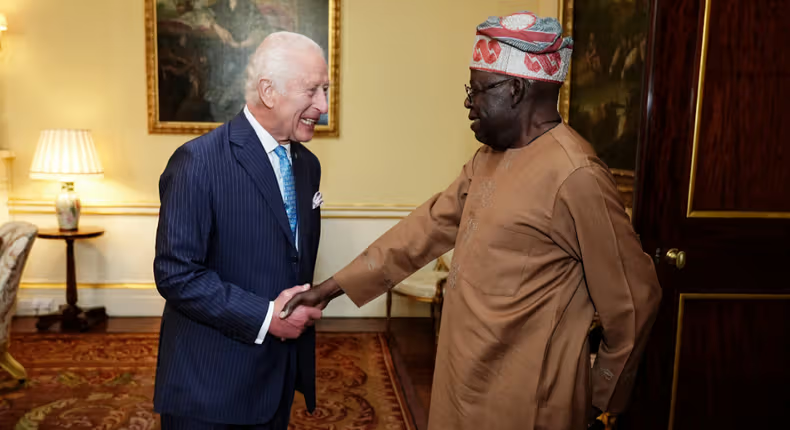
The United Kingdom has reinforced its long-standing anti-corruption cooperation with Nigeria, signing a new agreement that will see more than $9.5 million in recovered assets returned to Abuja for use in public infrastructure projects.
The agreement, announced by the British High Commission in Abuja, provides the framework for repatriating funds confiscated in Jersey after a court ruled that the money was linked to corruption involving senior Nigerian officials. The Memorandum of Understanding was signed in December 2025 by Mark Temple, the UK’s Attorney General for Jersey, and representatives of the Nigerian government.

The latest asset return builds on a series of earlier agreements between Jersey and Nigeria, under which more than $300 million has already been repatriated. Those funds were channelled into major infrastructure projects, including the Lagos–Ibadan Expressway and the Second Niger Bridge, under international monitoring arrangements designed to ensure transparency and accountability.
📢 GET A DETAILED ARTICLES + JOBS
Join ASJ's WhatsApp Channel and never miss a post or opportunity.

UK authorities said the new agreement reflects a broader commitment by the UK government and its Crown Dependencies to support Nigeria in tracing, seizing, and returning proceeds of corruption hidden overseas. Over time, this cooperation has become a central pillar of bilateral engagement on governance, financial integrity, and economic reform.
Under the terms of the agreement, the $9.5 million will support three flagship road projects: the Lagos–Ibadan Expressway, the Second Niger Bridge, and the Abuja–Kano Road. With the Lagos–Ibadan Expressway and the Second Niger Bridge already completed, the recovered funds are expected to be directed primarily toward the 375-kilometre Abuja–Kano Highway—a critical transport artery linking Nigeria’s capital to its second-largest city and a vital corridor for trade and mobility in the north.

The British High Commission explained that the forfeiture process began on November 29, 2023, when Jersey’s Attorney General applied to the Royal Court of Jersey under the Forfeiture of Assets (Civil Proceedings) (Jersey) Law 2018. On January 12, 2024, the court issued a forfeiture order after determining that the funds were the proceeds of corruption involving third-party contractors who diverted public funds for the benefit of senior Nigerian officials.
Commenting on the ruling, Mr. Temple said the case demonstrated the effectiveness of Jersey’s civil forfeiture regime in tackling financial crime. He described the return of the funds as evidence that strong legislation, combined with international cooperation, can produce concrete results in the fight against corruption.
Nigeria’s Attorney General and Minister of Justice, Lateef Fagbemi, SAN, said the recovery underscored the importance of collaboration with international partners and reinforced the message that foreign jurisdictions should not serve as safe havens for illicit wealth.
Mr. Fagbemi also assured UK and Jersey authorities that the repatriated funds would be used strictly in line with the terms of the agreement. He added that asset recovery remains a key element of Nigeria’s broader strategy to strengthen governance, rebuild public trust, and redirect recovered wealth into projects with clear economic and social impact.
Source: Accra Street Journal
Last Updated on April 26, 2026 by Samuel Kwame Boadu
Disclaimer: Some content on Accra Street Journal may be aggregated, summarized, or edited from third-party sources for informational purposes. Images and media are used under fair use or royalty-free licenses. Accra Street Journal is a subsidiary of SamBoad Publishing Hub under SamBoad Business Group Ltd, registered in Ghana since 2014.
For concerns or inquiries, please visit our Privacy Policy or Contact Page.


Samuel Kwame Boadu is a Ghanaian media entrepreneur and storyteller with a passion for amplifying urban voices and uncovering everyday truths. He is the Editor-in-Chief and Founder of Accra Street Journal, a dynamic digital platform dedicated to capturing the pulse of Ghana’s capital—its people, culture, challenges, business, sports and innovations.