







The global gold market is entering a decisive new phase, and this time the disruption is not coming from Africa, China, or traditional Western producers. It is emerging from the Middle East.
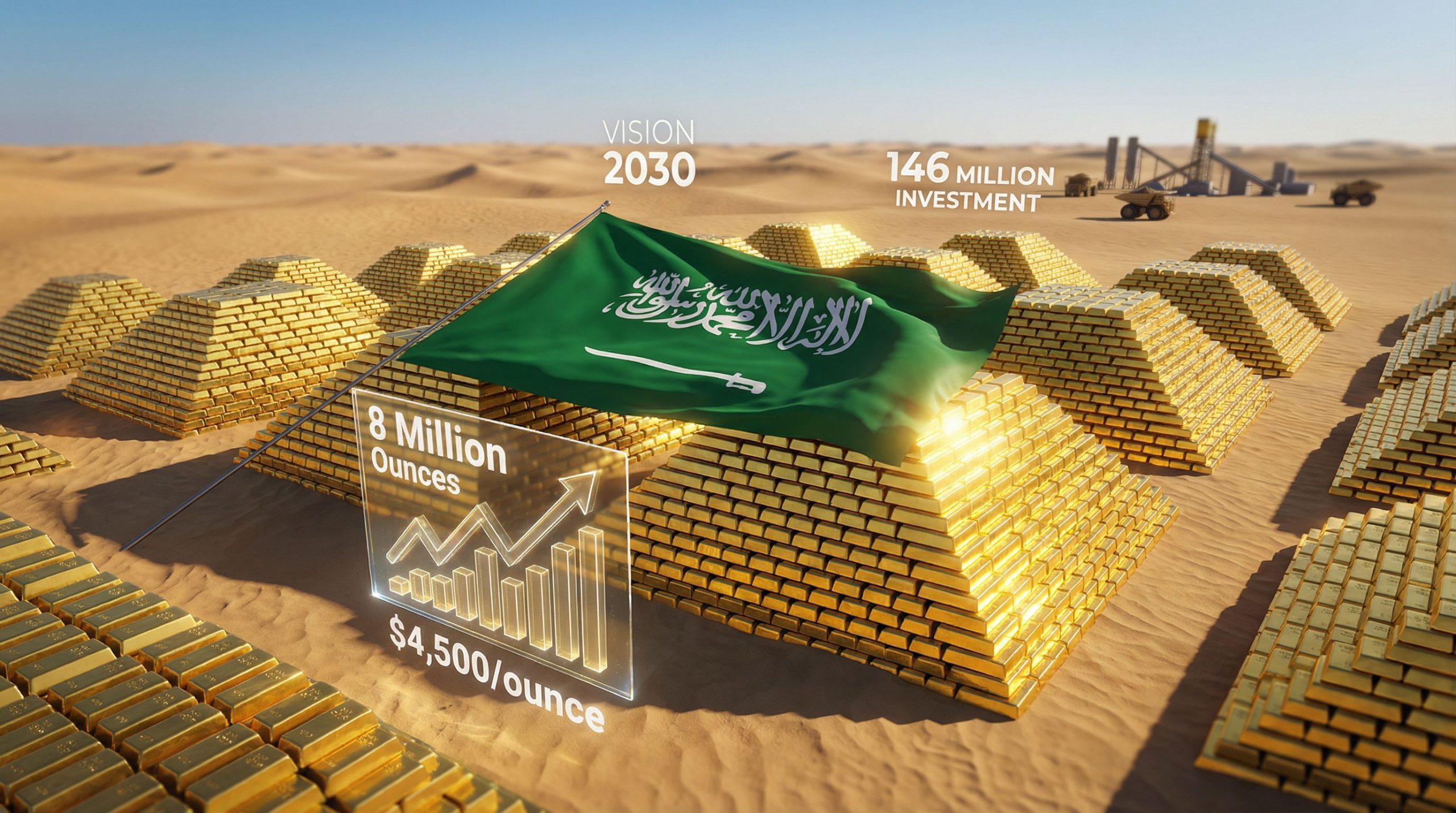
Saudi Arabia’s announcement of an eight-million-ounce gold discovery over the past year marks more than a geological milestone. It signals a strategic shift that could permanently alter global bullion flows, sustain elevated gold prices, and challenge long-established producers such as Ghana to rethink their place in the value chain.

For decades, the Middle East has functioned largely as a trading and refining hub for African gold. That era may be ending. Saudi Arabia is no longer positioning itself merely as a destination for bullion. It is becoming a competitor.
📢 GET A DETAILED ARTICLES + JOBS
Join ASJ's WhatsApp Channel and never miss a post or opportunity.

A Historic Gold Boom Meets a New Power Player
The timing of Saudi Arabia’s entry could not be more consequential. The global gold market experienced an unprecedented surge between 2025 and early 2026. Prices rose by more than 64 percent in 2025 alone, climbing from about $2,710 per ounce in January to average levels above $3,400 for much of the year, before peaking near $4,500 in December.
As of mid-January 2026, gold continues to trade at record levels around $4,600 per ounce, supported by geopolitical tensions, aggressive central bank reserve diversification, and heightened demand for safe-haven assets.

For gold-producing economies like Ghana, this rally has delivered extraordinary windfalls. According to data from the Ghana Gold Board (GoldBod), gold export revenues from the artisanal and small-scale mining sector alone reached approximately $10 billion in 2025. These inflows have strengthened reserves, supported the cedi, and offered temporary fiscal breathing room.
Yet Saudi Arabia’s discovery introduces a new variable. While demand remains strong, the entry of a heavily capitalised producer with ambitions across mining, refining, and branding could reshape how and where value is captured.
Why Ghana Cannot Ignore Saudi Arabia’s Strategy
Saudi Arabia is not approaching gold as a side project. Under its Vision 2030 agenda, the Kingdom is pursuing full vertical integration of its minerals sector. At the recent Future Minerals Forum, the Chairman of Saudi Gold Refinery Co., Suliman Al-Othaim, made it clear that the country intends to control the entire gold value chain, from aerial imaging and drilling to refining and internationally hallmarked bars.
The refinery alone is expected to process up to 36 tonnes of gold annually by 2030, backed by strong state financing and regulatory support. The goal is to achieve 50 percent local production within the decade.
This matters deeply for Ghana and other African exporters. A significant portion of Ghana’s gold, particularly from the small-scale sector, has historically been exported to Middle Eastern hubs such as Dubai for refining and onward trade. Saudi Arabia’s emergence threatens to rewire these long-standing routes.
Instead of African gold merely passing through the Middle East, it could increasingly compete directly with Saudi-produced and Saudi-refined bullion in global markets.
Opportunity and Risk for African Producers
In the short term, Saudi Arabia’s rise could create new trading opportunities. A new, well-funded refinery hub in Riyadh may offer competitive pricing and alternative routes for African exporters seeking diversification beyond Dubai.
However, the longer-term risk is structural. If African producers continue exporting largely unrefined bullion while new players build refining, branding, and logistics capacity, Africa risks remaining trapped at the bottom of the value chain, even during a historic price boom.
Ghana’s experience illustrates this dilemma clearly. In 2025 alone, the country exported over 100 metric tonnes of small-scale gold. Yet most of that gold left the country with minimal domestic value addition, limiting job creation, industrial learning, and downstream revenues.

Saudi Arabia’s strategy exposes the vulnerability of this model.
From Volume to Value: Ghana’s Strategic Imperative
The global gold rally has temporarily masked structural weaknesses in Ghana’s gold economy. High prices have boosted export earnings regardless of how the gold is processed. But price cycles do not last forever, and new supply sources inevitably alter bargaining power.
As competition intensifies, Ghana’s advantage will not lie in how much gold it produces, but in how much value it retains.
This is where policy urgency becomes unavoidable. Ghana must accelerate domestic refining capacity, strengthen assaying and hallmarking systems, and integrate gold into broader industrial and manufacturing strategies. Gold should support jewellery manufacturing, electronics inputs, and reserve accumulation, not just foreign refineries.
The work of institutions such as GoldBod in formalising small-scale production is a step in the right direction. But formalisation without value addition merely improves efficiency for external buyers.
The Bigger Global Shift
Saudi Arabia’s gold push also reflects a deeper global realignment. The Middle East is no longer content to serve as a transit point for African resources. It is positioning itself as a producer, processor, and price influencer.
At the same time, central banks across Asia, the Middle East, and parts of Africa are accumulating gold at record levels, reinforcing demand and supporting elevated prices. In this environment, control over supply chains and processing capacity matters as much as geological endowment.
For Ghana, the message is clear. The era when exporting raw gold was sufficient is closing fast.
Conclusion: A Narrow Window for Strategic Action
Saudi Arabia’s gold surge does not spell immediate trouble for Ghana. In fact, it underscores the enduring importance of gold in a fragmented global economy. But it does sharpen the strategic calculus.
With prices at historic highs and global competition intensifying, Ghana has a narrow window to reposition itself, not just as Africa’s leading gold producer, but as a serious value-adding hub.
The future of gold will not be decided by who digs the most out of the ground. It will be decided by who controls the chain from mine to market. Ghana still has time to choose where it stands in that race.

Source: Accra Street Journal
Last Updated on January 19, 2026 by Samuel Kwame Boadu
Disclaimer: Some content on Accra Street Journal may be aggregated, summarized, or edited from third-party sources for informational purposes. Images and media are used under fair use or royalty-free licenses. Accra Street Journal is a subsidiary of SamBoad Publishing Hub under SamBoad Business Group Ltd, registered in Ghana since 2014.
For concerns or inquiries, please visit our Privacy Policy or Contact Page.

Samuel Kwame Boadu is a Ghanaian media entrepreneur and storyteller with a passion for amplifying urban voices and uncovering everyday truths. He is the Editor-in-Chief and Founder of Accra Street Journal, a dynamic digital platform dedicated to capturing the pulse of Ghana’s capital—its people, culture, challenges, business, sports and innovations.