



Introduction: A Controversial Proposal
A heated transatlantic debate over slavery reparations has taken a dramatic new turn. Reform UK, the right-wing political party led by Nigel Farage, has announced a controversial policy proposal that would block new visas for citizens of countries—including Ghana, Nigeria, and several Caribbean nations—that formally demand reparations from Britain for its historical role in the transatlantic slave trade .
The proposal, outlined by the party’s home affairs spokesperson Zia Yusuf, would apply to all visa types, including visitor, work, and student visas, and would affect millions of potential travellers from Africa and the Caribbean . Reform UK has stated that “from this point” should any country formally demand reparations from Britain, a future Reform government would respond “by immediately halting the issuance of new visas to their nationals” .

The announcement comes just weeks after Ghana led a historic United Nations resolution declaring the transatlantic slave trade “the gravest crime against humanity,” a move that has significantly escalated global calls for reparatory justice . The resolution was adopted by 123 votes to three, with the UK abstaining .
📢 GET A DETAILED ARTICLES + JOBS
Join ASJ's WhatsApp Channel and never miss a post or opportunity.

What Reform UK Is Proposing
The Policy in Detail
Reform UK’s home affairs spokesman Zia Yusuf announced that the party would deny new visas to people from countries seeking slavery reparations from Britain if it formed the next government . The ban would cover all visa types, including those for visitors, work, and study .
The party has named several countries it considers to be making demands for reparations, including Ghana, Nigeria, Jamaica, Barbados, Kenya, Haiti, Guyana, and The Bahamas, among others . Reform UK said it would consider the establishment of national reparations committees or task forces, tabling motions at the UN, making high court claims, and official declarations as actions that would trigger the visa ban .
The Political Rationale
Yusuf argued that countries seeking reparations “ignore the fact that Britain made huge sacrifices to be the first major power to outlaw slavery and enforce this prohibition” . He stated that 3.8 million visas have been issued to people from countries calling for reparations over the last two decades, and that these countries have received £6.6 billion in foreign aid .
In a statement to the Telegraph, Yusuf declared: “The United Kingdom is not an ATM for ethnic grievances of the past, and we will no longer tolerate being ridiculed on the world stage. While countries like Jamaica, Nigeria and Ghana ramp up their demands for reparations, the Westminster establishment has rewarded them. Enough is enough” .
Speaking at a press conference in Warwickshire, Nigel Farage accused the UN of using affected nations as “pawns to attack everything this country is and has stood for” . He acknowledged that “there are parts of our past we wouldn’t be proud of,” but also pointed to Britain’s role in abolishing the slave trade as a point of national pride .
The 19 Countries Named
Reform UK listed 19 nations that would be affected by the proposal :
-
Antigua and Barbuda
-
Bahamas
-
Barbados
-
Belize
-
CARICOM (the regional bloc)
-
Dominica
-
Ghana
-
Grenada
-
Guyana
-
Haiti
-
Jamaica
-
Kenya
-
Montserrat
-
Nigeria
-
St. Kitts and Nevis
-
St. Lucia
-
St. Vincent and the Grenadines
-
Suriname
-
Trinidad and Tobago
The UN Resolution: Ghana’s Historic Leadership
A Landmark Vote
On March 25, 2026, the United Nations General Assembly adopted a landmark resolution declaring the Transatlantic Trafficking of Enslaved Africans and the system of racialised chattel enslavement as “the gravest crime against humanity” . The resolution was adopted with an overwhelming majority of 123 Member States voting in favour, three voting against (the United States, Israel, and Argentina), and 52 abstaining, including the United Kingdom .
The resolution was spearheaded by Ghana and strongly supported by the African Union. Ghana’s leadership in championing this resolution reflects a deliberate and strategic effort to move global discourse on slavery beyond symbolic acknowledgment toward institutional accountability and reparatory justice .
President Mahama’s Statement
Speaking at a high-level event on reparatory justice held in New York on March 24, 2026, the President of Ghana, H.E. John Dramani Mahama, reiterated the significance of this landmark decision, stating: “This resolution is a pathway to healing and reparative justice. This resolution is a safeguard against forgetting” .
His words capture the dual purpose of the resolution: to honour the memory of the millions whose lives were stolen and to lay the foundation for a more just international order—one that confronts historical truth while building mechanisms for equitable futures .
Ghana’s Foreign Minister Responds
Ghanaian Foreign Minister Samuel Okudzeto Ablakwa, speaking to the BBC in March, clarified what reparations mean for affected nations: “We are demanding compensation — and let us be clear, African leaders are not asking for money for themselves. We want justice for the victims and causes to be supported, educational and endowment funds, skills training funds .
The UK Government’s Position
Official Stance
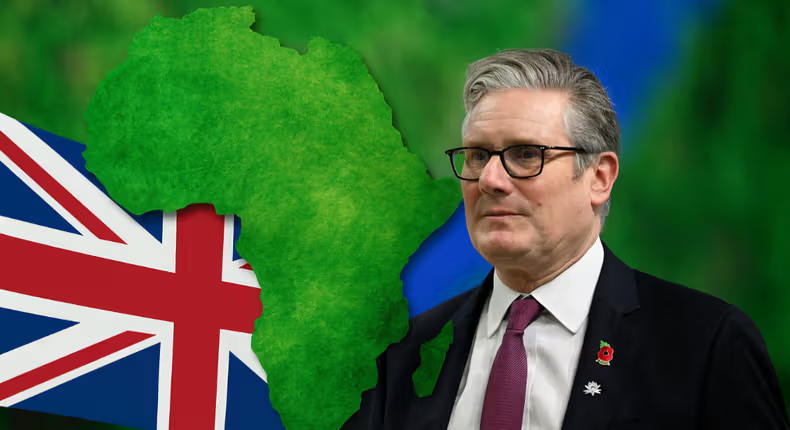
The UK government has distanced itself from Reform UK’s proposal. A spokesperson for the Foreign Office acknowledged the lasting impact of slavery but reiterated that its position on reparations remains unchanged. Labour leader and Prime Minister Keir Starmer has ruled out both an apology and financial compensation, emphasising a forward-looking approach [source article].
The Abstention Controversy
The UK abstained from the UN resolution vote rather than voting against it, a decision that drew criticism from Conservative Party leader Kemi Badenoch. Writing on her X handle, Badenoch, who is of Nigerian descent, criticised the Labour government for abstaining instead of voting against the resolution .
She wrote: “Russia, China and Iran vote with others to demand trillions in reparations from UK taxpayers…and the Labour government abstain! Britain led the fight to end slavery. Why didn’t Starmer’s representative vote against this? Ignorance…or cowardice? We shouldn’t be paying for a crime we helped eradicate and still fight today” .
The Labour Response
A Labour Party spokesperson dismissed Reform UK’s visa proposal as a “desperate gimmick” that would do nothing to restore order and control to Britain’s borders . The spokesperson added that “nobody will take Nigel Farage seriously on this when his party is full of opportunistic Tories who failed on immigration when they were in government” .
The Liberal Democrats also criticised the proposal. Immigration and asylum spokesperson Will Forster accused Reform of “chasing cheap headlines by threatening our allies,” adding that the proposal would “damage our economy and our public services” .
Global Reactions
Caribbean Community (CARICOM)
The Caribbean Community (Caricom), a grouping of 21 countries, issued its 10-point plan for “reparatory justice” more than a decade ago. This included asking for a full formal apology, cancelling foreign debts, and investment to tackle illiteracy and public health issues .
The African Union
The African Union has declared 2025 as the “Year of Reparations” and 2026-2036 as the “AU Decade for Reparations” . The African Commission on Human and Peoples’ Rights welcomed the UN resolution, stating that it “carries considerable moral, political, and normative weight” and calls on the international community to “engage in meaningful dialogue on reparations, including measures such as formal apologies, restitution, and guarantees of non-repetition” .
The Broader Context: Aid Cuts and Shifting Policy
The Aid Budget Reduction
Reform UK has also pledged to slash Britain’s foreign aid budget to £1 billion annually (approximately $1.25 billion), representing a cut of about 90 percent from current levels [source article]. The current UK government has already reduced aid spending from 0.5% of GDP to 0.3%, with the savings redirected to increase defence spending .
Bilateral aid to Africa will fall by 56%, with severe cuts in some of the continent’s poorest countries. Health services for women and children in Somalia will be reduced, while 250,000 people will lose access to family planning in Malawi .
The Historical Debate
The debate over reparations has intensified globally in recent years. Countries such as Ghana, alongside regional bodies like the Caribbean Community and the African Union, have stepped up calls for formal apologies, restitution of looted artefacts, and broader reparatory justice.
Successive UK governments have rejected calls for reparations. In March 2026, Conservative Party leader Kemi Badenoch said the UK should not pay compensation for “a crime we helped eradicate and still fight today” .
What This Means for Ghanaians
Current Impact
It is important to note that Reform UK is not the governing party. The proposal remains a policy position of an opposition party and has no current legal force. The UK government has distanced itself from the proposal, and a Labour spokesperson has dismissed it as a “desperate gimmick” .
Potential Future Implications
Should Reform UK gain sufficient political influence or form a future government, the proposal could have significant implications for Ghanaian travellers, students, and professionals seeking to visit, study, or work in the United Kingdom. The proposal would affect all visa types, including visitor, work, and study visas .
For now, the standard UK visa application process for Ghanaians remains unchanged.
Frequently Asked Questions (FAQs)
1. What has Reform UK proposed regarding visas for Ghanaians?
Reform UK has proposed blocking new visas for citizens of countries—including Ghana—that formally demand slavery reparations from Britain. The ban would apply to all visa types, including visitor, work, and student visas .
2. Why has Ghana been named in this proposal?
Ghana led the United Nations resolution declaring the transatlantic slave trade “the gravest crime against humanity” and has been at the forefront of calls for reparatory justice. The resolution was adopted on March 25, 2026 .
3. Is this policy currently in effect?
No. Reform UK is an opposition party, not the governing party. The proposal has no current legal force, and the UK government has distanced itself from it .
4. How has the UK government responded?
A Labour Party spokesperson dismissed the proposal as a “desperate gimmick.” The Foreign Office has reiterated that the UK’s position on reparations remains unchanged, with Prime Minister Keir Starmer ruling out both an apology and financial compensation .
5. What was the UN resolution about?
The UN resolution, spearheaded by Ghana, declared the transatlantic slave trade “the gravest crime against humanity.” It was adopted by 123 votes to three, with the UK abstaining .
6. What does Ghana say about reparations?
Ghanaian Foreign Minister Samuel Okudzeto Ablakwa stated that African leaders are not asking for money for themselves but for “justice for the victims and causes to be supported, educational and endowment funds, skills training funds” .
7. Which other countries are affected by the proposal?
The proposal names 19 countries, including Nigeria, Jamaica, Barbados, Kenya, Haiti, Guyana, and several Caribbean nations .
8. What has Nigel Farage said about this policy?
Nigel Farage accused the UN of using affected nations as “pawns to attack everything this country is and has stood for,” while acknowledging that “there are parts of our past we wouldn’t be proud of” .
9. How has the Caribbean Community responded?
Caricom issued its 10-point plan for “reparatory justice” over a decade ago, including calls for a formal apology, debt cancellation, and investment in education and public health .
10. What is the African Union’s position?
The African Union has declared 2025 as the “Year of Reparations” and 2026-2036 as the “AU Decade for Reparations,” supporting Ghana’s leadership on this issue .
Conclusion: A Growing Transatlantic Divide
The clash between Reform UK’s visa threat and Ghana’s leadership on reparatory justice represents a significant escalation in the transatlantic debate over historical accountability. For Ghana, the UN resolution was a diplomatic triumph—a long-sought recognition of the scale and enduring impact of the transatlantic slave trade . For Reform UK, it is a provocation demanding a强硬 response .
The coming months will reveal whether other nations align with Ghana’s position and whether the UK government will adjust its stance. The issue is gaining traction globally, with over 120 countries backing the UN resolution . This sets the stage for a potentially divisive clash between historical accountability and modern diplomatic relations.
The debate is far from settled. It is intensifying.
Frequently Asked Questions (FAQs)
1. What has Reform UK proposed regarding visas for Ghanaians?
Reform UK has proposed blocking new visas for citizens of countries—including Ghana—that formally demand slavery reparations from Britain .
2. Why has Ghana been named in this proposal?
Ghana led the UN resolution declaring the transatlantic slave trade “the gravest crime against humanity .
3. Is this policy currently in effect?
No. Reform UK is an opposition party; the proposal has no current legal force .
4. How has the UK government responded?
A Labour spokesperson dismissed the proposal as a “desperate gimmick” .
5. What was the UN resolution about?
It declared the transatlantic slave trade “the gravest crime against humanity” and called for reparatory justice .
6. What does Ghana say about reparations?
Ghana’s Foreign Minister stated that African leaders seek “justice for the victims” and funding for educational and skills training programmes .
7. Which other countries are affected by the proposal?
Nineteen countries, including Nigeria, Jamaica, Barbados, Kenya, and Haiti .
8. What has Nigel Farage said about this policy?
Farage accused the UN of using affected nations as “pawns to attack everything this country is and has stood for” .
9. How has the Caribbean Community responded?
Caricom has a 10-point plan for “reparatory justice,” including formal apologies and debt cancellation .
10. What is the African Union’s position?
The AU has declared 2025 the “Year of Reparations” and 2026-2036 the “AU Decade for Reparations”
Source: Accra Street Journal
Last Updated on April 7, 2026 by Samuel Kwame Boadu
Disclaimer: Some content on Accra Street Journal may be aggregated, summarized, or edited from third-party sources for informational purposes. Images and media are used under fair use or royalty-free licenses. Accra Street Journal is a subsidiary of SamBoad Publishing Hub under SamBoad Business Group Ltd, registered in Ghana since 2014.
For concerns or inquiries, please visit our Privacy Policy or Contact Page.

Samuel Kwame Boadu is a Ghanaian media entrepreneur and storyteller with a passion for amplifying urban voices and uncovering everyday truths. He is the Editor-in-Chief and Founder of Accra Street Journal, a dynamic digital platform dedicated to capturing the pulse of Ghana’s capital—its people, culture, challenges, business, sports and innovations.