








Once teetering on the edge of insolvency with a negative capital adequacy ratio, CalBank executed one of Ghana’s most dramatic banking turnarounds. This is the story of asset quality recovery, the “BeINsured” gamble, and whether the worst is truly over.

Executive Introduction
In the annals of Ghanaian banking, the line between “too big to fail” and “too reckless to save” is often blurred by a single variable: capital. Between 2023 and 2024, CalBank PLC (GSE: CAL) found itself on the wrong side of that line. With a Capital Adequacy Ratio (CAR) plunging to negative territory (-6.38%) and nearly half its loan book turning toxic (47.5% NPL ratio), the mid-tier lender looked like a candidate for a distressed merger rather than a recovery story .
Yet, as of the 2025 audited results, a phoenix has risen. Oversubscribed rights issues, a leaner cost structure, and a pivot toward digital micro-insurance have pulled CalBank back from the brink. But for investors and corporate clients, a critical question lingers: Is this a structural turnaround or a temporary sugar rush fueled by one-off recovery gains?
📢 GET A DETAILED ARTICLES + JOBS
Join ASJ's WhatsApp Channel and never miss a post or opportunity.
This profile dissects CalBank’s business model, its near-death experience, the strategic gamble on USSD insurance (BeINsured), and the competitive realities of competing against banking giants like Stanbic and Ecobank in a crowded SME space.
Company Overview
Background & Niche
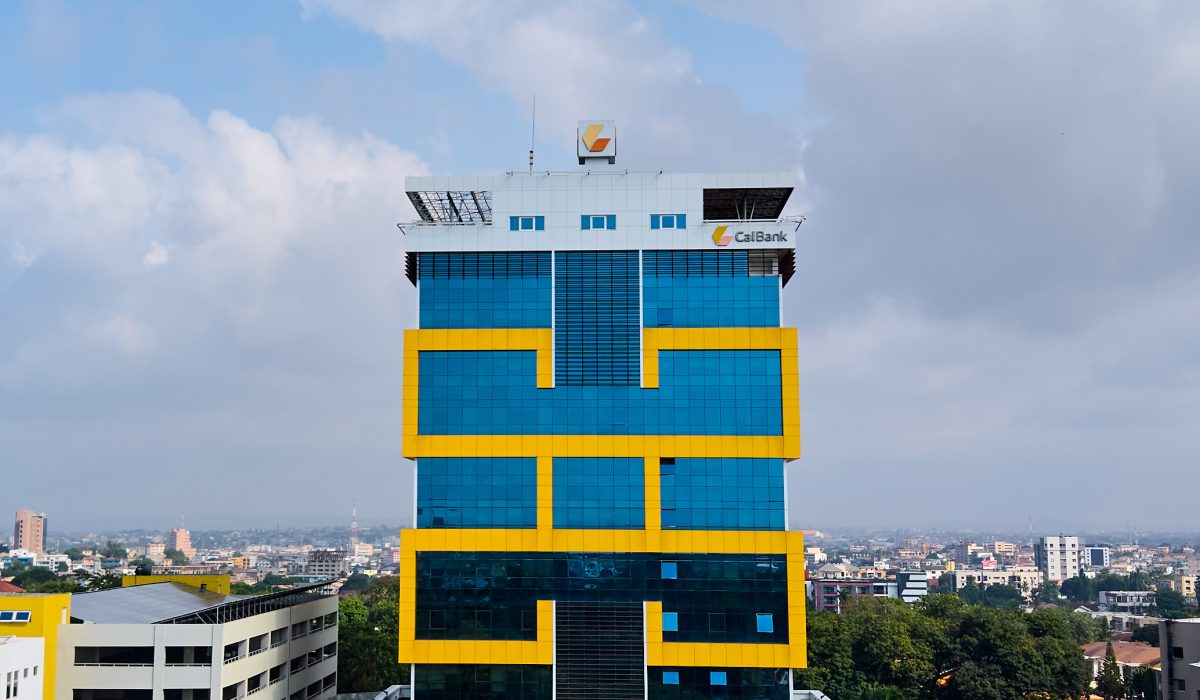
Founded in July 1990, CalBank established itself as a niche player in corporate and project finance . Unlike the consumer-heavy giants (GCB) or the pan-African behemoths (Ecobank), CalBank historically punched above its weight in structured trade finance and commercial real estate. Its headquarters at 23 Independence Avenue in Accra serves as the command center for a network of approximately 33 branches .
The Ownership Reset
The most significant shift in 2025 was the ownership and capital structure. A fully subscribed GHS 900 million Rights Issue dramatically rebuilt shareholder equity, taking it from GHS 217.3 million to GHS 1.53 billion . This influx diluted previous holdings but brought in institutional stability. Major holders now include international frontier funds like Robeco Afrika Fonds NV (holding ~2.63%) .
Leadership
The architect of the recovery is Carl Selasi Asem, the Managing Director, supported by Johnson Delali Oware (Deputy MD). Crucially, the bank has bolstered its risk functions with Sadick Arthur as Chief Risk Officer and Albert Timothy Ghansah as Chief Technology Officer, signaling that technology and risk management are no longer afterthoughts but core pillars . Daniel Nii Kwei-Kumah Sackey chairs the board, tasked with ensuring the governance failures of the past do not resurface .
Business Model: The “Three-Legged Stool”
CalBank operates a diversified universal banking model, structured into four reporting segments, though its revenue tells a specific story .
1. Treasury (The Cash Engine)
Historically, Treasury has been the volatile heartbeat of CalBank, contributing heavily to net trading income. In 2025, Net Trading Income surged 65.7% to GHS 150 million . In the context of a Cedi that remains volatile, the bank has proven adept at positioning its fixed-income portfolio to capture yields on Ghanaian government treasuries.
2. Corporate & Project Finance (The Anchor)
This is the bank’s traditional DNA—lending to oil and gas, infrastructure, and large-scale agriculture. While this segment suffered massive impairments during the economic crisis (leading to the NPL spike), it remains a core competency. The 2026 strategy, however, is one of severe selectivity: high-quality obligors only .
3. Consumer, Retail & SME Banking (The Growth Bet)
CalBank is attempting to rebalance away from wholesale corporate risk toward granular retail and SME assets. This is lower-yielding but safer. The bank ranked 3rd in SME Banking Customer Experience in the 2025 KPMG survey (score 82.3), trailing only Access Bank and Absa . This suggests that while they are not the largest, they are trusted by small business owners.
How They Make Money
For the full year 2025:
-
Net Interest Income: GHS 513.6 million (up 12.8%), reflecting disciplined pricing.
-
Fees & Commissions: GHS 211.7 million (up 17.9%), driven by digital transaction volumes.
-
Net Trading Income: GHS 150.0 million (up 65.7%), reflecting opportunistic treasury management .
-
Net profit margin: A healthy 23.66% .
Market Position & Competition
CalBank operates in a brutal oligopoly. It is not the largest (Ecobank holds the asset crown) nor the most profitable (Stanbic dominates corporate margins). However, it has carved out a distinct “relationship banking” niche.
The Experience War
Data from the 2025 KPMG Survey reveals a paradox: CalBank is not a digital-first leader (Standard Chartered wins there), but it wins on “Empathy” and “Responsiveness.” In the StratComm Africa survey, CalBank tied for top spot in overall customer service satisfaction (81%), specifically leading in “Responsiveness” (willingness to help) and “Assurance” .
Competitive Advantages (Surviving the Giants)
-
Agility: Unlike the pan-African banks with rigid credit scoring models from London or Johannesburg, CalBank’s commercial banking heads have local discretion.
-
Cost Discipline: Operating expenses were slashed to GHS 224.4 million in 2025 from GHS 292.2 million in 2024 . They are leaner than most Tier-1 banks.
-
The Recovery Unit: CalBank has turned its “Remedial and Recoveries” department into a profit center. A net impairment gain of GHS 193.7 million suggests they are aggressively suing or restructuring defaulted loans to recover value .
Digital Strategy & Innovation: The “BeINsured” Leap
CalBank lacks the budget to out-spend MTN or Ecobank on core banking AI. Instead, it is pursuing utility-driven innovation.
The BeINsured Platform
In a groundbreaking partnership with MTN Ghana and Bluespace, CalBank launched “BeINsured,” Ghana’s first USSD-based auto insurance marketplace .
-
The Mechanism: Allows vehicle owners to buy insurance, pay premiums, and file claims via basic feature phones (no internet required).
-
The Genius: It leverages MTN Mobile Money for payments, turning CalBank into the invisible banking layer behind the transaction.
-
Strategic Value: Auto insurance is mandatory in Ghana but has low penetration due to bureaucracy. By digitizing the funnel, CalBank collects low-risk, high-volume fee income without originating a loan .
Inclusive Banking
Headed by Martha Acquaye, the bank is moving away from “branch-led” growth to “agent-led” growth. The focus is on lowering the cost-to-serve, enabling them to offer micro-loans to informal traders—a segment the larger banks find too expensive to service manually .
Challenges & Risks
Despite the stellar 2025 report, the risk register remains orange—not green.
1. The Phantom NPLs (17% is still toxic)
While the NPL ratio dropped from 47.5% to 17%, this is still double the industry target . A 17% bad loan ratio means that for every GHS 1 million lent, GHS 170,000 is not paying interest. If the Ghanaian economy stalls in 2026, these legacy loans could re-default.
2. Earnings Contraction (The 5-Year Trap)
Over five years, CalBank’s earnings have contracted at an average rate of 9.7% annually . The 2025 profit surge is a rebound from an abysmally low base. The bank needs to prove it can grow new assets, not just recover old losses.
3. Governance Scars
The AGM in 2026 was tense. Management explicitly admitted to a lack of “shared vision” in past years . For institutional investors, the question is whether the new board has truly exorcised the ghosts of reckless lending that plagued the pre-2024 era.
4. Shareholder Dilution
The GHS 900 million rights issue was necessary for survival, but it punished retail investors who could not afford to participate. While the stock has a 110.2% 12-month change , this recovers value for those who stayed, but the dilution of voting rights is permanent.
Economic & Industry Impact
Employment & SME Lifeline
With roughly 1,046 employees , CalBank is a mid-tier employer. However, its impact on SME employment is larger. As the third-best bank for SME experience, it acts as the working capital provider for traders in Makola and spare part dealers in Abossey Okai.
Financial Inclusion via Insurance
The “BeINsured” platform is a masterclass in embedded finance. It allows commercial drivers—who often operate on thin margins—to avoid police impoundment by buying digital proof of insurance instantly. This formalizes the informal transport sector, increasing tax and premium revenue for the state .
Future Outlook
CalBank enters 2026 as a “show me” stock. The transformation is technically complete (capital restored), but the growth engine needs fuel.
The Bull Case (Optimistic)
-
The NPL ratio drops to single digits (sub-10%) by end of 2026.
-
BeINsured scales to other products (life, health, property), generating GHS 50M+ in non-funded income.
-
Return on Equity (currently a healthy 32.88%) attracts foreign institutional money .
-
Target: A re-rating of the P/E from ~5.58x to 8x.
The Bear Case (Pessimistic)
-
The Ghanaian Cedi depreciates sharply, spooking the treasury gains.
-
Sticky inflation forces the Bank of Ghana to raise rates, suppressing demand for new credit.
-
A major corporate client in the “Remedial” unit collapses, resulting in a write-off that wipes out quarterly profits.
-
Risk: Stagnation as a “recovery bank” rather than a growth bank.
The Verdict
CalBank is arguably the most interesting turnaround story on the GSE right now, but it is not for the risk-averse. Management has done the hard work of cleaning the stables. The digital pivot is intelligent and cost-effective. However, the legacy asset quality remains a sword hanging over the balance sheet. For corporate clients, CalBank offers high-touch service; for investors, it offers high-beta exposure to Ghana’s recovery—with the corresponding risk of relapse.
FAQ SECTION
1. Is CalBank a Tier-1 bank in Ghana?
No. While it is a significant player and publicly listed, it is generally classified as a Tier-2 or mid-tier bank by asset size (GHS 11.93 billion) compared to giants like Ecobank (GHS 46 billion) or GCB. However, in terms of SME banking and customer service, it competes directly with Tier-1 players .
2. What caused CalBank’s near-collapse in 2023-2024?
The bank suffered from extremely high Non-Performing Loans (NPLs) that hit 47.5%. This was driven by corporate borrowers defaulting during Ghana’s economic crisis (Cedi devaluation & high inflation), combined with the Domestic Debt Exchange Program (DDEP) that eroded the value of its treasury holdings .
3. How did CalBank survive the crisis?
Survival came via an oversubscribed GHS 900 million Rights Issue in 2025, which restored its Capital Adequacy Ratio (CAR) from -6.38% to 19.80%, well above the regulatory floor of 13% .
4. What is ‘BeINsured’ and why does it matter for investors?
BeINsured is Ghana’s first USSD-based auto insurance marketplace, built in partnership with MTN. It allows drivers to buy insurance via feature phone. For investors, it represents a high-volume, low-risk fee income stream that does not rely on loan growth .
5. Who is the current CEO of CalBank?
The Managing Director is Carl Selasi Asem. He has been leading the bank through its “Growth, Transformation, and Returns” phase following the capital rebuild .
6. Is CalBank a good investment after the rights issue?
It depends on your risk appetite. The stock has rebounded (110% 12-month change) and trades at a low P/E of ~5.58x. However, the NPL ratio is still high (17%), and earnings have contracted over 5 years. It is a “turnaround play” rather than a “dividend aristocrat” .
7. How does CalBank compare to Stanbic in corporate banking?
Stanbic leads the corporate banking segment with a CX score of 88.8, excelling in resolution and relationship management. CalBank is competitive but generally focuses on mid-cap corporates rather than the large multinationals that Stanbic targets .
8. What is the bank’s dividend policy?
Historically, the bank conserved cash during the crisis to rebuild capital (2023-2024). As of the 2025 results, the focus is on sustainable growth. Investors should watch for announcements regarding the resumption of dividend payments in the 2026 fiscal year, contingent on further NPL reduction .
9. What is CalAsset Management?
CalAsset Management is the bank’s wholly-owned investment management subsidiary. It provides asset management, portfolio management, and investment advisory services, representing a small but growing non-bank revenue stream for the group .
10. Does CalBank offer mobile banking?
Yes. While they may not have the highest digital penetration compared to Standard Chartered, they have a robust digital strategy focused on USSD (BeINsured) and mobile app onboarding. Their digital solutions unit is led by Emmanuel Kwabena Yeboah .
QUICK FACTS BOX
| Item | Details |
|---|---|
| Founded | July 1990 |
| Headquarters | 23 Independence Avenue, Accra, Ghana |
| Industry | Banking / Financial Services |
| Services | Corporate & Project Finance, Treasury, Retail Banking, Brokerage, Asset Management |
| Stock Ticker | GSE: CAL |
| CEO (MD) | Carl Selasi Asem |
| Board Chairman | Daniel Nii Kwei-Kumah Sackey |
| Market Position | Mid-Tier / Turnaround Bank |
| Operational Footprint | ~33 Branches |
| Total Assets (2025) | GHS 11.93 Billion |
| Total Equity (2025) | GHS 1,528.4 Million |
| Capital Adequacy Ratio | 19.80% (as of Dec 2025) |
| NPL Ratio | 17% (as of Dec 2025, down from 47.5%) |
| Key Innovation | BeINsured (USSD Auto Insurance Marketplace) |
Source: Accra Street Journal
Last Updated on May 3, 2026 by Samuel Kwame Boadu
Disclaimer: Some content on Accra Street Journal may be aggregated, summarized, or edited from third-party sources for informational purposes. Images and media are used under fair use or royalty-free licenses. Accra Street Journal is a subsidiary of SamBoad Publishing Hub under SamBoad Business Group Ltd, registered in Ghana since 2014.
For concerns or inquiries, please visit our Privacy Policy or Contact Page.

Samuel Kwame Boadu is a Ghanaian media entrepreneur and storyteller with a passion for amplifying urban voices and uncovering everyday truths. He is the Editor-in-Chief and Founder of Accra Street Journal, a dynamic digital platform dedicated to capturing the pulse of Ghana’s capital—its people, culture, challenges, business, sports and innovations.