










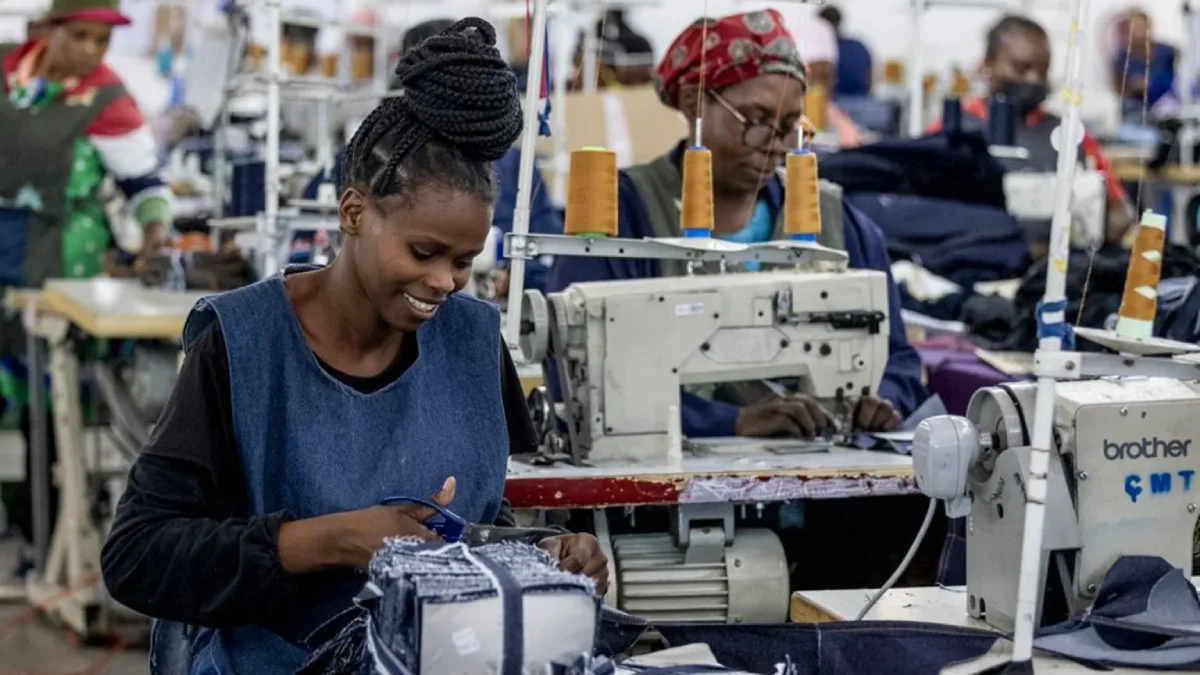
Financing constraints continue to slow expansion in Ghana’s garment and textile industry, with stakeholders warning that limited access to affordable, long-term credit is restricting productivity, industrial scaling, and competitiveness across the value chain. At a recent multi-stakeholder workshop convened under the Sector Network for Economic Development in Africa (NEDA)—an internal learning platform of GIZ implemented under the German Federal Ministry for Economic Cooperation and Development’s Invest for Jobs initiative—participants from financial institutions, development partners, and garment manufacturing firms examined structural financing challenges and possible solutions.
The workshop reviewed a proposed catalytic financing framework developed under a study titled “Modelling of context-tailored Catalytic Capital Scheme for SMEs in the textile and agribusiness sectors in Ghana and Nigeria.” The model seeks to mobilise private capital from financial institutions, development finance institutions (DFIs), and philanthropic investors, while leveraging technical support from development cooperation partners. Key proposals include a guarantee fund targeted at growth-stage enterprises and scaling manufacturers to support financing for raw materials and machinery acquisition, and a concessional “sidecar matching facility” aimed at supporting industrial manufacturers with long-term capital expenditure financing.

The Ministry of Trade, Agribusiness and Industry and the Association of Ghana Apparel Manufacturers (AGAM) emphasised the need for coordinated policy and industry alignment. Development partners including GIZ, the International Labour Organisation (ILO), and the Jobs for Economic Transformation (JET) initiative highlighted that financing interventions must be complemented with technical assistance to make firms “investment-ready.”
📢 GET A DETAILED ARTICLES + JOBS
Join ASJ's WhatsApp Channel and never miss a post or opportunity.

Key Developments: The Financing Gap, Catalytic Capital Proposals, and Stakeholder Alignment
The garment and textile sector has long been identified as a priority for Ghana’s industrialisation agenda. The government’s flagship “One District, One Factory” (1D1F) programme includes textile and garment factories. The African Continental Free Trade Area (AfCFTA) offers potential for regional value chains. The sector is labour-intensive, meaning that growth translates directly into jobs—a critical need for an economy that must create over 500,000 new jobs annually to absorb young entrants to the labour market.
Yet the sector remains undercapitalised. The workshop discussions centred on what stakeholders described as a persistent “lack of affordable, long-term capital” for SMEs, which constitute the majority of firms in the textile and apparel value chain. Traditional commercial banks are reluctant to lend to garment manufacturers for several reasons: the sector is perceived as risky (fashion is volatile, orders are unpredictable), collateral is often inadequate (machinery depreciates quickly, buildings may be rented), and loan tenors are mismatched (banks prefer short-term working capital loans; manufacturers need long-term financing for machinery and facility expansion).

The proposed catalytic financing framework addresses these gaps by layering risk mitigation and concessional capital. The guarantee fund would cover a portion of lender losses in the event of default, reducing the bank’s risk exposure. This is a well-established mechanism: guarantee schemes have been used successfully in other sectors (agriculture, renewable energy) and other countries. The key design questions are: what percentage of the loan is guaranteed? (typically 50% to 70%); what fees are charged to the borrower? (must be affordable); and what is the eligibility criteria? (targeting growth-stage enterprises).
The concessional “sidecar matching facility” is a more innovative instrument. A sidecar facility runs alongside a commercial loan: the commercial bank provides a portion of the financing at market rates, while a DFI or philanthropic investor provides the remainder at below-market rates. The blended rate is lower than the commercial rate alone, making the total financing more affordable. The facility is “matching” because the concessional funds are only available if the commercial bank also commits funds. This aligns incentives: the bank has skin in the game.
The workshop also emphasised technical assistance. Financing alone is insufficient if firms lack the capacity to use capital effectively. Technical assistance can include: productivity improvement (lean manufacturing, quality control), compliance standards (social and environmental certifications required by international buyers), and enterprise management (financial management, marketing, supply chain coordination). The development partners—GIZ, ILO, JET—are well-positioned to provide this assistance.
The Ministry of Trade, Agribusiness and Industry and AGAM stressed the need for coordinated policy and industry alignment. This is a recurring theme in Ghana’s industrial policy: fragmentation across ministries, agencies, and development partners leads to duplication and inefficiency. A single, coordinated financing facility, with clear eligibility criteria and a single application process, would be more effective than multiple, uncoordinated schemes.
Financial institutions also highlighted the importance of risk-sharing mechanisms. Banks are not opposed to lending to garment manufacturers; they are opposed to taking the entire risk. A guarantee fund that shares the risk would unlock credit. The banks also want to see a pipeline of investment-ready firms—businesses with credible business plans, audited financial statements, and clear growth projections.
Analysis & Implications: The Cost of Inaction and the Opportunity of AfCFTA
The cost of doing nothing is high. Ghana’s garment and textile industry employs around 30,000 to 40,000 people, mostly in small-scale businesses. In contrast, Ethiopia’s garment sector, boosted by major foreign investment from China, Bangladesh, and European brands, employs over 50,000 workers and exports more than $200 million annually. Kenya’s apparel exports topped $200 million annually and reached $500 million in 2025. Ghana’s exports are only a small fraction of these figures.
The opportunity of the African Continental Free Trade Area (AfCFTA) is significant. Under AfCFTA, apparel assembled in Ghana using fabric sourced from another African country can qualify for preferential tariffs. This could create regional value chains: for example, fabric produced in Nigeria or Egypt, cut and sewn in Ghana, and exported to South Africa or Morocco. However, to seize this opportunity, Ghanaian manufacturers need financing to upgrade equipment, train workers, and meet quality standards.
The catalytic capital model is not new, but its application to Ghana’s garment sector is welcome. The model has been used successfully in other contexts: the African Development Bank’s Facility for Energy Inclusion uses catalytic capital to unlock private investment in renewable energy; the IFC’s SME Ventures programme uses a similar approach for equity investments. The garment sector is a good candidate because it is labour-intensive, has clear growth potential, and can absorb capital productively.
The “investment-ready” concept is crucial. Technical assistance to improve productivity, compliance, and management capacity is not a nice-to-have; it is a prerequisite for successful financing. A firm that cannot produce consistent quality, that lacks social compliance certifications (required by international buyers), or that has poor financial records will struggle to repay any loan, regardless of the interest rate. Development partners should prioritise technical assistance before, or alongside, the provision of catalytic capital.

The role of anchor buyers is also important. International brands (H&M, Zara, Nike) and regional retailers can support SME financing by providing purchase order guarantees or supply chain financing. If a brand commits to buying a certain volume of garments from a Ghanaian manufacturer, that manufacturer can use the purchase order as collateral for a loan. This de-risks the transaction for the bank. The catalytic capital model could be extended to include buyer guarantees.
The Accra Street Journal notes that Ghana’s garment sector has been here before. Previous initiatives—the National Garment and Textile Industry Revitalisation Programme, the Export Development and Agricultural Investment Fund (EDAIF) textile component—have had limited impact. The catalytic capital model is more sophisticated than previous efforts, but its success will depend on implementation. A well-designed facility that is poorly executed will fail. A poorly designed facility will also fail. The devil is in the details.
What This Means for Ghanaian Garment Manufacturers, Financial Institutions, and Policymakers
For garment manufacturers, the catalytic capital model offers hope of affordable, long-term financing. The guarantee fund would reduce collateral requirements; the sidecar facility would lower interest rates. However, manufacturers must be prepared to meet eligibility criteria: formal registration, audited accounts, a credible business plan, and a demonstrated ability to produce quality garments. Manufacturers who are informal, undocumented, or operating on a subsistence basis will not qualify.
For financial institutions, the model offers a way to lend to a sector they have historically avoided. The guarantee fund shares the risk; the sidecar facility reduces the effective interest rate, making the loan more affordable to the borrower without reducing the bank’s return (the DFI or philanthropic investor absorbs the subsidy). Banks should work with development partners to design a facility that meets their risk-return requirements.
For policymakers, the priority is coordination. The Ministry of Trade, the Ministry of Finance, the Bank of Ghana, and development partners must align on a single facility, not multiple, competing facilities. The facility should be managed by a credible institution (perhaps the Development Bank Ghana) with clear governance, transparent criteria, and independent monitoring. The government should also consider complementary policies: improving the business environment, reducing the cost of electricity (garment factories are energy-intensive), and negotiating trade agreements that provide preferential access to large markets.
The ILO, GIZ, and JET can play a critical role in technical assistance. Their comparative advantage is not in providing capital (they have limited funds) but in building capacity. They should focus on making firms investment-ready: training on productivity, quality, compliance, and management. They should also work with financial institutions to build their capacity to assess garment sector lending.
The Accra Street Journal’s assessment: the catalytic capital model is promising but not a silver bullet. Financing is one barrier; others include unreliable electricity, slow customs clearance, limited access to markets, and competition from cheap imports (including second-hand clothing, or “obroni wawu,” and low-cost Asian textiles). Addressing these barriers requires a comprehensive industrial policy, not a single financing facility. The catalytic capital model can help, but it cannot solve all problems.
Wider Context: SME Financing in Africa and the Catalytic Capital Movement
The challenge of SME financing is not unique to Ghana’s garment sector. Across Africa, SMEs account for the majority of employment (approximately 80%) but receive less than 20% of bank credit. The gap exists because banks perceive SMEs as risky, costly to serve, and lacking collateral. Catalytic capital—capital that is patient, concessionary, or risk-bearing—is designed to bridge this gap.
The catalytic capital movement has grown in recent years. The World Bank‘s Guarantee Platform, discussed elsewhere, is a large-scale example. The Africa Guarantee Fund, established by the AfDB and DFIs, provides guarantees to banks lending to SMEs. The IFC’s SME Ventures programme provides equity. Philanthropic investors (e.g., the Mastercard Foundation, the Rockefeller Foundation) are increasingly active in this space.
The garment sector is a good candidate for catalytic capital because it has a clear pathway to growth. A garment manufacturer that receives financing for machinery can increase production capacity, meet larger orders, and generate revenue to repay the loan. The sector is also labour-intensive, so growth translates directly into jobs. The catalytic capital model is not appropriate for all sectors; it works best where there is a clear “investment-to-output-to-repayment” chain.
The comparison with Ethiopia and Kenya is instructive. Ethiopia’s garment sector grew rapidly with foreign direct investment (Chinese and Bangladeshi firms) attracted by cheap electricity, low wages, and export incentives. Kenya’s sector grew with a mix of local and foreign investment, supported by trade agreements (AGOA) and a more developed financial sector. Ghana has neither the foreign investment of Ethiopia nor the financial depth of Kenya. Catalytic capital is a way to jumpstart growth without waiting for either.
The future of the garment sector in Ghana will depend on whether the catalytic capital model is implemented effectively. If it is, Ghana could become a regional hub for apparel manufacturing, supplying the West African market (ECOWAS) and potentially export markets (EU, US under AGOA). If it is not, the sector will continue to struggle, and Ghana will miss the AfCFTA opportunity. The workshop was a step in the right direction. The next step is action.
Outlook / What Happens Next
The catalytic financing framework will now move from concept to design. The study titled “Modelling of context-tailored Catalytic Capital Scheme for SMEs in the textile and agribusiness sectors in Ghana and Nigeria” will inform the design. The next phase is to secure commitments from financial institutions, DFIs, and philanthropic investors. A pilot phase, targeting 10 to 20 garment manufacturers, could launch in 2027.
The guarantee fund will likely be capitalised by a combination of DFI funds (AfDB, IFC, German development bank KfW) and government funds (Ministry of Trade, Development Bank Ghana). The sidecar matching facility will require DFI or philanthropic funds that are willing to accept below-market returns. The technical assistance component will be funded by development partners (GIZ, ILO, JET).
For garment manufacturers, the advice is to prepare. Formalise your business, get audited financial statements, develop a business plan, and invest in quality and compliance. The firms that are ready when the facility launches will be the first to benefit.
For the Accra Street Journal’s readers, the garment sector is a bellwether for Ghana’s industrialisation ambitions. If Ghana cannot build a competitive garment industry—a labour-intensive, low-barrier-to-entry sector—what hope is there for more complex manufacturing? The catalytic capital model is a test. If it works, it could be replicated in other sectors (agribusiness, furniture, light manufacturing). If it fails, Ghana’s industrialisation dreams will remain just that—dreams.
Source: Accra Street Journal
Last Updated on May 22, 2026 by Samuel Kwame Boadu
Disclaimer: Some content on Accra Street Journal may be aggregated, summarized, or edited from third-party sources for informational purposes. Images and media are used under fair use or royalty-free licenses. Accra Street Journal is a subsidiary of SamBoad Publishing Hub under SamBoad Business Group Ltd, registered in Ghana since 2014.
For concerns or inquiries, please visit our Privacy Policy or Contact Page.

Samuel Kwame Boadu is a Ghanaian media entrepreneur and storyteller with a passion for amplifying urban voices and uncovering everyday truths. He is the Editor-in-Chief and Founder of Accra Street Journal, a dynamic digital platform dedicated to capturing the pulse of Ghana’s capital—its people, culture, challenges, business, sports and innovations.





