




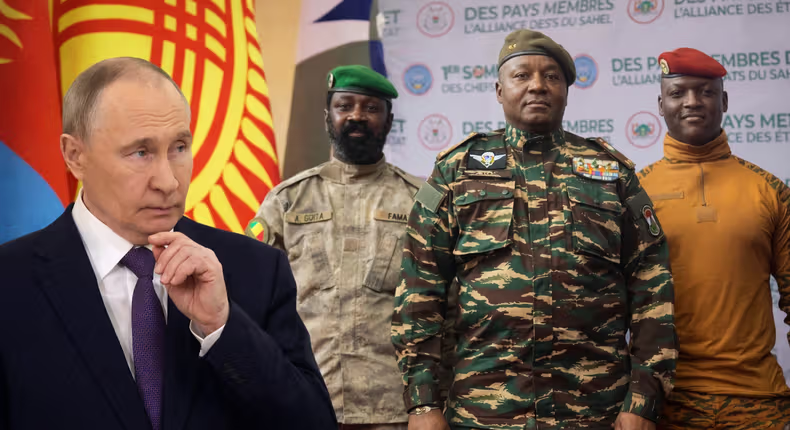
Russia is preparing to host another major Africa summit in October, marking the Kremlin’s third such gathering since 2019 and underscoring President Vladimir Putin’s intensified efforts to expand Moscow’s political, military, and economic footprint across the continent—particularly in the unstable Sahel region, where Western influence has weakened sharply in recent years. Although Russian officials have not yet confirmed an exact date, preparations are already underway for a series of cooperation agreements expected to reshape Moscow’s growing partnerships with African governments. Among the most anticipated deals are new energy and economic agreements between Russia and Mali, a country that has rapidly strengthened ties with the Kremlin after cutting military cooperation with France and other Western allies.
The summit comes as Burkina Faso, Mali, and Niger—three Sahel nations governed by military juntas—are partnering with Russia to develop the region’s first shared telecommunications satellite, a project aimed at boosting digital connectivity, security, and regional economic integration. Russia has increasingly framed its African outreach around anti-colonial rhetoric, presenting itself as a historic ally that never ruled colonies on the continent.

That message has found growing resonance in francophone Africa, where frustration with France has fuelled political realignments. Despite Western efforts to isolate Moscow diplomatically following the war in Ukraine, African participation in previous Russia-Africa summits remained strong, with representatives from 49 countries attending the 2023 St Petersburg summit, including 17 heads of state.
📢 GET A DETAILED ARTICLES + JOBS
Join ASJ's WhatsApp Channel and never miss a post or opportunity.

Key Developments: The October Summit, Sahel Partnerships, and Satellite Ambitions
The upcoming October summit will be Russia’s third major Africa-focused gathering since the inaugural 2019 event in Sochi, which was co-hosted by Putin and then-African Union chair Egyptian President Abdel Fattah el-Sisi. A second summit planned for 2020 was cancelled due to the COVID-19 pandemic, but Russia revived the initiative in 2023 in St Petersburg, despite international pressure linked to the Ukraine conflict. The 2023 summit produced dozens of agreements spanning defence, mining, infrastructure, and energy cooperation.
The 2026 summit is expected to build on that momentum. Russian Energy Minister Sergey Tsivilev has confirmed that Moscow and Mali are preparing to finalise “major cooperation agreements” following talks held on the sidelines of the Kazan Forum, an annual diplomatic and economic gathering hosted in Russia’s Republic of Tatarstan. The agreements are expected to span energy, mining, and infrastructure, with potential financing mechanisms that bypass Western financial networks.
The Sahel telecommunications satellite project is a flagship initiative. Burkina Faso, Mali, and Niger—three of the poorest and most unstable countries in the Sahel—are partnering with Russia to develop the region’s first shared satellite. The project aims to boost digital connectivity, improve security coordination, and foster regional economic integration. For landlocked Sahel states, satellite connectivity can bypass the infrastructure gaps (fiber-optic cables, terrestrial networks) that have limited internet access. For Russia, the project is a strategic investment: it deepens dependency on Russian technology and creates a platform for intelligence gathering.
The satellite project also symbolises the broader shift in Sahel alliances. All three countries have expelled French troops in recent years, ending decades of counter-terrorism cooperation. Mali and Burkina Faso have brought in Russian military advisers and mercenaries from the Wagner group (now absorbed into Russia’s Ministry of Defence). Niger, after a July 2023 coup, followed a similar trajectory. The satellite project extends cooperation from security to technology.
The anti-colonial messaging is central to Russia’s appeal. Unlike France, Britain, Belgium, and Portugal, Russia never colonised African territory. Putin has repeatedly invoked this history in speeches to African leaders, contrasting Russia’s “respect for sovereignty” with the “neocolonial practices” of Western powers. In francophone Africa, where memories of French colonial rule are still raw, and where recent French military interventions have been deeply unpopular, the message resonates.
The Sahel is the epicentre of this shift. The region—a semi-arid belt stretching from Senegal to Sudan—has been ravaged by Islamist insurgencies, ethnic conflict, and political instability. Western military interventions (France’s Operation Barkhane, the UN’s MINUSMA) have failed to restore security and have been accused of human rights abuses. Russia’s Wagner mercenaries, despite their own brutal reputation, have been welcomed by juntas as a pragmatic alternative.
The geopolitical context is also significant. Russia’s war in Ukraine has strained its relations with the West, but African countries have largely remained neutral. The Africa summits are part of Russia’s broader strategy to build alliances across the Global South, demonstrating that it is not isolated. For African governments, engagement with Russia offers leverage in negotiations with Western powers, as well as access to alternative sources of military equipment, grain, fertilisers, and energy.
Analysis & Implications: Russia’s Strategy, Western Decline, and African Agency
Russia’s Africa strategy is opportunistic and multi-dimensional. Militarily, Russia offers security assistance without the human rights conditionality that Western partners impose. Wagner mercenaries (now operating under Russian MoD control) provide training, advisory services, and combat support to Sahel governments. Critics accuse them of human rights abuses, including civilian killings, but Sahel juntas argue that any assistance is preferable to none.
Economically, Russia offers grain, fertilisers, and energy products at competitive prices. The disruption of Ukrainian grain exports during the war created an opportunity for Russia to expand its market share in Africa. Russian fertiliser exports to Africa have also increased, benefiting agricultural production. Energy cooperation—including oil and gas exploration, nuclear power agreements (notably with Egypt), and mining concessions—provides additional economic leverage.
Financially, Russia offers alternatives to Western-dominated systems. Local currency trade arrangements reduce dependence on the US dollar and euro. Alternative payment systems (Russia’s SPFS, analogous to SWIFT) allow transactions that bypass Western sanctions. For African countries that have faced financial pressure from Western powers, these alternatives are attractive.
The telecommunications satellite project is a new frontier. Russia’s space agency Roscosmos has partnered with African countries on satellite projects before (notably Angola), but the Sahel project is the first regional shared satellite. It will provide communications, earth observation, and potentially navigation services. For Russia, it is a commercial and strategic win. For Sahel states, it is a step toward digital sovereignty.
The decline of Western influence in the Sahel is undeniable. France has withdrawn its troops from Mali, Burkina Faso, and Niger. The United States has reduced its military presence. The UN peacekeeping mission in Mali (MINUSMA) has ended. The security vacuum has been filled by Russia (and, to a lesser extent, by Turkey and the UAE). For Western powers, the challenge is to remain engaged without repeating the mistakes of the past—heavy-handed interventions that alienated local populations.
However, African agency is often overlooked in the “great power competition” narrative. Sahel governments are not passive recipients of Russian influence; they are active choosers. They have turned to Russia because Western partners failed to deliver security, imposed conditionality, and were perceived as neocolonial. If Western powers adjust their approach—offering support without strings, respecting sovereignty, and engaging on African terms—they could regain influence. But that adjustment has not yet occurred.
The Accra Street Journal notes that Ghana, while not in the Sahel, is affected by the regional instability. The Sahel’s security crisis has spilled over into coastal West Africa, including Ghana, where extremists have launched attacks in the north. Ghana’s government has balanced its traditional Western partnerships (with the US, UK, and EU) with pragmatic engagement with Russia and China. The summit will be watched closely in Accra.
What This Means for Sahel States, Russia, and the West
For Sahel states—Mali, Burkina Faso, Niger—the Russia partnership offers immediate benefits: military equipment, training, and support for counter-insurgency operations; access to grain and fertilisers; and a powerful UN Security Council ally that can block resolutions they oppose. However, the partnership carries risks: dependency on Russia, which has its own interests; reputational damage (human rights groups have documented Wagner abuses); and potential isolation from Western development assistance.
The satellite project is a long-term bet. If successful, it could improve connectivity, security coordination, and economic integration. If it fails—due to technical challenges, funding shortfalls, or political instability—it would be an expensive embarrassment. The Sahel states have limited technical capacity; they will rely heavily on Russian expertise.
For Russia, the Sahel engagement is a strategic success. It has filled a vacuum left by Western withdrawal, gained access to valuable resources (gold, uranium), and built a network of aligned governments. The October summit will be a showcase for these achievements. However, Russia’s resources are finite; the war in Ukraine is the Kremlin’s priority. The Sahel must compete with other fronts for attention and funding.
For the West, the Sahel shift is a strategic loss. The retreat from the region has created space for competitors, not only Russia but also China, Turkey, and Iran. Western governments are reassessing their approach. The new strategy is likely to focus on coastal West Africa (Ghana, Côte d’Ivoire, Benin, Togo) as a bulwark against Sahel instability, while maintaining humanitarian and development assistance in the Sahel without large-scale military deployments.
The broader lesson is that influence cannot be taken for granted. France assumed it would have a permanent role in francophone Africa; it was wrong. The United States assumed its security assistance would be welcomed indefinitely; it is learning otherwise. African governments are diversifying their partnerships, and they will work with whoever offers the best terms. The West’s response should be to offer better terms, not to complain about the competition.
Wider Context: Great Power Competition in Africa
Africa has become a theatre of great power competition. China is the dominant economic force, with trade volumes exceeding $280 billion annually and infrastructure investments across the continent. Russia is the rising military and security partner, particularly in the Sahel. The United States and European Union are struggling to maintain relevance, with their influence eroded by history (colonialism, Cold War interventions), perceived double standards (democracy promotion that is inconsistently applied), and declining economic weight.
The Russia-Africa summits are a response to China’s Forum on China-Africa Cooperation (FOCAC), which has been held every three years since 2000. FOCAC is larger, more established, and more economically significant. The Russia summits are smaller, but they serve a different purpose: signalling that Russia is a player. The 2019 Sochi summit was the first; the 2023 St Petersburg summit demonstrated resilience; the 2026 October summit will show staying power.
The Sahel is a microcosm of this competition. The region is poor, unstable, and strategically located. Control over the Sahel affects migration flows to Europe, counter-terrorism efforts, and access to natural resources (gold, uranium, oil). Russia’s engagement is opportunistic; China’s is more cautious (focused on economic interests, not security); Turkey’s is growing (drones, military training); the UAE is active (logistics, intelligence).
For African governments, the multiplicity of partners provides choice and leverage. They are no longer forced to accept Western terms; they can shop around. This has led to better deals in some cases (higher prices for resources, lower conditionality) but also to a race to the bottom in governance standards (juntas that have seized power by force can still find partners).
The Accra Street Journal’s assessment: the October summit will produce headlines and agreements, but the real test is implementation. Russia has a track record of over-promising and under-delivering in Africa. The satellite project is ambitious; whether it will be completed on time and on budget is uncertain. The security partnerships have stabilised some regimes but have not defeated insurgencies. The grain and fertiliser deals have helped, but Russia’s exports are subject to its own production and export constraints.
Africa’s interests lie in diversifying partnerships while strengthening its own institutions. Dependency on any single external power—whether the West, China, or Russia—is a vulnerability. The ideal scenario is a multipolar Africa that trades with all, works with all, and is dominated by none. The October summit will be another step in that direction, but the destination is still far away.
Source: Accra Street Journal
Last Updated on May 22, 2026 by Samuel Kwame Boadu
Disclaimer: Some content on Accra Street Journal may be aggregated, summarized, or edited from third-party sources for informational purposes. Images and media are used under fair use or royalty-free licenses. Accra Street Journal is a subsidiary of SamBoad Publishing Hub under SamBoad Business Group Ltd, registered in Ghana since 2014.
For concerns or inquiries, please visit our Privacy Policy or Contact Page.

Samuel Kwame Boadu is a Ghanaian media entrepreneur and storyteller with a passion for amplifying urban voices and uncovering everyday truths. He is the Editor-in-Chief and Founder of Accra Street Journal, a dynamic digital platform dedicated to capturing the pulse of Ghana’s capital—its people, culture, challenges, business, sports and innovations.