







From $29.5 trillion in mineral wealth to the same old traps—how global price swings shape the continent’s fiscal and political destiny
Executive Introduction
For over a century, the rhythm of African economic growth has been dictated not by decisions made in Accra, Lagos, or Nairobi, but by commodity prices set in London, New York, and Shanghai. When global demand surges, African economies soar; when prices crash, they stall. This pattern is not incidental. It is structural, measurable, and—for 45 of Africa’s 54 economies—a matter of export dependency so deep that the UN Conference on Trade and Development (UNCTAD) classifies them as “commodity dependent,” with primary products accounting for more than 60% of export earnings .

The numbers tell a stark story. Between 2000 and 2014, the China-fueled commodity supercycle saw African regional exports nearly quadruple, per capita income rise by 37.1%, and extreme poverty decline from 62.5% to 45.7% . Then the music stopped. After 2014, incomes plateaued or declined, poverty reduction stalled, and commodity-fueled government borrowing—often poorly managed—shrank fiscal space across the continent . The COVID-19 pandemic and subsequent global inflationary shocks exposed the same vulnerabilities, reigniting a debate about how African economies can break free from the commodity price rollercoaster .
📢 GET A DETAILED ARTICLES + JOBS
Join ASJ's WhatsApp Channel and never miss a post or opportunity.

This ASJ report examines why commodity cycles exert such powerful influence on African economic growth, the mechanisms through which price shocks transmit through economies, the structural vulnerabilities that amplify their impact, and the policy frameworks that could—if implemented with discipline—break the cycle. The evidence suggests that commodity dependence is not destiny, but escaping it requires more than diversification rhetoric; it demands institutional reform, fiscal discipline, and a willingness to invest windfalls during booms rather than squander them.
Part 1: The Arithmetic of Dependency—How Commodities Dominate African Exports
The starting point for understanding commodity cycles is the export structure of African economies. According to UNCTAD’s Economic Development in Africa report, 45 of 54 African economies remain dependent on exports of primary commodities—from farms, mines, and oil fields . A country is classified as commodity dependent when these products exceed 60% of its total exports.
The Two-Track Growth Pattern
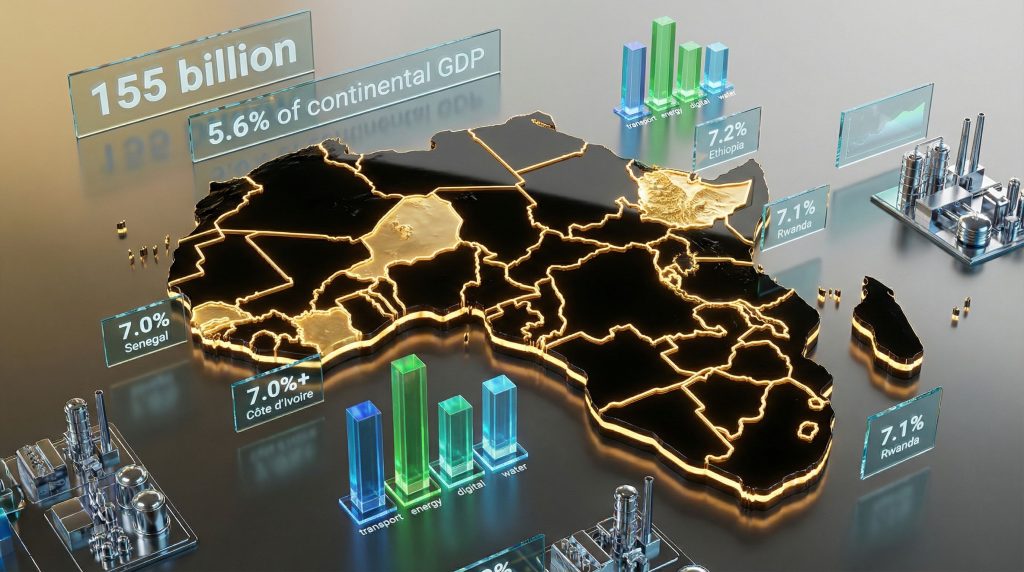
The International Monetary Fund (IMF) has documented a sharp divergence in Sub-Saharan Africa’s growth trajectory based precisely on this distinction . Over the past decade, growth in resource-intensive countries (RICs)—especially fuel-exporting economies such as Angola, Chad, and Nigeria—has slowed sharply, falling far below growth in non-RICs such as Ethiopia, Rwanda, and Senegal. Indeed, incomes in RICs have essentially stagnated .
This marks a stark contrast with the decade leading up to 2014, when RICs experienced rapid growth in line with the region’s strong overall performance. The divergence, IMF economists conclude, has been driven largely by two factors: first, a dramatic decline in commodity export prices around 2014–15 as the commodity supercycle ended; and second, pre-existing structural vulnerabilities—including poor business environments, limited human capital, weak governance, and poor management of resource revenues—that exacerbated the impact of the terms-of-trade shock .
The Weight of Dependency
The scale of this dependency is difficult to overstate. Across West Africa, more than 70% of export earnings are concentrated in hydrocarbons, minerals, and agricultural products . In oil-exporting countries, the concentration is even more extreme. Yet even within the commodity-dependent category, there is variation: countries with broader export baskets—such as Côte d’Ivoire, Ghana, and Senegal—exhibited greater resilience during external shocks, reflected in smaller trade deficits and faster post-crisis recovery . This suggests that the degree of diversification, even within a commodity-dependent framework, matters for resilience.
Part 2: The Transmission Mechanisms—How Price Shocks Move Through Economies
The influence of commodity cycles on economic growth operates through several distinct channels. Understanding these mechanisms is essential for designing effective policy responses.
Channel 1: Direct Fiscal Impact
For governments that derive a significant share of revenue from commodity exports—whether through taxes, royalties, or state-owned enterprises—price fluctuations translate directly into fiscal volatility. When commodity prices are high, revenues surge; when they fall, budgets contract sharply.
IMF analysis confirms that fiscal policy in resource-intensive countries is generally far more correlated with economic shocks than in other countries, intensifying their effects . During booms, many RICs embark on costly capital projects that are often poorly planned and implemented. When commodity prices fall, capital spending is cut sharply, creating a pro-cyclical fiscal bias that amplifies the cycle rather than smoothing it .
Channel 2: Balance of Payments and Currency Pressure
Commodity exports are the primary source of foreign exchange for most African economies. When prices fall, export earnings decline, putting pressure on the balance of payments, weakening currencies, and increasing the cost of servicing foreign debt. This, in turn, fuels inflation (particularly for import-dependent economies) and constrains the ability of central banks to pursue counter-cyclical monetary policy.
Channel 3: Investment and Growth Multipliers
Perhaps surprisingly, given the critical literature on the “resource curse,” econometric evidence shows generally positive effects of commodity price booms on GDP across 35 African countries . Price booms generate economic growth by stimulating productive investment . The problem is not that booms do not create growth—it is that the growth is often not sustained when prices fall, and the investments made during booms are frequently inefficient or non-productive.
Channel 4: Government Expenditure Pro-Cyclicality
The most damaging transmission mechanism is the tendency of governments to spend windfall revenues during booms and cut spending during busts. World Bank research on CEMAC countries (Central Africa) found that economic growth in resource-rich countries increased during the 2004-2014 commodity boom and was driven by resource export earnings. But their economic performance collapsed afterward, as the volatility of commodity prices undermined development gains achieved during booms .
Many oil-exporting countries have consistently spent all their oil revenues in the year they accrued, with no meaningful savings to buffer future downturns . Fuel subsidies—the cost of which increases as oil prices rise—further limit the ability to save during booms while crowding out growth-friendly development spending .
Part 3: The Structural Vulnerabilities—Why Africa Feels the Pain More Deeply
Commodity price volatility affects all producing nations. But African economies are disproportionately vulnerable for three structural reasons.
Vulnerability 1: Concentration and Lack of Diversification
Lower-income countries seem particularly prone to terms-of-trade-induced economic swings because they export primary commodities that tend to fluctuate more in price than the manufactured goods they import . Their exports are dominated by a small number of commodities, or a set of commodities where prices tend to move together. And poorer countries tend to be more open—international trade accounts for a large share of GDP, shaking the overall economy more vigorously than in a large, closed system .
Recent research on West Africa confirms that structural trade imbalances—particularly in Nigeria, the subregion’s largest economy—magnify regional vulnerabilities due to overdependence on crude oil exports and high import bills .
Vulnerability 2: Weak Governance Amplifies Shocks
The IMF’s analysis is unequivocal: terms-of-trade shocks have a stronger and longer-lasting impact on growth in countries with weak governance . For every one-percent worsening in a country’s terms of trade, medium-term growth is around ¼ percentage point higher in countries with smaller governance challenges .
The mechanisms are intuitive. Weak governance, systemic corruption, and an unfavorable business climate take a toll on productivity and output—and the effects are most striking when commodity prices fall . Such weaknesses affect both the resource sector itself and prospects for the economy diversifying into other sectors. For instance, the potential for theft of oil production undermines productive efficiency and diverts resources from more productive uses. Fuel exporters outside the region, with generally stronger governance, have weathered the commodity price slump far better .
Vulnerability 3: Lack of Stabilization Mechanisms
Most African countries lack effective fiscal stabilization mechanisms. Sovereign wealth funds exist in 14 African countries, but they are small relative to the size of the economy and national budget—as of 2020, assets under management were 1.6% of GDP in Angola, 1% of GDP in Ghana, and 0.4% of GDP in Nigeria .
The problem is not merely inadequate savings. There is an inherent tension between stabilization tools, which to properly hedge risk need to be sizeable and invested in foreign, liquid assets, and economic diversification, which requires bold domestic investment . Governments face a trade-off: invest in domestic development that might help reduce commodity dependence in the long run, or build up liquid foreign reserves that can smooth investment and consumption over the cycle. In practice, African sovereign wealth funds often do a bit of both—and consequently, the funds available for genuine stabilization purposes are not usually large .
Part 4: The Coming Supercycle—Why 2026-2035 Will Be Different (And Why It Might Not Be)
Analysts project a new commodity supercycle extending through 2035, driven by the global energy transition, artificial intelligence infrastructure, and continued demand for critical minerals . But this cycle will not simply repeat the pattern of 2000-2014.
The Changing Commodity Mix
Unlike the previous supercycle, which was dominated by fuel exports, the coming cycle is expected to be driven by industrial and precious metals, with oil and gas under downward price pressure . Demand for precious metals, especially gold, is being driven by the search for safe assets amid heightened global economic uncertainty and geopolitical risk. Demand for industrial metals is being fueled by the AI-driven expansion of data centers and investments in energy transition .
This shift has significant implications for African economies. Countries rich in copper, cobalt, lithium, graphite, and rare earths—Zambia, the DRC, South Africa, Zimbabwe, Mozambique—are positioned to benefit. Fuel-exporting countries such as Nigeria and Angola face a less certain outlook, with diversification becoming an urgent imperative rather than a long-term aspiration .
The Geopolitical Dimension
The global race to secure access to industrial metals and critical minerals has intensified. The US launched “Project Vault,” a $1.2 billion move to stockpile critical minerals, while China already races ahead with stockpiles and processing capacity . African policymakers face a strategic choice: whether to align with competing global powers or pursue a coordinated continental approach to mineral development.
There are already murmurs about how African policymaking is approaching this moment. At Mining Indaba 2026, a South African Minister accused his Congolese counterpart of “selling out” to the US when the DRC signed on to Project Vault, instead pushing for a continental approach .
The Value-Addition Imperative
The discourse on value addition has substantially improved since the last supercycle. There is now broader ideological permission for domestic private ownership in the natural resource sector, including in collaboration with governments . Several African governments have announced plans for domestic processing hubs, with targets of 40% local value-addition by 2030.
But as one analyst notes, “predominantly relying on foreign firms and exporting raw commodities will ensure that this time is not different, and will certainly expose countries to abuse by global powers” . The key is aggressive domestication of private ownership and value addition—not just more conferences and workshops, but actual processing capacity and local supply chains.
Part 5: Breaking the Cycle—What Successful Diversification Looks Like
The academic literature and policy experience point to several pathways for reducing commodity dependence and building economic resilience.
The Diversification Success Stories
Kenya stands out as a diversification success story. Leveraging its position as East Africa’s largest economy, Nairobi has blossomed into a “Silicon Savannah” of fintech startups, while aggressive investment in geothermal and wind energy provides over 80% of its electricity sustainably . The country’s ICT and agribusiness sectors are regional models.
Botswana offers a different model: using diamond revenues to invest in education, infrastructure, and downstream processing (beneficiation), while creating specialized economic hubs . Mauritius transformed from a sugar-based economy to one built on textiles, finance, and tourism .
The Policy Toolkit
Research and experience point to several policy interventions that can reduce vulnerability to commodity cycles :
| Intervention | Mechanism | Examples |
|---|---|---|
| Fiscal stabilization funds | Save windfall revenues during booms for use during busts | Botswana’s Pula Fund |
| Sovereign wealth funds | Invest resource revenues for intergenerational equity | Nigeria’s Sovereign Wealth Fund (0.4% of GDP) |
| Counter-cyclical fiscal policy | Avoid pro-cyclical spending that amplifies cycles | Chile’s structural balance rule |
| Export diversification | Expand non-resource exports through industrial policy | Côte d’Ivoire’s cocoa processing |
| Regional integration | Leverage AfCFTA for cross-border value chains | West Africa’s manufactured goods trade |
| Human capital investment | Use resource revenues to fund education and skills | Botswana’s education spending |
The Binding Constraint: Governance
The most persistent barrier to diversification is not lack of policy ideas—it is weak governance and institutional capacity. As the IMF notes, “weak governance, systemic corruption, and an unfavorable business climate take a toll on productivity and output—and the effects are most striking when commodity prices fall” .
Countries with stronger governance have weathered commodity price slumps far better than their peers with weaker institutions. This suggests that institutional reform—anti-corruption enforcement, transparent contracting, fiscal rules with enforcement mechanisms—is a prerequisite for any diversification strategy to succeed.
Conclusion: Cycles Are Inevitable, Vulnerability Is Not
Commodity cycles are a structural feature of global markets, not a temporary aberration. African economies will never be immune to price swings in oil, gold, copper, or cocoa. But the severity of their impact—whether a price drop triggers a lost decade or a manageable slowdown—depends on factors within policymakers’ control.
The evidence is clear. Countries with diversified export bases, stronger governance, effective fiscal stabilization mechanisms, and credible value-addition strategies have weathered commodity cycles better than those without . The 45 African economies that remain commodity dependent are not doomed to repeat the boom-bust cycle—but breaking free requires more than diversification rhetoric.
It requires investing windfall revenues during booms rather than squandering them on inefficient projects. It requires building fiscal buffers that can be drawn down during busts. It requires strengthening governance and institutions so that resource wealth translates into productive investment rather than corruption and waste. And it requires a strategic approach to the coming critical minerals supercycle—one that prioritizes domestic value addition, regional integration, and genuine partnership rather than raw extraction for external benefit.
The global energy transition is reshaping commodity demand. Artificial intelligence is creating new markets for industrial metals. Geopolitical competition for critical minerals is intensifying. African economies are positioned at the center of these shifts—with $29.5 trillion in mineral wealth, some of the world’s largest reserves of cobalt, platinum, manganese, and graphite, and a young, increasingly educated workforce.
Whether this moment becomes another missed opportunity or a genuine turning point depends on the choices made today. As one analyst put it: “The primary focus should be an aggressive domestication of private ownership and value addition. Predominantly relying on foreign firms and exporting raw commodities will ensure that this time is not different” .
The cycles will continue. Whether they dictate Africa’s economic destiny is a matter of policy, not fate.
Quick Reference: How Commodity Cycles Affect African Growth
| Phase | Typical Impact | Risk Factor | Policy Response |
|---|---|---|---|
| Boom | Rising GDP, increased fiscal revenues, currency appreciation, poverty reduction | Pro-cyclical spending; inefficient investments; corruption | Save windfall revenues; invest in productive capacity; strengthen governance |
| Bust | Contracting GDP, fiscal deficits, currency depreciation, stalled poverty reduction | Debt distress; service cuts; social unrest | Draw down fiscal buffers; maintain counter-cyclical spending; protect social programmes |
Key Statistics:
-
45 of 54 African economies are commodity dependent (>60% of exports)
-
Resource-intensive countries saw incomes stagnate post-2014
-
70%+ of West Africa’s export earnings concentrated in commodities
-
Poverty reduction in RICs effectively halted in 2014
-
Child in RIC lives 4 years less, 25% more likely to live in poverty
-
Sovereign wealth funds as % of GDP: Angola 1.6%, Ghana 1%, Nigeria 0.4%
-
New supercycle projected through 2035 (critical minerals-led, not oil)
FAQ Section
Q1: Why are African economies so vulnerable to commodity price cycles?
A: Forty-five of 54 African economies are commodity dependent (primary products exceed 60% of exports) . This concentration, combined with weak governance, limited fiscal stabilization mechanisms, and pro-cyclical spending patterns, amplifies the impact of price swings .
Q2: How did the 2000-2014 commodity supercycle affect Africa?
A: Regional exports nearly quadrupled, per capita income rose 37.1%, and extreme poverty declined from 62.5% to 45.7% . However, after 2014 incomes plateaued, poverty reduction stalled, and commodity-fueled borrowing left many countries with unsustainable debt .
Q3: What is the “resource curse” and does it affect African countries?
A: The “resource curse” refers to the paradox where resource-rich countries often register lower economic growth and higher inequality than those without such resources . World Bank research confirms that many African resource-rich countries failed to transform natural resource revenues into productive forms of capital, including human and physical capital .
Q4: What transmission channels link commodity prices to economic growth?
A: Four primary channels: direct fiscal impact (government revenue volatility), balance of payments pressure (currency and debt service), investment and growth multipliers (productive investment during booms), and government expenditure pro-cyclicality (spending booms and cutting busts) .
Q5: Why do some African countries weather commodity shocks better than others?
A: Countries with broader export baskets (Côte d’Ivoire, Ghana, Senegal) exhibit greater resilience, reflected in smaller trade deficits and faster post-crisis recovery . Stronger governance also matters significantly—terms-of-trade shocks have stronger and longer-lasting impacts in countries with weak governance .
Q6: Is there a new commodity supercycle coming?
A: Yes. Analysts project a new supercycle extending through 2035, driven by demand for critical minerals for the energy transition, AI infrastructure, and precious metals as safe-haven assets
Q7: What policy tools can reduce vulnerability to commodity cycles?
A: Effective tools include fiscal stabilization funds (saving windfall revenues), sovereign wealth funds (intergenerational savings), counter-cyclical fiscal policy, export diversification, regional integration (AfCFTA), and human capital investment .
Q8: Why are sovereign wealth funds so small in African countries?
A: As of 2020, assets under management were 1.6% of GDP in Angola, 1% in Ghana, and 0.4% in Nigeria . There is an inherent tension between stabilization tools (which need to be invested in liquid foreign assets) and economic diversification (which requires domestic investment). Most African funds do a bit of both, limiting funds available for genuine stabilization .
Q9: Can African countries break free from commodity dependence?
A: Yes, but it requires more than diversification rhetoric. Kenya (fintech and renewables), Botswana (beneficiation and education), and Mauritius (services and manufacturing) offer successful models . Key prerequisites include strong governance, institutional reform, investment in human capital, and strategic use of resource revenues .
Q10: How should African policymakers prepare for the coming supercycle?
A: The primary focus should be aggressive domestication of private ownership and value addition—not just exporting raw commodities but processing them domestically . Regional coordination on energy generation, transportation, and logistics (e.g., Lobito Corridor) offers scope for collective benefit. Security capacity to protect resource assets is also essential
Source: Accra Street Journal
Last Updated on May 23, 2026 by Samuel Kwame Boadu
Disclaimer: Some content on Accra Street Journal may be aggregated, summarized, or edited from third-party sources for informational purposes. Images and media are used under fair use or royalty-free licenses. Accra Street Journal is a subsidiary of SamBoad Publishing Hub under SamBoad Business Group Ltd, registered in Ghana since 2014.
For concerns or inquiries, please visit our Privacy Policy or Contact Page.

Samuel Kwame Boadu is a Ghanaian media entrepreneur and storyteller with a passion for amplifying urban voices and uncovering everyday truths. He is the Editor-in-Chief and Founder of Accra Street Journal, a dynamic digital platform dedicated to capturing the pulse of Ghana’s capital—its people, culture, challenges, business, sports and innovations.