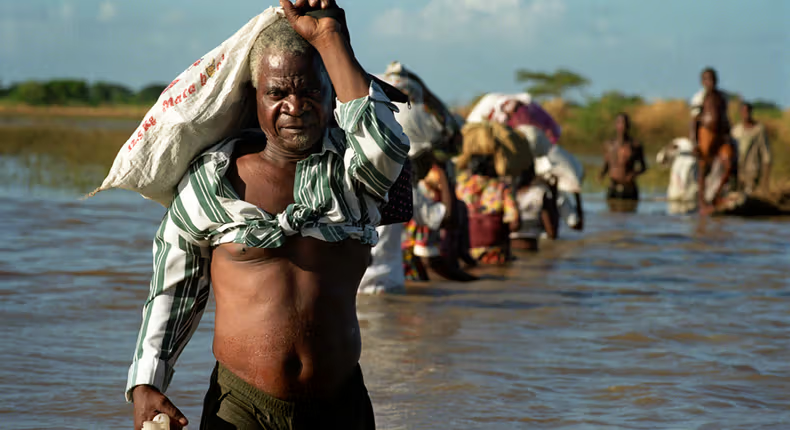
The Food and Agriculture Organization (FAO) has appealed for about $108 million in funding to support nearly 1.8 million people in Mozambique expected to face prolonged food insecurity after devastating floods linked to climate change. In its “Mozambique: Floods Recovery Plan 2026–2031,” the UN agency warned that repeated flooding could continue to disrupt livelihoods and slow recovery over the next five years, especially in rural communities dependent on agriculture. According to the FAO, floods earlier this year affected more than 724,000 people and damaged around 440,000 hectares of farmland in some of Mozambique’s most productive regions.
The agency estimated total damages and economic losses at 30.4 billion meticais, about $476 million at current exchange rates, with agriculture making up nearly 73% of the losses. Crops, livestock, fisheries, and irrigation infrastructure were among the hardest hit sectors. Gaza and Maputo provinces saw the worst destruction, while Sofala, Inhambane, Manica, Tete, and Nampula were also heavily affected. As part of its response, the FAO is seeking $79 million under its Mozambique Emergency and Resilience Plan for 2026–2028, including $38 million for assistance in 2026 alone, plus an urgent appeal for an additional $27.9 million to help about 620,000 people.

Key Developments: The Scale of Destruction, Agricultural Collapse, and the Six-Year Recovery Horizon
The floods that struck Mozambique earlier in 2026 are among the most severe in the country’s recent history. The comparison to the catastrophic 2000 floods—which killed hundreds of people, destroyed farmland and infrastructure, and became a defining national trauma—is unavoidable. However, the 2026 event is distinguished by its geographic scope and the cumulative vulnerability of a population already weakened by repeated climate shocks.
📢 GET A DETAILED ARTICLES + JOBS
Join ASJ's WhatsApp Channel and never miss a post or opportunity.

The 440,000 hectares of damaged farmland represent a significant portion of Mozambique’s cultivated area. Smallholder farmers, who constitute the majority of the agricultural workforce, have lost their standing crops, seed stocks, and in many cases, their livestock. The timing of the floods—occurring during the growing season—means that farmers have missed the planting window, and the next harvest will be delayed by at least six to twelve months. The food security implications are immediate and severe.
The FAO’s estimate that agriculture accounted for nearly 73% of the total economic losses underscores the sector’s centrality to Mozambique’s rural economy. In provinces such as Gaza and Maputo, where agriculture is the primary livelihood, the destruction of crops, irrigation systems, and fisheries has eliminated both food sources and income. The recovery plan notes that the crisis has “severely disrupted agrifood systems,” and that the destruction of productive assets could undermine food security and rural incomes well beyond the current planting season.

The six-year recovery horizon (2026–2031) reflects the reality that rebuilding agricultural systems is not a short-term exercise. Farmers who have lost their seed stocks need not only food aid but also new seeds, tools, and training. Livestock farmers need restocking. Irrigation infrastructure, once destroyed, takes years to repair. The FAO’s appeal is for both immediate relief (to prevent starvation) and long-term reconstruction (to restore productive capacity).
The geographic distribution of the damage is notable. Gaza and Maputo provinces, in the south, recorded the highest levels of destruction. These are among Mozambique’s most productive agricultural regions, known for crops such as maize, rice, cassava, and vegetables. The destruction of irrigation schemes in the Limpopo River valley—a historic breadbasket—will have ripple effects on food prices across the country.
The provinces of Sofala, Inhambane, Manica, Tete, and Nampula were also significantly affected. The broad geographic spread means that the flood crisis is not a localized disaster but a national emergency. The FAO’s appeal for $108 million to support 1.8 million people—approximately 5% of Mozambique’s population of 33 million—reflects the scale of the need.
The UN agency’s warning that repeated climate-related floods could undermine Mozambique’s long-term recovery efforts through 2031 is a sobering acknowledgment of the new normal. Mozambique is one of Africa’s most climate-vulnerable countries, exposed to both cyclones (from the Indian Ocean) and floods (from rivers such as the Zambezi, Limpopo, and Save). The frequency and intensity of extreme weather events have increased over the past decade, overwhelming the country’s adaptive capacity.
Analysis & Implications: Climate Vulnerability, Agricultural Dependence, and the Aid Dependency Trap
Mozambique’s vulnerability to climate disasters is a function of geography and poverty. The country’s major rivers originate in neighboring countries (Zimbabwe, Zambia, Malawi, South Africa) and flow through Mozambique to the Indian Ocean. Upstream water management decisions—such as dam releases from Kariba, Cahora Bassa, or South African dams—can exacerbate downstream flooding. Coordination on transboundary water management is weak, leaving Mozambique at the mercy of events beyond its control.
The country’s agricultural dependence compounds the vulnerability. Agriculture employs approximately 70% of Mozambique’s workforce and contributes about 25% of GDP. Most farmers are smallholders practicing rainfed agriculture, with limited access to irrigation, improved seeds, or climate information. When floods destroy crops, farmers have few alternatives. The FAO’s estimate that agriculture accounted for 73% of economic losses is not surprising; the sector is the primary asset of the rural poor.
The aid dependency trap is real. Mozambique has repeatedly appealed for international assistance following climate disasters: the 2000 floods, the 2007 floods, Cyclone Idai in 2019, Cyclone Kenneth in 2019, and now the 2026 floods. Each appeal generates a response—donors contribute, aid is distributed, and the country recovers—only to be struck again. The cumulative cost of disaster response is enormous, and the opportunity cost (what could have been achieved with those funds in the absence of disasters) is incalculable.
The FAO’s six-year recovery plan is an attempt to break the cycle. Instead of responding to each disaster as a standalone event, the plan aims to build resilience: strengthening early warning systems, promoting climate-smart agriculture, restoring mangroves and wetlands that buffer against floods, and improving water management. The $108 million appeal is modest relative to the scale of the need; it is a down payment on a longer-term investment.
The role of climate change is undeniable. The IPCC has projected that southern Africa will experience increased rainfall variability, with more intense storms and longer dry spells. Mozambique, located at the downstream end of major river systems, is particularly exposed. The 2026 floods are consistent with these projections. The question is not whether climate change causes individual events (it does not, in a deterministic sense) but whether the increase in frequency and intensity can be attributed to climate change (it can, in a probabilistic sense).

The Mozambican government’s leadership in the Post-Disaster Needs Assessment (PDNA) programme is commendable. The PDNA is a government-led, donor-supported process that assesses damages, losses, and recovery needs. The FAO’s recovery plan is aligned with the PDNA, ensuring that aid is coordinated and directed to priority areas. However, the government’s capacity to implement the plan is limited by fiscal constraints, institutional weaknesses, and the sheer scale of the disaster.
The Accra Street Journal notes that Mozambique’s experience is a warning to other African countries, including Ghana. While Ghana is not as exposed to cyclones or transboundary floods, it faces its own climate risks: coastal erosion (due to sea-level rise), flooding in Accra (as documented), and drought in the north. The investment in resilience—early warning systems, drainage infrastructure, climate-smart agriculture—is far cheaper than the cost of disaster response. Mozambique’s repeated appeals are a testament to the cost of underinvestment.
What This Means for Mozambique’s Food Security, Rural Economy, and National Development
For food security, the immediate outlook is dire. The destruction of 440,000 hectares of farmland, combined with the loss of seed stocks and livestock, means that the affected communities will face food deficits for at least the next 12 months. The FAO’s appeal includes food aid, cash transfers, and support for market-based food distribution. Without these interventions, widespread hunger is likely.
For the rural economy, the loss of productive assets—crops, livestock, fishing gear, irrigation infrastructure—means that households have lost both their source of food and their source of income. The recovery plan includes support for restocking (seeds, livestock), repairing irrigation systems, and providing cash-for-work programs to inject liquidity into affected communities. The goal is to restore livelihoods, not just provide relief.
For national development, the floods represent a setback. Mozambique has made progress in reducing poverty, improving infrastructure, and attracting investment (particularly in natural gas). The diversion of resources to disaster response—and the destruction of economic assets—undermines these gains. The World Bank estimates that climate-related disasters cost Mozambique approximately 1% to 2% of GDP annually. Reducing this figure requires investment in resilience.
The government’s role is critical. The recovery plan is government-led, but implementation depends on the capacity of ministries at national and provincial levels. The government must ensure that aid is distributed transparently, that recovery projects are well-managed, and that the lessons of the 2026 floods are applied to future planning. The temptation to revert to business-as-usual—rebuilding in flood-prone areas, neglecting early warning systems—must be resisted.
The donor community’s role is equally critical. The FAO’s $108 million appeal is a fraction of what is needed; other UN agencies, bilateral donors, and development finance institutions will also contribute. The challenge is coordination: ensuring that aid is not duplicated, that gaps are filled, and that recovery is aligned with long-term development goals. The PDNA process is designed to achieve this coordination.
The Accra Street Journal’s assessment: Mozambique is at a crossroads. The country can continue to respond to climate disasters as they occur—spending billions over time on relief and recovery—or it can invest in resilience, reducing the cost of future disasters. The $108 million FAO appeal is a step toward resilience, but it is only a step. The government, donors, and the private sector must work together to build a more resilient Mozambique. The next flood is coming. The question is whether the country will be ready.
Wider Context: Climate Disasters in Southern Africa
Mozambique is not alone in its vulnerability. Southern Africa is a climate hotspot, with countries including Malawi, Zimbabwe, Zambia, Madagascar, and South Africa experiencing increased frequency and intensity of cyclones, floods, and droughts. The 2019 Cyclone Idai, which devastated Mozambique, Zimbabwe, and Malawi, killed over 1,000 people and caused billions in damage. The 2022 Cyclone Gombe affected Mozambique and Malawi. The pattern is clear: climate disasters are becoming more frequent and more severe.
The humanitarian response system is stretched thin. The UN’s Central Emergency Response Fund (CERF) has been repeatedly depleted by multiple crises. Donors are facing competing priorities: the war in Ukraine, the conflict in Sudan, the ongoing needs in the Horn of Africa (drought), and now the floods in Mozambique. The $108 million appeal is modest, but it is not guaranteed. Donor fatigue is real.
The link between climate change and disasters is increasingly recognized. The COP26 (Glasgow) and COP28 (Dubai) agreements included provisions for loss and damage funding—compensation for developing countries that suffer climate-related losses. Mozambique is a candidate for such funding. The operationalization of the loss and damage fund is slow, but it offers hope for future financing.
The private sector’s role in resilience is underdeveloped. Insurance products for smallholder farmers (such as index-based insurance) are available in some countries but not at scale. Climate-smart agriculture technologies (drought-tolerant seeds, water-efficient irrigation) are available but not affordable for most farmers. The gap between what is technically possible and what is financially accessible is large.
The Accra Street Journal’s conclusion: Mozambique’s flood crisis is a preview of what is to come. As climate change intensifies, more African countries will face similar disasters. The choice is between reactive, costly, and repeatedly inadequate responses—or proactive, systematic investment in resilience. The FAO’s $108 million appeal is a necessary first step. The real work is building a future where such appeals are no longer needed.
Source: Accra Street Journal
Last Updated on May 28, 2026 by Samuel Kwame Boadu
Disclaimer: Some content on Accra Street Journal may be aggregated, summarized, or edited from third-party sources for informational purposes. Images and media are used under fair use or royalty-free licenses. Accra Street Journal is a subsidiary of SamBoad Publishing Hub under SamBoad Business Group Ltd, registered in Ghana since 2014.
For concerns or inquiries, please visit our Privacy Policy or Contact Page.

Samuel Kwame Boadu is a Ghanaian media entrepreneur and storyteller with a passion for amplifying urban voices and uncovering everyday truths. He is the Editor-in-Chief and Founder of Accra Street Journal, a dynamic digital platform dedicated to capturing the pulse of Ghana’s capital—its people, culture, challenges, business, sports and innovations.