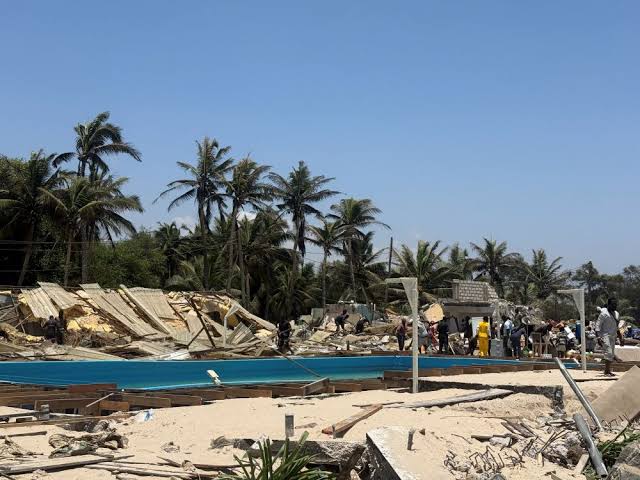








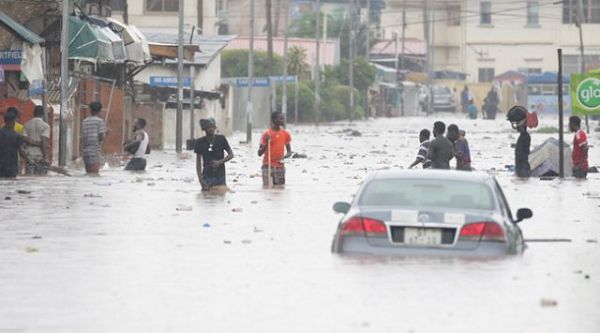
Accra is sinking deeper into a perennial crisis. What was once an annual disaster confined to a predictable handful of low-lying neighborhoods has systematically mutated into an all-encompassing metropolitan nightmare. With every passing rainy season, the capital’s flood map expands, capturing new suburbs, swallowing critical economic arteries, and pushing the city closer to a point of total vulnerability. Years ago, the impact was largely limited to specific flood-prone enclaves such as Odawna, Alajo, and Agbogbloshie. That safety has completely evaporated.
The waters have pushed outward, claiming established residential and commercial zones including Gbawe, Dansoman, Kaneshie, and Christian Village. Central commuter routes and premium real estate zones once considered immune—including Madina, Legon, Lashibi-Klagon, the Airport to Tetteh Quarshie corridor, Ofankor, Dzorwulu, and Weija—now routinely submerge, trapping thousands of commuters and cutting off economic activity. Driving in the rain is now considered dangerous, as vehicle damage and hour-long traffic delays have become the norm rather than the exception.

While changing global weather patterns intensify recent downpours, the drowning of Accra is fundamentally a man-made catastrophe driven by rapid unregulated urbanization, construction within natural water paths, paving over of wetlands and ecological buffers, and drainage systems choked with plastic waste, silt, and debris.
📢 GET A DETAILED ARTICLES + JOBS
Join ASJ's WhatsApp Channel and never miss a post or opportunity.

Key Developments: The Expanding Flood Footprint, Economic Toll, and Infrastructure Collapse
The geographic expansion of Accra’s flood-prone areas is the most visible indicator of systemic failure. Historically, flooding was a localized phenomenon affecting low-lying neighborhoods near the Odaw River and its tributaries. Today, the flood map extends across virtually every major suburb, from the affluent Airport residential area to the rapidly developing Legon corridor. Each heavy storm adds a new area to the danger list, suggesting that the underlying infrastructure—drains, culverts, and channels—has been overwhelmed beyond its design capacity.
The economic toll is staggering. Properties worth millions of cedis—family homes, household vehicles, corporate offices, retail stock, and public infrastructure—are destroyed each rainy season. For the average citizen, this represents a relentless drain on personal finances, as individuals are repeatedly forced to spend life savings rebuilding homes and replacing destroyed livelihoods. For businesses, the cost includes lost inventory, damaged equipment, and productivity losses from hours spent trapped in flood-induced traffic jams.

The macroeconomic impact is equally grim. The national economy absorbs structural shocks from ruined public infrastructure (roads, bridges, power installations), disrupted trade (markets and commercial districts rendered inaccessible), lost productivity hours, and the recurring financial burden of emergency relief and post-disaster management. The Ghana Meteorological Agency reports that rainfall intensity has increased over the past decade, but the primary variable is not the weather; it is the city’s inability to handle the water.
The failure of the Odaw River drainage system is a case study in infrastructure neglect. The Odaw, Accra’s primary stormwater channel, is designed to carry water from the city’s northern catchment to the Korle Lagoon and out to sea. However, the channel is heavily silted, choked with plastic waste, and obstructed by informal settlements and bridges that lack adequate clearance. During heavy rains, the Odaw overflows its banks, flooding adjacent communities including Alajo, Nima, and parts of the central business district.
The paving over of wetlands is a second critical failure. Wetlands act as natural sponges, absorbing stormwater and releasing it slowly. Accra’s wetlands—including the Korle, Sakumo, and Kpeshie lagoons—have been systematically encroached upon by developers, who fill the land for residential and commercial construction. The loss of these buffers means that rainwater that once soaked into the ground now runs off quickly, overwhelming drains and channels.
The role of plastic waste cannot be overstated. Ghana generates approximately 1 million tonnes of plastic waste annually, of which only 5% to 10% is recycled. The remainder ends up in landfills, open dumps, water bodies, and drains. During rains, plastic bags, bottles, and packaging are carried into drainage channels, where they accumulate and block flow. The resulting backflows cause drains to overflow, flooding streets and homes. The problem is not merely a lack of drainage capacity; it is a lack of waste management.
The Accra Street Journal notes that the flood crisis is not a new problem. The city has experienced major floods in 1968, 1974, 1995, 2001, 2007, 2011, 2015, 2020, and repeatedly since. Each event is followed by government pledges, task forces, and cleanup exercises. Each is followed by a return to the status quo ante. The difference now is that the flood map is expanding faster than any conceivable cleanup effort, and the economic losses are accumulating beyond the capacity of individuals and the state to absorb.
Analysis & Implications: Regulatory Failure, Urban Planning Collapse, and the Economics of Inaction
The flood crisis is a symptom of deeper governance failures. Accra’s physical planning regime has been described as “non-existent” by urban planning experts. The city’s building codes prohibit construction in waterways and wetlands, but enforcement is weak to the point of irrelevance. Developers build where they wish, often with the complicity or neglect of regulatory authorities. The result is a city built on a drainage system that no longer functions.
The National Disaster Management Organization (NADMO) has been criticized for its reactive rather than proactive approach. NADMO’s mandate includes disaster prevention, but the agency is most visible after a flood, distributing relief items rather than enforcing building codes or clearing drains. The Accra Metropolitan Assembly (AMA) has similar responsibilities but lacks the resources, political will, or capacity to enforce them.
The economics of inaction are compelling. A 2022 World Bank study estimated that flood-related losses in Accra cost the Ghanaian economy approximately $200 million annually—equivalent to 0.5% of GDP. That figure is almost certainly higher today, given the expansion of the flood map and the increase in property values. The cost of preventive measures—dredging drains, constructing retention basins, enforcing building codes—is a fraction of the cost of repeated rebuilding.
The human cost is incalculable. Lives lost to drowning are the most visible tragedy. The less visible costs include displacement, loss of livelihood, trauma, and the diversion of household income from savings and investment to rebuilding. A family that loses its home to flooding once may recover; a family that loses its home repeatedly is condemned to perpetual poverty.

The climate change dimension cannot be ignored, but it should not be used as a cover for policy failure. The Intergovernmental Panel on Climate Change (IPCC) projects that West Africa will experience increased rainfall intensity, meaning that storms will be heavier even if total rainfall does not change. Accra’s drainage system, built for a climate that no longer exists, must be upgraded. The government cannot blame the weather forever.
The Accra Street Journal notes that the flood crisis is also a governance crisis. The city’s rapid expansion—from a population of approximately 500,000 in 1980 to over 5 million today—has outpaced the capacity of state institutions to regulate development. The solution is not merely technical (more drains) but institutional (a functioning urban planning authority). Without institutional reform, the drains will continue to choke, the waters will continue to rise, and the flood map will continue to expand.
What This Means for Accra Residents, Businesses, and National Economic Planning
For Accra residents, the flood crisis is a daily reality. Those living in flood-prone areas must invest in sandbags, raised foundations, and flood barriers. Many have given up; after repeated flooding, they no longer rebuild to the same standard, accepting lower-quality housing as a form of risk management. The psychological toll is severe; families live in fear of the next storm.
For businesses, the cost of flooding is a line item in risk management. Retailers in flood-prone areas purchase insurance (if available and affordable) or absorb losses. Logistics companies reroute fleets during rains, incurring higher fuel and labor costs. The informal sector—market traders, street vendors, small workshops—is most vulnerable, as these businesses lack the resources to relocate or rebuild.
For national economic planning, the flood crisis is a drag on growth. Every cedi spent on disaster relief is a cedi not spent on infrastructure, education, or health. Every hour lost in traffic is an hour not spent producing goods and services. Every property destroyed represents a loss of capital that could have been used for productive investment. The cumulative effect is a significant reduction in the city’s—and the country’s—economic potential.
The government’s response to date has been inadequate. Task forces are formed, announcements are made, and then the cycle repeats. What is needed is a multi-year, adequately funded, institutionally supported flood management program. The program must include: dredging and desilting of major drains (Odaw, Onyasia, others); enforcement of building codes (prohibiting construction in waterways); waste management (collection, recycling, and disposal); and the construction of retention basins and green infrastructure (parks, wetlands) to absorb stormwater.
The funding for such a program is not trivial, but it is affordable relative to the cost of inaction. The government could use a portion of its $14.42 billion reserves to fund a multi-year flood management program. Alternatively, it could seek concessional financing from the World Bank, AfDB, or other development partners. The cost of borrowing is lower than the cost of rebuilding.
The Accra Street Journal’s advice to residents: stay informed, prepare, and advocate. Know whether your home is in a flood-prone area; take precautions (raised foundations, flood barriers, sandbags). Purchase flood insurance if available. Most importantly, hold your elected officials accountable. Flooding is a political problem as much as a technical one. If the government fails to act, vote for those who will.
Wider Context: Urban Flooding in African Coastal Cities
Accra is not alone in its struggle with urban flooding. Lagos, Nigeria, faces similar challenges: unregulated development, blocked drains, and seasonal flooding that paralyzes economic activity. Freetown, Sierra Leone, has experienced deadly floods and landslides. Abidjan, Côte d’Ivoire, struggles with drainage capacity. Maputo, Mozambique, is vulnerable to both fluvial and coastal flooding. Dar es Salaam, Tanzania, has seen rapid urbanization outpace infrastructure investment.
The common factors are: rapid urbanization without planning, weak enforcement of building codes, paving over of natural drainage (wetlands, floodplains), and inadequate waste management. The solutions are also common: investment in drainage infrastructure, enforcement of regulations, restoration of natural buffers, and community engagement.
The climate change dimension adds urgency. African coastal cities are among the most vulnerable to climate impacts: sea-level rise, coastal erosion, and increased rainfall intensity. The IPCC has warned that West Africa will experience more intense storms even if the total number of storms does not increase. Cities that do not adapt will suffer increasingly severe floods.
The Accra case is a warning to other rapidly growing African cities. The cost of prevention is high, but the cost of inaction is higher. The city that fails to plan for flood risk will see its economic potential eroded, its residents impoverished, and its infrastructure destroyed. Accra is at that point now. The question is whether the government will act before the next rainy season.
Outlook / What Happens Next
The next heavy rain will come. When it does, the flood map will expand further, new areas will be added to the danger list, and the economic toll will rise. The government’s response—emergency relief, task forces, promises—will be insufficient. The cycle will continue.
The only way to break the cycle is structural reform. The city needs a functioning planning authority, adequately funded and empowered to enforce building codes. The drainage system needs to be dredged, expanded, and maintained. The waste management system needs to be overhauled, with a focus on plastic collection and recycling. The wetlands need to be protected and restored.
The government has the resources. The Bank of Ghana holds $14.42 billion in reserves; a fraction of that could fund a multi-year flood management program. The government also has access to development finance. What is lacking is political will. Flood prevention is not as visible as road construction or hospital building. But the cost of inaction is mounting.
For the Accra Street Journal’s readers, the message is urgent. Accra is not safe. The flood map is expanding. The next flood could affect your home, your business, or your commute. Prepare, advocate, and vote. The future of the capital is at stake.
Source: Accra Street Journal
Last Updated on May 26, 2026 by Samuel Kwame Boadu
Disclaimer: Some content on Accra Street Journal may be aggregated, summarized, or edited from third-party sources for informational purposes. Images and media are used under fair use or royalty-free licenses. Accra Street Journal is a subsidiary of SamBoad Publishing Hub under SamBoad Business Group Ltd, registered in Ghana since 2014.
For concerns or inquiries, please visit our Privacy Policy or Contact Page.

Samuel Kwame Boadu is a Ghanaian media entrepreneur and storyteller with a passion for amplifying urban voices and uncovering everyday truths. He is the Editor-in-Chief and Founder of Accra Street Journal, a dynamic digital platform dedicated to capturing the pulse of Ghana’s capital—its people, culture, challenges, business, sports and innovations.