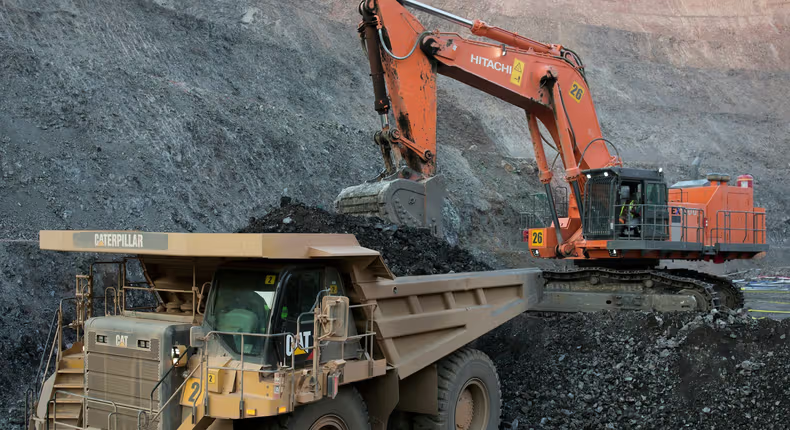
The world’s top cobalt producer is considering changes to more than 40 articles of its 2018 mining code, with the Chamber of Mines warning that the rapid reform process could fuel regulatory uncertainty and dent investor confidence
The Democratic Republic of Congo is revising its mining code to consolidate greater control over its resources, a move that could raise eyebrows among investors as the world’s top cobalt producer follows in the footsteps of several African countries seeking to capture more value from their mineral wealth .

The proposed amendments, introduced by MP Serge Chembo N’Konde and submitted to the government for comment in June, target more than 40 articles of the existing 2018 mining code, addressing strategic minerals, local content, community development, and enforcement gaps . The policy claims that elements of the 2018 legislation are outdated and that more state monitoring is required, as the regulations were last updated eight years ago .
📢 GET A DETAILED ARTICLES + JOBS
Join ASJ's WhatsApp Channel and never miss a post or opportunity.

The proposed changes would expand state control over strategic and reserved minerals, permit the establishment of strategic stockpiles, strengthen regulatory and anti-fraud monitoring, broaden powers to suspend or withdraw permits, and increase penalties for infringements, including fines of up to $1 million and prison terms of up to 20 years .
According to the DRC’s main mining industry body, investor confidence could wane as the country makes alterations to its mining sector . The Chamber of Mines has scheduled an emergency session for July 15–17 to establish a shared industry stance and determine whether further amendment to the mining code is necessary .

The speed with which the revision process appears to be unfolding raises fears that mining operators may not be sufficiently involved,” the chamber said, warning that further changes could fuel regulatory uncertainty and institutional tensions .
The Central African country boasts resources including cobalt, gold, and tantalum, and hosts mining giants such as China’s CMOC, Huayou Cobalt and Zijin, Switzerland-based Glencore, and Canada’s Barrick . The DRC supplies approximately 75% of the world’s cobalt and is the second-largest copper supplier globally .
Miners argue that the sector’s problems stem less from flaws in the 2018 code than from its implementation, citing overlapping mandates, unauthorised interventions, and conflicting interpretations that undermine legal certainty . Civil society organisations have also called for transparency and inclusion of all actors in the revision process .
According to a report by Accra Street Journal, the revision follows a broader trend across Africa, with governments seeking to increase state control over strategic mineral supply chains. In May, the DRC imposed a three-month suspension of mining activities in parts of South Kivu province, targeting operations in the Mwenga and Shabunda regions, two of the country’s most important artisanal and semi-industrial mining zones in the gold and coltan corridors
Source: Accra Street Journal
Last Updated on July 15, 2026 by Samuel Kwame Boadu
Disclaimer: Some content on Accra Street Journal may be aggregated, summarized, or edited from third-party sources for informational purposes. Images and media are used under fair use or royalty-free licenses. Accra Street Journal is a subsidiary of SamBoad Publishing Hub under SamBoad Business Group Ltd, registered in Ghana since 2014.
For concerns or inquiries, please visit our Privacy Policy or Contact Page.


Samuel Kwame Boadu is a Ghanaian media entrepreneur and storyteller with a passion for amplifying urban voices and uncovering everyday truths. He is the Editor-in-Chief and Founder of Accra Street Journal, a dynamic digital platform dedicated to capturing the pulse of Ghana’s capital—its people, culture, challenges, business, sports and innovations.