

From gridlocked arteries to the promise of mass transit — a 2026 intelligence brief on Accra’s mobility crisis
Executive Introduction
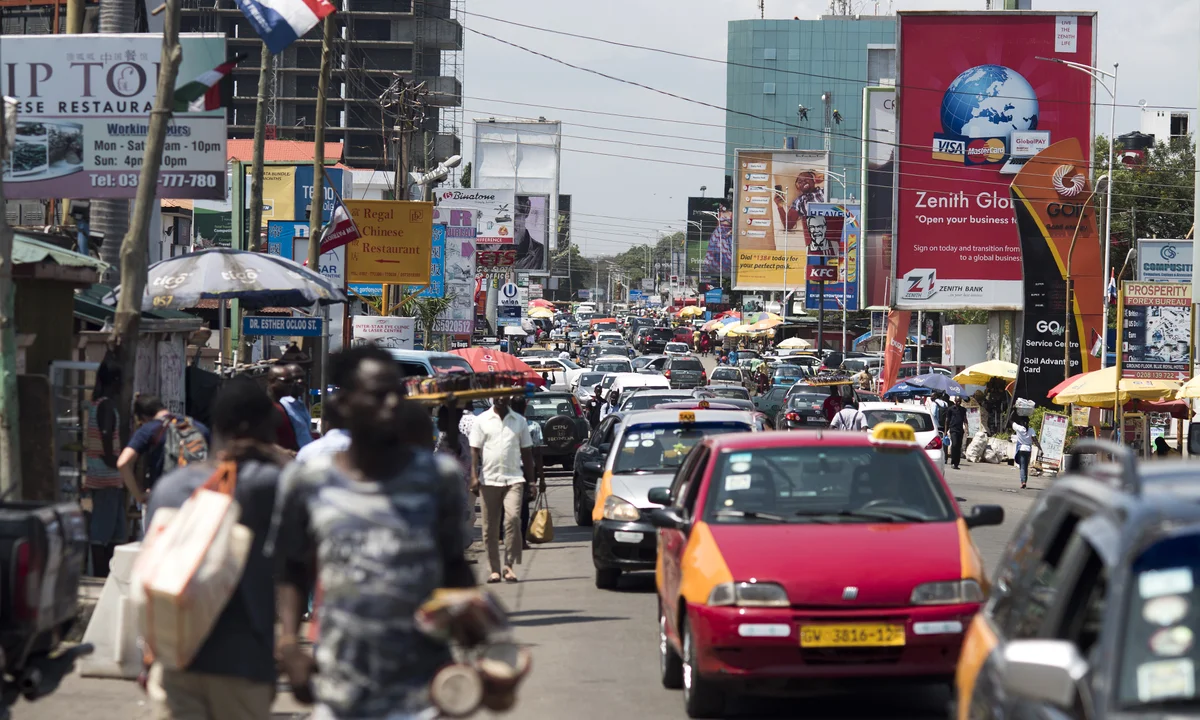
Accra’s traffic congestion is one of the most visible and economically damaging failures of urban governance in Ghana today. The city’s 2.77 billion annual trips, including an estimated 1.91 billion car trips in the core area, move through a road network that was never designed for such volumes . Every year, congestion costs Ghana’s economy an estimated GH¢4.5 billion — GH¢3.2 billion in lost time, GH¢434 million in wasted fuel, and GH¢815 million in stress-related productivity losses . Idling vehicles generate approximately 73,000 metric tons of excess carbon dioxide annually .
The human cost is equally significant: only 48 percent of Accra’s residents can reach half of the city’s jobs within one hour by public transport . For those who live in outlying areas, the daily journey is a test of endurance—queues at bus stations as early as 5:30 a.m., journeys stretching beyond three hours, and fares inflated far beyond approved rates .

This report examines the structural drivers of congestion in Accra: the dominance of an informal transport sector that has outpaced governance, the institutional fragmentation that has undermined reform, the encroachment crisis that compounds flood risks, the lessons from failed mass transit initiatives, and the emerging solutions that could finally break the gridlock.
📢 GET A DETAILED ARTICLES + JOBS
Join ASJ's WhatsApp Channel and never miss a post or opportunity.

Part 1: The Tro-Tro Paradox — 70% of Commuters, Zero Regulation
Accra’s transport system is defined by a fundamental paradox: the vast majority of commuters rely on a sector that operates with minimal formal governance. Tro-tros, the privately owned minibuses that carry approximately 70 percent of daily commuters, are governed by trade unions which set flat fares in consultation with the Ministry of Transport .
The tro-tro’s genius is its adaptability: it goes nearly everywhere, operates without timetables, and charges a fraction of what a taxi costs. No government system has ever matched its coverage. But its dominance is also a symptom of a formal system that has never consistently shown up. Vehicles are poorly maintained, safety standards are essentially unenforced, and the “fill-and-run” model means passengers wait indefinitely . The tro-tro is organically efficient but structurally fragile.

The driver’s perspective: Kwame Nkrumah Circle, the city’s central transport hub, remains chaotic. Multiple tro-tro stations, a Metro Mass terminal, an Aayalolo bus terminal, and scattered taxi points create disorder. Unruly tro-tro drivers compete aggressively for passengers, causing gridlock, long queues, and pedestrian hazards .
The Governance Problem
The roots of the congestion crisis are institutional. A 2026 study by Glima Research concluded that “this is not a capacity problem. It is a governance and strategy problem” . Urban development and transport planning are handled in isolation, with minimal coordination between agencies responsible for spatial planning, road infrastructure, and public transport . The Project Advisory Office established to coordinate Bus Rapid Transit (BRT) implementation lacked the statutory authority to align mandates, plans, or budgets across institutions, undermining its effectiveness .
The result is a system where well-intentioned reforms are undermined by institutional fragmentation, political interference, and the absence of a dedicated, independent urban transport authority with a mandate that survives election cycles .
Part 2: The Mass Transit Failures — Aayalolo and BRT
Accra’s attempts to introduce formal mass transit have been instructive—for what they reveal about the difficulty of reform.
The BRT That Became “Bus Slow Transit”
In November 2016, the government launched the Aayalolo Bus Service with roughly $95 million in international funding, including from the World Bank and the Agence Française de Développement. The vision was sound: dedicated lanes, scheduled departures, and electronic payment. What followed is one of the more instructive cautionary tales in Ghanaian infrastructure policy .
The dedicated lanes were never built. The government purchased nearly three times more buses than the World Bank recommended. Successive administrations neglected the system. By 2025, Aayalolo drivers were observed stopping indiscriminately along the Accra-Nsawam highway, competing directly with tro-tros on the very corridor the system was meant to bypass .
Stakeholder resistance from paratransit transport unions was a critical barrier. Limited consultations and negotiations with paratransit operators contributed to conflicting opinions and perceptions, creating uncertainty among transport operators and property owners along the corridor. Many property owners disputed the compensation packages, and negotiations quickly broke down, causing significant delays and reducing public trust in the project .
The Institutional Lesson
The Aayalolo experience is not proof that BRT cannot work in Ghana. It is proof that without physically separated lanes, institutional independence, and continuity across administrations, no bus system will ever justify its investment. A 2026 policy brief argues that the success of future BRT initiatives depends on institutional reform, integrated planning, and sustainable funding through taxation and land value capture instruments .
Part 3: The Drainage and Encroachment Crisis
Congestion is not only a transport problem. It is also a planning failure that compounds flood risks and disrupts mobility.

10,497 Structures in Drainage Buffers
A new assessment by the Greater Accra Resilient and Integrated Development (GARID) Project has revealed that about 16 percent of the legally designated 25-metre drainage buffer zones across selected assemblies have been encroached upon, raising concerns over worsening flood risks . The assessment examined developments along waterways in 16 metropolitan, municipal, and district assemblies, identifying 10,497 structures situated within designated drainage buffer zones .
Several assemblies recorded significant increases in unauthorised developments:
| Assembly | Structures in Drainage Buffer (2022) | Structures (2026) | Increase |
|---|---|---|---|
| Ga North | 1,049 | 2,261 | +1,212 |
| Ablekuma West | 904 | 1,293 | +389 |
| Ga Central | 2,275 (2023) | 2,329 | +54 |
| Ayawaso East | 337 | 494 | +157 |
Source: GARID Project assessment
The GARID Project Coordinator warned that continued encroachment on waterways is reducing the capacity of drainage systems to carry stormwater, increasing the likelihood of flooding during periods of heavy rainfall .
The Borla Taxi Crisis
The waste disposal crisis compounds the drainage problem. The Borla Taxi and Tricycle Association has revealed that some operators are forced to wait for days before they can offload refuse at the city’s only functioning dump site. Only one dumping site now serves the entire Greater Accra Region, compared to 17 operational sites in 2023 . The delayed waste disposal increases the likelihood of refuse ending up in drains and waterways, contributing to Accra’s recurring flooding .
Weak Enforcement as a Root Cause
Second Deputy Speaker of Parliament Andrews Asiamah Amoako has attributed the persistent flooding to weak urban planning, poor land use practices, and indiscipline. “If you pass the law but we are not able to implement it to address the problem, then it is more or less useless,” he said .
Part 4: The Emerging Solutions — What Could Fix Congestion
Despite the challenges, a range of reforms—some simple, some structural—could significantly reduce congestion in Accra.
1. Decongesting Kwame Nkrumah Circle
A practical reform proposal for decongesting Circle has emerged: restricting long-distance and major corridor routes to formal mass transit buses .
The proposal:
-
Reserve key high-volume routes from Circle (e.g., to Kasoa, Madina, Teshie, Ashiaman, Amasaman, Adenta, Ofankor) exclusively for Metro Mass and Aayalolo buses
-
Mandate frequent departures (every 10 minutes during peak hours) to eliminate long queues
-
Remove all informal tro-tro stations and consolidate them into centralized bus terminals
-
Repurpose freed-up tro-tro stations into a modern international/regional coach terminal
Expected outcomes include fewer vehicles idling, smoother traffic flow, reduced gridlock and air pollution, and safer pedestrian environments .
2. City-Owned Electric Metro Buses
The Accra Metropolitan Assembly is planning to introduce what it describes as the city’s first metro transport system, starting with electric buses to operate on major routes at low fares to ease traffic congestion during peak hours . The Mayor noted that while about 70 percent of trips in Accra are made by public transport, road space still largely benefits private car users .

3. A Smarter Public Transportation Strategy
A 2026 policy brief outlines a sequenced, multimodal strategy :
Short-term (now):
-
Formalise the tro-tro sector through fleet renewal incentives tied to compliance
-
Introduce digital ticketing to generate planning data
-
Create a route licensing framework built with, not against, the GPRTU
-
Commit to one fully operational BRT corridor (the Mallam-Kasoa corridor is the strongest candidate)
Medium-term:
-
Expand BRT systematically along Accra-Tema and Circle-Achimota
-
Begin the Eastern Rail Line rehabilitation in earnest, starting with Accra-Nsawam
Long-term:
-
Complete the Accra-Kumasi standard-gauge railway rehabilitation, reducing a six-hour road journey to under three hours
4. Independent Urban Transport Authority
The policy brief argues for establishing an independent urban transport authority for Greater Accra with statutory funding and fixed terms that do not expire with each administration. This would provide the institutional continuity that has historically been missing from transport reform .
5. Arterial Roads and Alternative Routes
Professor Martin Oteng-Ababio, Board Chairman of the Forest Plantation Development Fund, has called for the development of additional arterial and alternative roads in Accra. “What we have not done best, from my perspective, is the arterial roads. We all have to use the same route from Achimota to Legon. There’s no bypass that you can conveniently use. If one car breaks down along the way, it has a rippling effect on the whole traffic system,” he said .
6. Decongestion Enforcement in the CBD
The AMA, in collaboration with five sister assemblies, has launched a decongestion exercise directing hawkers and traders to operate behind a designated “Red Line.” The Mayor has cautioned drivers and transport operators against taking advantage of cleared spaces, warning that indiscriminate parking and the conversion of cleared areas into new stations would be met with strict sanctions .
Quick Reference: Congestion in Accra by the Numbers
| Metric | Value |
|---|---|
| Annual trips in Accra | 2.77 billion |
| Annual car trips in core area | 1.91 billion |
| Annual congestion cost to Ghana’s economy | GH¢4.5 billion |
| Time lost (71% of congestion cost) | GH¢3.2 billion |
| Wasted fuel | GH¢434 million |
| Stress-related productivity losses | GH¢815 million |
| Excess CO₂ emissions | 73,000 metric tons/year |
| Citizens who can reach 50% of jobs within 1 hour | 48% |
| Commuters using tro-tros daily | ~70% |
| Structures in drainage buffer zones | 10,497 |
| Drainage buffer land lost to encroachment | ~16% |
| BRT/Aayalolo investment | ~$95 million |
| Government target: rail journey Accra-Kumasi | <3 hours |
Source: Accra Street Journal
Last Updated on July 18, 2026 by Samuel Kwame Boadu
Disclaimer: Some content on Accra Street Journal may be aggregated, summarized, or edited from third-party sources for informational purposes. Images and media are used under fair use or royalty-free licenses. Accra Street Journal is a subsidiary of SamBoad Publishing Hub under SamBoad Business Group Ltd, registered in Ghana since 2014.
For concerns or inquiries, please visit our Privacy Policy or Contact Page.

Samuel Kwame Boadu is a Ghanaian media entrepreneur and storyteller with a passion for amplifying urban voices and uncovering everyday truths. He is the Editor-in-Chief and Founder of Accra Street Journal, a dynamic digital platform dedicated to capturing the pulse of Ghana’s capital—its people, culture, challenges, business, sports and innovations.