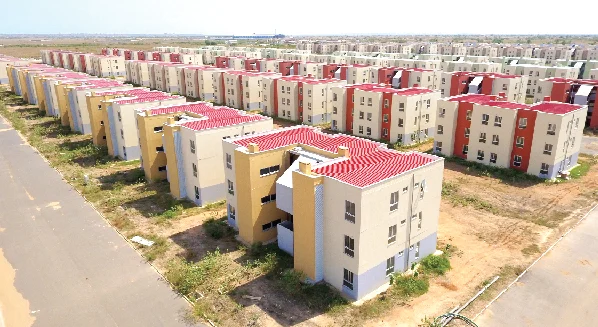
Affordable housing has become one of the most pressing urban questions facing Accra today. As the city continues to expand, the gap between housing demand and housing access grows wider, placing increasing strain on households across income levels. While the conversation around affordable housing often focuses on prices and rent, the future of housing affordability in Accra is tied to deeper structural forces—urban planning, financing, governance, and demographic change.
Understanding what lies ahead requires a realistic assessment of how Accra’s housing system currently works and what must change for affordability to improve meaningfully.

Accra’s Growing Housing Pressure
Accra’s population growth remains a defining force in its housing future. Rural-to-urban migration, natural population increase, and economic centralisation continue to push more people into the city. This growth fuels demand for housing at a pace that far exceeds supply, particularly in well-serviced areas.
📢 GET A DETAILED ARTICLES + JOBS
Join ASJ's WhatsApp Channel and never miss a post or opportunity.

Affordable housing, by definition, is most needed by middle- and lower-income households. Yet these groups compete in a market increasingly shaped by scarcity, rising construction costs, and speculative investment.
Without intervention, demographic pressure alone suggests that affordability will remain under strain.

What “Affordable Housing” Means in Accra
In theory, affordable housing refers to accommodation that does not consume a disproportionate share of household income. In Accra, however, affordability is often judged not by monthly rent, but by access to advance rent and location.
A unit may appear affordable on paper but remain inaccessible due to:
-
High upfront rent demands
-
Poor transport links
-
Inadequate infrastructure
-
Informal tenure arrangements
This disconnect complicates housing policy and clouds public debate.
Land as the Core Constraint
Land remains the single biggest obstacle to affordable housing in Accra. Fragmented ownership, customary tenure systems, litigation risks, and high acquisition costs discourage mass housing development.
Developers who navigate these hurdles often focus on premium housing to recoup investments quickly. Affordable housing projects struggle to compete without significant incentives or subsidies.
Until land administration improves, large-scale affordability will remain elusive.
Construction Costs and Market Reality
Building affordable housing is not simply about lowering prices. Construction materials, labour, financing, and compliance costs have risen steadily. Inflation and currency fluctuations further increase development risk.
As a result, even developers with social intent face economic constraints. Without economies of scale or government-backed financing, affordability becomes difficult to sustain.
This reality limits the private sector’s ability to deliver truly affordable units at scale.

The Role of Government Policy
Government policy will play a decisive role in shaping the future of affordable housing. Past initiatives have often focused on flagship projects rather than systemic reform.
Effective policy must address:
-
Land acquisition and titling
-
Infrastructure provision
-
Developer incentives
-
Housing finance accessibility
-
Rental market regulation
Without coordinated policy execution, affordable housing will remain fragmented and insufficient.
Financing and Mortgage Access
Affordable housing is inseparable from housing finance. Mortgage penetration in Ghana remains low, limiting home ownership options for average earners.
Short loan tenures, high interest rates, and strict eligibility requirements exclude many households. Without accessible financing, even modestly priced housing remains out of reach.
Expanding long-term, affordable housing finance will be critical to future affordability.
Rental Housing and the Affordability Debate
Given ownership constraints, rental housing will continue to dominate Accra’s housing landscape. The future of affordable housing therefore depends heavily on reforming the rental market.
This includes:
-
Addressing advance rent practices
-
Encouraging formal tenancy agreements
-
Improving enforcement of housing regulations
Without rental reform, affordability gains in construction alone will have limited impact.
Infrastructure as a Housing Multiplier
Affordable housing is not just about buildings—it is about livable communities. Infrastructure investment determines whether peripheral areas become viable housing options.
Improved roads, transport systems, water supply, and sanitation can unlock new housing zones and ease pressure on central areas. Without infrastructure expansion, demand will remain concentrated, keeping prices high.

Infrastructure development is therefore a critical affordability strategy.
Urban Planning and Density
Accra’s low-density sprawl increases housing costs by stretching infrastructure and limiting efficient land use. The future of affordability may depend on higher-density, well-planned developments.
Vertical housing, mixed-use developments, and transit-oriented planning can reduce per-unit costs and improve access. However, these approaches require strong planning enforcement and public acceptance.
Density, if managed well, can support affordability rather than undermine quality of life.
Private Sector and Innovation
Private developers will remain central to housing delivery. Innovation in construction methods, materials, and design can help reduce costs over time.
However, innovation alone cannot overcome systemic barriers. It must be supported by policy incentives, financing access, and regulatory clarity.
Public-private collaboration may offer the most realistic pathway forward.
Informal Housing and the Reality Ahead
Informal housing will continue to play a role in accommodating Accra’s population. Attempts to eliminate informality without providing alternatives risk displacing vulnerable households.
The future of affordable housing must therefore include upgrading and integrating informal settlements rather than ignoring or criminalising them.
Pragmatic solutions acknowledge reality rather than idealised models.
Social and Economic Implications
Housing affordability affects more than shelter. It influences:
If affordability continues to decline, the social and economic costs will ripple across the city.
What the Future Likely Holds
In the near term, affordable housing in Accra will remain constrained. Demand will continue to outpace supply, and market-driven solutions alone will not resolve affordability challenges.
However, gradual improvements are possible through:
-
Targeted infrastructure expansion
-
Incremental policy reform
-
Improved land administration
-
Expanded housing finance
The future will be shaped less by single projects and more by systemic consistency.
Final Reflection From ASJ
The future of affordable housing in Accra will not be defined by promises, but by execution. Without coordinated action across land, finance, planning, and regulation, affordability will remain aspirational.
Yet, with deliberate reforms and realistic expectations, incremental progress is possible. Affordable housing is not an overnight achievement—it is a long-term commitment.
Accra’s growth makes this commitment unavoidable.
FAQs
Is affordable housing achievable in Accra?
Yes, but only through coordinated long-term reforms.
What is the biggest barrier to affordability?
Land acquisition and housing finance constraints.
Will renting remain dominant in Accra?
Yes, for the foreseeable future.
Can private developers solve the housing problem alone?
No, policy and infrastructure support are essential.
Does infrastructure affect housing affordability?
Yes, it expands viable housing areas and reduces pressure.
Source: Accra Street Journal
Last Updated on June 19, 2026 by Samuel Kwame Boadu
Disclaimer: Some content on Accra Street Journal may be aggregated, summarized, or edited from third-party sources for informational purposes. Images and media are used under fair use or royalty-free licenses. Accra Street Journal is a subsidiary of SamBoad Publishing Hub under SamBoad Business Group Ltd, registered in Ghana since 2014.
For concerns or inquiries, please visit our Privacy Policy or Contact Page.

Samuel Kwame Boadu is a Ghanaian media entrepreneur and storyteller with a passion for amplifying urban voices and uncovering everyday truths. He is the Editor-in-Chief and Founder of Accra Street Journal, a dynamic digital platform dedicated to capturing the pulse of Ghana’s capital—its people, culture, challenges, business, sports and innovations.