










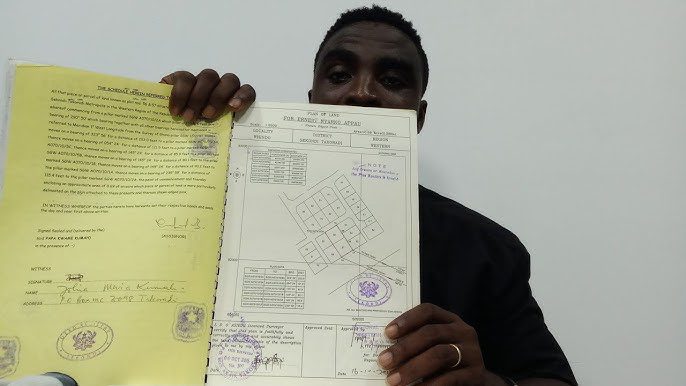
Introduction: The Honest Answer
“How long does it take to register land in Ghana?”
The official answer might be “90 days.” The Lands Commission’s target is “30 days.” The reality is quite different.

Land registration in Ghana is not a sprint. It is not even a marathon. It is more like a journey where the distance is unknown, the road conditions vary dramatically, and the arrival time depends on factors largely outside your control.
📢 GET A DETAILED ARTICLES + JOBS
Join ASJ's WhatsApp Channel and never miss a post or opportunity.

The honest answer is this: complete registration typically takes 4 to 12 months , but some cases stretch into years. The timeline depends primarily on location: urban properties in Accra process fastest (4-6 months), while rural properties can take 8-12 months or longer .
This Accra Street Journal guide provides a realistic, data-driven timeline for land registration in Ghana, explaining why delays occur, what you can expect at each stage, and how the government’s ongoing reforms aim to change the system.

The Real Numbers: Urban vs. Rural
The most significant factor determining your registration timeline is location.
| Region | Registration Type | Typical Timeline | Legal Protection |
|---|---|---|---|
| Greater Accra | Title Registration | 4-6 months | State-guaranteed (indefeasible) |
| Parts of Kumasi | Title Registration | 4-6 months | State-guaranteed |
| Kasoa and environs | Title Registration | 4-6 months | State-guaranteed |
| Other regions | Deeds Registration | 8-12 months | Notice only (weaker protection) |
Why the stark difference? Because over 98% of Ghana’s land falls outside official “registration districts” . Only the Greater Accra Region, parts of Kumasi, and Kasoa and its environs have been declared as areas where title registration (which provides a state-guaranteed, indefeasible title) is available .
Justice Alexander Osei-Tutu of the Court of Appeal has explained that this situation is “unfair and a major factor in the incessant land disputes across the country” . For the 98% of land outside registration districts, only deed registration is available—a system that “gives notice of the registration to third parties, and could be registered multiple times; just that priority was given to who registered it first” .
Justice Osei-Tutu offered a memorable analogy: “Title registration may loosely be compared to a marriage contracted under the Ordinance… which is purely monogamous and secures the marriage from future intruders/suitors, while Deeds registration is synonymous with customary marriage, which is potentially polygamous” .
Detailed Timeline: What to Expect at Each Stage
Stage 1: Pre-Registration Due Diligence (4-8 weeks)
Before you can even begin registration, you must complete thorough due diligence to ensure the land is legitimately available for purchase.
| Activity | Timeline | Cost Estimate (GHS) |
|---|---|---|
| Engage licensed surveyor | 1-2 weeks | 2,000-8,000 |
| Conduct Lands Commission search | 2-4 weeks | 55 + additional fees |
| Engage licensed solicitor | 1 week | 3,000-8,000 |
| Physical site inspection | 1-2 weeks | Included in surveyor fees |
Professional due diligence is not optional—it is essential. Industry professionals recommend a comprehensive three-tier verification process: official land title search at the Lands Commission, professional legal consultation, and physical site inspection with licensed surveyors . Attempting to skip or rush these steps is the leading cause of fraud-related losses .
Stage 2: Document Preparation (2-4 weeks)
Once due diligence confirms the title is clean, your lawyer and surveyor prepare the necessary documents.
| Document | Estimated Timeline | Notes |
|---|---|---|
| Indenture/transfer document | 1-2 weeks | Prepared by lawyer |
| Site plan with barcode | 1-2 weeks | Surveyor obtains from Lands Commission |
| Stamp duty payment | 1-2 weeks | 0.25%-1% of property value |
| Tax clearance certificate | 1-2 weeks | From GRA |
The site plan barcode is a critical requirement. Without it, your property documents are incomplete in the eyes of the law, and you cannot register your property with the Lands Commission.
Stage 3: Application Lodgment (1 day)
Once all documents are ready, your lawyer submits the complete application package to the Client Service and Access Unit (CSAU) at the Lands Commission.

Required Documents Checklist:
-
Completed application form (Form 1A)
-
Stamped indenture or transfer document
-
Site plan with barcode
-
Search report from Lands Commission
-
Tax clearance certificate
-
Valid identification (Ghana Card/Passport)
-
Two passport-size photographs
-
Payment receipt for applicable fees
For Stool/Family Lands (Additional):
-
Consent from Public and Vested Lands Management Division (PVLMD)
-
Planning comments from Town and Country Planning Department
Stage 4: Due Diligence and Adjudication (Urban: 2-4 months / Rural: 4-8 months)
This is where the real waiting begins. The Lands Commission conducts thorough due diligence on your application.
What happens during this stage:
-
Public notice: A notice of the application is published to invite any competing claims
-
Site verification: Commission officials may visit the property
-
Title examination: Verification that the seller had legitimate authority to transfer
-
Adjudication: Any competing claims are resolved before title is issued
For properties in Land Title Registration districts (Accra, parts of Kumasi, Kasoa), this process is more structured but still takes 4-6 months . For the 98% of land outside these districts, deed registration takes significantly longer—8-12 months .
Stage 5: Payment of Registration Fees (1-2 weeks)
Once due diligence is complete, you receive a demand for final fees.
| Fee Type | Amount |
|---|---|
| Registration fees | GHS 1,148 – 1,178 per acre |
| Survey expenses | Variable |
| Stamp duty (if not already paid) | 0.25%-1% of property value |
| Certificate issuance fee | Included in registration fees |
Total closing costs for foreign buyers typically run between 4% and 7% of the purchase price .
Stage 6: Issuance of Land Certificate (2-4 weeks)
After all fees are paid and due diligence is complete, the Land Registrar issues your Land Certificate.
Total Estimated Timeline by Location:
| Location | Total Registration Timeline |
|---|---|
| Greater Accra Region | 4-6 months |
| Parts of Kumasi | 4-6 months |
| Kasoa and environs | 4-6 months |
| Other regions (deed registration) | 8-12 months |
Why Does Land Registration Take So Long?
Reason 1: Most Land Cannot Be Registered with a Title
The most fundamental reason for delays is also the least understood: over 98% of land in Ghana cannot be registered with a title at all .
Under the current legal regime, only lands that fall within areas designated by the Minister of Lands and Natural Resources as “registration districts” can be registered for title . Those outside such districts rely on deed registration, which does not provide a state-guaranteed title and “could be registered multiple times” .
Justice Osei-Tutu criticised the fact that although title registration was introduced 40 years ago through the Land Title Registration Law, 1986 (PNDCL 152), more than 13 regions are yet to be declared registration districts .
The Numbers:
-
Greater Accra Region (registration district): 3,245 km² (1.4% of Ghana’s land size)
-
Parts of Kumasi under registration district: 309 km² (0.13% of Ghana’s land size)
-
Kasoa and environs under registration district: 56.7 km² (0.024% of Ghana’s land size)
-
Total land under title registration: Less than 2% of Ghana
Reason 2: Manual, Paper-Based Systems
The Lands Minister, Emmanuel Armah-Kofi Buah, has declared that “90% of your work is still paper-based” . This manual system creates multiple problems:
-
Missing files: Documents are misplaced, lost, or destroyed
-
Physical searches: Applicants must visit offices in person, wait in queues
-
No real-time tracking: No online status checking
-
Vulnerability to manipulation: Paper files can be altered, removed, or “lost”
Reason 3: Inadequate Infrastructure and Data Deficiencies
The Lands Commission operates with significant infrastructure limitations:
-
No comprehensive national base map
-
Incomplete land data
-
Outdated surveying equipment
-
Financial constraints
The government requires approximately $165 million to fully map and digitalise land records across the country .
Reason 4: Government Embargoes and Policy Changes
In January 2025, President Mahama directed the Lands Commission to halt the sale, leasing, and processing of all state and public lands . This embargo, intended to curb abuse and restore public confidence, has significantly disrupted land registration processes .
Cabinet has approved a nationwide review of public lands sold or allocated without the completion of required processes, and any transaction found to have bypassed due procedure will be cancelled .
The Government’s 30-Day Target: What You Should Know
The government has set an ambitious target: reduce land registration processing to a maximum of 30 days .
This target is part of a broader reform agenda that includes:
-
Digitalisation of all land records and services within two years
-
Establishment of 110 district Lands Commission offices
-
100% retention of internally generated funds (IGF) by the Lands Commission, with 67% ring-fenced for digitalisation
However, this target is not yet a reality. The Lands Commission has confirmed that “plans are underway” but the 30-day timeline remains aspirational.
For now, budget for 4-12 months. Do not plan your construction timeline around the 30-day promise.
Urban vs. Rural: The Timeline Gap Explained
The disparity between urban and rural registration times is not arbitrary—it reflects fundamental differences in the legal framework.
Title Registration (Urban)
-
Available in: Accra, parts of Kumasi, Kasoa and environs
-
Legal protection: Indefeasible title (state-guaranteed)
-
Processing time: 4-6 months
-
Risk of multiple sales: Very low
Deeds Registration (Rural)
-
Available in: 98% of Ghana (all other regions)
-
Legal protection: Notice to third parties only
-
Processing time: 8-12 months
-
Risk of multiple sales: High (multiple instruments can be registered)
Justice Osei-Tutu explained that “deeds registration under the law has the latitude of registering multiple instruments relating to the same parcel of land” . This means that even after registration, your ownership may not be secure—and it also means the Lands Commission must spend extra time investigating competing claims before processing any application.
What This Means for Foreign Buyers
Foreign buyers face additional considerations that can extend timelines:
| Consideration | Detail |
|---|---|
| Maximum lease term | 50 years (constitutional limit) |
| Citizen lease term | 99 years |
| Registration requirement | Must register with Lands Commission |
| Corporate ownership | Requires GIPC registration if investment exceeds thresholds |
Foreigners cannot hold freehold land in Ghana and are constitutionally restricted to leasehold interests with a maximum duration of 50 years . This is half the 99-year lease that Ghanaian citizens can hold, creating a significant gap in long-term property security for international buyers .
The property registration timeline for foreigners has improved from 5-12 months down to around 3 months for straightforward applications, with the government targeting 30 working days by late 2025 .
Summary: Realistic Timelines by Scenario
| Scenario | Estimated Timeline | Key Factors |
|---|---|---|
| Best-case (Accra, straightforward title) | 4-6 months | Clear title, all documents ready, no competing claims |
| Average (Accra, minor complications) | 6-8 months | Some back-and-forth with Lands Commission |
| Deed registration (outside Accra) | 8-12 months | Slower processing, weaker legal protection |
| Complex cases (multiple claims, missing documents) | 12+ months | Legal disputes, missing files, government embargoes |
| Government target (not yet achieved) | 30 days | Aspirational; not currently realistic |
Frequently Asked Questions (FAQs)
1. How long does land registration take in Ghana?
Complete registration typically takes 4-6 months in Greater Accra and 8-12 months in other regions. The government’s 30-day target has not yet been achieved .
2. Why does land registration take so long in Ghana?
Delays stem from multiple factors: over 98% of land falls outside title registration districts, manual paper-based systems (90% not digitalised), inadequate infrastructure, government embargoes on public land transactions, and the need to investigate competing claims .
3. What is the difference between title registration and deed registration?
Title registration provides a state-guaranteed, indefeasible title (available only in Accra, parts of Kumasi, and Kasoa). Deed registration (covering 98% of Ghana) merely provides notice to third parties and allows multiple registrations of the same land .
4. How long does it take to register land in Accra specifically?
In Greater Accra, registration typically takes 4-6 months for straightforward applications with all documents in order .
5. How long does it take to register land outside Accra?
In rural areas and regions outside the title registration districts, registration typically takes 8-12 months .
6. What is the government doing to speed up registration?
The government has launched an $85 million digital transformation project, established a target of 30-day processing, and plans to establish 110 district Lands Commission offices .
7. How much does land registration cost in Ghana?
Registration costs typically range from GHS 2,000-5,000+ per acre, including registration fees (GHS 1,148-1,178 per acre), survey expenses, and stamp duty (0.25%-1% of property value) .
8. Can I speed up the registration process by paying extra?
Attempting to expedite through unofficial channels typically increases fraud risk rather than reducing processing time . Work through licensed professionals and follow proper channels.
9. Does the government embargo on public lands affect private land registration?
The embargo affects state and public lands. For private lands, the regular registration process continues, though some delays may still occur.
10. What is the 30-day registration target?
The government has directed the Lands Commission to complete all land-related applications within 30 days. This target has not yet been achieved and remains aspirational .
Conclusion: Plan for Reality, Not Promises
The honest answer to “How long does land registration take in Ghana?” is: 4 to 12 months, depending on location.
If you are buying in Accra, budget 4-6 months. If you are buying elsewhere, budget 8-12 months. If your case is complex (multiple claims, missing documents, disputed boundaries), budget longer.
Do not plan your construction timeline around the government’s 30-day target. Do not assume that paying more will speed the process. Do not skip due diligence in hopes of faster registration.
Instead, engage licensed professionals, conduct thorough searches, file your caution immediately, and follow up regularly with the Lands Commission. The system is improving—digitalisation is underway, new district offices are being established, and processing times are gradually decreasing. But for now, patience is not just a virtue; it is a necessity.
The journey from land purchase to Land Certificate in Ghana is not for the impatient. But understanding the realistic timeline is the first step toward managing your expectations and protecting your investment.
Source: Accra Street Journal
Last Updated on June 14, 2026 by Samuel Kwame Boadu
Disclaimer: Some content on Accra Street Journal may be aggregated, summarized, or edited from third-party sources for informational purposes. Images and media are used under fair use or royalty-free licenses. Accra Street Journal is a subsidiary of SamBoad Publishing Hub under SamBoad Business Group Ltd, registered in Ghana since 2014.
For concerns or inquiries, please visit our Privacy Policy or Contact Page.

Samuel Kwame Boadu is a Ghanaian media entrepreneur and storyteller with a passion for amplifying urban voices and uncovering everyday truths. He is the Editor-in-Chief and Founder of Accra Street Journal, a dynamic digital platform dedicated to capturing the pulse of Ghana’s capital—its people, culture, challenges, business, sports and innovations.





