










Introduction: More Than a Festival
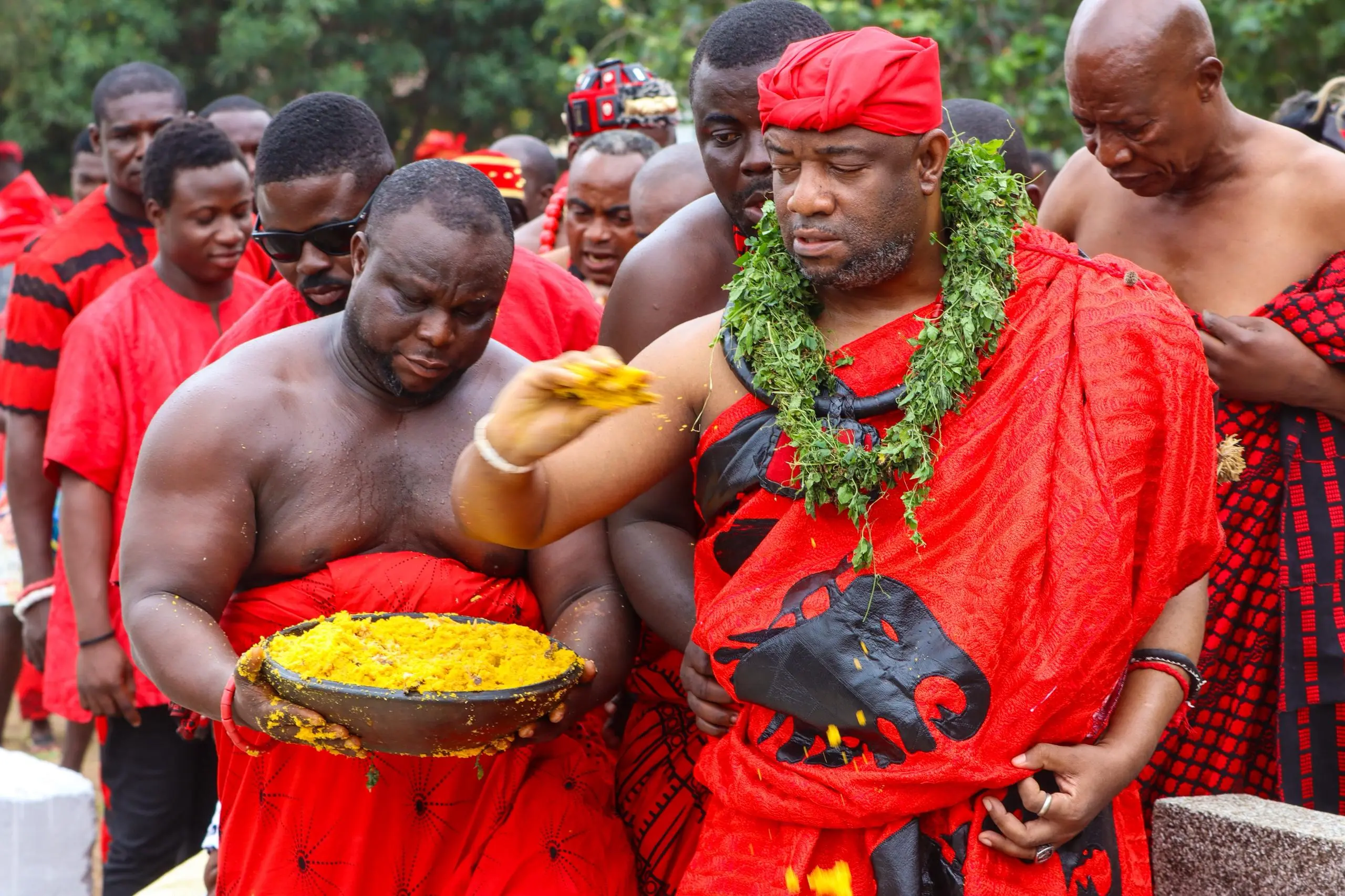
The Homowo festival is one of Ghana’s most treasured cultural celebrations—a time of thanksgiving, of remembrance of survival through famine, and of joy as communities come together to sprinkle kpokpoi and usher in abundance . The word itself, Homowo, means “hooting at hunger,” commemorating the Ga people’s historic triumph over famine .
But beneath the vibrant drums and colourful regalia lies a deeper reality. Homowo is not merely a cultural event. It is a political act—a performance of sovereignty, a test of leadership, and a battleground where chieftaincy disputes, state power, and community identities collide.

The Ga Traditional Council’s annual ban on drumming and noise-making, the peace pacts signed before the festival, the chieftaincy disputes that erupt during the celebrations, and the violent clashes that have claimed lives in recent years—these are not anomalies. They are expressions of the political meaning of tradition.
📢 GET A DETAILED ARTICLES + JOBS
Join ASJ's WhatsApp Channel and never miss a post or opportunity.

This Accra Street Journal article explores Homowo beyond its celebratory surface, examining how the festival functions as a tool for asserting traditional authority, negotiating with the state, and exposing the fractures within Ga political life.
Part 1: The Ban on Drumming – A Sovereign Act
The Month of Silence
Every year, in the months leading up to Homowo, the Ga Traditional Council imposes a month-long ban on drumming and noise-making across the Ga State . For 2026, the ban runs from May 4 to June 4 . The prohibition covers:

-
Clapping of hands
-
Placement of loudspeakers outside church premises and mosques
-
Roadside evangelism
-
Use of megaphones, loudspeakers, tambourines, and other musical instruments, both outside and indoors
Funeral rites and related activities are also suspended until one week after the ban is lifted .
A Legally Recognised Custom
This ban is not merely a suggestion. Nii Ayikoi Otoo, President of the Ga-Dangme Council, has emphasised that these customary practices are legally recognised under the 1992 Constitution. Article 11(3) upholds and protects the country’s customary laws and cultural practices, while Article 26(1) guarantees the rights of communities to preserve and practice their cultural heritage .
“This ban is a sacred tradition observed to maintain peace, solemnity, and spiritual reflection as the Ga people prepare for Homowo, a festival that commemorates resilience, unity, and thanksgiving for a bountiful harvest,” Nii Otoo explained .
The Politics of Silence
The ban is not simply religious. It is a declaration of authority. By requiring churches, mosques, and individuals to comply—even with the backing of the Ghana Police Service and the Regional Security Council—the Ga Traditional Council asserts its jurisdiction over the land .
A joint task force working with the Regional Security Council and the Ghana Police Service enforces the directive and prosecutes offenders . This partnership between traditional authorities and state security agencies demonstrates how customary law and state law intersect—and how the festival becomes a moment when traditional power is both performed and reinforced.
The Bans in Other Areas
While the Ga Traditional Council announces a single ban for Ga Mashie, other traditional areas—Osu, La, Teshie, Nungua, Tema, Kpone, Prampram, and Ningo—announce separate bans for specific periods . This decentralised approach reflects the autonomy of individual Ga towns and the complex political structure of the Ga State, where the Ga Mantse is paramount, but each town has its own chief and its own calendar.
Part 2: Homowo as a Political Platform
The Ga Mantse’s Strategic Partnerships
In 2025, King Tackie Teiko Tsuru II, the Ga Mantse, leveraged the Homowo festival to forge strategic alliances with state institutions. The Ghana Tourism Authority (GTA) announced a partnership with the Ga Traditional Council to “elevate the celebration of this year’s Homowo Festival” .
GTA CEO Maame Efua Houadjeto acknowledged that many of the key tourist activities take place on Ga Traditional land, making it appropriate to work with the custodians of those cultural assets . The Ga Mantse, in turn, pledged to provide an office space for the GTA within his Palace and requested a liaison officer for constant communication .
This is not merely cultural promotion. It is political positioning. By partnering with the GTA, the Ga Mantse reinforces his role as the gatekeeper of Ga heritage—a role that carries weight in negotiations with the state over land, development, and resources.

Aligning Homowo with National Development Goals
King Teiko Tsuru also announced an ambitious goal: aligning the Homowo festival with Sustainable Development Goal (SDG) Two—Eradicating Hunger .
“We aim to use this year’s Homowo Festival as a platform to raise awareness and actively contribute to the eradication of hunger in Ghana, particularly in marginalised communities where poverty is on the rise,” he said .
By linking a traditional festival to a global development framework, the Ga Mantse positions himself as a modern leader engaged with international agendas—not merely a custodian of custom.
The FESTAC Connection
In August 2025, the Ghana Tourism Authority and the FESTAC Committee paid a courtesy call on the Ga Mantse, seeking his permission to host FESTAC celebrations on Ga land and inviting him to serve as patron .
The King warmly received the delegation, granting both requests . This demonstrates how Homowo becomes a gateway for broader cultural diplomacy, with the Ga Mantse leveraging the festival’s visibility to attract international events and investment to Ga land.
Part 3: Peace Pacts and the Politics of Order
Signing Peace Pacts
In the weeks leading up to Homowo, various traditional councils sign peace pacts to ensure calm during the celebrations. In August 2025, the Ga West Traditional Council signed such a pact, with representatives from all areas pledging their full support to ensuring peace before, during, and after the festival .
The Municipal Chief Executive, Honourable John Desmond Sowah Nai, highlighted his willingness to offer assistance, while ACP Susana Adjei, the Ga West Divisional Police Commander, emphasised that “peace brings development, togetherness, wealth, health, education and culture” .
Why Peace Pacts Are Necessary
The signing of peace pacts is not a mere formality. It is a recognition that Homowo has, in recent years, become a flashpoint for violence.
In 2025, clashes in Sowutuom and Teshie during the kpokpoi sprinkling ceremony resulted in deaths and injuries . In Sowutuom, three lives were lost after a violent confrontation erupted between residents and local traditional leaders. Eyewitnesses spoke of bullets flying for nearly half an hour, residents fleeing for safety, and shops forced to remain closed .
In Teshie, three young men were confirmed dead after rival factions clashed during the sprinkling of kpokpoi at the Chief’s Palace. Despite prior agreements by the Municipal Security Committee to prevent such confrontations by restricting rites to clan houses, defiance of the directive triggered a violent escalation .
The Underlying Causes
The violence is not random. It stems from chieftaincy disputes, political tensions, and the fight for dominance and control over festival rites . In communities like Teshie, La, Sowutuom, and others, what should be a season of joy has instead become a period when families lock their doors in fear .
The editorial in The Ghanaian Chronicle captured the crisis:
“How has a festival rooted in thanksgiving and harmony become synonymous with gunfire, injuries and death? Why are sacred traditions being hijacked by factional rivalries and power struggles? Instead of evoking pride and joy, Homowo in these communities now evokes panic and fear” .
The editorial called on traditional leaders, chiefs, and elders to resolve internal disputes peacefully and on state institutions to act decisively—not only in restoring calm after violence erupts but in preventing such chaos through intelligence gathering and timely intervention .
Historical Precedent
The violence is not new. In 2010, a 30-year-old man was stabbed to death during Homowo in Nungua. In 2011, clashes in La resulted in one death and several injuries. In 2012, a 25-year-old man was shot dead during Homowo in Odododiodoo .
The persistence of violence raises a troubling question: how did a festival that was meant to feed the hungry become a festival of bloodshed?
Part 4: The Weaponisation of Tradition
Chieftaincy Disputes as Drivers of Violence
The violence during Homowo is inextricably linked to chieftaincy disputes. As Nii Odoi Kwao II, Head of the Nii Odoi Kwao family of Osu, explained, the institution of chieftaincy has been corrupted by individuals who use their wealth, often ill-gotten, to manipulate traditional affairs .
“Chieftaincy and royalty are founded on three principles, the foremost being heredity. A chief must come from the rightful lineage, as the institution is hereditary and ancestral. It is not something one can simply assume,” he stressed .
He lamented that the institution has now been reduced to “a contest for the highest bidder,” a trend that undermines its sacred traditions .
The Role of Wealth and Power
The interference of wealthy individuals has led to the disruption of royal lineages, with people claiming titles that do not rightfully belong to them . This corruption of the chieftaincy system manifests during Homowo, when rival factions clash over the right to perform rites or to be recognised as the legitimate traditional authority.
Calls for Government Intervention
Nii Odoi Kwao II appealed to the President, the Attorney General, and the Inspector General of Police to urgently intervene in the chieftaincy disputes, noting that many of the cases are already before the authorities and that firm action is needed if peace is to prevail .
He urged the government to empower the Ghana Police Service, the Economic and Organised Crime Office (EOCO), and the Judiciary to enforce the law without fear or favour, “Only then can we restore dignity to the chieftaincy institution and stem the tide of disputes, especially in the Greater Accra Region,” he said .
Part 5: Homowo as a Call for Unity
The Abola Paramount Chief’s Message
Amid the violence and political maneuvering, some traditional leaders have used Homowo to call for unity. The Paramount Chief of the Abola Traditional Council and Atofotse of the Ga State, Nii Ahene Nunoo III, speaking on the theme “Deepening the Unity Within Abola,” reminded the people that the true strength of the Ga State lies in togetherness .
“Unity is not merely a concept; it is a lived experience. It is what binds us together as brothers and sisters, irrespective of our backgrounds, beliefs, or interests. In times of joy, we celebrate as one; in times of challenge, we rally together,” he said .
He outlined several strategies to strengthen unity, including promoting dialogue through regular forums, encouraging inclusivity across gender and age, increasing youth mentorship, and strengthening collaboration with local organisations, NGOs, and businesses to drive communal development and conflict resolution initiatives .
The Weija Example
In 2014, Weija celebrated what was described as the “most peaceful Homowo in the history of the Gas,” a legacy worth emulating by other communities .
The Dzaasetse and Acting Mantse of Weija, Nii Ogbedada Nii Boafo Danyina-Nse I, called on all chiefs and traditional leaders within the Ga Traditional Area to put an end to the little squabbles that seem to be hindering the peace of the Ga State .
He also made a significant political statement: “The time has come for political leaders to allow the Chieftaincy institutions to work independently from any of their interferences since that is a panacea for peace and development” .
Summary Table: The Political Dimensions of Homowo
| Dimension | Expression | Political Meaning |
|---|---|---|
| Sovereignty | Annual ban on drumming, enforced by state security | Assertion of traditional authority over territory |
| Partnership | GTA collaboration, FESTAC patronage | Positioning the Ga Mantse as gatekeeper of Ga heritage |
| Development | Alignment with SDG 2 (Eradicating Hunger) | Linking tradition to global agendas |
| Conflict | Chieftaincy disputes, violent clashes | Exposure of fractures in traditional governance |
| Peace | Signing of peace pacts, calls for unity | Recognition that order requires active maintenance |
| Resistance | Calls for government to weed out impostors | Demand that state enforce law in traditional affairs |
Frequently Asked Questions (FAQs)
1. What does Homowo mean?
Homowo means “hooting at hunger.” It commemorates the Ga people’s historic triumph over famine, when after a period of severe drought and food shortage, the rains returned and the harvest was bountiful .
2. Why does the Ga Traditional Council ban drumming before Homowo?
The ban on drumming and noise-making is a sacred tradition observed to maintain peace, solemnity, and spiritual reflection as the Ga people prepare for Homowo . It is a period of quiet before the joyous celebration.
3. Is the ban on drumming legally enforceable?
Yes. The ban is backed by the 1992 Constitution, which upholds customary laws and cultural practices. A joint task force working with the Regional Security Council and the Ghana Police Service enforces the directive .
4. Why has Homowo become violent in some communities?
Violence during Homowo is driven by chieftaincy disputes, political tensions, and the fight for dominance and control over festival rites. Rival factions clash over who has the right to perform traditional ceremonies .
5. What is the Ga Mantse’s role in Homowo?
The Ga Mantse is the paramount chief of the Ga people. He leads the traditional council, performs sacred rituals (such as the Maamε visit to ancestral burial grounds), and represents the Ga State in partnerships with state institutions like the Ghana Tourism Authority .
6. What is the political significance of the GTA partnership with the Ga Mantse?
The partnership reinforces the Ga Mantse’s role as the gatekeeper of Ga heritage, giving him leverage in negotiations with the state over land, development, and resources. It also positions him as a modern leader engaged with tourism and economic development .
7. What is the FESTAC connection to Homowo?
In 2025, the FESTAC Committee sought the Ga Mantse’s permission to host FESTAC celebrations on Ga land and invited him to serve as patron. This demonstrates how Homowo becomes a gateway for cultural diplomacy and international events .
8. How do chieftaincy disputes affect Homowo?
Chieftaincy disputes often erupt during Homowo, as rival factions clash over the right to perform rites or to be recognised as the legitimate traditional authority. These disputes have led to deaths and injuries in recent years .
9. What are peace pacts, and why are they signed before Homowo?
Peace pacts are agreements signed by traditional authorities and community leaders to ensure calm during the festival. They are necessary because of the history of violence during Homowo and serve as a recognition that order requires active maintenance .
10. What is being done to address the violence?
Traditional leaders have called for government intervention, including empowering the police, EOCO, and the judiciary to enforce the law. Some councils have signed peace pacts, and the police have restricted certain rites to family homes in volatile areas .
Conclusion: The Unfinished Politics of Tradition
Homowo is not simply a festival. It is a political institution—a site where traditional authority is asserted, challenged, and negotiated. The annual ban on drumming declares the Ga Traditional Council’s sovereignty over the land. The partnerships with the Ghana Tourism Authority and FESTAC position the Ga Mantse as a modern leader and gatekeeper of Ga heritage. The peace pacts acknowledge that order is not automatic; it must be actively constructed.
But the violence during Homowo also reveals the fractures within Ga political life. Chieftaincy disputes, fueled by wealth and political interference, have turned a festival of thanksgiving into a season of fear. The bloodshed in Sowutuom and Teshie is not a deviation from tradition; it is an expression of the unresolved tensions within the chieftaincy institution itself.
The challenge for the Ga people—and for Ghana—is whether Homowo can be reclaimed. Not as a festival free of politics, but as a festival where politics is conducted peacefully, where disputes are resolved through dialogue rather than bullets, and where the celebration of survival does not require new graves.
As the editorial in The High Street Business concluded: “Culture should unite, not divide. Tradition should heal, not harm. And festivals should inspire joy, not funerals. If Homowo continues on this violent trajectory, it risks losing its meaning altogether. Ghana must not allow that to happen” .
Frequently Asked Questions (FAQs)
1. What does Homowo mean?
Homowo means “hooting at hunger,” commemorating the Ga people’s triumph over famine .
2. Why does the Ga Traditional Council ban drumming before Homowo?
The ban is a sacred tradition observed to maintain peace, solemnity, and spiritual reflection as the Ga people prepare for Homowo .
3. Is the ban on drumming legally enforceable?
Yes. The ban is backed by the 1992 Constitution, and a joint task force with the police enforces it .
4. Why has Homowo become violent in some communities?
Violence is driven by chieftaincy disputes, political tensions, and the fight for dominance over festival rites .
5. What is the Ga Mantse’s role in Homowo?
The Ga Mantse leads the traditional council, performs sacred rituals, and represents the Ga State in partnerships with state institutions .
6. What is the political significance of the GTA partnership?
It reinforces the Ga Mantse’s role as gatekeeper of Ga heritage, giving him leverage in negotiations with the state .
7. What is the FESTAC connection to Homowo?
FESTAC sought the Ga Mantse’s permission to host celebrations on Ga land, demonstrating how Homowo facilitates cultural diplomacy .
8. How do chieftaincy disputes affect Homowo?
They erupt during Homowo as rival factions clash over the right to perform rites, leading to violence .
9. What are peace pacts?
Agreements signed by traditional authorities to ensure calm during the festival, acknowledging that order requires active maintenance .
10. What is being done to address the violence?
Traditional leaders have called for government intervention, including empowering police and EOCO. Some councils have signed peace pacts
Source: Accra Street Journal
Last Updated on April 11, 2026 by Samuel Kwame Boadu
Disclaimer: Some content on Accra Street Journal may be aggregated, summarized, or edited from third-party sources for informational purposes. Images and media are used under fair use or royalty-free licenses. Accra Street Journal is a subsidiary of SamBoad Publishing Hub under SamBoad Business Group Ltd, registered in Ghana since 2014.
For concerns or inquiries, please visit our Privacy Policy or Contact Page.

Samuel Kwame Boadu is a Ghanaian media entrepreneur and storyteller with a passion for amplifying urban voices and uncovering everyday truths. He is the Editor-in-Chief and Founder of Accra Street Journal, a dynamic digital platform dedicated to capturing the pulse of Ghana’s capital—its people, culture, challenges, business, sports and innovations.





