Introduction: A Town Forged in Conflict
Walk through the bustling streets of Teshie today, and you will see a thriving coastal community—fishing boats pulled up on the sand, schools and hospitals serving a growing population, and workshops where artists craft the world-famous fantasy coffins that have made this town internationally renowned.
But beneath this modern surface lies a history forged in conflict. Teshie was not founded through peaceful migration or gradual settlement. It was born from a feud, shaped by war, and hardened by the need to defend the coastal plains of Accra from external aggression.

The Accra Street Journal story of Teshie is the story of a warrior state—a community that earned its place among the six independent Ga towns through bravery, strategic vision, and an unyielding commitment to protect its people. This is that story.
📢 GET A DETAILED ARTICLES + JOBS
Join ASJ's WhatsApp Channel and never miss a post or opportunity.

Part 1: The Origins – A Feud in La
The Two Groups of the Ga People
The Ga people who inhabit the Accra plains originated from two distinct migration streams. The Bonny group traced their ancestry to Ile-Ife in Nigeria, while the Boma group came from the region of present-day DR Congo. These two groups joined forces at Asoye in Benin and migrated together, eventually settling at Ladoku on the Shai Hills, then Adjangote Hills, and the Nsaki River area before finally founding La on the coast between 1600 and 1629 .
Within this dual migration, two leaders emerged. Odoi Atsem led the Bonny group, while Numo Nmashie led the Boma group. They shared governance of La, with Odoi Atsem as Mantse (chief) and Numo Nmashie as Mankralo—a position akin to a prime minister or second-in-command .

The Feud That Split La
In approximately 1710, a serious feud erupted between Odoi Atsem and Numo Nmashie. The dispute threatened to tear La apart. Fortunately, the Ga Mashie King intervened, averting what could have been a devastating civil war .
But the resolution did not heal the rift. Numo Nmashie, unwilling to remain in La under circumstances that had become untenable, made a fateful decision: he would leave and establish a new settlement.
The Founding of Teshie
Numo Nmashie moved eastward to an area called Ledzekoku. There, he purchased land from the Nungua Mantse, Afote Okley. On this land, he founded Teshie, establishing a new Ga town that would become the eastern bastion of coastal Accra .
Nmashie retained his Mankralo position in this new settlement, and he established a quarter system that would structure Teshie’s social and political organisation. He established three quarters: Krobo, Agbawe, and Klemusum, each playing a specific role in the administration and custodianship of Teshie .
A Strategic Decision: Not to Become Chief
Numo Nmashie made a remarkable decision that reveals his strategic wisdom. He did not appoint himself chief of Teshie. Instead, he appointed Nii Trebi as chief and structured the quarters to ensure unity and continuity. His vision for Teshie was not about personal power but about creating a sustainable, well-governed community .
The Klemusum quarter was entrusted with the Lakpa deity, adding a spiritual dimension to Teshie’s heritage. The adherence to established protocols regarding land transactions reflects a commitment to preserving the integrity of the Numo Nmashie family’s legacy .
Part 2: The Warrior State
The Six Independent Ga States
Before the arrival of Europeans on the Gold Coast, there were six independent Ga states: Ga Mashie, Osu, La, Teshie, Nungua, and Tema. Each of these towns had its own sovereign stool and paramount chief, with its own sub-chiefs and village headmen .
These were not subordinate entities. They were co-equal states that came together in times of external threat. And in those times, the warrior state of Teshie often led the way.
Gonti Ni Ashiii See Anmoo Kpo – The Accolade of Teshie
Teshie earned its reputation as a warrior state through acts of extraordinary bravery. The most famous of these is captured in the accolade: “Gonti ni ashiii see anmoo kpo” —meaning that once upon a time, the entire Ga State was under the leadership of the Teshie Mantse to repel an attack on Ga Mashie by Obutu aggressors .

This was not a symbolic gesture. Teshie warriors fought and bled to defend Accra. Their courage saved the Ga State from conquest, and the memory of that defense is woven into the identity of Teshie to this day.
Wars Fought by Teshie
Teshie fought in several major conflicts that shaped the history of the Accra plains:
-
The Akwamu War – When the Akwamu kingdom, which had destroyed the Ga capital at Ayawaso in 1677, threatened Ga independence, Teshie warriors stood in the line of battle.
-
The Angula War – Another conflict that tested the military capacity of the Ga states.
-
The Katamanso War (1826) – This was the decisive battle that broke Asante power on the coast. Teshie warriors fought alongside British forces, other Ga states, and the Denkyira to defeat the Asante army. According to the records, “Katamanso was won through the bravery of Teshie Warriors” .
The Katamanso War was a turning point in Gold Coast history. It marked the end of Asante expansion toward the coast and established the British as the dominant power in the region. Teshie’s contribution to that victory was so significant that the town’s warriors are still celebrated for their role.
Military Structure
The military organization of the Ga states was based on the asafo companies—warrior groups drawn from each quarter of the town. Teshie’s three quarters—Krobo, Agbawe, and Klemusum—each provided warriors for the defense of the state. In times of war, the Teshie Mantse would lead these forces, coordinating with the other Ga states under a unified command .
Part 3: The Danish Fort – Augustaborg
European Rivalry on the Coast
The late 18th century saw intense competition among European powers for control of the Gold Coast trade. The Dutch, British, and Danish all maintained fortified trading posts along the coast, vying for influence over local polities.
During the Fourth Anglo-Dutch War (1780-1784), fighting between the British and Dutch spilled over to the Gold Coast. The Dutch lost several forts to the British, including Fort Crèvecoeur (Dutch Accra). The Dutch commanders at Tema, Ponny, and Teshie fled their posts, abandoning their garrisons .
The Danish Opportunity
Denmark was not a party to the war. But the Danish Governor, Jens Adolf Kjöge, saw an opportunity. He sought to eliminate Dutch competition on the eastern Gold Coast by seizing their abandoned posts. He sent gifts to the local chiefs, making promises of advantages they had not enjoyed under the Dutch. The chiefs agreed to replace the Dutch flag with the Danish flag and declare themselves subjects of the Danish king .
Kjöge had the abandoned Dutch posts destroyed. Then, in 1787, he began construction of a new fort at Teshie, which he named Fort Augustaborg after Princess Louise Auguste, daughter of King Christian VII of Denmark .
Fort Augustaborg’s Role
Fort Augustaborg was a square fortification with four bastions at the corners serving as gun emplacements. It was smaller than the Danish forts at Christiansborg (Osu) and Kongensteen, but it served a critical strategic purpose: protecting the Danish factory and, more importantly, preventing Dutch attempts at reconquest .
The Dutch protested vigorously to the Danish government, but their protests were ignored. Even after the dissolution of the Dutch West India Company in 1791 and the transfer of its possessions to the Dutch state, demands for the return of Tema, Teshie, and Ponny remained unanswered. The three posts remained in Danish hands .
British Takeover
With the proclamation of a new Danish constitution on June 5, 1849, Denmark decided to sell all its African possessions. Negotiations were held with Britain and the Netherlands. In the summer of 1849, Denmark sold all its forts on the Gold Coast to Britain for £10,000 .
In early 1850, Fort Augustaborg was transferred to British control. On March 30, 1850, the last Danish flag was lowered on the Gold Coast. Fort Augustaborg remained in British possession until Ghana’s independence on March 6, 1957. Today, only ruins remain .
Part 4: Chieftaincy and Autonomy – Teshie’s Independent Stool
The 1927 Native Administration Ordinance
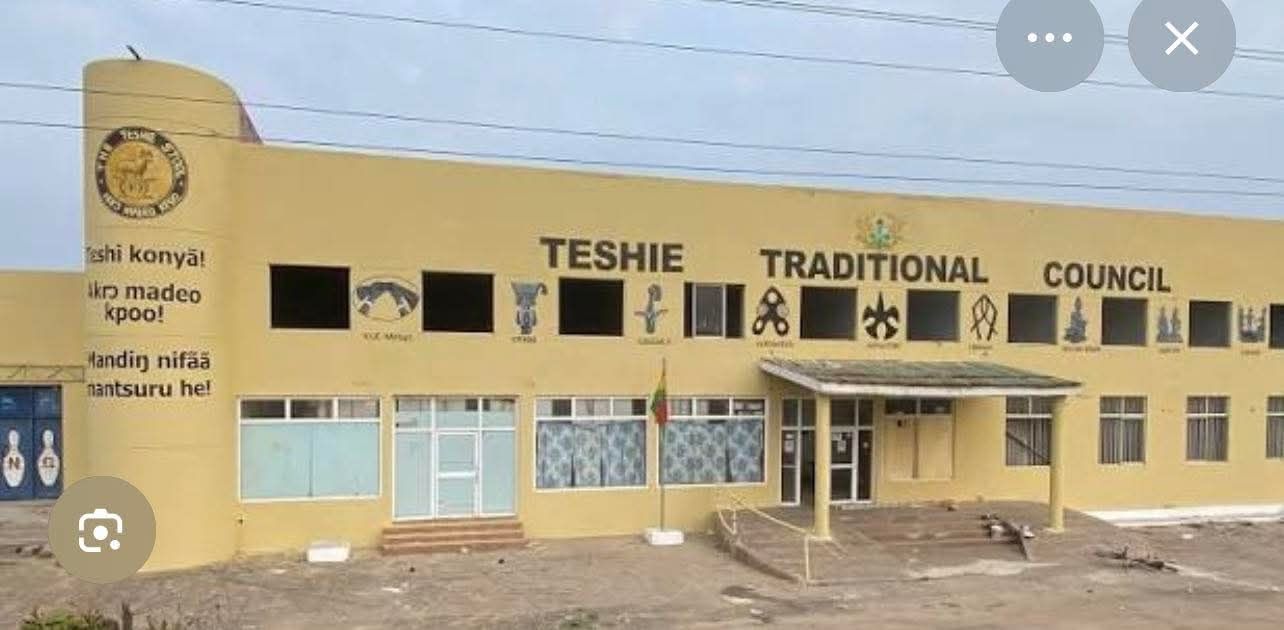
The colonial administration imposed the Native Administration Ordinance (NAO) in 1927, which provided for the establishment of State Councils to regulate the powers and jurisdiction of native tribunals. This law imposed the Ga Mantse as President of the Ga State Council .
But Teshie’s chiefs never accepted this as a permanent diminution of their authority. The Teshie stool has always maintained that it is a sovereign, independent paramountcy, not a subordinate division of the Ga Mashie stool.
The 2011 Verdict of the National House of Chiefs
In May 2011, a sub-committee of the National House of Chiefs issued a landmark verdict: it stated that there are seven divisions under the Ga Mashie Stool (Abola, Asere, Gbese, Otu Blohum, Sempe, Akumadze, and James Town). Crucially, the sub-committee affirmed that the Teshie Stool, the Osu Stool, the La Stool, the Nungua Stool, and the Tema Stool hold no allegiance to the Ga Paramount Stool .
This was a formal recognition that these five stools are co-equal paramountcies, not vassals of Ga Mashie. The Ga Paramount Stool never challenged this verdict at the National House of Chiefs or the Supreme Court of Ghana, making the decision final .
The 2022 Dispute
In October 2022, tensions flared again when the Ga Paramount Stool sent messengers to the Teshie Mantse Palace, inviting the Teshie Mantse to attend the annual Yam Rites of the Ga Paramount Stool. The Teshie Mantse declined the invitation, noting that this had never happened before and was unusual .
Soon after, social media announcements declared that the Teshie Mantse was a vassal to the Ga Paramount Stool as part of a newly formed “Ga State Council.” The Teshie Paramount Stool issued a statement rejecting this characterization as an insult to the 1992 Constitution and the Chieftaincy Act 2008 (Act 579) .
The Teshie Mantse declared: “as a fully-fledged Paramount Chief, he is not ready to pull down his cloth from over his shoulder to the chest and stand on his sandals in public to pay obeisance to the Ga Mantse who is his co-equal Paramount Chief” .
This dispute reflects the ongoing tension between the historical autonomy of the Ga states and the centralizing tendencies of the Ga Paramount Stool. Teshie’s warrior spirit, it seems, extends to the defense of its chieftaincy prerogatives as well.
Part 5: The Art of War and Culture
Fantasy Coffins: Teshie’s Global Art Form
Teshie is internationally renowned as the home of fantasy coffins—elaborately sculpted coffins shaped like objects that represented the life of the deceased. This art form was invented in the 1950s by Seth Kane Kwei, an artist from La who later established his workshop in Teshie .
The Kane Kwei Carpentry Workshop continues to produce these remarkable works of art under the direction of Eric Adjetey Anang, the legitimate heir of the inventor. Other artists, including Daniel Mensah (“Hello”), continue the tradition. Teshie fantasy coffins have been exhibited in museums around the world, including the Sainsbury Centre for Visual Arts in the UK and the Hämeenlinna Art Museum in Finland .
The coffin art tradition is deeply connected to Ga cosmology and beliefs about death and the afterlife. A fisherman might be buried in a coffin shaped like a fish; a pilot in a coffin shaped like an airplane; a carpenter in a coffin shaped like a hammer. This art form is a unique expression of Ga culture and has put Teshie on the global cultural map.
The Homowo Festival
Like all Ga towns, Teshie celebrates the Homowo festival every August. Homowo means “hooting at hunger” and commemorates the Ga people’s victory over a severe famine. The festival is a time of thanksgiving, marked by the preparation and sharing of kpokpoi (a corn-based dish served with palm soup), traditional drumming and dancing, and the sprinkling of food as a spiritual offering .
Homowo is also a time when chieftaincy authority is publicly displayed and affirmed. The Teshie Mantse leads the celebrations, reinforcing his role as custodian of Teshie’s traditions.
The Kpledzoo Festival
The Kpledzoo festival, celebrated by the Ga people, is another occasion when Teshie’s martial traditions are remembered. The festival involves rituals and ceremonies that honor the ancestors and reaffirm the community’s identity as descendants of warriors .
Part 6: Teshie in Modern Ghana
Population and Growth
Teshie has grown dramatically over the past half-century. In 1970, its population was 32,803. By 2010, it had reached 182,145, making it the ninth most populous settlement in Ghana . Today, Teshie is a thriving urban center within the Ledzokuku Municipal District, part of the Greater Accra conurbation.
The town stretches from the Kpeshie Lagoon to Teshie-Nungua Estates (First Junction) along the coastal road. It has grown to such an extent that its boundaries with La to the west and Nungua to the east are increasingly blurred .
Economy
The traditional economy of Teshie is fishing, but this is gradually being supplemented by other activities. The town’s proximity to Accra and Tema has attracted businesses seeking lower rents than the capital city center. Teshie also has several hotels along the coast, catering to domestic tourists and business travelers .
The fantasy coffin workshops attract art collectors and tourists from around the world, contributing to the local economy.
Military and Security Institutions
Teshie is home to two of Ghana’s most important security institutions:
-
The Ghana Military Academy Training School – One of the most prestigious military training institutions in Ghana, whose alumni include former Head of State Jerry John Rawlings .
-
The Kofi Annan International Peacekeeping Training Centre (KAIPTC) – Established in 1998, this institution provides peacekeeping training to military and civilian personnel from across Africa and beyond .
The presence of these institutions reflects Teshie’s long-standing martial tradition. The town that once sent warriors to defend the Ga State now trains peacekeepers for the continent.
Education
Teshie has a robust educational infrastructure, including:
-
Nursing and Midwifery Training College
-
Family Health University College, Nursing & Midwifery School
-
Presbyterian Senior High School
-
Teshie Technical Training Centre
-
O’Reilly Senior High School
-
Saint Johns Senior High School
-
Anglican Senior High School
-
Numerous basic schools
Politics
Teshie falls within the Ledzokuku Constituency. The current Member of Parliament is Hon. Ben Ayiku of the National Democratic Congress .
The Teshie Mantse Today
The current Teshie Mantse continues to assert the stool’s independent status. He is a member of the Greater Accra Regional House of Chiefs and participates in national chieftaincy affairs, but he maintains that Teshie is a sovereign paramountcy, not a division of any other stool.
The stool has also been active in advocating for development in the area. In 2023, Teshie chiefs warned the Greater Accra Regional Minister and the Registrar of the Greater Accra Regional House of Chiefs to refrain from interfering in Teshie’s chieftaincy concerns .
Key Takeaways at a Glance
| Aspect | Summary |
|---|---|
| Founder | Numo Nmashie (Mankralo of La), after a feud with La’s chief Odoi Atsem in 1710 |
| Date Founded | Early 18th century (approximately 1710-1720) |
| Original Quarters | Krobo, Agbawe, Klemusum |
| Warrior Accolade | “Gonti ni ashiii see anmoo kpo” – Teshie led the Ga State to repel Obutu aggressors |
| Major Wars | Akwamu War, Angula War, Katamanso War (1826) |
| European Fort | Fort Augustaborg (Danish, 1787; British, 1850-1957) |
| Cultural Legacy | Fantasy coffins (invented 1950s by Seth Kane Kwei) |
| Status | One of six independent Ga states; paramount stool with no allegiance to Ga Mantse |
| Population (2010) | 182,145 (9th most populous in Ghana) |
| Key Institutions | Ghana Military Academy, KAIPTC |
| Traditional Festival | Homowo (August) |
Frequently Asked Questions (FAQs)
1. When was Teshie founded?
Teshie was founded in the early 18th century, approximately 1710-1720, following a feud between Numo Nmashie and La’s chief Odoi Atsem .
2. Who founded Teshie?
Numo Nmashie, the Mankralo of La, founded Teshie after purchasing land from the Nungua Mantse, Afote Okley. He was from the Boma group of Ga migrants .
3. Why is Teshie known as a warrior state?
Teshie earned this reputation through its military valor. The accolade “Gonti ni ashiii see anmoo kpo” commemorates the occasion when the Teshie Mantse led the entire Ga State to repel an attack on Ga Mashie by Obutu aggressors. Teshie warriors also fought bravely in the Katamanso War of 1826, which was won through their bravery .
4. What is the significance of Fort Augustaborg?
Fort Augustaborg was a Danish fort built in 1787 at Teshie, following the seizure of abandoned Dutch posts during the Fourth Anglo-Dutch War. It was named after Princess Louise Auguste of Denmark. It was transferred to the British in 1850 and remained in British hands until Ghana’s independence. Only ruins remain today .
5. Is Teshie subordinate to the Ga Mantse?
No. The National House of Chiefs affirmed in 2011 that the Teshie Stool holds no allegiance to the Ga Paramount Stool. Teshie is a co-equal paramountcy, not a division of Ga Mashie .
6. What are fantasy coffins?
Fantasy coffins are elaborately sculpted coffins shaped like objects representing the life of the deceased. This art form was invented in the 1950s by Seth Kane Kwei, and Teshie is the global center of its production. The Kane Kwei Carpentry Workshop continues the tradition today .
7. What is the Homowo festival?
Homowo is the annual harvest festival of the Ga people, celebrated every August. The name means “hooting at hunger” and commemorates the Ga people’s victory over famine. It is marked by the preparation of kpokpoi (corn-based dish), drumming, dancing, and spiritual offerings .
8. What wars did Teshie fight in?
Teshie fought in the Akwamu War, the Angula War, and the Katamanso War (1826). The Katamanso War was decisive in breaking Asante power on the coast .
9. What is the current population of Teshie?
As of 2010, Teshie’s population was 182,145, making it the ninth most populous settlement in Ghana. The population has grown significantly since 1970, when it was 32,803 .
10. What are the main institutions in Teshie?
Teshie is home to the Ghana Military Academy Training School and the Kofi Annan International Peacekeeping Training Centre (KAIPTC), as well as several senior high schools and a nursing training college .
Conclusion: The Legacy of the Warrior State
Teshie’s history is a testament to the resilience and courage of the Ga people. From its founding by Numo Nmashie after a bitter feud in La, through centuries of warfare and defense of the coastal plains, to its emergence as a center of art, education, and security training, Teshie has never lost its identity.
The accolade “Gonti ni ashiii see anmoo kpo” is not merely a phrase; it is a living memory of the time when Teshie warriors stood between Accra and its enemies. The Katamanso War was won through their bravery. The Danish fort that still stands in ruins is a reminder of European rivalry and African agency. The fantasy coffins that grace museums around the world are a testament to Ga creativity and cosmology.
Today, Teshie is a thriving urban center, home to the institutions that train Ghana’s military officers and peacekeepers. The Teshie Mantse still asserts the stool’s independent status, refusing to bow to any paramountcy. The warriors of old have been replaced by students, artists, and professionals, but the spirit of Teshie endures.
The warrior state that defended coastal Accra has not forgotten its past. And that past continues to shape its future.
Frequently Asked Questions (FAQs)
1. When was Teshie founded?
Early 18th century (approximately 1710-1720) .
2. Who founded Teshie?
Numo Nmashie, the Mankralo of La, after a feud with La’s chief Odoi Atsem .
3. Why is Teshie known as a warrior state?
For its military valor, including leading the Ga State to repel Obutu aggressors and bravery in the Katamanso War (1826) .
4. What is the significance of Fort Augustaborg?
A Danish fort built in 1787, later British, now in ruins .
5. Is Teshie subordinate to the Ga Mantse?
No. The National House of Chiefs affirmed in 2011 that the Teshie Stool holds no allegiance to the Ga Paramount Stool .
6. What are fantasy coffins?
Elaborately sculpted coffins invented in the 1950s by Seth Kane Kwei; Teshie is the global center of this art .
7. What is the Homowo festival?
The annual Ga harvest festival celebrated every August, meaning “hooting at hunger” .
8. What wars did Teshie fight in?
The Akwamu War, Angula War, and Katamanso War (1826) .
9. What is the current population of Teshie?
182,145 (2010), making it the 9th most populous in Ghana .
10. What are the main institutions in Teshie?
Ghana Military Academy Training School and KAIPTC (Kofi Annan International Peacekeeping Training Centre)
Source: Accra Street Journal
Last Updated on April 12, 2026 by Samuel Kwame Boadu
Disclaimer: Some content on Accra Street Journal may be aggregated, summarized, or edited from third-party sources for informational purposes. Images and media are used under fair use or royalty-free licenses. Accra Street Journal is a subsidiary of SamBoad Publishing Hub under SamBoad Business Group Ltd, registered in Ghana since 2014.
For concerns or inquiries, please visit our Privacy Policy or Contact Page.

Samuel Kwame Boadu is a Ghanaian media entrepreneur and storyteller with a passion for amplifying urban voices and uncovering everyday truths. He is the Editor-in-Chief and Founder of Accra Street Journal, a dynamic digital platform dedicated to capturing the pulse of Ghana’s capital—its people, culture, challenges, business, sports and innovations.