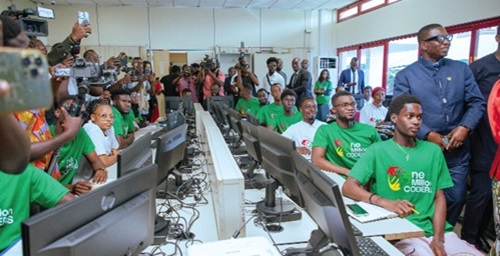
Introduction: The Question Every Young Ghanaian Is Asking
On a humid evening in Nima, a 22-year-old university graduate scrolls through his phone. He has heard about coding—about Ghanaians working remotely for American companies, earning dollars while living in Accra. He has seen the headlines: “One Million Coders Programme,” “$270 Million AI Strategy,” “400,000 trainees in 2026.” But no one has answered his simple question: What should I actually learn?
That question—simple, urgent, practical—is what this article answers.

April 2026 will be remembered as the month Ghana stopped talking about digital transformation and started funding it. On April 24, President John Dramani Mahama launched the National Artificial Intelligence Strategy, committing $250 million to build a top-tier AI computing centre and an additional $20 million for implementation . Just three months earlier, the Minister for Communication, Digital Technology and Innovation, Samuel Nartey George, announced that the One Million Coders Programme would target 400,000 trainees in 2026 alone, with globally competitive certifications through partnerships with major tech firms .
📢 GET A DETAILED ARTICLES + JOBS
Join ASJ's WhatsApp Channel and never miss a post or opportunity.

The policy signals are unambiguous. The question is no longer if Ghana will build a digital economy, but what skills will power it.
For the young Ghanaian standing at this crossroads, the choice of programming language is not merely technical—it is strategic, financial, and deeply personal.

Historical Context: From Gold Coast to Code Coast
Ghana’s journey to becoming a coding hub did not begin in 2026. It began in 2003 with the establishment of the Kofi Annan Centre of Excellence in ICT, West Africa’s first such institution. For nearly two decades, the centre trained thousands in networking, cybersecurity, and basic programming. But graduates often struggled—not because they lacked skill, but because their certificates lacked global recognition.
This was the fundamental flaw in Ghana’s early tech education: local training, local certification, local ceiling.
The turning point arrived with the articulation of the One Million Coders Programme. Unlike previous initiatives, this programme explicitly prioritises internationally recognised certifications over local ones. Training is delivered locally through the Kofi Annan Centre, GIFEC facilities across constituencies, and four public universities. But certification comes through partnered global tech firms . The model, as Minister George explained, is a distance learning system: “training is delivered locally but certified by globally recognised institutions” .
The government also committed to converting GIFEC facilities in every constituency into training centres with free internet access and shared laptops for trainees without personal devices. The first phase in 2026 targets 100 constituencies .
Simultaneously, Ghana’s startup ecosystem has matured. In 2025, Ghana attracted $56 million in startup funding, ranking fifth in Africa for the number of ventures raising at least $100,000 . Fintech, healthtech, energy, and logistics lead the charge. The Association of Ghana Startups notes that while Ghana trails the “Big Four” (Kenya, South Africa, Egypt, Nigeria) in total funding, it has a healthy pipeline of early-stage ventures .
What was missing—what the 2026 AI Strategy supplies—is a dedicated government investment in the technological infrastructure that high-value coding requires.
Data + Facts Layer: The Numbers Behind the Choice
Let the data shape your decision.
The scale of opportunity: The One Million Coders Programme aims to train 400,000 people in 2026 alone, with a target of one million over the programme’s duration . The National AI Strategy will train 300,000 Ghanaians this year under its digital and AI skills track .
Salary expectations: Entry-level tech roles in Ghana typically range from GH¢2,000 to GH¢7,000 per month . While this is below Nigerian salaries (where junior Python developers earn ₦300,000–500,000, approximately GH¢3,000–5,000), remote work changes the equation entirely . A Ghanaian developer working remotely for a European or American company can earn 5–10 times the local rate.

Startup demand: The top startups in Accra in 2026 span healthcare (mPharma, $18 million raised), fintech (Bazobuntu social savings platform), logistics (Swoove), and HR-fintech—all requiring software developers with practical, not theoretical, skills .
Mobile money ecosystem: Ghana’s mobile money dominance creates a unique demand for developers who can integrate payment APIs. Open-source tools like Flexpay, EasySwitch, and XCEL PayGate—all built by African developers—demonstrate the stack in use: Python, JavaScript/TypeScript, PHP, and Java .
Structural Analysis: Why Certain Languages Win in Ghana
Not all programming languages are equal in the Ghanaian context. Three structural factors determine which ones matter.
First, the fintech imperative. Ghana’s economy runs on mobile money. MTN MoMo, Vodafone Cash, and AirtelTigo Money process billions of cedis annually. Every fintech startup, every e-commerce platform, every business digitising payments needs developers who can integrate mobile money APIs. This creates demand for:
-
JavaScript/TypeScript for web and mobile payment interfaces (React, Node.js)
-
Python for payment processing engines and data analytics
-
PHP for legacy systems and WooCommerce integrations
-
Java for enterprise banking backend systems
The GitHub repository for mobile money tools shows active SDKs and libraries for exactly these languages—built by developers who understand the local payment landscape .
Second, the AI infrastructure bet. The government’s $250 million AI computing centre signals a long-term commitment to machine learning and data science. The National AI Strategy explicitly aims to position Ghana as a leading digital innovation hub in Africa . This makes Python non-negotiable—it is the lingua franca of AI, machine learning, and data science. UNESCO’s country representative described the strategy as “a bold statement about its future, a future where innovation is married with equity and where technology serves the interest of all Ghanaians” .
Third, the remote work credential. Minister George was explicit: the One Million Coders Programme aims to secure “sustainable employment, particularly in remote digital jobs” . International employers do not care about Ghanaian certificates; they care about what you can build. But globally recognised certifications—earned through partnerships with major tech firms—change that calculus. The languages global employers prioritise are, in order: Python, JavaScript, Java, Go, and increasingly Rust for systems programming .
What This Means for Ghanaians
Let us make this concrete for different profiles.
For the recent SHS graduate with no computer: GIFEC facilities in your constituency will provide free internet and shared laptops . Start with JavaScript. It runs in any browser, requires no installation, and powers the interactive parts of every website. Within six months of focused learning, you can build simple web applications that interface with mobile money payments.
For the university student in Kumasi: The One Million Coders Programme is rolling out in at least four public universities . Use this to earn globally recognised certifications—not for the paper, but for the structured curriculum. Specialise in Python with a focus on data analytics. The AI Centre will need data scientists, and the salaries for mid-level Python developers in Nigeria (comparable to Ghana with remote premiums) reach ₦800,000–1,500,000 monthly .
For the employed professional looking to pivot: Your advantage is domain knowledge. If you work in banking, logistics, healthcare, or agriculture, learn to code in the language that serves your industry. Fintech demands JavaScript and Python. Logistics apps increasingly use Flutter (Dart) for mobile and Node.js for backend. Healthcare platforms like mPharma ($18 million raised) need full-stack developers .

For the aspiring AI specialist: The National AI Strategy is your signal. Python is mandatory. Add SQL for databases and learn the mathematics behind machine learning. The $250 million Centre of Excellence for AI Computing will not just consume talent—it will create it . Ambassador Kojo Bonsu’s Gen Z AI Club, launched on April 11 2026, is already building this pipeline, preparing young Ghanaians “to staff and innovate within the $250 million AI Center” .
Regional / Global Comparison: Where Ghana Stands
Nigeria: Nigeria’s tech ecosystem is larger—$343 million raised in 2025 versus Ghana’s $56 million—and its developer salaries are benchmarked higher . However, Ghana has two advantages: policy coherence (the AI Strategy and Coders Programme are linked) and lower competition (fewer developers means better visibility for talented individuals). The languages in demand are identical: Python, JavaScript, Java, with Go and Rust emerging as premium skills.
Kenya: Kenya raised $984 million in 2025, driven by energy and mobility ventures like M-Kopa . Its developer ecosystem is mature, with strong mobile money integration (M-Pesa) driving demand for similar languages. Ghana can learn from Kenya’s success with mobile-first development and API-driven fintech.
South Africa: The continent’s largest economy raised $600 million in 2025 . South African developers command the highest salaries, but the cost of living is proportionally higher. For remote work, Ghana’s lower cost base is actually an advantage—a Ghanaian developer can earn global rates while living locally.
Global standard: The European and American markets reward Python (AI/data), JavaScript (web/full-stack), Go (cloud infrastructure), and Rust (systems/blockchain) with senior salaries exceeding $150,000 annually. The One Million Coders Programme’s emphasis on globally recognised certifications aims to make these markets accessible to Ghanaians .
Risks + Future Outlook
What could go wrong?
Risk 1: Certification without competence. Globally recognised certificates open doors, but they do not keep them open. Employers test skills, not credentials. The programme must ensure that certification reflects genuine ability—not just exam-passing.
Risk 2: Infrastructure gaps. Free internet and shared laptops are necessary but insufficient. Electricity outages, unreliable connectivity, and lack of post-training support could derail learners. The government has promised to convert GIFEC facilities into training centres, but maintenance and bandwidth remain challenges .
Risk 3: Job absorption. Four hundred thousand trainees in 2026 is an ambitious target. Where will the jobs come from? The Association of Ghana Startups notes that while early-stage funding is healthy, follow-on capital for scaling ventures remains limited . Without a growing startup ecosystem, trained developers may struggle to find local employment—forcing them into remote work, which requires additional skills like time-zone management and English proficiency.
Risk 4: Gender disparity. Less than one percent of total African startup funding in 2025 went to women-led ventures . In Ghana specifically, female founders report being “over-questioned and underfunded.” If the coding programmes do not actively recruit and support women, the tech economy will reproduce existing inequalities.
The future outlook: By 2028, if the One Million Coders Programme succeeds and the AI Centre is operational, Ghana could transition from a net consumer of digital services to a net exporter of digital talent. The country’s smaller population becomes an advantage—it is easier to achieve saturation coverage of coding education. The question is whether the infrastructure, jobs, and inclusive policies will arrive on the same timeline.
Strong Conclusion: The Language Is Less Important Than the Ecosystem
Here is the insight that the “best language” debates miss: the language you choose matters far less than the ecosystem you enter.
A JavaScript developer in Accra today can build a fintech payment gateway, integrate mobile money APIs, deploy on cloud infrastructure, and earn global wages—all without leaving the country. A Python developer can work on AI models for health diagnostics, agricultural optimisation, or fraud detection. A PHP developer can maintain thousands of existing businesses running on WordPress and Laravel.
The common thread is not a specific language. It is the ability to solve real problems with code.
The government’s $270 million AI investment and the One Million Coders Programme are not guarantees of success. They are down payments on a possibility: that the young Ghanaian scrolling through his phone in Nima can, within two years, be employed by a company in Berlin, building software that serves customers in Nairobi.
That possibility starts with choosing a language—any language—and starting today. JavaScript for the web. Python for the future. Both for the ambitious.
The infrastructure is being built. The policies are in motion. The only missing ingredient is you.
FAQs
1. What is the best programming language for beginners to learn in Ghana in 2026?
JavaScript is widely recommended for beginners because it runs in any browser, requires no special software, and is essential for web development—the largest source of entry-level tech jobs in Ghana. Python is also excellent, especially if you are interested in AI, data science, or backend development .
2. Which programming language pays the most in Ghana?
While Ghana-specific salary data is limited, Nigerian benchmarks (comparable market) show Python, Go, and Rust commanding the highest salaries, with senior developers earning ₦800,000–1,800,000 monthly (GH¢8,000–18,000) . Remote work for international companies can significantly exceed these amounts.
3. Is Python worth learning in Ghana given the new AI Strategy?
Absolutely. The government’s $270 million National AI Strategy, launched in April 2026, includes a $250 million AI computing centre that will create demand for Python developers skilled in machine learning, data science, and AI applications .
4. What is the One Million Coders Programme and how do I join?
It is a government initiative targeting 400,000 trainees in 2026, with a goal of training one million Ghanaians in digital skills. Training occurs at GIFEC facilities across 100 constituencies and at least four public universities, with free internet and shared laptops provided. Certification comes through partnerships with global tech firms .
5. Can I get a remote job as a Ghanaian developer without a university degree?
Yes. The government programme explicitly prioritises skills and globally recognised certifications over formal degrees. Minister George noted that many international employers do not recognise standalone local ICT certificates, which is why the programme focuses on certifications from partnered global tech firms .
6. Which programming languages are used for mobile money integration in Ghana?
The most common languages for mobile money APIs are JavaScript/TypeScript (for React Native and Node.js), Python, PHP, and Java. Open-source tools like EasySwitch (Python), Flexpay (PHP/TypeScript), and XCEL PayGate (JavaScript) demonstrate this stack in production .
7. How much can a beginner developer earn in Ghana?
Entry-level tech salaries in Ghana typically range from GH¢2,000 to GH¢7,000 per month, depending on skills, company, and whether the role is local or remote . Remote roles for international companies can pay significantly more—often $1,000–3,000 monthly for junior positions.
8. Should I learn Flutter for mobile app development in Ghana?
Flutter (using Dart) is increasingly popular for cross-platform mobile development. The demand for Flutter developers in Ghana is growing as startups need both Android and iOS apps without maintaining two codebases. However, JavaScript frameworks like React Native remain more common due to the larger talent pool .
9. What is the National AI Strategy and how does it affect coding jobs?
Launched on April 24 2026, the strategy commits $250 million to establish an AI computing centre and $20 million for implementation. It aims to train 300,000 Ghanaians in digital and AI skills this year and position Ghana as a leading African digital innovation hub .
10. Are there free coding resources available for Ghanaians?
Yes, through the One Million Coders Programme, GIFEC facilities across constituencies provide free internet access and shared laptops. The government is also partnering with the Ministry of Education to deliver training in public universities. Additional free resources include GitHub’s open-source mobile money tools, freeCodeCamp, and YouTube tutorials .
Last Updated on April 26, 2026 by Samuel Kwame Boadu
Disclaimer: Some content on Accra Street Journal may be aggregated, summarized, or edited from third-party sources for informational purposes. Images and media are used under fair use or royalty-free licenses. Accra Street Journal is a subsidiary of SamBoad Publishing Hub under SamBoad Business Group Ltd, registered in Ghana since 2014.
For concerns or inquiries, please visit our Privacy Policy or Contact Page.

Samuel Kwame Boadu is a Ghanaian media entrepreneur and storyteller with a passion for amplifying urban voices and uncovering everyday truths. He is the Editor-in-Chief and Founder of Accra Street Journal, a dynamic digital platform dedicated to capturing the pulse of Ghana’s capital—its people, culture, challenges, business, sports and innovations.