









As the fastest-growing subsidiary in the GTCO group with a 77% profit surge in 2025, a Fitch credit rating upgrade to B-, and a strategic rebranding that unifies 10 countries under one iconic logo, this Nigerian lender is demonstrating that continental integration is not just a political ideal—it is a profitable business strategy.

Executive Introduction
In the upper echelons of African banking, there are regional players, and then there is Guaranty Trust Holding Company (GTCO). The Nigerian-born financial behemoth has, over three decades, built an empire that spans 10 countries across Africa and the United Kingdom, all unified under a brand identity so distinctive that its black-and-white interlocking squares have become synonymous with professionalism, speed, and corporate banking excellence.
The jewel in this crown—and the subject of this profile—is GTCO Bank Ghana Ltd (formerly GTBank Ghana, now operating under the unified GTCO brand). In 2025, this subsidiary did more than just perform; it soared. The Ghanaian unit recorded an extraordinary 77.3 percent increase in profit after tax, reaching N127.5 billion ($85.0 million), overtaking Sierra Leone to become the fastest-growing banking subsidiary within the entire GTCO group .
📢 GET A DETAILED ARTICLES + JOBS
Join ASJ's WhatsApp Channel and never miss a post or opportunity.
This performance did not occur in a vacuum. The Ghanaian economy underwent a remarkable recovery in 2025, with the cedi appreciating by 41–43 percent against the US dollar—making it one of the world’s best-performing currencies and marking its first annual appreciation in over three decades . Inflation eased to 3.3 percent in February 2025, maintaining a single-digit trend supported by currency strength and favourable commodity prices . And rating agency Fitch, recognising the improved local-currency debt servicing conditions, upgraded GTBank Ghana’s credit rating to ‘B-‘ from ‘CCC+ .
For investors, corporate clients, and industry observers, GTCO Bank Ghana represents a unique proposition: a foreign-owned bank that has transcended its Nigerian origins to become a genuinely Ghanaian institution, beloved for its service culture, respected for its professionalism, and now rebranded as part of a pan-African financial services group that offers far more than just banking .
This ASJ profile examines the strategic rebranding from GTBank to GTCO, the financial performance that earned a Fitch upgrade, the leadership of Managing Director Thomas Attah John, the bank’s customer service cult, and whether the “Power of One” strategy—unifying banking, payments, and pension services under a single brand—can deliver sustained growth in a fiercely competitive market.
Company Overview
The GTCO Group: A Nigerian Icon Goes Continental
GTCO’s origins trace to 1989, when Guaranty Trust Bank was founded in Nigeria with a then-revolutionary proposition: banking could be fast, professional, and even pleasant. Over three decades, the institution grew into one of Nigeria’s “Big Five” banks, known for its iconic black-and-white logo, its industry-leading digital platforms, and its obsessive focus on customer service.
The transformation into a holding company—Guaranty Trust Holding Company Plc (GTCO) —marked a strategic evolution. The group now operates through multiple subsidiaries:
-
Banking Subsidiaries: GTCO Bank Nigeria, GTCO Bank Ghana, GTCO Bank Kenya, GTCO Bank Uganda, GTCO Bank Tanzania, GTCO Bank Rwanda, GTCO Bank Gambia, GTCO Bank Sierra Leone, GTCO Bank Cote d’Ivoire, and GTCO Bank Liberia
-
Non-Bank Subsidiaries: Guaranty Trust Bank (UK) Limited, GTCO Pension, and GTCO Payments
With a presence in 11 countries and 12 subsidiaries, GTCO has built one of the most extensive banking networks on the continent . The holding company structure allows the group to offer a broader range of financial services—banking, payments, and pensions—under a unified brand.
GTCO Bank Ghana: A History of Excellence
GTCO Bank Ghana (formerly Guaranty Trust Bank Ghana Ltd) has operated in the country for over a decade, building a reputation for service excellence, innovation, and professionalism. The bank operates across key segments including corporate banking, commercial banking, retail banking, and treasury services. The bank’s total assets in local currency terms were approximately GHS 8.69 billion as of December 2024, with customer deposits of GHS 5.80 billion and loans and advances of GHS 1.73 billion (using an average 2024 exchange rate of N181.23/GHS for conversion of the N1.98 trillion assets figure from BusinessDay’s NGN-USD conversion).
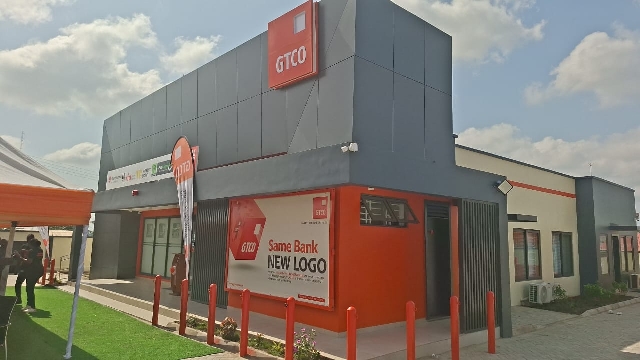
The bank’s physical footprint includes branches in strategic locations across Ghana’s major commercial hubs.
The Rebranding: From GTBank to GTCO (June 2025)
In June 2025, GTCO Bank Ghana completed its transition to the new group identity, changing its corporate logo from GTBank to GTCO . The rebranding, which received approval from the Bank of Ghana, was the final step in the group’s transition to a holding company structure that had already been implemented across other operational areas.
Managing Director Thomas Attah John explained the strategic rationale:
“This transition to the new GTCO logo seeks to emphasise the fact that the bank is now part of a financial services group that offers more than just banking. While our logo has changed, our commitment to innovation, excellence, and dedication to providing excellent banking services to our customers remains the same.”
The rebranding was not merely cosmetic. It positioned GTCO Bank Ghana alongside sister subsidiaries offering payments, pensions, and asset management services, signalling to customers that the institution could serve their needs across the entire financial spectrum—not just traditional banking.
Crucially, the bank reassured customers that the legal name and operations in Ghana would remain unchanged, and existing account details, branch operations, and service quality would be unaffected .
The “Power of One” Philosophy
The rebranding reinforced GTCO’s “Power of One” positioning—a strategy that represents the brand and exposure benefits in its relationship with the parent company and all subsidiaries across ten countries in Africa and the United Kingdom . The unified identity signals to customers that whether they walk into a branch in Accra, Lagos, Nairobi, or London, they will receive the same professional, efficient, customer-focused service.
Leadership: Thomas Attah John
At the helm of GTCO Bank Ghana is Thomas Attah John, Managing Director. John has been the public face of the bank’s transformation, including the 2025 rebranding and the aggressive growth strategy that delivered the 77% profit increase.
Under his leadership, the bank has maintained its reputation for service excellence while navigating the complexities of Ghana’s post-DDEP recovery and the strategic repositioning required by the parent group’s holding company evolution.
The 2025 Financial Performance: 77% Profit Growth and a Fitch Upgrade
GTCO Bank Ghana’s 2025 financial performance was the standout story within the GTCO group, overtaking the Sierra Leone unit to become the fastest-growing subsidiary .
Profitability Highlights
| Metric | 2025 | 2024 | Change |
|---|---|---|---|
| Profit After Tax (PAT) | N127.5 billion ($85.0 million) | N71.8 billion ($47.9 million) | +77.3% |
| Operating Income | N/A | N/A | +67% |
For context, GTBank Ghana recorded a 40.6% profit growth in 2024, meaning the bank’s growth trajectory accelerated significantly in 2025 .
Drivers of Exceptional Performance
The Cedi Appreciation Effect
The most significant external driver of GTCO Bank Ghana’s 2025 performance was the sharp appreciation of the Ghanaian cedi. The currency gained between 41 and 43 percent against the US dollar in 2025—making it one of the world’s best-performing currencies and marking its first annual appreciation in over three decades .
For a Nigerian-owned bank reporting to a Nigerian parent (where financials are consolidated in Nigerian naira), a strengthening cedi produces significant translation gains. When cedi-denominated profits are converted to naira, they appear substantially larger. This accounting effect contributed meaningfully to the 77% profit surge.
Macroeconomic Stabilisation
The cedi’s appreciation was underpinned by fundamental improvements in Ghana’s economy:
-
Elevated gold prices (Ghana is Africa’s top gold producer)
-
Stronger export earnings
-
Improved foreign reserves
-
Completion of the sovereign debt restructuring
Inflation eased to 3.3 percent in February 2025, maintaining a single-digit trend since September, supported by currency strength and favourable commodity prices .
Operational Excellence
Beyond favourable macroeconomics, GTCO Bank Ghana executed operationally. Operating income rose 67 percent, driven by both net interest income and non-interest income .
The bank’s operating returns on risk-weighted assets averaged 16 percent between 2021 and 2024, a performance metric that few competitors can match . These returns were largely driven by high yields on sovereign securities—a strategy that carries concentration risk but provided exceptional returns during the high-interest-rate environment.
The Fitch Credit Rating Upgrade
In June 2025, global rating agency Fitch upgraded GTCO Bank Ghana’s credit rating to ‘B-‘ from ‘CCC+’ .
Fitch’s rationale focused on Ghana’s improving macroeconomic environment:
-
Improved local currency debt servicing conditions
-
Progress in normalising relations with external creditors
-
Strong profitability and cedi appreciation improving banking sector capitalisation
-
The banking sector’s positioning for the end of regulatory reliefs at the end of 2025
However, Fitch also issued a cautionary note: sovereign exposure remains elevated, with banks holding fixed-income securities equivalent to over 200 percent of total equity as of end-2024 . These include new cedi bonds, US dollar local bonds issued under the Domestic Debt Exchange Programme, and restructured Eurobonds.
Fitch specifically noted GTCO Bank Ghana’s strong profitability metrics, while observing that net interest margins declined to 13.6 percent in 2024 from 16.2 percent in 2023 due to lower treasury bill rates .
Comparative Performance: Ghana Leads the Pack
Within the GTCO group, Ghana’s 77% profit growth outpaced every other banking subsidiary in 2025, overtaking Sierra Leone which had recorded a sharper 329% surge in 2024 but whose growth moderated in 2025 .
This performance positions GTCO Bank Ghana as a crown jewel within the GTCO portfolio—a subsidiary that is not merely contributing to group earnings but is driving group growth.
Business Model: The Universal Bank With a Service Culture Moat
GTCO Bank Ghana operates as a full-service universal bank, but its business model is distinguished not by product variety (though that is ample) but by an almost cult-like commitment to customer service.
Core Business Segments
1. Corporate and Institutional Banking
This segment serves large Ghanaian enterprises, multinationals, and public institutions. Products include:
-
Corporate current accounts
-
Structured trade finance
-
Working capital facilities
-
Treasury and cash management
-
Syndicated loans
2. Commercial and SME Banking
Serving mid-sized enterprises and small businesses, this segment provides:
-
Business current and savings accounts
-
Term loans and overdrafts
-
Trade finance facilities
-
Electronic collections and bulk payments
3. Retail and Personal Banking
Individual consumers, salary earners, and mass-market depositors benefit from:
-
Current and savings accounts
-
Credit and debit cards
-
Personal loans
-
Investment products
4. Treasury and Investment Services
Providing fixed income trading, foreign exchange, and liquidity management, this segment supports the bank’s profitability and enables the lending activities of other segments.
The Service Culture Moat
GTCO Bank Ghana’s most distinctive competitive advantage is not on its balance sheet; it is in the attitudes of its staff and the perceptions of its customers. The bank is widely recognised in Ghana for:
-
Fast, efficient service at branches (minimal queuing)
-
Professional, courteous staff
-
Reliable digital platforms
-
Responsive customer support
This service culture is not accidental; it is engineered. The GTCO group is known across Africa for its rigorous staff training, performance-based culture, and an obsessive focus on customer experience. In Ghana, this translates into a bank that corporate clients trust with their most important treasury mandates and retail customers choose for everyday banking.
How They Make Money: Revenue Streams
Based on group-level disclosures and industry norms, GTCO Bank Ghana generates revenue through:
-
Net Interest Income: The spread between lending rates and deposit costs. The bank’s net interest margin was 13.6% in 2024 (down from 16.2% in 2023 due to lower treasury bill rates) .
-
Non-Interest Income: Fees and commissions from trade finance, digital transfers, account maintenance, and other transaction-based services.
-
Trading Income: Foreign exchange and fixed income trading.
The 2025 results were driven by a 67% increase in operating income, with strong contributions from both funded and non-funded revenue streams .
Market Position and Competition
Industry Standing: The Professional Foreigner
GTCO Bank Ghana occupies a distinct position in the Ghanaian banking landscape. It is not the largest by assets (GCB holds that crown) nor the most capitalised in absolute terms. But it is widely regarded as one of the best-managed banks in the country, with a service culture that competitors acknowledge and customers reward.
The bank’s 16 percent average operating returns on risk-weighted assets (2021–2024) place it among the most profitable banks in the country on a risk-adjusted basis .
Competitive Advantages
-
Service Culture Moat: GTCO’s reputation for fast, professional, pleasant banking is a genuine differentiator. Competitors cannot replicate this overnight; it requires years of cultural investment.
-
GTCO Group Scale: As part of a pan-African group present in 11 countries, GTCO Bank Ghana can offer cross-border banking services that purely local banks cannot match.
-
Nigerian Trade Corridors: Nigeria is Ghana’s largest trading partner. GTCO’s Nigerian parent provides unique access to trade finance and cross-border payment corridors.
-
Fitch ‘B-‘ Credit Rating: The rating upgrade provides third-party validation of the bank’s creditworthiness, useful for corporate clients and institutional depositors .
-
Strong Profitability Metrics: Operating returns on risk-weighted assets of 16 percent (2021–2024 average) demonstrate efficient capital deployment .
-
The “Power of One” Ecosystem: The unified GTCO brand across banking, payments, and pensions positions the bank to capture customers’ full financial lives, not just their banking needs.
Competitive Disadvantages
-
Foreign Ownership Perception: Some Ghanaian depositors and corporate clients may prefer “indigenous” banks for patriotic or local procurement reasons.
-
Limited Government Banking Share: As a foreign-owned bank, GTCO may not have the same access to government payroll, public sector banking, and SOE relationships that state-influenced banks (GCB, CBG, ADB) enjoy.
-
Sovereign Exposure Concentration: Fitch noted that banks in Ghana, including GTCO, hold fixed-income securities equivalent to over 200 percent of total equity . This concentration exposes the bank to sovereign risk.
-
Margin Compression: Net interest margins declined from 16.2% to 13.6% in 2024 and are likely to compress further as the Bank of Ghana continues its policy rate reductions .
Digital Strategy and Innovation
GTCO Bank Ghana’s digital strategy is built on the group’s industry-leading technology platforms. The parent group is widely recognised across Africa for its digital banking capabilities, and the Ghana subsidiary benefits from shared technology investments.
Digital Offerings
-
GTCO Mobile Banking App: A comprehensive mobile banking platform for retail customers
-
Internet Banking: For corporate and retail clients requiring more sophisticated transaction capabilities
-
GTCO Payments: The group’s payments subsidiary, offering merchant services and digital payment solutions
-
Corporate Online: Dedicated platform for business clients
The Unified Digital Experience
Following the rebranding to GTCO, the bank’s digital platforms are being unified under the new identity, providing a consistent experience across all subsidiaries. This is particularly valuable for corporate clients operating across multiple African countries—they can use the same digital platform in Accra as they do in Lagos or Nairobi.
Future Digital Priorities
The GTCO group continues to invest heavily in digital infrastructure, including:
-
Enhanced cybersecurity systems
-
Biometric authentication
-
Open banking APIs for fintech partnerships
As the holding company structure matures, GTCO Bank Ghana will increasingly benefit from shared digital investments across the group, reducing the cost of innovation and accelerating time-to-market for new products.
The Parent Group: GTCO Holdings and the Africa Strategy
Understanding GTCO Bank Ghana requires understanding the strategic direction of its parent, Guaranty Trust Holding Company Plc.
The Holding Company Transformation
The transition from Guaranty Trust Bank (a single banking entity) to GTCO (a diversified financial holding company) represented a fundamental strategic evolution. The group now operates through multiple subsidiaries:
-
Banking Subsidiaries across 10 African countries
-
GTCO Pension offering retirement savings products
-
GTCO Payments providing digital payment solutions
-
GTCO UK offering international banking services
This structure allows the group to offer customers a complete suite of financial services under a single, unified brand—the “Power of One” .
Africa as a Strategic Priority
The GTCO group has identified Africa as its primary growth market. Unlike European banks retreating from the continent due to regulatory complexity and risk concerns, GTCO is doubling down. Its presence in 11 countries, with subsidiaries ranging from Nigeria (its home market) to Ghana, Kenya, Uganda, Tanzania, Rwanda, Gambia, Sierra Leone, Cote d’Ivoire, and Liberia, demonstrates a long-term commitment to African banking.
Ghana’s Role in the GTCO Portfolio
GTCO Bank Ghana’s 2025 performance—77% profit growth, overtaking Sierra Leone as the fastest-growing subsidiary—elevates Ghana’s importance within the group portfolio . The country’s macroeconomic recovery, cedi appreciation, and growing gold export earnings make it an increasingly attractive market.
The upgraded Fitch rating and the successful completion of the rebranding process also signal that GTCO sees Ghana as a market for the long haul .
Challenges and Risks
No analysis of GTCO Bank Ghana is complete without acknowledging the headwinds that accompany its strong performance.
Risk 1: Sovereign Exposure Concentration
Fitch’s warning about sovereign exposure is not merely hypothetical. Ghana’s banks hold fixed-income securities equivalent to over 200 percent of total equity, including new cedi bonds, US dollar local bonds issued under the DDEP, and restructured Eurobonds .
If Ghana’s fiscal position deteriorates again—due to falling gold prices, a reversal of cedi strength, or a new external shock—these securities would lose value, directly impairing bank capital.
Risk 2: Margin Compression
Net interest margins declined from 16.2% to 13.6% in 2024 and will likely compress further as the Bank of Ghana continues its policy rate reductions from 18% toward lower levels . The bank’s 67% operating income growth in 2025 was partly driven by treasury yields that are unlikely to persist.
Risk 3: Parent-Group Dependency
As a wholly-owned subsidiary, GTCO Bank Ghana’s strategic direction is determined in Nigeria. If the parent group faces challenges—currency volatility (the naira has been volatile), regulatory changes, or competitive pressures—the Ghana subsidiary could be affected.
Risk 4: Cedi Reversal Risk
The cedi’s 41–43% appreciation in 2025 was a significant tailwind for profits when converted to naira . Currencies that appreciate sharply often correct. If the cedi depreciates in 2026 or 2027, the translation gains will reverse, potentially making 2026 profit growth look anaemic by comparison.
Risk 5: Competition
GTCO Bank Ghana competes with:
-
GCB Bank: The state-influenced giant is receiving government support to strengthen its position
-
Ecobank Ghana: Pan-African scale and cross-border trade finance capabilities
-
Stanbic and Absa: South African-owned banks with deep corporate banking expertise
-
Access Bank and FirstBank: Nigerian-owned competitors with similar parent-group advantages
All of these competitors are sophisticated, well-capitalised, and hungry for market share.
Economic and Industry Impact
Contributing to Banking Sector Stability
The Fitch upgrade to ‘B-‘ for GTCO Bank Ghana is not merely a trophy for the bank; it signals to international investors that Ghana’s banking sector is recovering from the DDEP-induced turbulence . A strong, well-rated bank contributes to overall system stability.
Facilitating Nigerian-Ghanaian Trade Corridors
As Nigeria’s largest trading partner, Ghana benefits from strong banking relationships between the two countries. GTCO Bank Ghana’s Nigerian parent provides trade finance and cross-border payment corridors that facilitate bilateral commerce.
Employment and Skills Development
GTCO Bank Ghana employs hundreds of Ghanaians (exact figures not publicly disclosed), providing stable formal-sector jobs. The bank’s rigorous training culture also develops banking skills that benefit the broader industry as trained staff move to other institutions.
Financial Inclusion
Through its retail banking segment and digital platforms, GTCO Bank Ghana extends banking services to customers who might otherwise be excluded from the formal financial system.
Future Outlook
As of May 2026, GTCO Bank Ghana is executing a dual strategy: consolidating the gains from Ghana’s macroeconomic recovery while investing in digital platforms and cross-selling opportunities under the unified GTCO brand.
The Immediate Agenda
The bank’s priorities for 2026-2027 are likely to include:
-
Maintaining service excellence as the operating model scales
-
Deepening cross-sell to banking, payments, and pension customers
-
Managing the margin compression from falling interest rates
-
Monitoring sovereign exposure while maintaining attractive yields
-
Leveraging the GTCO group’s pan-African network for corporate client acquisition
The Bull Case (Optimistic)
-
Service culture moat widens: As competitors struggle with post-DDEP operational challenges, GTCO’s reputation for service excellence attracts corporate and retail customers.
-
Cross-sell scales: The “Power of One” ecosystem successfully cross-sells payments and pension products to banking customers, increasing revenue per customer.
-
Margin compression managed: Non-interest income growth offsets net interest margin compression; operating income continues to grow despite falling rates.
-
Cedi stability persists: Ghana’s currency remains stable; translation gains moderate but do not reverse.
-
Parent-group support intensifies: GTCO Holdings sees Ghana as a priority market and provides additional capital for digital transformation.
The Bear Case (Pessimistic)
-
Margin compression accelerates: The Bank of Ghana reduces policy rates faster than expected; net interest income declines sharply; non-interest income cannot compensate.
-
Sovereign exposure crystallises: Ghana’s fiscal position deteriorates; bond yields spike; the bank’s securities portfolio loses value, requiring capital write-downs.
-
Cedi reverses gains: The cedi depreciates sharply; translation gains from 2025 disappear; 2026 profit growth in naira terms is negative.
-
Competition intensifies: GCB Bank, with government support, aggressively pursues corporate clients; Nigerian-owned competitors (Access, FirstBank) launch competing products.
-
Parent-group re-prioritises: GTCO Holdings allocates capital to faster-growing markets (Kenya, maybe) and reduces investment in Ghana.
The Verdict
GTCO Bank Ghana is not the largest bank in Ghana, nor does it have the most branches, nor the most assets. But it may be the best-managed. The Fitch rating upgrade to ‘B-‘ is external validation of internal excellence .
The 77% profit growth in 2025 was spectacular, but it was driven by a once-in-a-generation cedi appreciation that will not recur every year . The underlying operational performance—16% average returns on risk-weighted assets, 67% operating income growth, a service culture that customers genuinely appreciate—is what makes this bank an enduring institution.
The rebranding to GTCO is not a marketing gimmick; it is a strategic evolution that positions the bank as part of a diversified financial services group offering banking, payments, and pensions . The “Power of One” is a genuine competitive advantage: customers can open an account in Accra, transfer funds to Lagos, pay merchants via GTCO Payments, and save for retirement via GTCO Pension—all with the same login credentials and the same service experience.
For corporate clients, GTCO Bank Ghana offers pan-African connectivity, a Fitch-rated balance sheet, and a service culture that values their time. For retail customers, the bank offers reliability, efficiency, and the peace of mind that comes from banking with an institution that takes its reputation seriously. For investors, the bank offers exposure to one of Africa’s best-managed banking groups at a time when Ghana’s economy is stabilising.
The risks are real—sovereign concentration, margin compression, currency volatility—but the trajectory is positive. GTCO Bank Ghana has entered 2026 as the fastest-growing subsidiary of one of Africa’s most respected banking groups . That is not an accident; it is the result of years of disciplined execution, a relentless focus on customer service, and the strategic vision to recognise that continental integration is not just a political ideal but a profitable business strategy.
FAQ SECTION
1. Is GTCO Bank Ghana the same as GTBank Ghana?
Yes. GTCO Bank Ghana is the new brand identity for Guaranty Trust Bank (Ghana) Ltd. The bank changed its corporate logo from GTBank to GTCO in June 2025 following the reorganisation of the parent group into a holding company (Guaranty Trust Holding Company Plc). The bank’s legal name and operations remain unchanged .
2. Who owns GTCO Bank Ghana?
GTCO Bank Ghana is a wholly-owned subsidiary of Guaranty Trust Holding Company Plc (GTCO) , a Nigerian financial services holding company listed on the Nigerian Stock Exchange. The group operates banking subsidiaries in 10 African countries, plus a UK subsidiary, as well as payments and pension subsidiaries .
3. Who is the Managing Director of GTCO Bank Ghana?
The Managing Director is Thomas Attah John. He led the bank through the 2025 rebranding to GTCO and has been the public face of the bank’s strategy and performance .
4. How did GTCO Bank Ghana perform in 2025?
GTCO Bank Ghana recorded a 77.3% increase in profit after tax to N127.5 billion ($85.0 million), overtaking Sierra Leone to become the fastest-growing banking subsidiary within the GTCO group. Operating income rose 67 percent. The bank’s strong performance was driven by the sharp appreciation of the Ghanaian cedi, improved macroeconomic conditions, and strong operational execution .
5. What is GTCO Bank Ghana’s credit rating?
In June 2025, Fitch upgraded GTCO Bank Ghana’s credit rating to ‘B-‘ from ‘CCC+’ , citing improved local currency debt servicing conditions, Ghana’s progress in normalising relations with external creditors, and strong profitability .
6. Why did GTBank Ghana change to GTCO?
The rebranding from GTBank to GTCO reflects the parent group’s evolution from a standalone bank to a diversified financial holding company (GTCO Plc). The new identity emphasises that GTCO now offers “more than just banking”—including payments (GTCO Payments) and pensions (GTCO Pension) alongside traditional banking services. The “Power of One” strategy unifies all subsidiaries under a single brand .
7. Will the rebranding affect my bank account?
No. The bank assured customers that the rebranding will not affect existing account details, branch operations, or the quality of service delivery. The bank’s legal name remains Guaranty Trust Bank (Ghana) Ltd, and it continues to operate as a fully licensed commercial bank under the supervision of the Bank of Ghana .
8. What is the “Power of One” strategy?
The “Power of One” is GTCO’s brand positioning that represents the brand and exposure benefits in its relationship with the parent company and all subsidiaries across ten countries in Africa and the United Kingdom. It signals that customers receive a unified, consistent experience whether they are using banking, payments, or pension services across any GTCO location .
9. How did the cedi appreciation affect GTCO Bank Ghana’s profits?
The Ghanaian cedi appreciated by 41–43 percent against the US dollar in 2025—its first annual appreciation in over three decades. For a Nigerian-owned bank reporting to a Nigerian parent, this cedi strength produced significant translation gains when cedi-denominated profits were converted to naira, contributing meaningfully to the 77% profit growth .
10. What did Fitch say about sovereign exposure?
Fitch warned that banks in Ghana, including GTCO Bank Ghana, hold fixed-income securities equivalent to over 200 percent of total equity as of end-2024. These include new cedi bonds, US dollar local bonds issued under the DDEP, and restructured Eurobonds. While the rating upgrade reflects improved conditions, this sovereign exposure concentration remains a risk .
11. Does GTCO Bank Ghana offer mobile banking?
Yes. GTCO Bank Ghana offers mobile banking through the GTCO Mobile Banking App, as well as internet banking for corporate and retail clients. The bank also benefits from GTCO Payments, the group’s payments subsidiary, which provides merchant services and digital payment solutions .
12. How many branches does GTCO Bank Ghana have?
The exact number of branches is not publicly disclosed, but GTCO Bank Ghana has a physical presence across strategic locations in Ghana’s major commercial hubs. The bank describes itself as having a strong service culture and professionalism and continues to operate all branches under the new GTCO logo .
QUICK FACTS BOX
| Item | Details |
|---|---|
| Founded (Ghana) | Guaranty Trust Bank entered Ghana in the 2000s; precise year not publicly disclosed |
| Headquarters | Accra, Ghana |
| Industry | Banking / Financial Services |
| Services | Corporate Banking, Commercial Banking, Retail Banking, Treasury, Trade Finance, Digital Banking |
| Ownership | Wholly-owned subsidiary of Guaranty Trust Holding Company Plc (GTCO), Nigeria |
| Parent Founded | 1989 (as Guaranty Trust Bank, Nigeria) |
| Parent Markets | 11 countries (Nigeria, Ghana, Kenya, Uganda, Tanzania, Rwanda, Gambia, Sierra Leone, Cote d’Ivoire, Liberia, UK) |
| Parent Subsidiaries | 12 (including banking, payments, and pension subsidiaries) |
| CEO (MD) | Thomas Attah John |
| Market Position | Mid-Tier Foreign-Owned Bank; Known for service excellence and professionalism |
| Total Assets (2024 est.) | ~GHS 8.69 billion (converted from N1.58 trillion using average 2024 exchange rate) |
| Customer Deposits (2024 est.) | ~GHS 5.80 billion |
| Profit After Tax (2025) | N127.5 billion ($85.0 million) |
| Profit Growth (2025) | +77.3% year-on-year |
| Operating Income Growth | +67% year-on-year |
| Operating Returns on Risk-Weighted Assets | 16% average (2021–2024) |
| Net Interest Margin (2024) | 13.6% (down from 16.2% in 2023) |
| Fitch Credit Rating | ‘B-‘ (upgraded from ‘CCC+’ in June 2025) |
| Key Strategic Initiative | Rebranding to GTCO (June 2025); “Power of One” brand unification |
| Parent Group Strategy | Diversified financial holding company (banking, payments, pensions) across Africa and UK |
| Regulator | Bank of Ghana |
| Website | www.gtbank.com/ghana (transitioning to GTCO identity) |
Source: Accra Street Journal
Last Updated on May 4, 2026 by Samuel Kwame Boadu
Disclaimer: Some content on Accra Street Journal may be aggregated, summarized, or edited from third-party sources for informational purposes. Images and media are used under fair use or royalty-free licenses. Accra Street Journal is a subsidiary of SamBoad Publishing Hub under SamBoad Business Group Ltd, registered in Ghana since 2014.
For concerns or inquiries, please visit our Privacy Policy or Contact Page.

Samuel Kwame Boadu is a Ghanaian media entrepreneur and storyteller with a passion for amplifying urban voices and uncovering everyday truths. He is the Editor-in-Chief and Founder of Accra Street Journal, a dynamic digital platform dedicated to capturing the pulse of Ghana’s capital—its people, culture, challenges, business, sports and innovations.