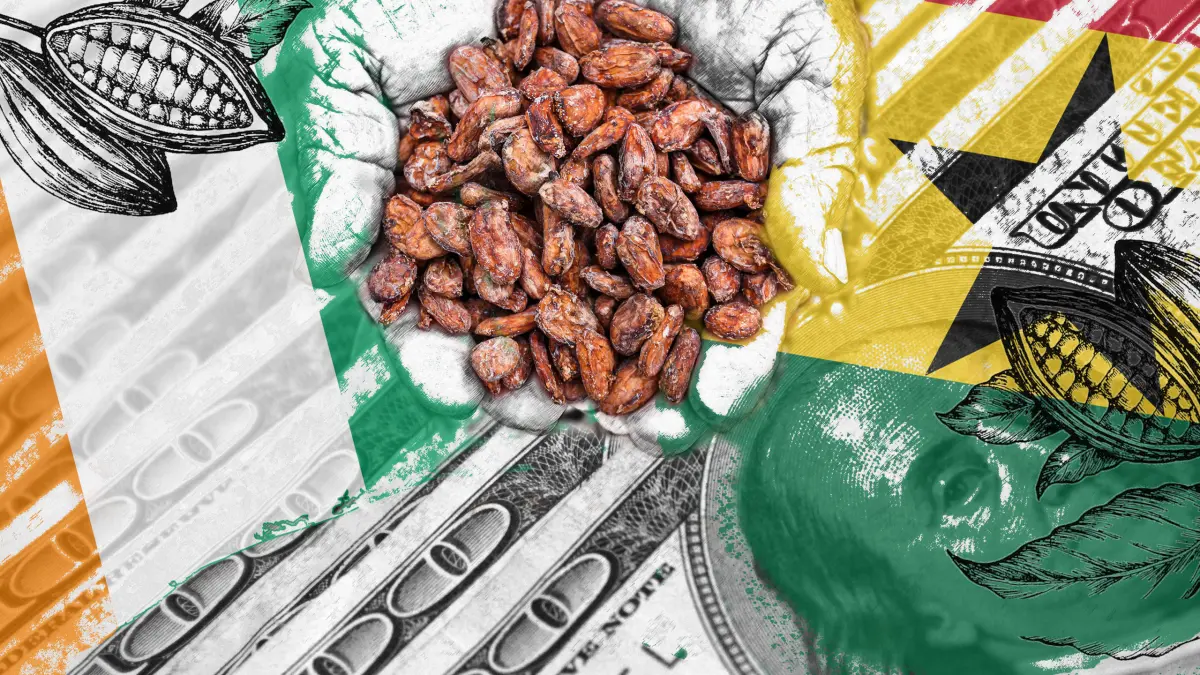








The Ghana Cocoa Board (COCOBOD) is finalizing a new domestic financing framework for the 2026/27 cocoa season that will replace the three-decade-old syndicated loan structure with cedi-denominated commercial paper and commercial notes, backed by domestic liquidity sources including pension funds and institutional investors. Announced at the Africa Cocoa Finance and Investment Forum (ACFIF 2026) at the London Stock Exchange, COCOBOD Chief Executive Dr. Ransford Abbey described the shift as a necessary “paradigm shift” in cocoa sector financing, aimed at improving price stability and ensuring sustainable farmer income while reducing dependence on offshore financiers.

Under the outgoing model—which required between 70% and 92% of the cocoa crop to be collateralized to foreign financiers—Ghana borrowed dollars, converted to cedis, paid farmers, sold cocoa for dollars, and repaid dollars, absorbing currency risk at every step. The new framework eliminates the currency mismatch, introduces quarterly pricing reviews responsive to global cocoa price movements, and expands financing access for local cocoa processors and indigenous firms. For a sector that employs over 800,000 farmers and generates approximately 15% of export earnings, the transition from syndicated loans to domestic commercial paper is not merely a technical financing change—it is a structural reorientation of Ghana’s most important agricultural value chain.
Key Developments: Commercial Paper, Pricing Mechanism, and Local Processor Access
The new framework departs from the syndicated loan model in three fundamental ways.
📢 GET A DETAILED ARTICLES + JOBS
Join ASJ's WhatsApp Channel and never miss a post or opportunity.
First, the instrument itself. COCOBOD plans to raise funds through cedi-denominated commercial paper and commercial notes rather than syndicated dollar loans. Commercial paper is short-term unsecured debt (typically 30 to 270 days) issued by corporations to meet working capital needs. Commercial notes are similar but can have slightly longer tenors. Both are typically purchased by institutional investors—pension funds, insurance companies, money market funds—seeking higher yields than treasury bills with acceptable credit risk.
The shift from bank-led syndicated loans to investor-purchased commercial paper transforms COCOBOD’s creditor base. Instead of negotiating annually with a consortium of international banks (Standard Chartered, Citi, Deutsche Bank, etc.), COCOBOD will tap a broader, deeper pool of domestic investors. As Dr. Abbey noted, pension funds alone hold substantial liquidity that could support the transition. Ghana’s pension fund assets exceed GH¢60 billion; insurance industry assets top GH¢15 billion. A $1 billion equivalent issuance (approximately GH¢11 billion at current exchange rates) represents less than 15% of pension fund assets alone—well within absorption capacity.
Second, the pricing mechanism. The new structure introduces quarterly reviews responsive to movements in global cocoa prices and exchange rates. Under the syndicated model, the farmer gate price was typically set once per season, based on forward sales and projected FOB prices. If global prices rose during the season, farmers did not benefit until the following year. If prices fell, COCOBOD absorbed the loss. The new quarterly review mechanism allows COCOBOD to adjust the producer price within the season—upward when global prices rise, downward (though politically difficult) when they fall. The stated policy of paying farmers 70% of the Free-On-Board (FOB) price is maintained, but the denominator (FOB price) will be updated quarterly.
This innovation, if implemented transparently, could transform farmer incentives. Knowing that a sustained global price rally will lead to a mid-season price increase encourages farmers to invest in farm maintenance and quality, rather than smuggle or abandon cocoa. It also aligns the interests of farmers and COCOBOD: both benefit from higher global prices.
Third, expanded financing access for local processors. The syndicated loan model was designed to finance the purchase and export of raw cocoa beans. Processors—companies that grind beans into butter, powder, and liquor—had to arrange their own working capital, often at higher costs. The new framework explicitly includes provisions to expand financing access for local cocoa processors and indigenous firms, strengthening local value retention. This aligns with Ghana’s long-standing but underachieved goal of processing at least 50% of its cocoa domestically. Current processing rates are approximately 35%.
For Accra Street Journal, this processor financing component is potentially the most transformative element of the new framework. If local grinders can access affordable working capital, they can compete more effectively for beans, potentially paying farmers higher prices while still achieving profitable margins. The result could be a virtuous cycle: better farmer prices, higher quality, more domestic processing, greater value retention, and stronger export earnings.
Analysis & Implications: The End of the Syndicated Loan Era
The syndicated loan model served Ghana well for decades but became increasingly untenable after 2020. Its fundamental flaw was currency mismatch: COCOBOD borrowed dollars but earned cedis from domestic cocoa sales (the farmer gate price is paid in cedis; the difference between that and the FOB dollar price is the surplus). To repay dollars, COCOBOD needed to generate dollar surpluses from cocoa exports. As long as the cedi was stable and cocoa prices were healthy, the system worked. When the cedi depreciated sharply—as it did in 2022 and 2023—the cedi cost of repaying dollar loans skyrocketed, even if cocoa prices remained constant.
The new domestic commercial paper model eliminates this mismatch entirely. COCOBOD will borrow cedis, pay farmers in cedis, and repay in cedis from its cedi revenues (including the cedi equivalent of dollar export proceeds). Currency risk shifts from COCOBOD to the individual investor—but investors holding cedi-denominated assets are already exposed to cedi risk. The sovereign balance sheet is no longer leveraged to cocoa financing.
Dr. Abbey’s disclosure that the previous model required between 70% and 92% of the cocoa crop to be collateralized to foreign financiers is striking. That meant that for every 100 bags of cocoa produced, up to 92 were effectively pre-sold or pledged to lenders before farmers were paid. The remaining 8% to 30% provided the margin for COCOBOD’s operational costs, farmer bonuses, and domestic value addition. Collateralization at such levels left little flexibility for responding to market opportunities or shocks.
The new model, by relying on unsecured commercial paper (though likely enhanced by a COCOBOD guarantee or government backing), reduces the collateral burden. Fewer beans need to be pre-pledged, allowing more to be sold spot into rising markets or directed to local processors.
However, unsecured commercial paper requires strong credit credibility. COCOBOD must convince domestic investors that its creditworthiness merits lower yields than sovereign debt but higher than top-tier corporates. The government’s improved macroeconomic position—inflation at 3.4%, cedi stable, IMF program on track—supports that case. But the memory of the domestic debt exchange program (DDEP), which restructured local currency bonds including some COCOBOD-related instruments, remains an obstacle.
The quarterly pricing mechanism is innovative but operationally complex. COCOBOD will need to forecast global cocoa prices with reasonable accuracy to set quarterly FOB assumptions. If actual prices diverge significantly from projections, the 70% payout ratio could produce either windfall surpluses (if actual prices are higher) or deficits (if actual prices are lower). A stabilization fund, built during high-price periods to cushion low-price periods, would mitigate this risk. The announcement did not mention such a fund.
What This Means for Ghanaian Farmers, Processors, and Investors
For cocoa farmers, the new framework promises more responsive pricing and more timely payments. The quarterly review mechanism means that if global cocoa prices surge mid-season—as they did in 2024 when prices exceeded $10,000 per tonne—farmers could see a price increase within weeks, rather than waiting until next season. This could reduce smuggling (since the legal price adjusts) and improve morale.
However, quarterly reviews also introduce downside risk. If global prices fall, the 70% FOB formula would reduce producer prices. Politically, this is challenging. Farmers have become accustomed to stable or rising producer prices; a mid-season cut would be deeply unpopular. COCOBOD may resist applying downward adjustments, effectively subsidizing farmers from its surplus and increasing its own risk. The credibility of the framework depends on symmetric application: prices must be allowed to fall as well as rise.
For local processors, expanded financing access is the most significant benefit. Currently, Ghanaian grinders operate at a disadvantage compared to Dutch and American processors because their cost of capital is higher. Affordable working capital—through lines of credit linked to the COCOBOD commercial paper program—could level the playing field. The goal of processing 50% of cocoa domestically becomes achievable.
For investors, the commercial paper offers a new asset class: short-term, cedi-denominated, cocoa-linked paper with yields above treasury bills. If structured with a COCOBOD guarantee or government backing, the credit risk would be low—essentially sovereign risk. The yield would need to be attractive: treasury bills currently yield approximately 22% to 24%. Commercial paper yielding 18% to 20% with lower liquidity (no active secondary market) might be a hard sell. Commercial paper yielding 24% to 26% would be attractive but would raise COCOBOD’s financing costs.
The ideal structure might blend tenors: some 90-day paper for working capital, some 1-year notes for more stable funding, and some 3-year bonds for investment in processing capacity. This would match liabilities to assets: short-term paper finances harvest purchases (quickly liquidated), longer notes finance processor expansion (longer payback).
Wider Context: African Commodity Finance Innovation
Ghana is not alone in rethinking commodity finance. Across Africa, producers of cocoa, coffee, cotton, and cashews are seeking alternatives to traditional trade finance models that favor international traders and banks.
Côte d’Ivoire, Ghana’s West African neighbor and fellow cocoa giant, has experimented with domestic bond financing but continues to rely heavily on syndicated loans. The Ivorian model includes a stabilization fund that smooths prices across seasons, reducing the need for mid-season adjustments. Ghana might consider adopting a similar fund as a complement to quarterly price reviews.
Nigeria’s Cocoa Board has used a mix of commercial bank loans and agricultural credit guarantee schemes, but has not yet issued commercial paper at scale. Ethiopian coffee financing remains heavily dependent on export-oriented loans from international buyers.
The common challenge across all these models is the same: reconciling the need for predictable, affordable financing with the volatility of global commodity markets. No structure eliminates risk entirely; the best structures distribute risk to those best able to bear it. Ghana’s new framework distributes currency risk from COCOBOD to investors (who accept cedi exposure), distributes price risk from COCOBOD to farmers (via quarterly reviews), and seeks to distribute operational risk from COCOBOD to local processors (via expanded access).
This is economically efficient but politically sensitive. Farmers who have never experienced a mid-season price cut may resist the framework unless cushioned by a stabilization fund. Investors who have never purchased cocoa commercial paper may demand prohibitively high yields until a track record is established. Processors who have never accessed affordable working capital may need technical assistance to use it effectively.
The London Stock Exchange forum was the right venue to announce the framework—global investors needed to hear it. But execution will happen in Accra, in the cedi bond market, with domestic institutions. The success of the framework depends less on international applause than on local implementation.
Outlook / What Happens Next
COCOBOD is finalizing a detailed prospectus outlining participation opportunities for financial institutions and investors. The prospectus will specify tenors, yields, minimum investment amounts, and security arrangements (guarantees, collateral, sinking funds). It is expected to be released by July 2026, ahead of the October harvest.
The first commercial paper issuance will likely be a pilot of GH¢2 billion to GH¢3 billion (about $180 million to $270 million) to gauge market interest. If it goes well, the full $1 billion equivalent (GH¢11 billion) would be raised in stages throughout the season. This staggered approach helps lower refinancing risk—if one stage falls short, COCOBOD can adjust terms or explore other funding options..
The National Pensions Regulatory Authority (NPRA) will need to approve cocoa commercial paper as an eligible asset for pension funds. This approval is likely but will require COCOBOD to demonstrate that the paper meets regulatory standards for credit quality, diversification, and liquidity. A government guarantee would accelerate approval.
For farmers, the most important milestone is the first quarterly price review, expected in December 2026 or January 2027. If global prices are stable or rising, the review will be uncontroversial. If prices have fallen, COCOBOD faces a hard choice: apply the 70% formula (cutting producer prices) or override it (preserving farmer incomes but breaking the framework’s credibility). How COCOBOD navigates that first test will determine the framework’s long-term viability.
The paradigm shift Dr. Abbey announced in London is necessary and overdue. Ghana’s cocoa sector cannot afford to remain hostage to currency mismatches and foreign collateralization. The domestic commercial paper model is the right direction. The coming months will reveal whether execution matches vision—and whether Ghana’s investors, farmers, and policymakers are ready to leave the syndicated loan era behind.
Source: Accra Street Journal
Last Updated on May 10, 2026 by Samuel Kwame Boadu
Disclaimer: Some content on Accra Street Journal may be aggregated, summarized, or edited from third-party sources for informational purposes. Images and media are used under fair use or royalty-free licenses. Accra Street Journal is a subsidiary of SamBoad Publishing Hub under SamBoad Business Group Ltd, registered in Ghana since 2014.
For concerns or inquiries, please visit our Privacy Policy or Contact Page.

Samuel Kwame Boadu is a Ghanaian media entrepreneur and storyteller with a passion for amplifying urban voices and uncovering everyday truths. He is the Editor-in-Chief and Founder of Accra Street Journal, a dynamic digital platform dedicated to capturing the pulse of Ghana’s capital—its people, culture, challenges, business, sports and innovations.