







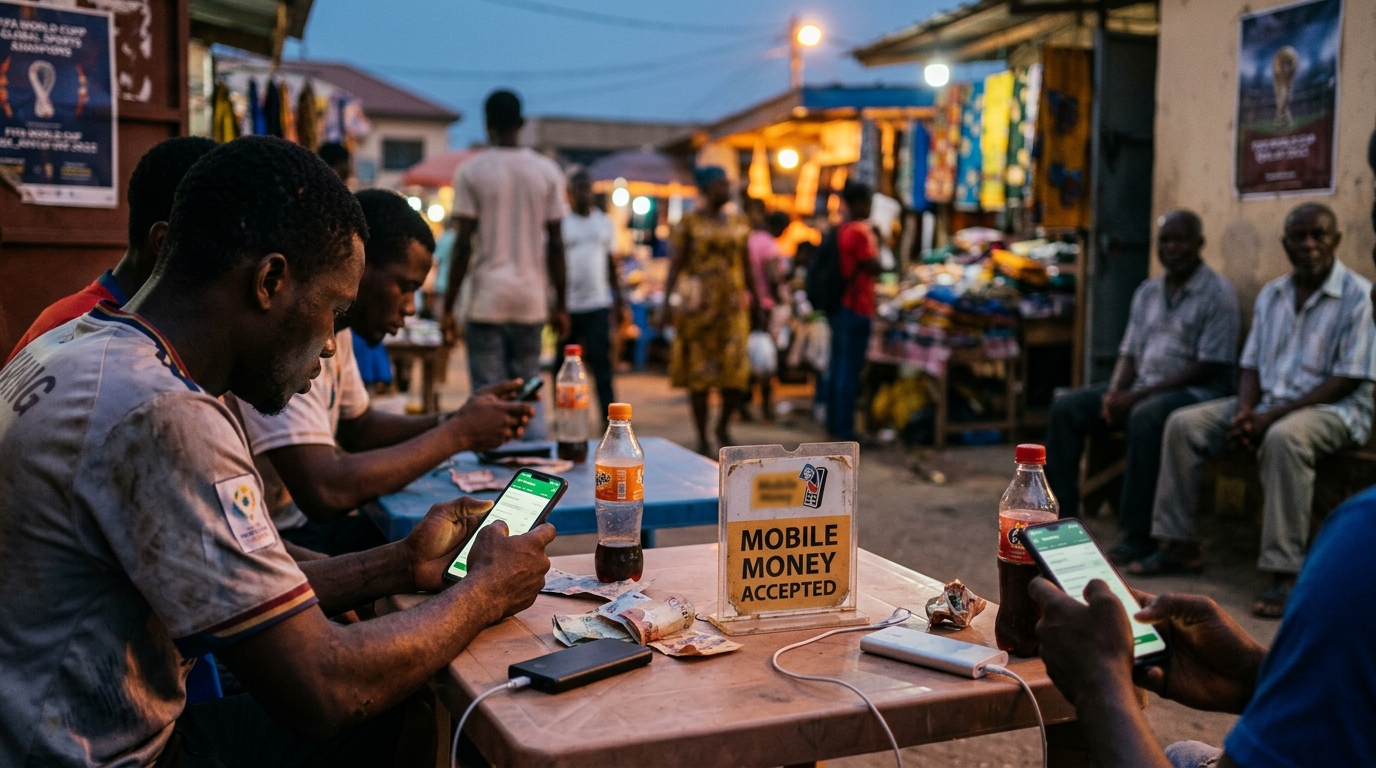
Ask a trader at Makola Market where her shop is today, and she might not point to a wooden stall. She will pull out her phone, open WhatsApp, and show you a catalog of wigs, fabrics, or phone accessories that reaches customers across Accra — and beyond. Her “shop” is in her pocket. Her “rent” is data. Her “foot traffic” is measured in views, likes, and shares.
This is mobile retailing, and it is no longer a niche experiment. It is the new mainstream.

In December 2025 alone, Ghanaians transacted GH¢518.4 billion through mobile money platforms — more than fourteen times the value of cheques cleared that same month . Active mobile money accounts reached 26.7 million, meaning there are now more mobile wallets than there are adults in the country . And the balance held in those wallets — GH¢39.6 billion — suggests Ghanaians are not just transacting; they are storing value, building businesses, and trusting the ecosystem with their livelihoods .
📢 GET A DETAILED ARTICLES + JOBS
Join ASJ's WhatsApp Channel and never miss a post or opportunity.

But the numbers only tell part of the story. Beneath the statistics is a fundamental restructuring of Accra’s retail economy. A young entrepreneur can now launch a clothing brand from a bedroom in Madina, receive payments via MoMo, market through Instagram and TikTok, and deliver via Bolt Food or a network of freelance riders — all without renting a single square foot of commercial space . A food vendor in Osu can reach customers in East Legon. A fashion designer in Labone can build a clientele across the entire city .
This ASJ report examines the rise of mobile retailing in Accra: the technologies driving it, the entrepreneurs building on it, the challenges it creates, and the future it points toward. We draw on primary data from the Bank of Ghana, industry reports, and on-the-ground observation of how Accra’s traders, vendors, and small business owners are adapting to a mobile-first reality.
Part 1: The Numbers That Define a Revolution
Before examining the human stories, understand the scale of what has happened. Mobile retailing did not emerge from a government policy or a corporate strategy. It grew from millions of individual decisions — to accept mobile money instead of cash, to post products on WhatsApp instead of renting a shop, to scroll and buy instead of walking and browsing.
Mobile Money: The Financial Spine
The Bank of Ghana’s December 2025 data reveals a financial system that has been fundamentally reshaped :
| Indicator | December 2025 Value | Significance |
|---|---|---|
| Monthly MoMo transaction value | GH¢518.4 billion | 14x higher than cheque transactions |
| Active MoMo accounts | 26.7 million | More than Ghana’s adult population |
| MoMo float balance | GH¢39.6 billion | Ghanaians trust wallets as stores of value |
| Active MoMo agents | 491,000 | Critical infrastructure for cash-in/cash-out |
For context, the total value of cheques cleared in December 2025 was just GH¢37.3 billion — a fraction of mobile money’s throughput . Even GhIPSS Instant Pay, the high-speed electronic transfer system, processed only GH¢73.3 billion in the same month. Mobile money is not just winning; it is lapping the competition.
As one industry analyst put it: “Mobile Money is not just another payment option alongside cash or cards. It is the primary financial rail” .
The User Base That Drives It
Mobile money’s growth is not abstract. It is reflected in how ordinary Ghanaians live. A 2025 analysis identified three seismic shifts in mobile behavior :
-
Mobile Money as operating system — Not a payment tool, but the infrastructure on which commerce runs
-
Phygital consumer behavior — Over 60 percent of urban consumers research online before buying offline
-
Mobile as ecosystem, not channel — The phone is the bank, the mall, the marketplace, and the community square
These shifts are not trends. They are the new baseline.
Part 2: The Technology Stack — What Makes Mobile Retailing Work
Mobile retailing in Accra does not rely on a single app or platform. It is an ecosystem of complementary tools, each serving a specific function in the retail chain.
The Communication Layer: WhatsApp Business
WhatsApp is not just a messaging app in Ghana. It is the primary sales channel for countless small businesses .
Why WhatsApp dominates:
-
Ubiquity: Nearly every smartphone user has it installed
-
Rich features: Catalogs, broadcast lists, status updates, and auto-replies
-
Trust: One-on-one communication builds customer confidence
-
Low barrier: Free to use, no technical expertise required
How businesses use it:
-
Product catalogs displayed via WhatsApp Business
-
Order taking and customer service via chat
-
Promotions via status updates and broadcast lists
-
Payment confirmation and delivery coordination
A business owner can now manage an entire retail operation — from product display to customer service to order tracking — without a website, without an e-commerce platform, without a physical store.
The Payment Layer: Mobile Money Interoperability
The 2018 introduction of mobile money interoperability — allowing transfers across MTN MoMo, Telecel Cash, and bank accounts — was the turning point . Before interoperability, a customer on Telecel could not easily pay a merchant on MTN. Now, the system is seamless.
The data shows the impact: interoperability transaction values rose to GH¢5.8 billion in December 2025 . A customer can see a product on Instagram, inquire via WhatsApp, pay via MoMo from any network, and receive confirmation instantly. The friction that once killed sales is gone.
The Discovery Layer: Instagram, TikTok, and Visual Commerce
For businesses targeting young, urban consumers, visual platforms have become essential .
Key trends in social commerce:
| Platform | Role in Mobile Retailing |
|---|---|
| Product showcase, influencer partnerships, story promotions | |
| TikTok | Viral product discovery, user-generated content, trend-driven sales |
| Community building, targeted ads, older demographics |
More than 70 percent of consumers under 30 in Ghana have purchase decisions influenced by TikTok and Instagram . Products that lack social validation — reviews, unboxings, influencer mentions — struggle to gain traction. Social proof is the new storefront.
The Emerging AI Layer: Automated Sales Assistants
The next frontier is artificial intelligence. In May 2026, Ghanaian e-commerce platform SellQuic launched an AI-powered Store Assistant designed to help online vendors manage customer conversations across WhatsApp and Instagram .
The problem it solves: As more vendors rely on messaging apps as storefronts, keeping up with customer inquiries has become impossible at scale. Delayed responses mean lost sales.
How it works:
-
Instant replies to WhatsApp and Instagram messages
-
Real-time responses on products, pricing, and availability
-
Customizable brand voice for each vendor
-
Smart follow-ups to convert interested buyers
-
Seamless handover of complex conversations to humans
SellQuic’s AI Store Assistant represents a recognition that conversation is commerce in Ghana. And automation is becoming essential to managing that conversation at scale .
Part 3: The Entrepreneurs — Who Is Building Mobile-First Retail Businesses
The numbers and technologies are impressive. But the real story of mobile retailing in Accra is the entrepreneurs adapting them to survive, thrive, and grow.
The Social Commerce Vendor
This is the most common form of mobile retailing in Accra. An individual — often a young woman — builds a business entirely within social media and messaging apps.
Typical operation:
-
Products displayed via WhatsApp status and Instagram feed
-
Orders taken via chat
-
Payments via MoMo (mobile number sent to customer)
-
Delivery via logistics app or commercial rider
Startup costs: Minimal. A smartphone, a data plan, and initial inventory.
Why it works: No rent, no utilities, no shop assistants. Overhead is low enough that even modest sales generate profit.
The constraint: Scaling beyond the founder’s ability to manage messages manually is difficult. This is where AI assistants like SellQuic’s enter the picture .
The Click-and-Collect Retailer
Physical stores have not disappeared. Their role is changing.
Over 60 percent of urban consumers now engage in Research Online, Buy Offline (ROBO) . They discover products on social media, compare prices through WhatsApp groups and marketplace platforms, then visit physical stores to make the final purchase.
What this means for retailers: The physical store is no longer a transaction point. It is a fulfillment and experience hub. The sale is won or lost online, days before the customer walks through the door.
Traditional retailers like Shoprite, Melcom, and Palace are adapting, but the shift favours smaller, more agile competitors who can engage customers where they already spend time — on their phones .
The Gig Economy Worker as Retailer
Not everyone who sells through mobile platforms identifies as a business owner. But the gig economy has created retail opportunities for individuals who might not otherwise participate .
Examples:
-
A delivery rider who also sells phone accessories to customers on his route
-
A freelance makeup artist who sells beauty products through her Instagram portfolio
-
A Bolt driver who offers phone charging cables for sale during trips
These micro-entrepreneurs blur the line between worker and business owner. Their “retail operation” is layered on top of another income-generating activity. Mobile platforms make this possible by reducing the overhead of selling to near zero.
Part 4: The Consumer Shift — Why Accra Shops Differently Now
Mobile retailing exists because consumer behavior changed first.
The Hyper-Rational Shopper
Today’s Ghanaian consumer is informed, digitally empowered, and economically defensive . Before making a purchase, they:
-
Compare prices across WhatsApp groups and marketplace platforms
-
Watch TikTok reviews and unboxings
-
Check product availability via Instagram stories
-
Read Google Maps reviews for physical stores
Brand loyalty is decreasing. Switching behavior is increasing, particularly in fast-moving consumer goods (FMCG) categories . The consumer who bought a specific detergent last month will switch to a cheaper alternative this month if social media suggests it is equivalent.
The Sachet Economy Goes Digital
Smaller pack sizes have long driven volume growth in Ghana’s low- and middle-income segments . Mobile retailing has extended this logic to digital commerce.
A customer who cannot afford a full-sized product can buy a trial-size SKU through WhatsApp, pay via MoMo, and have it delivered. For the merchant, this expands the addressable market. For the consumer, it reduces risk.
The Cultural Shift: Entrepreneurship as Accessible
The visibility of successful mobile-driven businesses has reshaped perceptions of self-employment . Younger generations view entrepreneurship as a viable career path, not a fallback option.
Why this matters: When entrepreneurship is seen as accessible, more people attempt it. More attempts mean more businesses. More businesses mean more competition, innovation, and—eventually—formalization. The cultural shift toward mobile-first entrepreneurship has long-term implications for economic diversification .
Part 5: The Structural Constraints — What Still Holds Mobile Retailing Back
For all its growth, mobile retailing in Accra faces significant challenges. Acknowledging them is essential for understanding what comes next.
Constraint 1: The Digital Divide
While smartphone penetration is increasing, not every entrepreneur has equal access to reliable internet, modern devices, or digital literacy . This creates a gap between those who can fully leverage mobile tools and those who remain constrained by traditional methods.
Who is left behind: Older entrepreneurs, those in neighborhoods with poor network coverage, and individuals who cannot afford data plans that support heavy app usage. The benefits of mobile retailing are not yet evenly distributed.
Constraint 2: Platform Dependency Risk
Entrepreneurs who build entirely within mobile ecosystems face exposure to risks they do not control . Algorithm changes, service fees, and platform policies can directly affect business performance.
Example: If WhatsApp changes its broadcast policy or Instagram adjusts its feed algorithm, a business that relies on these platforms for customer reach can see its sales drop overnight. This dependency is a structural vulnerability.
Constraint 3: The Trust Gap
While mobile money is trusted for payments, consumer protection remains uneven. A customer who pays for a product that never arrives has limited recourse. A merchant who ships goods and never receives payment faces the same problem.
Current solutions: Reputation systems, community enforcement, and word-of-mouth. But these are informal. Formal dispute resolution mechanisms for mobile commerce are still developing.
Constraint 4: Data Privacy and Taxation Uncertainty
As mobile-based businesses grow, questions around taxation, consumer protection, and data privacy become more pressing . Policymakers face the challenge of creating frameworks that support innovation without stifling it.
The risk: Overly aggressive taxation could drive transactions back into informal cash channels. Weak consumer protection could erode trust. Striking the right balance is critical.
Part 6: The Future — Where Mobile Retailing Is Headed
The trajectory is clear: deeper integration, more automation, and gradual formalization.
Trend 1: AI-Augmented Retailing
The SellQuic AI Store Assistant is a preview of what is coming . As AI tools become more accessible, small vendors will automate customer service, inventory tracking, and personalized marketing. The competitive advantage will shift from who works hardest to who uses data most intelligently.
Customer analytics is already identified as a competitive edge that Ghanaian e-commerce businesses cannot ignore . The next phase will see AI moving from back-office tool to front-line sales assistant.
Trend 2: Blending of Formal and Informal
Entrepreneurs who begin with mobile-first operations often transition into more structured enterprises as they grow . This gradual formalization expands the tax base, improves access to financing, and enhances business credibility.
The implication: Mobile apps are not just enabling startups — they are acting as gateways into the formal economy. A vendor who starts with WhatsApp and MoMo may eventually register a business, open a bank account, and access formal credit.
Trend 3: Hyper-Localization
Generic campaigns do not perform well in Ghana. Local relevance drives better results . Using Pidgin and local dialects can improve digital campaign engagement rates by 30–40 percent.
What this means: Mobile retailing will become more localized, not less. Successful vendors will speak their customers’ language — literally and culturally.
Trend 4: Community-Led Growth
Traditional loyalty programs are losing effectiveness as community influence rises . Micro-influencers with 1,000 to 50,000 followers achieve two to three times higher engagement rates than celebrity endorsements.
The winning play: Building owned communities on WhatsApp and Telegram around product usage and lifestyle themes. The brand that becomes a community hub wins loyalty that points-based systems cannot buy.
ASJ’s Conclusion
Mobile retailing in Accra is not a fad. It is a structural shift in how the city’s economy operates.
The infrastructure is now in place: 26.7 million active mobile money accounts, 491,000 MoMo agents, near-ubiquitous smartphone penetration among the working-age population, and platforms — WhatsApp, Instagram, TikTok — that have become the de facto storefronts for millions of small businesses .
But mobile retailing is not just about technology. It is about access. A young entrepreneur can now launch a business without a shop, without a bank account, without formal credit, without an established network. The barriers that once excluded entire segments of the population from retail entrepreneurship have been dramatically lowered.
The challenges are real: digital divide, platform dependency, trust gaps, regulatory uncertainty. But the direction is unmistakable. Accra’s retail economy is moving onto mobile devices. The shopfront of the future is in your pocket.
For now, the most successful mobile retailers are those who understand what their customers actually do: compare prices across WhatsApp groups, trust peer reviews over brand advertising, and expect conversation as part of the transaction. Stop marketing at the Ghanaian consumer, as one analyst put it. Start building solutions with them .
Quick Facts Box
| Indicator | Value | Source |
|---|---|---|
| Monthly MoMo transaction value (Dec 2025) | GH¢518.4 billion | Bank of Ghana |
| Active MoMo accounts | 26.7 million | Bank of Ghana |
| MoMo float balance | GH¢39.6 billion | Bank of Ghana |
| Active MoMo agents | 491,000 | Bank of Ghana |
| Interoperability transaction value (Dec 2025) | GH¢5.8 billion | Bank of Ghana |
| Urban consumers using ROBO (research online, buy offline) | >60% | Industry analysis |
| Consumers under 30 influenced by TikTok/Instagram | >70% | Industry analysis |
| SMEs using basic digital tools | ~60% | IFC/industry estimates |
| Telefonika retail branches nationwide | ~20 | Company statement |
| SellQuic AI Store Assistant launch date | May 1, 2026 | Company announcement |
FAQ Section
Q1: What is mobile retailing in Accra?
A: Mobile retailing refers to buying and selling goods and services through mobile devices, primarily using WhatsApp Business for catalogs and orders, mobile money for payments, and social media platforms like Instagram and TikTok for discovery and marketing.
Q2: How much money moves through mobile money in Ghana?
A: In December 2025 alone, mobile money platforms processed GH¢518.4 billion in transactions — more than fourteen times the value of cheques cleared that month .
Q3: How many active mobile money accounts are there in Ghana?
A: As of December 2025, there were 26.7 million active mobile money accounts, meaning more accounts than adults in the country .
Q4: Why is WhatsApp so important for retail in Ghana?
A: WhatsApp is ubiquitous on smartphones, free to use, and offers business features like catalogs and auto-replies. It allows one-on-one customer communication that builds trust, making it the primary sales channel for countless small businesses .
Q5: What is the SellQuic AI Store Assistant?
A: Launched on May 1, 2026, this AI-powered tool helps online vendors manage customer conversations across WhatsApp and Instagram, providing instant replies, product information, and smart follow-ups to convert buyers .
Q6: What does ROBO mean in Accra’s retail context?
A: Research Online, Buy Offline. Over 60 percent of urban consumers discover products on social media and compare prices online before visiting physical stores to make final purchases .
Q7: How does mobile money interoperability work?
A: Interoperability allows transfers across different mobile money networks (MTN MoMo, Telecel Cash) and between mobile wallets and bank accounts. Transaction values reached GH¢5.8 billion in December 2025 .
Q8: What are the biggest challenges facing mobile retailers in Accra?
A: Key challenges include unequal access to smartphones and reliable internet (digital divide), dependency on platform algorithms and policies, trust gaps in dispute resolution, and regulatory uncertainty around taxation and data privacy .
Q9: How are young Ghanaians using TikTok and Instagram for business?
A: Over 70 percent of consumers under 30 have purchase decisions influenced by these platforms. Businesses use them for product showcases, influencer partnerships, viral discovery, and user-generated content .
Q10: Is mobile retailing sustainable in the long term?
A: It can be sustainable if supported by strong digital infrastructure, improved digital literacy, balanced regulation that encourages innovation, and efforts to bridge the digital divide
Source: Accra Street Journal
Last Updated on May 17, 2026 by Samuel Kwame Boadu
Disclaimer: Some content on Accra Street Journal may be aggregated, summarized, or edited from third-party sources for informational purposes. Images and media are used under fair use or royalty-free licenses. Accra Street Journal is a subsidiary of SamBoad Publishing Hub under SamBoad Business Group Ltd, registered in Ghana since 2014.
For concerns or inquiries, please visit our Privacy Policy or Contact Page.

Samuel Kwame Boadu is a Ghanaian media entrepreneur and storyteller with a passion for amplifying urban voices and uncovering everyday truths. He is the Editor-in-Chief and Founder of Accra Street Journal, a dynamic digital platform dedicated to capturing the pulse of Ghana’s capital—its people, culture, challenges, business, sports and innovations.