



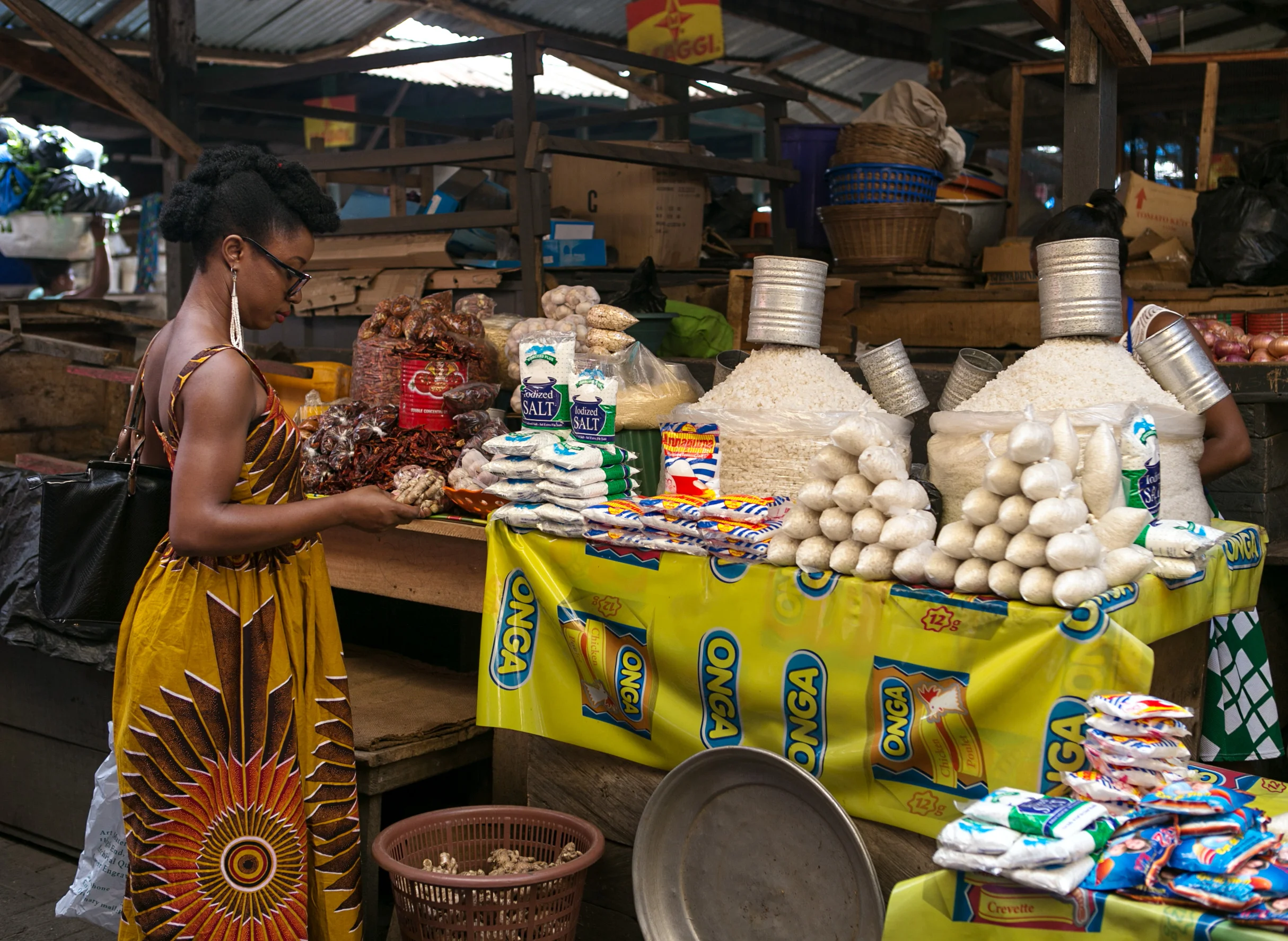
From necessity to preference — the economic forces reshaping Accra’s supermarket shelves and consumer habits
Executive Introduction
Walk into any well-stocked supermarket in Accra today — Spintex, East Legon, Tema Community One — and you will witness a small but telling rebellion. The imported spaghetti from Turkey sits untouched. The Ghanaian-made pasta beside it is nearly gone. The fancy Italian tomato paste in the small metal tube gathers dust. The local Ghanaian brand in the familiar sachet moves off the shelves before noon .
This is not a fluke. It is not a sudden surge of patriotism triggered by a public campaign. And it is certainly not because wealthy Accra households have suddenly decided to sacrifice quality for sentiment. The maths has changed. And the maths, in Ghana, always wins .

For decades, the local manufacturer was the underdog in every sense — struggling against cheaper imports, battling consumer suspicion, and losing shelf space to foreign products that carried an unspoken status. The Ghanaian shopper with extra money in their pocket did not dream of buying local. They dreamed of buying what came from elsewhere. That script is being rewritten. Slowly. Imperfectly. But unmistakably .
📢 GET A DETAILED ARTICLES + JOBS
Join ASJ's WhatsApp Channel and never miss a post or opportunity.

This ASJ report examines the structural forces driving the growing popularity of local goods in Accra: the currency collapse that has made imported goods punishingly expensive, the quiet upgrade in local production capacity, the emergence of a cultural movement around Ghanaian food and fashion, the export story that proves local quality can compete globally, and the persistent challenges that could reverse the trend.
Part 1: The Currency Effect — When the Cedi Rewrites Consumer Math
Let us clear away the easy explanations first. No, the “Buy Ghana” campaign from the Ministry of Trade has not suddenly worked. Those initiatives have been running for years with modest results. A poster on a wall does not change behaviour. The price tag does .

The real driver is simpler and more brutal: the cedi has made imported goods punishingly expensive for the average household .
Consider the arithmetic. A middle-class household in Accra that used to spend 500 cedis a week on groceries two years ago now spends closer to 900 cedis for the exact same basket — if they buy imports. A switch to local substitutes brings that number down to around 650 or 700 cedis. That is real money. That is school fees. That is transport fare for the month .
When the price difference was marginal — say 10 or 15 per cent — the consumer paid the premium for the imported brand. They saw it as insurance against quality failure. Now that the gap has widened to 30 or 40 per cent in many categories, that insurance premium no longer makes sense. The shopper is not switching because they love local goods. They are switching because staying loyal to imports has become an unaffordable luxury .
The Timing Is Not Accidental
Three forces have converged over the past 24 to 36 months that have fundamentally altered the competitive landscape between local and imported goods in Accra :
-
The currency collapse of 2022 and its lingering aftershocks: The cedi lost more than 30 per cent of its value against the dollar in a single year. Importers who used to hedge their exposure through forward contracts found those instruments either unavailable or ruinously expensive. Almost everything that arrives by container repriced sharply upward. And those prices have not come back down, even as the cedi has shown signs of stabilisation .
-
A quiet but meaningful upgrade in local production capacity: Over the past five years, a new generation of Ghanaian manufacturers has emerged — not the struggling state-owned enterprises of the past, but private, lean, cost-conscious operators. They have invested in better packaging, improved shelf life, and more consistent quality .
-
The informal retail network has become a distribution channel for local goods in ways it never was before: Ten years ago, the chop bar operator bought whatever was cheapest, regardless of origin. Today, the same operator has learned that customers ask questions. They notice where the cooking oil comes from. They check the label on the tin of mackerel .
Part 2: The Quality Upgrades — When Local Became Competitive
For decades, the perception that local products were of lower quality was a significant barrier. Artisans at the Arts Centre in Accra have noted that “Ghanaians often do not value and appreciate our crafts as much as foreigners do,” and that low patronage by Ghanaians is often attributed to the perception that locally made products are of lower quality than imported goods .
That perception is being tested — and in many categories, overturned.
The Food Movement
A new local food movement in Accra is being advanced by chefs, food entrepreneurs, social media influencers, and food writers who share the common goals of promoting local Ghanaian food to a broad, and often elite, audience . A local chef and caterer with an Instagram following of over 6,000 describes his approach as: “Eat Local, in Season & Sustainably” .
In the central neighbourhood of Osu, a café menu’s tagline reads: “Celebrating local Ghanaian ingredients” . Ingredients are being used in new ways. A skincare company launched in 2017 bases all its products in edible oils, particularly local shea butter. The company’s Instagram tagline promotes ingredients sourced from Ghana: “RAW Handmade Skincare Sourced from the WILD of Ghana; so PURE YOU CAN EAT IT” .
Members of this movement are not merely preserving heritage; they are actively constructing a cosmopolitan future in which Ghanaian cuisine claims a seat at the global table .

The Fragrance Renaissance
For decades, luxury perfume lovers looked almost exclusively towards France, Italy and the Middle East when searching for their signature scent. But that narrative is changing fast, and Ghana is quietly becoming one of Africa’s most exciting destinations for premium fragrances .
From artisan perfumers hand-pouring niche creations in Accra to luxury houses inspired by African history, mythology and culture, Ghanaian fragrance brands are creating scents that can proudly stand beside some of the world’s most respected perfume labels . Brands like Scent of Africa, Maison Yusif, and Mac Bancy Perfumes are proving that the next signature perfume in your collection might just be proudly Made in Ghana .
The Export Proof
Ghana’s handicrafts sector has recorded about 500 per cent growth in exports, making it the fastest-growing segment within the country’s non-traditional export sector . Products such as ornaments, Adinkra-inspired items, paintings, woodcrafts, and other handicrafts are attracting growing interest in international markets .
Changing global consumer preferences have increased demand for handmade and culturally distinctive products, and Ghanaian handicrafts are gaining popularity due to their unique designs, craftsmanship, and cultural significance .
The Fashion-Food Parallel
Ghana’s export story is no longer about raw cocoa. In 2025, non-traditional exports reached US$5.01 billion, a 30.7 per cent year-on-year increase. Manufactured and semi-processed goods accounted for approximately 83 per cent of total NTE earnings, far surpassing agriculture and handicrafts .
Cocoa paste alone generated nearly US$790 million, while cocoa butter and cocoa powder recorded growth rates exceeding 100 per cent compared to the previous year . This shift from raw exports to processed goods makes Ghana’s export sector more resilient . Value-added products are typically less exposed to commodity price volatility and can access a wider range of markets .
Part 3: The Consumer Reality — Demographics, Drivers, and Barriers
Who Is Buying Local?
A study of consumer behaviour towards Ghanaian fashion products in the Greater Accra Metropolis found that gender and age significantly influence consumer behaviour, with women and younger adults (aged 20-39) showing a higher inclination towards purchasing locally made fashion items . Fashion trends emerged as a key determinant, acknowledging their influence on buying decisions .
The findings suggest that local fashion brands should target younger consumers through digital platforms and trend-driven marketing . Socially, the study shows the role of fashion as a form of cultural expression among urban youth while also identifying a niche market focused on quality and heritage .
The Patriotism Factor
Patriotism does play a role, but its effect is more complex than simple sloganeering. A study on purchase intentions towards locally manufactured automobiles found that patriotism had a mixed moderation effect . Consumers who have a high level of patriotism are more likely to trust domestic products, even if they perceive them to be risky . However, perceived quality negatively predicted purchase intentions — meaning that if the quality is not there, patriotism alone will not overcome it .
The study also found that perceived risk significantly predicts purchase intention, while perceived price fails to significantly predict purchase intention . Subjective norms (social pressure from others) do significantly predict purchase intentions . In other words, Ghanaians are influenced by what their peers think, but price alone is not the deciding factor — quality and reliability matter more .
The Barriers
Despite the momentum, significant barriers remain.

Artisans at the Arts Centre in Accra have called on Ghanaians and the government to support locally made products, noting that low patronage by residents and declining tourist arrivals were affecting their businesses . The artisans said although the Arts Centre remained a major showcase of Ghana’s cultural heritage, limited publicity had left many people unaware of its location and the unique experiences it offered .
A trader at the Arts Centre said business had been very slow, with some days passing without making any sales, adding that business usually picked up in June, July and December when tourist arrivals increased . She called on the government and influential public figures to promote locally made products by wearing Ghanaian attire such as kente and fugu, saying visible support from leaders would encourage others to do the same .
Key barriers include:
-
Perceived quality gaps: Ghanaians often still perceive local products as inferior
-
Price competition: Imported products, mass-produced by machines, are often cheaper
-
Inconsistent availability: Local products are not always reliably on shelves
-
Packaging failures: Some local brands have quality that varies from batch to batch, or packaging that fails — a sealed sachet of local juice that leaks in the shopping bag, a tin of local mackerel with a pull-top that breaks
-
Limited publicity: Many people are unaware of what is available locally
Part 4: The Ghana Month Effect — Culture as Catalyst
The month of March, which marks Ghana’s independence and celebrates the nation’s heritage, has seen many people switching from foreign styles to local fashion, music and cuisine .
A seamstress in Accra said she had received more orders for African print dresses this month than at any other time of the year. “Many people want to wear ‘Ghana’ this month. It is helping our business a lot, even though the price of fabric has gone up slightly,” she said . Most members of the public were opting for local favourites such as waakye, fufu and banku .
Some workers said although they could not wear African prints every day due to workplace dress codes, they expressed patriotism by eating local dishes and visiting tourist attractions such as the Aburi Botanical Gardens and the Kwame Nkrumah Mausoleum . However, some citizens appealed to local producers to keep prices moderate so that more people could patronise their products and participate in the celebrations .
Part 5: The Future — Will the Shift Hold?
Look ahead three to five years, and several scenarios are possible .
The Optimistic Scenario
The cedi stabilises, but the shift toward local goods holds because manufacturers have used this window to improve quality and build brand loyalty. Local goods move from being the cheaper option to being the preferred option in several categories. Investment flows into production capacity. Exports to neighbouring markets grow .
The Pessimistic Scenario
The cedi recovers sharply — unlikely given structural pressures, but possible — and the price advantage of local goods evaporates. Consumers, who never truly abandoned their preference for imports, switch back. Local manufacturers who expanded too aggressively face ruin. The window closes .
The Most Likely Scenario
The local goods shift will hold in some categories and reverse in others. Staples like cooking oil, bottled water, pasta, and fruit juices will likely stay local because the production economics are strong. More discretionary categories — premium snacks, specialty sauces, imported cheeses — will remain dominated by foreign brands for the foreseeable future .
What Would Lock It In?
What would lock in the shift permanently is policy. If the government uses this moment to create a genuinely supportive environment for local manufacturing — reliable electricity, access to affordable credit, streamlined port clearance for raw materials — the gains could become structural. If not, this remains a cyclical story .
The Deputy Minister of Foreign Affairs has called on Ghanaians to shift their mindset and patronise goods made in Ghana by Ghanaians to promote the growth of Ghanaian industries and contribute to the country’s development. He emphasised the importance of supporting local products, highlighting their natural value and unique qualities .
Conclusion: The Consumer Has Opened the Door
The popularity of local goods in Accra right now is not a triumph of persuasion. It is a verdict of necessity .
The Ghanaian shopper has not suddenly become more patriotic. They have become more practical. And that practicality is a gift to local manufacturers — a second chance they did not earn but cannot afford to waste .
The door is open. The consumer is willing. But willingness has limits. One bad batch, one broken seal, one out-of-stock moment at the wrong time, and that customer is gone. They will go back to the imported brand they trusted before, price be damned .
Local goods are winning in Accra today because the maths favours them. Whether they keep winning depends on whether local manufacturers can do the unglamorous, expensive, difficult work of consistency, distribution, and trust .
The currency gave them an opening. What they do with it is entirely up to them .
Quick Reference: What the Data Shows
| Indicator | Value | Source |
|---|---|---|
| Non-traditional export earnings (2025) | US$5.01 billion | GEPA |
| Year-on-year NTE growth | 30.7% | GEPA |
| Manufactured goods share of NTE | 83% | GEPA |
| Cocoa paste export growth | 70.97% | GEPA |
| Cocoa butter export growth | 120.18% | GEPA |
| Handicrafts export growth | ~500% | GEPA |
| Average imported rice price (5kg) | GH¢73.50 | Channel One TV |
| Average local rice price (olonka) | GH¢46.50 | Channel One TV |
| Average palm oil price (litre) | GH¢36.25 | Channel One TV |
FAQ Section
Q1: Why are local goods becoming more popular in Accra?
A: The primary driver is economic: the cedi’s depreciation has made imported goods much more expensive, and the quality gap between local and imported products has narrowed significantly. Consumers are switching because staying loyal to imports has become an unaffordable luxury .
Q2: Is patriotism driving the shift toward local goods?
A: Patriotism plays a role, but it is not the primary driver. The shift is mainly driven by price and value. When the price difference was small, consumers paid the premium for imports. Now that the gap has widened, they are switching to save money .
Q3: Which local product categories are winning in Accra?
A: Staples like cooking oil, bottled water, pasta, fruit juices, and frozen foods are the biggest winners. These are high-volume categories where the price advantage of local production is most pronounced .
Q4: Are Ghanaian products competitive internationally?
A: Yes. Non-traditional exports reached US$5.01 billion in 2025, with manufactured and semi-processed goods accounting for 83 per cent. Cocoa paste, cocoa butter, and cocoa powder have seen triple-digit growth .
Q5: What are the biggest barriers to local goods adoption?
A: Perceived quality gaps (some consumers still believe local products are inferior), inconsistent availability, and packaging failures that erode trust .
Q6: What would lock in the shift toward local goods?
A: Policy support for local manufacturing — reliable electricity, access to affordable credit, and streamlined port clearance for raw materials. Without these, the shift could reverse if the cedi recovers
Source: Accra Street Journal
Last Updated on July 18, 2026 by Samuel Kwame Boadu
Disclaimer: Some content on Accra Street Journal may be aggregated, summarized, or edited from third-party sources for informational purposes. Images and media are used under fair use or royalty-free licenses. Accra Street Journal is a subsidiary of SamBoad Publishing Hub under SamBoad Business Group Ltd, registered in Ghana since 2014.
For concerns or inquiries, please visit our Privacy Policy or Contact Page.

Samuel Kwame Boadu is a Ghanaian media entrepreneur and storyteller with a passion for amplifying urban voices and uncovering everyday truths. He is the Editor-in-Chief and Founder of Accra Street Journal, a dynamic digital platform dedicated to capturing the pulse of Ghana’s capital—its people, culture, challenges, business, sports and innovations.