EXECUTIVE INTRODUCTION
Ghana is frequently, and justifiably, celebrated as one of the continent’s pioneers in digital financial services. The mobile money revolution, led by MTN Mobile Money and its competitors, has been a genuinely transformative force, bringing millions of previously unbanked Ghanaians into a functional, if informal, digital financial system. The statistics on mobile money account penetration and transaction volumes are impressive and routinely cited at international fintech conferences as evidence of Africa’s digital leapfrog. A superficial reading of these statistics would suggest that cash, the physical, anonymous, and costly-to-handle currency note, is in terminal decline in the markets and business districts of Accra.
That reading is profoundly incomplete. In the daily, granular reality of business transactions in the capital—in the sprawling open-air markets, in the corner provision shops, in the B2B wholesale supply chains, and in the complex informal service economy—physical cash remains not just a preferred medium, but the dominant, deeply entrenched, and fiercely defended sovereign of the transaction. This is not a story of technological ignorance or irrational resistance to progress. This Accra Street Journal analysis is a clear-eyed examination of the specific, hard-headed, and economically rational reasons why so many Accra businesses continue to prefer, and in many cases insist upon, payment in physical currency. The persistence of cash is not a bug in the digital finance system; it is a rational response to the system’s specific, unresolved flaws. The cedi note, it turns out, refuses to abdicate because it still performs several critical functions that the digital ledger, for all its sophistication, cannot yet reliably or cheaply replicate.

THE TOTAL COST OF DIGITAL: THE TRANSACTION FEE THAT KILLS THE THIN MARGIN
The most immediate and powerful argument for cash, articulated daily by tens of thousands of small-scale traders and service providers across Accra, is the simple arithmetic of the transaction fee. The mobile money ecosystem, for all its convenience, is not free. The withdrawal of cash from an agent incurs a fee, calibrated as a percentage of the amount, which can reach a cap of several cedis for even modest sums. The transfer of money from one wallet to another, while often free for small amounts, attracts a fee for larger transactions. These fees, which may appear trivial to the salaried professional or the development economist, are, for the micro-entrepreneur operating on razor-thin margins, a direct, painful, and recurring tax on their gross revenue.
📢 GET A DETAILED ARTICLES + JOBS
Join ASJ's WhatsApp Channel and never miss a post or opportunity.

Consider the woman who sells a single bowl of waakye for five cedis. Her net margin on that bowl is already compressed by the cost of the rice, the beans, the oil, the gas or charcoal, the transport to the market, and the daily levy to the local assembly. If her customer pays with mobile money, and she later needs to withdraw that same five cedis as physical cash to buy the next day’s ingredients from a supplier who does not accept digital payments, a significant fraction of her already minuscule margin is consumed by the transaction fees. The cash transaction, by contrast, involves no intermediary taking a cut. The five-cedi note changes hands in its entirety. For the business at the bottom of the pyramid, where the individual transaction value is small and the volume is high, the cumulative cost of digital transaction fees is not a minor inconvenience; it is a structurally unsustainable tax on poverty. The cash economy is, for this vast and vital segment of the market, simply the cheaper, and therefore the only viable, payment rail.
THE INSTANT, FINAL SETTLEMENT: THE END OF THE GHOST IN THE MACHINE
A second, and equally compelling, advantage of cash is its unique property of instant, final, and irreversible settlement. When a customer hands over a physical cedi note to a trader, the transaction is concluded at that very moment. The value has been transferred. There is no intermediary to delay the funds, no network to go down, no disputed transaction to be reversed by a distant call centre, and no “payment failed” notification to introduce a moment of awkward, trust-eroding friction between the buyer and the seller. The finality is absolute and the liquidity is immediate. The cash is available for the trader to give as change to the next customer, to pay a supplier minutes later, or to take home at the end of the day.

The digital payment, by contrast, is a promise. It is a string of data on a server that represents a claim on value. For that claim to be converted into the physical cash the trader often needs to operate, it must survive the journey through the telecommunications network, the banking or fintech platform’s processing system, and the sometimes fragile liquidity of the mobile money agent. The trader has experienced, too many times, the dreaded network failure that leaves a customer’s payment hanging in limbo, the disputed chargeback, or the agent who does not have enough physical cash to meet the withdrawal request. Each of these failures is a small, costly lesson in the unreliability of the digital promise. The physical cedi note makes no such promises; it simply is the value. For a business whose cash flow is a daily, precarious calculation, the absolute, instant certainty of the cash settlement is not an emotional preference; it is a critical risk management tool.
THE INVISIBILITY PREMIUM: TAX, THE EX-WIFE, AND THE DARK SIDE OF DIGITAL
It would be analytically dishonest to ignore a third, and deeply significant, driver of cash preference in the Accra business environment: the powerful desire for financial opacity. The digital payment leaves a permanent, searchable, and legally admissible record. It is a confession of income, stored on the servers of a regulated financial institution, accessible to the tax authorities, the courts, the insolvency practitioner, and the estranged spouse’s lawyer. For a large and diverse constituency of business operators in the city, this digital trail is not a feature; it is a catastrophic bug. The cash transaction, by contrast, is a private affair between two consenting parties. It leaves no mandatory, centralised record. It is the ultimate tool of financial confidentiality.
The motivations for this desire for opacity are complex and cannot be reduced to simple criminality. They range from the entirely rational desire to minimise a tax burden that is perceived as punitive, arbitrary, and unaccompanied by commensurate public services, to the legitimate fear of intrusive state surveillance. They include the small trader’s need to shield her modest daily income from the grasping hands of a financially predatory relative, and they extend, undeniably, into the grey and black economies of bribery, corruption, and illicit trade, which are significant features of the Accra commercial landscape. For all these actors, the premium on invisibility is substantial, and they are willing to pay for it in the inconvenience and risk of handling large volumes of physical cash. Until the digital financial system can offer a form of privacy that mimics cash’s confidentiality, a significant segment of the business community will continue to prefer the anonymous cedi note for their most sensitive transactions. The digital ledger is a snitch; cash, famously, does not talk.
THE PHYSICALITY OF TRUST: THE NOTE YOU CAN SEE AND THE PERSON YOU KNOW
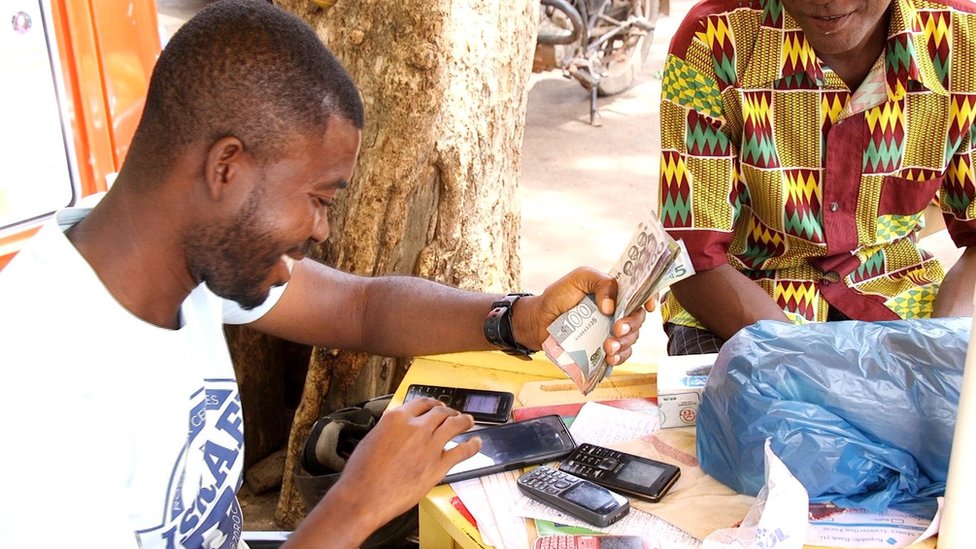
In the Accra marketplace, trust is not an abstract concept. It is a physical, sensory, and deeply social phenomenon. The transaction is often the culmination of a negotiation, a relationship, and a performance. In this context, the physical exchange of cash carries a symbolic weight that the sterile, electronic notification cannot match. The counting of the notes, the visual verification of their authenticity, the final handing over of the crisp or worn currency—this is a ritual of closure, a physical, tangible seal on the commercial agreement. The customer sees their money leave their hand; the trader sees the payment arrive. There is a mutual, sensory confirmation of the deal that the beep of a phone, however convenient, lacks.
Furthermore, a significant portion of Accra’s informal commerce operates on a spectrum of trust between strangers, where the risk of digital fraud is a constant, low-grade anxiety. The customer fears the fake mobile money prompt, the payment notification that turns out to be a cleverly designed SMS spoof. The trader fears the chargeback, the stolen phone used to make an unauthorised payment. The physical cash note, with its intricate security features, its distinctive texture, and its immediate, physical presence, short-circuits these digital anxieties. It is a technology of trust that requires no battery, no network signal, and no faith in a distant, unaccountable platform. In a low-trust environment, the primitive, physical medium provides a certainty that the sophisticated digital system has not yet fully achieved.
CONCLUSION: THE DUAL SYSTEM AND THE LONG SHADOW OF THE CEDI NOTE
The Accra business environment has not chosen between cash and digital. It has constructed a pragmatic, hybrid, and deeply rational dual system that leverages the unique strengths of each medium for different types of transactions, different levels of trust, and different requirements for speed, cost, and privacy. The digital payment is dominant for the remote transaction, the bill payment, the airtime top-up, and the salary disbursement. The physical cash note retains its iron grip on the high-volume, low-margin, face-to-face micro-transaction, the privacy-sensitive deal, and the immediate, final settlement between parties who may not trust each other.
The cedi note’s long reign is not a sign of Ghana’s digital failure. It is evidence of the sophistication and adaptability of its commercial culture, which coldly assesses the total cost and the total risk of a payment method and selects the optimal tool for the specific job. Cash will only begin to cede its territory when the digital alternatives can match it, not just on convenience, but on the harder metrics of total end-to-end cost for the micro-transaction, absolute reliability and instant finality of settlement, and a credible architecture of financial privacy. Until that day, the king will remain on the throne, his pockets stuffed with worn, carefully folded cedi notes, conducting the daily business of the city in the oldest, and for many purposes still the best, commercial language the world has ever known.
QUICK FACTS BOX: CASH PREFERENCE IN ACCRA BUSINESS
-
The Transaction Fee Tax: For micro-entrepreneurs with razor-thin margins, mobile money withdrawal and transfer fees represent a structurally unsustainable cost on small-value transactions, making cash the cheaper medium.
-
Instant, Final Settlement: Cash provides absolute, immediate, and irreversible finality, eliminating the risks of network failure, payment reversal, disputed charges, and agent illiquidity that plague digital payments.
-
The Invisibility Premium: A powerful, multi-motivated desire for financial opacity—driven by tax avoidance, legitimate privacy concerns, and the grey economy—makes the anonymous, unrecorded cash transaction highly valued.
-
Physical Trust Ritual: The tangible, sensory exchange of cash provides a symbolic and psychological closure to a transaction, offering a direct, mutual confirmation of value that builds trust in a way the digital notification cannot.
-
Strategic Outcome: The Accra market has not digitised; it has hybridised. Cash remains sovereign for the micro, face-to-face, and privacy-sensitive transaction, while digital dominates for remote, formal, and high-value payments. The future is a dual system, not a cashless one.
FAQ SECTION
1. If mobile money is so widespread in Ghana, why is cash still so commonly used in business?
Because for the small, daily, face-to-face micro-transactions that are the backbone of the Accra economy, the mobile money transaction fee is a punishing tax on already razor-thin margins. Cash is simply cheaper for these small amounts.
2. Are mobile money fees really a significant cost for a small business?
Yes, in cumulative terms. For a trader whose individual items sell for a few cedis and whose net margin is measured in pesewas, a single withdrawal fee can wipe out the profit from multiple sales. It is a structurally regressive tax on the smallest businesses.

3. Is it just about the cost of the fees?
No. The risk of network failure, a disputed payment reversal, or an agent without enough physical cash are all real, recurring problems that make the instant, final, and irreversible nature of a cash transaction inherently more reliable for a daily cash-flow business.
4. Is the desire to avoid tax a main reason businesses like cash?
It is one significant factor for a segment of the market. Cash leaves no mandatory digital trail, providing a level of financial privacy and opacity that is valued for a complex mix of reasons, from legitimate tax minimisation to shielding income from family members and the grey economy.
5. Does cash create more trust than a digital payment in Accra’s markets?
In a sense, yes. The physical, sensory act of counting and exchanging notes provides a ritual of closure and a mutual, tangible confirmation of the deal that the beep of a phone notification, which can be faked, does not always provide.
6. Are there businesses that deliberately only accept cash?
Yes. Many small traders, especially in the open markets, will strongly prefer or insist on cash for the lowest-value items, precisely to avoid the fee erosion on their margins, and some will operate entirely in cash for reasons of simplicity, cost, and financial privacy.
7. Is Ghana moving towards becoming a cashless society?
Not in the foreseeable future for the face-to-face micro-economy. What is emerging is a permanent, pragmatic dual system where digital payments and cash coexist, each used for the specific types of transactions where their unique advantages are strongest.
8. What are the hidden costs for a business of dealing only in cash?
The risk of theft, the time and cost of travelling to the bank to deposit large sums, the inability to transact with remote customers, and the lack of a digital transaction history that can be used to build a formal credit score for a loan.
9. How does the preference for cash affect the ability of an SME to get a bank loan?
Profoundly and negatively. A cash-based business has no verifiable digital financial record. To the formal bank, it is an invisible, high-risk entity, which drives the business even more deeply into the cash economy and the informal credit market.
10. What would it take for cash to truly decline in Accra’s business environment?
Mobile money fees, particularly for small amounts and withdrawals, would need to be drastically reduced or eliminated. The digital payment infrastructure would need to become perfectly reliable. And a credible system of financial privacy would need to be developed. Until then, cash is king.
Source: Accra Street Journal
Last Updated on July 29, 2026 by Samuel Kwame Boadu

Disclaimer: Some content on Accra Street Journal may be aggregated, summarized, or edited from third-party sources for informational purposes. Images and media are used under fair use or royalty-free licenses. Accra Street Journal is a subsidiary of SamBoad Publishing Hub under SamBoad Business Group Ltd, registered in Ghana since 2014.
For concerns or inquiries, please visit our Privacy Policy or Contact Page.

Samuel Kwame Boadu is a Ghanaian media entrepreneur and storyteller with a passion for amplifying urban voices and uncovering everyday truths. He is the Editor-in-Chief and Founder of Accra Street Journal, a dynamic digital platform dedicated to capturing the pulse of Ghana’s capital—its people, culture, challenges, business, sports and innovations.