EXECUTIVE INTRODUCTION
In a city increasingly defined by the glass facade, the gated community, and the digital transaction, Accra’s traditional folklore festivals operate as a radical, stubborn, and profoundly democratic counter-force. They are the moments when the asphalt is covered with libation, when the ancestor’s voice speaks through the masked dancer, and when the deep, pre-colonial memory of the Ga-Dangme people physically reclaims the streets of the modern capital. These festivals—Homowo, Kplejoo, Obonu, Asafotu, and the panoply of lesser-known lineage rites—are not mere cultural entertainments or tourist spectacles. They are the living archive of a civilization, a complex, multi-layered system of historical commemoration, spiritual maintenance, social regulation, and communal economic redistribution.
This Accra Street Journal spotlight is a deep analytical profile of this festival complex. It moves beyond the drumming and the colourful crowds to examine the rigorous ritual logic, the contested political economy, and the immense cultural labour that sustains these events. We argue that the Accra folklore festival is a sophisticated indigenous institution under silent, relentless pressure from urbanisation, Christian and Islamic orthodoxy, and the commodifying gaze of the state and the corporate sponsor. To watch the Wulomo pour schnapps to the earth at a Homowo launch is not to witness a quaint custom; it is to witness a high-stakes act of cosmological maintenance, a contractual renewal between the living, the dead, and the elemental forces that, in the Ga worldview, underpin the very possibility of life in the city.

THE COSMOLOGICAL FOUNDATION: WHY THE FESTIVALS EXIST
To understand the Accra folklore festival, one must first discard the Western category of “entertainment.” These festivals are liturgical acts. Their primary purpose is not human enjoyment but cosmic order. The Ga-Dangme worldview posits a reciprocal, contractual relationship between the living community, the ancestors (niimei), and the pantheon of deities (jemawon) that inhabit the lagoons, the sea, and the land. This relationship requires constant, calendrically precise maintenance. A festival is the public performance of that maintenance. It is the moment when the collective debt to the spiritual realm is acknowledged and paid, through prayer, libation, drumming, dance, and the specific ritual feeding of the stools, the shrines, and the lagoon deities.
📢 GET A DETAILED ARTICLES + JOBS
Join ASJ's WhatsApp Channel and never miss a post or opportunity.

The foundational festival narrative across the Ga-Dangme towns is the great migration from the east, the exodus from a place of hardship, and the establishment of the settlements along the Accra coast. Homowo, which translates literally as “hooting at hunger,” is the master narrative. It ritually re-enacts the famine that afflicted the migrating Ga people and the eventual bountiful harvest that saved them. This is not just history; it is a covenant. The annual performance of Homowo is a ritual promise to never forget the hunger, a thanksgiving for the abundance of the sea and land, and a public demonstration that the spiritual protocols that ensured survival have been faithfully observed. The festival is the Ga nation’s collective memory, performed as a sacred duty, not an optional street party.
THE RITUAL CALENDAR: A YEAR IN THE SACRED CYCLE
The Accra festival year is a meticulously sequenced liturgical calendar that begins with a period of silence and ends in a catharsis of public joy.

The Ban on Drumming and Noise-Making.
The sacred year opens not with a bang, but with a profound, city-wide silence. For a period of several weeks, typically in the months preceding Homowo, the Ga traditional authorities impose a ritual ban on all drumming, loud music, and public noisemaking across the Ga state. This is not a cultural curio; it is a fundamental act of spiritual preparation. The silence is a collective meditation, a quieting of the profane world to allow the ancestors and the deities to draw near. It is also a public assertion of the jurisdiction of the Ga Traditional Council and the Ga Mantse over the acoustic space of the city, a powerful, and increasingly contested, claim of customary authority over an urban territory dominated by secular law and noisy commercial life.
The Kplejoo Festival (Nungua).
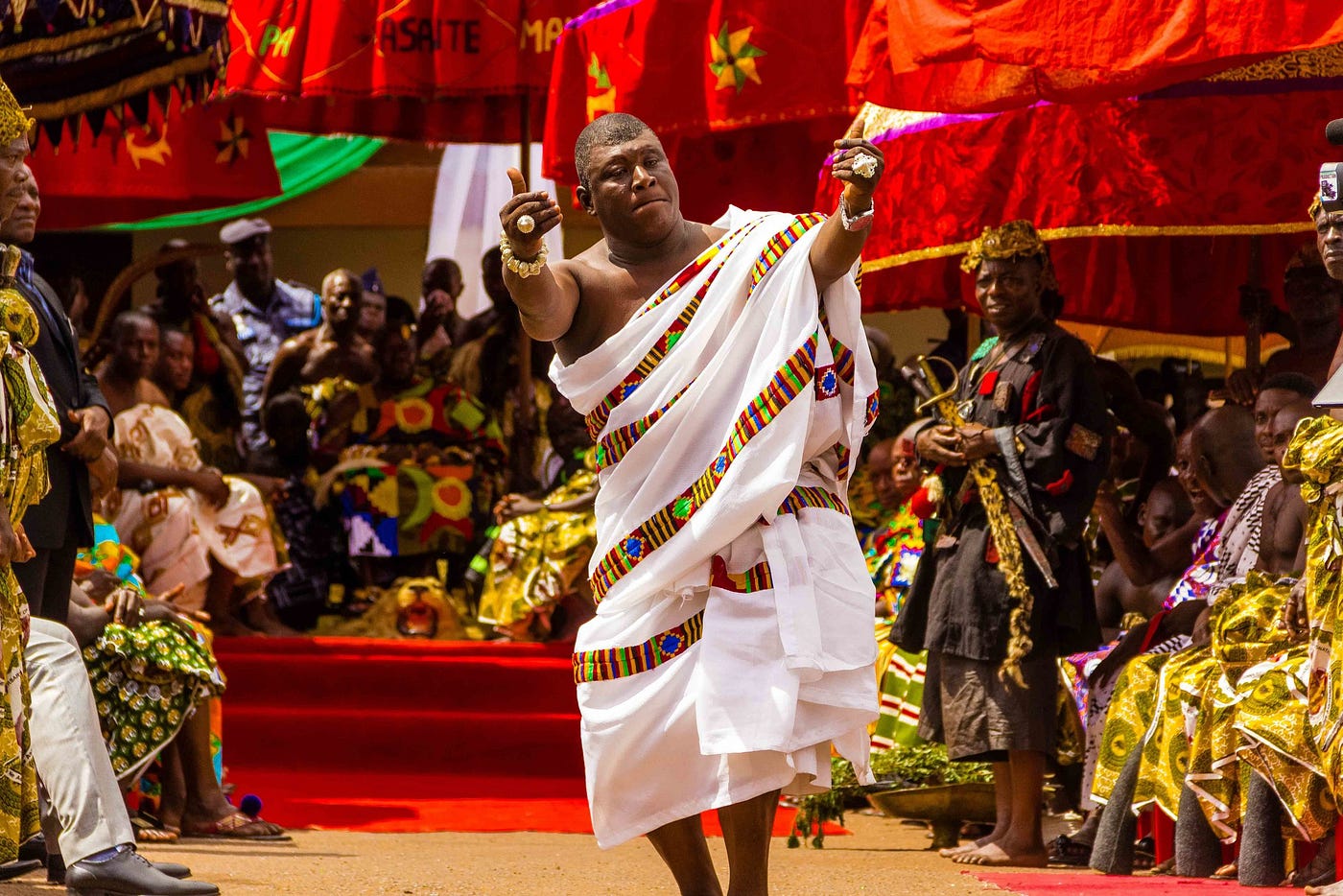
Kplejoo, celebrated by the people of Nungua, is one of the most visually spectacular and ritually intense of the Ga festivals. It features the appearance of a pantheon of masked figures, the jemawon made visible. The masks, elaborate and often fearsome, are not costumes; they are vessels. The wearer is possessed by the deity, and the dance is a physical manifestation of the spiritual power’s presence in the community. The Kplejoo rites are a concentrated dose of cosmological drama, cleansing the town, blessing the coming year, and displaying the raw, unmediated power of the sacred.
The Homowo Festival (Ga Mashie, Osu, La, Teshie, Nungua).
Homowo is the umbrella festival, celebrated at staggered dates by the different Ga-Dangme towns. The core ritual sequence is universal: the solemn libation at the ancestral shrines, the ritual planting of maize (the ngmaadumo), the sacred procession of the priests and elders, and the climactic public sprinkling of the ritual food, kpekple, on the streets, accompanied by the pounding rhythms of the obonu drums. The sprinkling is an act of feeding the ancestors and the land itself. The streets of James Town, Osu, La, and Teshie are transformed into sacred space, claimed for the day by the lineage, the stool, and the deity, not the municipal assembly.
Obonu and Asafotu (Teshie and Ada).
The Obonu festival of the people of Teshie, and the parallel Asafotufiami of Ada, introduce a warrior element to the ritual cycle. These festivals commemorate the martial prowess of the ancestors and feature the Asafo companies, the traditional warrior organisations. The display of ancient musketry, the martial drumming, and the vigorous, competitive dancing are a ritual re-enactment of military readiness and communal defence, a living memory of the pre-colonial state’s capacity for organised violence.
THE ECONOMICS OF THE FESTIVAL: HOMECOMING, HOSPITALITY, AND THE REDISTRIBUTIVE FLOW
The folklore festival is a major, though informal, economic engine. It triggers the largest annual internal migration in the Ga-Dangme calendar, the great homecoming. Every Ga son and daughter in the diaspora—whether in London, New York, or Kumasi—is under a profound cultural obligation to return to their ancestral home for their town’s Homowo. This reverse migration generates a massive, seasonal injection of foreign exchange and urban capital into the local economies of the Ga communities.
The economics of the festival are built on spectacular, and economically demanding, hospitality. Every family compound house is open. A vast quantity of food—palm nut soup, kpekple, fish, and meat—is prepared and distributed not just to family members but to neighbours, visitors, and complete strangers. This is a form of ritualised redistribution, a temporary, intense gift economy that levels social distinction and reinforces the bonds of kinship. For the commercial sector, the festivals are a peak season for the caterer, the sound system hire company, the kente and cloth seller, the barber and hairdresser, and the transport operator. The ritual calendar is the pulse of the local economy in these historic quarters.
THE FESTIVAL AS SOCIAL COURT: SATIRE, ACCOUNTABILITY, AND THE COMMUNAL VOICE
Critically, the Accra folklore festival contains within it a mechanism for public accountability. During Homowo, groups of young people, often organised into informal companies, compose and perform special satirical songs that circulate through the streets. These songs, delivered in Ga, are a form of communal court. They publicly name, shame, and mock individuals who have transgressed social norms—the corrupt elder, the adulterous husband, the woman who has refused to share her wealth, the chief who has sold family land for private gain.
This tradition of licensed satire is a crucial safety valve and a tool of social regulation. The target is not physically harmed, but their reputation is publicly pulverised in a context of ritual laughter and drumming. It is a profoundly democratic, if merciless, mechanism of accountability that operates entirely outside the formal legal system. It demonstrates that the festival is not a blind celebration of authority but a performance that holds authority to account, giving voice to the communal consensus on right and wrong.
CONTESTED GROUND: CHRISTIANITY, ISLAM, AND THE CHARISMATIC CRITIQUE
The most persistent and emotionally charged conflict surrounding the Accra folklore festivals is with the city’s powerful Pentecostal and charismatic Christian churches. For a significant and vocal segment of the Christian community, the pouring of libation, the invocation of ancestors, and the dancing of the masked jemawon are not culture but idolatry. They are “demonic” practices that a born-again Christian must renounce, abstain from, and spiritually war against. The ritual ban on drumming is particularly contested, seen by some churches as an infringement on their religious freedom to hold noisy, all-night vigils and praise-worship services.

This tension creates a painful cultural schism within Ga families themselves. Many modern, educated, Christian Ga professionals navigate a delicate and often anguished path: respecting the family obligation to attend the Homowo gathering, eating the food, but quietly abstaining from the libation, the shrine visit, and the purely ritual elements. The festival is thus a site of intense, intimate negotiation between Christian identity and ethnic obligation, a lived argument about what it means to be Ga and a believer. The Islamic communities, particularly in the Zongos, have a different, more distanced relationship, participating in the civic and commercial life of the festival but maintaining their distinct religious practice outside the libation and stool-ritual framework.
THE CONTEMPORARY STRUGGLE: STATE, SPONSOR, AND THE SPECTRE OF COMMODIFICATION
The official posture of the Ghanaian state towards the festivals is one of enthusiastic appropriation. Homowo, Kplejoo, and the others are branded as “cultural tourism” assets. Politicians flock to the durbar grounds, making speeches and donations, framing the festivals as part of a depoliticised, consumable “national heritage.” This state embrace is a double-edged sword. It brings visibility and some state resources, but it also flattens the complex, sacred ritual into a photogenic “traditional” backdrop for the modern politician’s image-making.
Corporate sponsorship, particularly from the alcoholic beverage and telecommunications industries, is the newest layer of this commercial dynamic. The giant promotional billboards at the festival grounds and the branded event canopies represent an injection of significant marketing capital. In return, the festival is subtly transformed into an advertising platform. This commodification process is a profound challenge for the traditional custodians. How do you maintain the sacred integrity of a rite when it is framed by a corporate logo and the libation is followed by the launch of a new promotional drink? The elders walk a tightrope, accepting the necessary funds while attempting to police the boundary between the sacred core and the commercial fringe.
CONCLUSION: THE CITY NEEDS THE GODS TO DANCE
The traditional folklore festivals of Accra are not relics. They are a dynamic, resilient, and intensely contested field of cultural, economic, and spiritual action. They are the most powerful visible expression that Accra is not a generic, interchangeable modern African city but the specific, sacred territory of the Ga-Dangme people. When the obonu drums sound in the narrow lanes of James Town, and the kpekple is sprinkled on the tarmac, a profound transaction occurs. The ancestors are fed, the communal memory is refreshed, and a social contract far older than the Constitution of Ghana is publicly renewed.
The pressures on this system—theological, economic, and spatial—are immense and are unlikely to ease. The survival of the festivals will depend on the capacity of the traditional authorities to negotiate modernity without surrendering their ritual soul: to accept the corporate sponsor’s money without letting the god become an advert; to welcome the politician without letting the stool become a campaign prop; and to accommodate the Christian convert without ceasing to feed the ancestors. The city will continue to change, but for a few sacred weeks every year, the gods still dance in Accra, and in that dancing, the deepest history of the city is told.
QUICK FACTS BOX: ACCRA’S TRADITIONAL FOLKLORE FESTIVALS
-
Core Ga-Dangme Festivals: Homowo (Ga Mashie, Osu, La, Teshie, Nungua), Kplejoo (Nungua), Obonu (Teshie), Asafotufiami (Ada).
-
Primary Purpose: Liturgical maintenance of cosmic order, ancestral veneration, renewal of the spiritual contract between the deities, the living, and the land.
-
Foundational Narrative: The Great Migration and the deliverance from famine, ritually commemorated as “Hooting at Hunger” (Homowo).
-
Key Ritual Elements: Ban on drumming and noise-making (preparatory silence), libation, ritual planting of maize, sacred mask dances (jemawon vessels), sprinkling of kpekple (ritual food), satirical accountability songs.
-
Economic Impact: Massive internal diaspora homecoming, seasonal injection of capital, peak demand for hospitality, food, cloth, and event services in the historic Ga quarters.
-
Principal Tensions: Evangelical Christian/Pentecostal rejection of rites as “idolatry”; state and political co-optation; corporate sponsorship-driven commodification.
-
Cultural Significance: The most powerful living assertion of Ga-Dangme territorial identity and customary authority in the modern, cosmopolitan capital; a public, performative archive of Ga history and ethics.
-
Key Custodians: The Ga Mantse and the Ga Traditional Council, the Wulomei (traditional priests), the lineage heads, and the stool-holders of the respective towns.

Source: Accra Street Journal
Last Updated on July 23, 2026 by Samuel Kwame Boadu
Disclaimer: Some content on Accra Street Journal may be aggregated, summarized, or edited from third-party sources for informational purposes. Images and media are used under fair use or royalty-free licenses. Accra Street Journal is a subsidiary of SamBoad Publishing Hub under SamBoad Business Group Ltd, registered in Ghana since 2014.
For concerns or inquiries, please visit our Privacy Policy or Contact Page.

Samuel Kwame Boadu is a Ghanaian media entrepreneur and storyteller with a passion for amplifying urban voices and uncovering everyday truths. He is the Editor-in-Chief and Founder of Accra Street Journal, a dynamic digital platform dedicated to capturing the pulse of Ghana’s capital—its people, culture, challenges, business, sports and innovations.