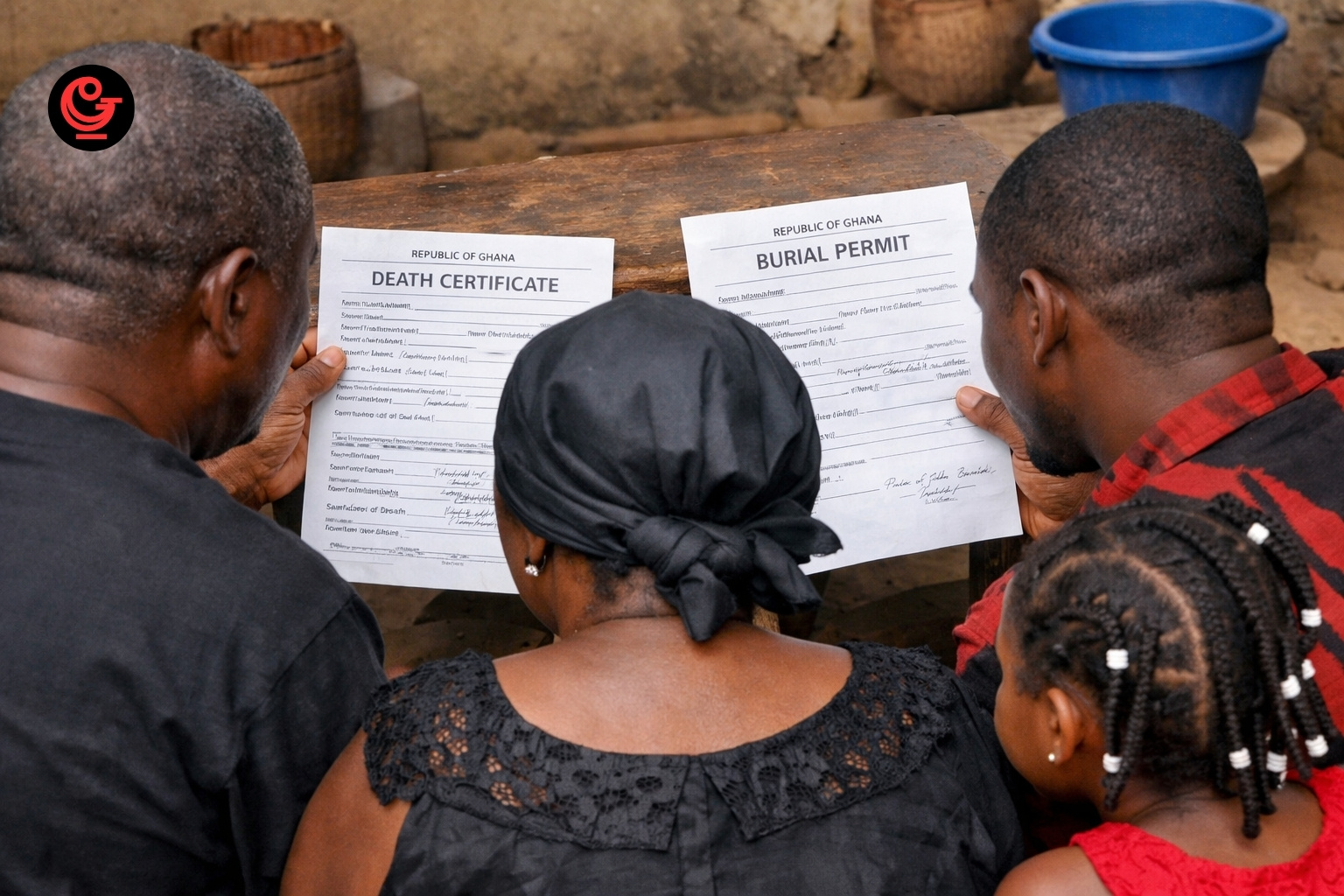
A death certificate is more than a record of loss. It is the legal document that allows a family to settle an estate, claim insurance, access SSNIT benefits, and complete the burial process. In Ghana, the registration of death is governed by the Registration of Births and Deaths Act, 2020 (Act 1027), and the process depends on where the death occurred and how quickly it is reported.
The Two Paths: Death in a Health Facility vs. Death at Home
The procedure differs depending on whether the deceased died in a hospital or outside one.

Death in a Health Facility
When a death occurs in a hospital or health facility, the process is straightforward.
📢 GET A DETAILED ARTICLES + JOBS
Join ASJ's WhatsApp Channel and never miss a post or opportunity.

Step 1: Obtain the Medical Certificate of Cause of Death (MCCD). The doctor who last attended to the deceased issues a signed MCCD. This document is free of charge and is the primary requirement for registration.
Step 2: Report to the Registry. The informant—usually a family member—takes the MCCD to the nearest Births and Deaths Registry (BDR) office in the district where the death occurred .

Step 3: Interview and Form B. A Registration Assistant interviews the informant and completes the Death Registration Report Form ‘B. The informant signs to confirm the information is correct .
Step 4: Issuance of Burial Permit or Death Certificate. If burial will take place in the same district, the Registry issues a Burial Permit free of charge. If the body is to be transported outside the district for burial, a Death Certificate is issued for a prescribed fee .
Death Outside a Health Facility
When a death occurs at home or outside a health facility, it is treated as a coroner’s case.
Step 1: Report to the Police. The informant notifies the police, and the body is moved to a mortuary pending a post-mortem .
Step 2: Coroner’s Report. A coroner conducts an inquest and issues a Coroner’s Report. This report is the document used to start the registration process.
Step 3: Registration. The informant presents the Coroner’s Report to the BDR office, and the same registration process follows .
Late Registration and Registration After Burial
The law sets time limits for registration. Under Act 301 (now updated by Act 1027), a death should be registered within 24 hours in the district where it occurred . In practice, some assemblies allow up to 14 days before a penalty applies .
Registration After 12 Months
If a death is registered more than 12 months after it occurred, the process requires the written authority of the Registrar and payment of a prescribed fee. The informant must declare the documents before a Commissioner of Oaths, supported by one of the following :
-
Medical Certificate of Cause of Death
-
Coroner’s Certificate together with a Police Report
-
An affidavit from a High Court sworn jointly by the head and two principal members of the deceased’s family
Registration After Burial
It is against the law to bury a body before applying for registration. If a burial has already taken place without registration, the informant must present a declaration from the owner, manager, or sexton of the cemetery where the deceased was buried, in addition to the standard requirements .

Required Information
Whether the death occurred in a hospital or at home, the informant will need to provide the following details for the registration form :
-
Name of the deceased
-
Date of death
-
Age of the deceased
-
Marital status
-
Educational level
-
Occupation
-
Place of residence
-
Place of death
-
Place of burial
-
Cause of death
-
Name and qualification of the examiner (if applicable)
-
Informant/witness details
The Difference Between a Burial Permit and a Death Certificate
This distinction is critical.
A Burial Permit is issued free of charge when the burial will take place in the same district where the death occurred. It is the document the sexton or cemetery manager requires before interment .
A Death Certificate is issued for a prescribed fee when the body will be transported outside the district of death for burial. The informant then surrenders the Death Certificate to the BDR office nearest the burial site to obtain a Burial Permit .
A Death Certificate is not a Burial Permit .
Fees
The fee for a Death Certificate is prescribed by the District Assembly and varies by jurisdiction. The BDR’s official website does not publish a national fee schedule. The Burial Permit itself is free .
For the current fee, contact the BDR office in the district where the death occurred. Some assemblies publish their fee schedules, but these are subject to annual review.
The Reality: Death Registration Coverage Remains Low
Despite the legal requirement, Ghana’s death registration coverage stood at only 32% in 2025, compared to 74% for births . The reasons include distance to registry offices, weak infrastructure, low awareness, and cultural practices.
The government has been decentralising registration since the enactment of Act 1027 in 2020, moving services closer to communities and embedding registration within district structures. Certificate printing has been expanded to all regional offices, progressing toward district-level delivery.
But the gap remains. For families who need a death certificate to settle an estate or claim benefits, the process is available—but it requires navigating a system that is still working to reach everyone.
Quick Facts
| Topic | Details |
|---|---|
| Governing Law | Registration of Births and Deaths Act, 2020 (Act 1027) |
| Registration Deadline | 24 hours (legal); 14 days (some assemblies) |
| Key Document (Hospital Death) | Medical Certificate of Cause of Death (MCCD) |
| Key Document (Home Death) | Coroner’s Report |
| Burial Permit Fee | Free |
| Death Certificate Fee | Prescribed by District Assembly |
| Death Registration Coverage (2025) | 32% |
| Birth Registration Coverage (2025) | 74% |

Last Updated on October 24, 2026 by Samuel Kwame Boadu
Disclaimer: Some content on Accra Street Journal may be aggregated, summarized, or edited from third-party sources for informational purposes. Images and media are used under fair use or royalty-free licenses. Accra Street Journal is a subsidiary of SamBoad Publishing Hub under SamBoad Business Group Ltd, registered in Ghana since 2014.
For concerns or inquiries, please visit our Privacy Policy or Contact Page.

Samuel Kwame Boadu is a Ghanaian media entrepreneur and storyteller with a passion for amplifying urban voices and uncovering everyday truths. He is the Editor-in-Chief and Founder of Accra Street Journal, a dynamic digital platform dedicated to capturing the pulse of Ghana’s capital—its people, culture, challenges, business, sports and innovations.