



13 min read
Introduction
Ghana’s manufacturing sector is often described in terms of what it could be. The potential is enormous—a large domestic market, abundant raw materials, a young workforce, and preferential access to Western markets. But the reality has been more complicated. Factories have been built and abandoned. Policies have been launched and scrapped. And for decades, the country has exported raw materials while importing finished goods.
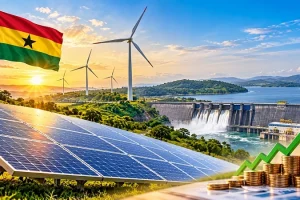
Yet something is shifting. The government’s New Economy programme allocates $10 billion between 2027 and 2030, with manufacturing as a core pillar . A $1.5 billion alumina refinery is being developed in Nyinahin. A $1 billion pharmaceutical hub is planned for Asuogyaman. And a robotics factory in Accra is aiming to produce 50,000 autonomous units annually by 2028 .
Key Takeaways
- The government's New Economy programme allocates $10 billion between 2027 and 2030, with manufacturing as a core pillar .
- The national ambition is to manufacture between 70 and 80 percent of Ghana's essential medicines locally by 2030, creating approximately 20,000 direct and indirect jobs across the pharmaceutical value chain .
- A $10 billion, four-year investment programme (2027–2030) targeting manufacturing, agriculture, infrastructure, energy, and other strategic sectors.
This article profiles the companies and industrial projects shaping Ghana’s manufacturing landscape. It covers the established manufacturers generating the largest revenues, the new investments in heavy industry and pharmaceuticals, and the policy shifts that will determine whether Ghana finally becomes a production economy.
The Established Manufacturers
Revenue data for private companies in Ghana is often estimated, but the available figures give a sense of scale.
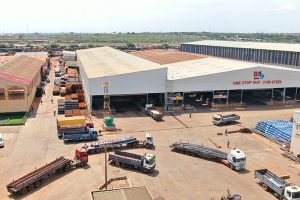
Finatrade is ranked as the largest manufacturing company in Ghana by revenue, with an estimated $594.6 million. The Accra-based company operates in manufacturing and cleaning products, employing between 1,000 and 5,000 people . Its position at the top of the manufacturing list reflects the importance of fast-moving consumer goods and household products in the domestic market.
Unilever Ghana follows with an estimated $200.7 million in revenue. Based in Tema, the company manufactures food, beverage, and cleaning products, and it is one of the most established multinational manufacturers operating in Ghana . Unilever’s presence is significant because it demonstrates that global consumer goods companies can manufacture locally for the Ghanaian and regional market.
AKSA Generators Ghana ranks third with $112.3 million in estimated revenue, operating in industrial machinery and equipment manufacturing . The company’s presence reflects demand from businesses and institutions that need reliable backup power—a necessity in a country where electricity supply, while improving, is not always consistent.
Ghana Cocoa Board appears at the top of broader company rankings with $2.3 billion in reported revenue, operating in the manufacture of cocoa, chocolate, and sugar confectionery . While COCOBOD is a state regulator and buyer rather than a traditional manufacturer, its role in processing and export makes it a central player in Ghana’s industrial landscape.
Other manufacturers appearing in revenue rankings include Jay Kay Industries & Investments ($324 million, printing), Sun Plast Industries, and Guinness Ghana Breweries . These companies represent the diversity of Ghana’s manufacturing base: from printing and packaging to plastics and beverages.
The Heavy Industry Bets: Alumina and Pharmaceuticals
Two projects stand out as the most significant industrial investments currently underway, both tied to the government’s New Economy programme.

The Nyinahin Alumina Refinery
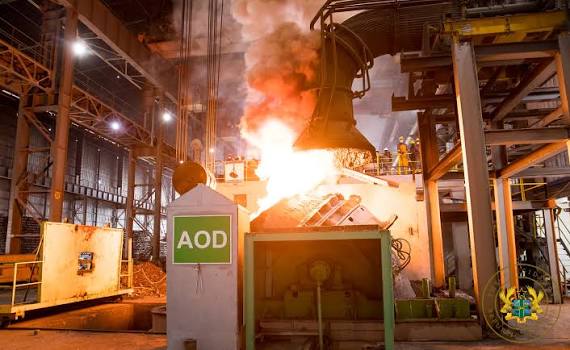
In November 2026, the Ghana Integrated Aluminium Development Corporation (GIADEC) signed an agreement with RUSAL, one of the world’s largest aluminium producers, for a bauxite mine and a 1.2-million-tonne-per-year alumina refinery at Nyinahin in the Ashanti Region .
The refinery is expected to cost more than $1.5 billion and take about 36 months to complete. It will mine approximately five million tonnes of bauxite annually for processing into 1.2 million tonnes of alumina. RUSAL will finance and construct the facility, holding majority stakes in two joint ventures: Nyinahini Bauxite Ltd and Ghana Alumina Company .

For Ghana, this is the most concrete step yet toward developing an integrated aluminium industry. The country has some of the largest undeveloped bauxite reserves in West Africa, but it has historically exported raw bauxite rather than processing it. The refinery would change that, capturing more value locally and supporting the development of rail and port infrastructure. It is also expected to create jobs and opportunities for local contractors and suppliers .
The project reflects a model of industrial development that relies on foreign direct investment and partnership with established global players. RUSAL brings technical expertise and capital; Ghana brings the resource and the policy framework. Whether the refinery is completed on schedule and operates profitably will be a test of whether this model can work at scale.
The Pharmaceutical and Biomanufacturing Hub
In November 2026, President Mahama announced plans for a pharmaceutical and biomanufacturing hub at Kwenyako in the Asuogyaman District of the Eastern Region .
The hub is part of the pharmaceutical and biomedical engineering pillar of the New Economy programme, which has been allocated up to $1 billion in investment. The national ambition is to manufacture between 70 and 80 percent of Ghana’s essential medicines locally by 2030, creating approximately 20,000 direct and indirect jobs across the pharmaceutical value chain .
A United States pharmaceutical company, Arriva, has already visited Ghana to begin preparations for investment in the hub as the first anchor investor. The hub is expected to host factories producing medicines and vaccines for Ghana and the wider African market, reducing dependence on imports and positioning Ghana as a pharmaceutical manufacturing centre for the continent .
This is a different kind of industrial project from the alumina refinery. Pharmaceuticals require regulatory approval, skilled labour, and quality control systems that are more complex than those needed for commodity processing. But the potential payoff is significant: medicines are a high-value product, and local manufacturing can reduce costs and improve supply security.
The New Wave: Technology and Advanced Manufacturing
Beyond heavy industry and pharmaceuticals, a newer category of manufacturing is emerging in Accra: advanced technology production.
Terra Industries is building what is described as Africa’s largest robotics factory in Accra. The 34,000-square-foot facility is designed for high-precision production of autonomous systems, including the Archer VTOL and Kama interceptor. The goal is to produce 50,000 units annually by 2028, with 120 high-value engineering roles created .
The company has secured funding from Silicon Valley investors including 8VC and Lux Capital, a signal that international capital sees potential in Ghana as a manufacturing destination for advanced technology. The facility represents a different vision of “Made in Ghana”—not just garments and processed food, but autonomous robotics and defense technology .
This is early-stage and the scale is small relative to the established manufacturers. But it matters because it shows that Ghana can attract investment in high-value, technology-intensive production. If Terra Industries succeeds, it could open the door for other advanced manufacturing companies to locate in Accra.

The Policy Framework: New Economy and 24-Hour Economy
The government’s industrial policy is built around two connected initiatives.
The New Economy programme allocates $10 billion over four years (2027–2030), with approximately $2.5 billion invested annually in strategic sectors. Manufacturing is one of eight priority pillars, alongside agriculture and agro-processing, infrastructure, energy, critical minerals, textiles and garments, tourism, and pharmaceuticals . The programme’s stated goal is to expand domestic production, increase local processing of raw materials, and strengthen Ghanaian businesses’ capacity to compete in domestic and international markets .
The 24-Hour Economy initiative complements this by encouraging multi-shift operations. According to the government, 268 filling stations and 33 manufacturing companies have commenced operations under the multi-shift system, and four projects under the initiative are expected to generate more than 160,000 direct jobs . The logic is straightforward: factories that run multiple shifts use their capital equipment more efficiently, create more jobs per unit of investment, and increase output without requiring new facilities.
The policy environment also includes incentives for local processing. The government has stated its intention to stop exporting raw cashew, shea, and unprocessed rubber, and instead process them locally. The alumina refinery and pharmaceutical hub are the largest expressions of this “value addition” agenda, but it runs across sectors.
The Lessons from 1D1F
No discussion of Ghanaian manufacturing is complete without acknowledging the One District One Factory (1D1F) programme, which was launched in 2017 and has since been effectively scrapped by the current government.
The programme’s record is contested. The previous government claimed that 321 factories had been started, with 170 operational and about 24,621 people directly employed. Critics point to abandoned projects, poor planning, and political interference. A cassava starch factory in Assin South, built with millions from the African Development Bank and the government, now sits abandoned and overgrown .
The political debate over 1D1F continues. The Minority has defended the programme’s design, arguing that it was a private-sector-led initiative that used interest subsidies and stimulus packages to de-risk manufacturing investment. They have disputed audit findings that characterised certain fund flows as “fictitious,” arguing that the transactions were properly appropriated and processed . The current government has moved on, replacing 1D1F with the New Economy approach.
The lesson from 1D1F is not that industrial policy is impossible. It is that execution matters more than ambition. Factories built without secure raw material supply, guaranteed markets, or adequate financing will fail, regardless of the political rhetoric surrounding them. The New Economy programme will be judged by the same standard.
Challenges
Ghana’s manufacturers face obstacles that are structural and persistent.
Energy costs and reliability. Factories need consistent, affordable power. While the electricity situation has improved from the dumsor years, costs remain high and supply is not always reliable. The government’s energy investments, including a planned 1,450 MW thermal plant, are meant to address this, but they will take time .
Access to finance. Manufacturing is capital-intensive. Interest rates, while falling, remain high by international standards. Small and medium manufacturers struggle to access the credit they need to buy equipment, expand capacity, or manage working capital.
Infrastructure. Roads, ports, and utilities are essential for manufacturing competitiveness. The logistics bottlenecks at Tema Port, the condition of roads to industrial areas, and the cost of doing business all affect manufacturers’ ability to compete with imports.
Skills. Factories need technicians, engineers, and managers with the right training. The skills mismatch between what the education system produces and what industry needs is a persistent complaint. Initiatives like the National Coders Programme and the TVET reforms are attempting to address this, but progress is slow.
Import competition. Ghanaian manufacturers often struggle to compete with imports from China, India, and elsewhere. Production costs are higher, and economies of scale are limited by the size of the domestic market. This is why export-oriented manufacturing—like the alumina refinery and the pharmaceutical hub—is so important. It allows Ghanaian producers to access larger markets and achieve scale.
Why It Matters to Ordinary Ghanaians
Manufacturing is not just about factories. It affects what people buy, what they earn, and whether their children have jobs.
Jobs. The alumina refinery, the pharmaceutical hub, and the textile factories promised under the New Economy programme are all presented as job creators. The pharmaceutical hub alone is projected to create 20,000 direct and indirect jobs . For a country where hundreds of thousands of young people enter the labour market each year, these jobs matter.
Prices and availability. Local manufacturing can reduce dependence on imports, which are vulnerable to exchange rate movements. When medicines are produced locally, they are less exposed to the cedi’s value. When food is processed locally, supply is more stable.
Self-reliance. A country that cannot make its own medicines or process its own raw materials is vulnerable to global shocks. The COVID-19 pandemic exposed these vulnerabilities. The pharmaceutical hub and the alumina refinery are attempts to build resilience.
National pride and identity. “Made in Ghana” is more than an economic slogan. It is about building a country that can stand on its own feet, that values its own products, and that gives its people the opportunity to create and build.
Future Outlook
The direction of Ghana’s manufacturing sector is clearer than it has been in years. The question is execution.
If current plans are implemented, the alumina refinery will be completed within three years, the pharmaceutical hub will attract anchor investors, and the New Economy programme will channel billions into industrial expansion. The 24-Hour Economy will increase utilisation of existing factories. And companies like Terra Industries will demonstrate that Ghana can compete in advanced manufacturing.
The risks are equally clear. If the alumina refinery faces delays or cost overruns, the model of foreign-partner-led industrial development will be questioned. If the pharmaceutical hub does not attract enough investment, the target of 70–80% local medicine production will be missed. If the New Economy programme is poorly managed, it will become another abandoned promise.
The most likely scenario is uneven progress. The established manufacturers will continue to operate and grow slowly. The large new projects will proceed, but not without challenges. Some will succeed; others will struggle. The manufacturing sector’s share of GDP will grow, but not dramatically.
The wild card is the global trading environment. If the African Continental Free Trade Area (AfCFTA) works as intended, Ghanaian manufacturers could access a much larger market. That would change the calculus significantly. But AfCFTA is still being implemented, and the benefits are not yet guaranteed.
Quick Facts
Topic: Leading Manufacturing and Industrial Companies in Ghana
Largest Manufacturer (est. revenue): Finatrade (~$594.6M)
**Second Largest:** Unilever Ghana (~$200.7M)
Largest State Industrial Project: Nyinahin alumina refinery ($1.5B, 1.2M tonnes/year)
**Pharmaceutical Hub Investment:** Up to $1B, target 20,000 jobs
New Economy Programme: $10B (2027–2030), manufacturing as core pillar
24-Hour Economy: 33 manufacturing companies on multi-shift operations
Advanced Manufacturing: Terra Industries robotics factory (50,000 units/year by 2028)
Key Policy Shift: 1D1F scrapped, replaced by New Economy approach
Main Challenge: Energy costs, access to finance, import competition, skills gaps
Key Opportunity: Value addition, AfCFTA, export-oriented manufacturing
FAQ Section
1. What is the largest manufacturing company in Ghana?
Based on estimated revenue, Finatrade ranks first with approximately $594.6 million, followed by Unilever Ghana at $200.7 million and AKSA Generators at $112.3 million .
2. What is the Nyinahin alumina refinery?
A $1.5 billion project by GIADEC and RUSAL to mine bauxite and produce 1.2 million tonnes of alumina per year. It is expected to take about 36 months to complete .
3. What is the pharmaceutical hub in Asuogyaman?
A planned pharmaceutical and biomanufacturing hub at Kwenyako, allocated up to $1 billion under the New Economy programme. It aims to produce medicines and vaccines for Ghana and Africa, creating 20,000 jobs .
4. What is the New Economy programme?
A $10 billion, four-year investment programme (2027–2030) targeting manufacturing, agriculture, infrastructure, energy, and other strategic sectors. It allocates GHS 30 billion in 2027 alone .
5. What happened to the 1D1F programme?
The One District One Factory programme was launched in 2017 but has been effectively scrapped by the current government, which replaced it with the New Economy approach. Critics point to abandoned projects and poor execution .
6. What is Terra Industries?
A company building a 34,000-square-foot robotics factory in Accra, aiming to produce 50,000 autonomous units annually by 2028. It has secured funding from Silicon Valley investors .
7. What is the 24-Hour Economy initiative?
A government policy to encourage multi-shift operations in factories and other businesses. According to the government, 33 manufacturing companies have commenced operations under the multi-shift system .
8. What are the biggest challenges facing Ghanaian manufacturers?
Energy costs and reliability, access to finance, infrastructure gaps, skills shortages, and competition from imports.
9. Why is local processing important for Ghana?
Ghana has historically exported raw materials and imported finished goods. Local processing captures more value, creates jobs, and reduces dependence on imports and foreign exchange.
10. Is Ghana’s manufacturing sector growing?
The sector is receiving significant new investment, particularly in heavy industry and pharmaceuticals. But it remains a relatively small part of the economy and faces structural challenges. The New Economy programme is the government’s attempt to change this.
Source: Accra Street Journal
Last Updated on November 26, 2026 by Samuel Kwame Boadu
Disclaimer: Some content on Accra Street Journal may be aggregated, summarized, or edited from third-party sources for informational purposes. Images and media are used under fair use or royalty-free licenses. Accra Street Journal is a subsidiary of SamBoad Publishing Hub under SamBoad Business Group Ltd, registered in Ghana since 2014.
For concerns or inquiries, please visit our Privacy Policy or Contact Page.

Samuel Kwame Boadu is a Ghanaian media entrepreneur and storyteller with a passion for amplifying urban voices and uncovering everyday truths. He is the Editor-in-Chief and Founder of Accra Street Journal, a dynamic digital platform dedicated to capturing the pulse of Ghana’s capital—its people, culture, challenges, business, sports and innovations.
Use the following reference when citing or referencing this article.
Your feedback helps us improve our journalism.
Report an Error
Help us maintain accuracy. Let our editorial team know if you spot an issue in this article.
Report a problem with this article