


11 min read
Introduction
Ghana is often praised as one of Africa’s most stable democracies. Three decades of constitutional rule, peaceful transfers of power, and a vibrant press have earned the country a reputation that many of its neighbours envy. A 2026 Afrobarometer survey found that an overwhelming majority of Ghanaians prefer democracy to any other form of government .
But that headline finding hides a more complicated reality. The same citizens who say they believe in democracy are also watching their parliament argue over political financing, their anti-corruption institutions fight for survival in court, and their government trade accusations with the opposition over who is truly accountable. The gap between supporting democracy in principle and being satisfied with how it works in practice is where Ghana’s future is being decided.
Key Takeaways
- It covers the political financing debate, the battle over the Special Prosecutor's Office, the passport corruption scandal, the struggle over local governance reform, and the economic pressures that shape everything else.
- In November 2026, Parliament, accountability institutions, and development partners issued a joint call for comprehensive reform of how political parties are funded.
- If there is a test case for whether Ghana's accountability systems actually work, it is the service passport scandal that broke in November 2026.
This ASJ article examines the state of democracy, governance, and accountability in Ghana. It covers the political financing debate, the battle over the Special Prosecutor’s Office, the passport corruption scandal, the struggle over local governance reform, and the economic pressures that shape everything else. It is written for anyone who wants to understand what is actually happening beneath the surface of Ghana’s democratic stability.
The Political Financing Problem
In November 2026, Parliament, accountability institutions, and development partners issued a joint call for comprehensive reform of how political parties are funded. The First Deputy Speaker, Bernard Ahiafor, warned that the rising cost of primaries, campaigns, and rallies has made politicians dangerously dependent on wealthy individuals and corporate donors. “Where financial support is motivated by expectations of future rewards, political financing risks becoming a transactional arrangement rather than a genuine contribution to democratic participation,” he said .
The problem is not new. Ghana’s Political Parties Act of 2000 was supposed to regulate party financing, but enforcement has been weak. The reforms being proposed now include limits on contributions and campaign spending, mandatory disclosure of party resources, independent auditing, and effective enforcement mechanisms.
Why does this matter? Because when politics is expensive, only the wealthy can compete. And when only the wealthy can compete, the interests of ordinary citizens get pushed aside. Dr. Kojo Asante of CDD-Ghana noted that the high cost of contesting elections places pressure on representatives and can affect their accountability to constituents . An MP who spent a fortune to win is more likely to listen to the donors who funded the campaign than the voters who cast the ballots.
This is not an abstract concern. It goes to the heart of whether Ghana’s democracy is genuinely representative or increasingly transactional.
The Special Prosecutor Under Siege
The Office of the Special Prosecutor (OSP) was created to investigate and prosecute corruption cases independently of the Attorney-General. In 2026, that independence came under direct attack.
In April, a High Court ruling stripped the OSP of its prosecutorial powers, declaring all its prosecutions null and void and awarding costs against the office. The Minority in Parliament responded with alarm, accusing the government of orchestrating a deliberate campaign to dismantle the institution .
The Minority laid out a timeline: the December 2025 detention of an NDC ally by the OSP, a private member’s bill to repeal the OSP (later withdrawn after President Mahama called it “premature”), a Supreme Court challenge to the OSP’s constitutional basis, fifteen petitions against the Special Prosecutor that were dismissed for lacking merit, and finally the Attorney-General’s own submission arguing that the OSP’s founding Act was unconstitutional .

“The Attorney-General is defending the plaintiff’s case against the state’s own institution,” said MP Alhassan Tampuli. “This is constitutionally unacceptable” .
The government’s supporters see it differently. In January 2026, Local Government Minister Ahmed Ibrahim claimed that “no corruption or corruption-related cases have been recorded among appointees of the current administration,” pointing to reforms including a Code of Conduct for Public Appointees, amendments to the Public Procurement Act, and asset declarations by all 261 MMDCEs . The Minority dismissed this as an “accountability charade,” arguing that “headlines are plentiful, but convictions are scarce” .

The truth is probably somewhere in between. What is clear is that the institutional framework for fighting corruption is being contested in real time, and the outcome will determine whether future governments face genuine accountability or whether anti-corruption bodies become tools that can be captured and neutralised.
The Passport Scandal: A Test Case
If there is a test case for whether Ghana’s accountability systems actually work, it is the service passport scandal that broke in November 2026.
The Ministry of Foreign Affairs uncovered a syndicate that had been issuing service passports to unqualified people in exchange for money since at least 2023. One petitioner said he paid $29,000; another said he paid $5,000 in 2026 . Ten passports were identified and cancelled. The Acting Director of Passports and a junior Foreign Service Officer were interdicted and referred to the police. The investigation was extended to a retired former Director of Passports.
What makes this case significant is not just the corruption itself. It is the response. The Ministry acted on petitions. It investigated. It cancelled the documents. It notified international partners. It referred suspects for prosecution. It publicly distinguished between service passports and diplomatic passports, rejecting claims that the latter were being sold .
Whether this leads to actual convictions remains to be seen. But it shows that when there is political will, the system can respond. The question is whether that will exists consistently, or only when the scandal becomes public and embarrassing.
Local Governance and the Limits of Reform
Ghana’s decentralisation system has long been criticised for being decentralised in name only. Metropolitan, Municipal, and District Chief Executives (MMDCEs) are nominated by the President and approved by assembly members, which means they are accountable to the centre rather than to the communities they serve.
The government’s response to the Constitution Review Committee’s recommendations proposed a new model: the President would nominate five candidates for each MMDCE position, a vetting body would shortlist three, and citizens would elect one, while retaining the non-partisan character of local elections .
Governance stakeholders were not impressed. At a forum organised by IDEG and Oxfam, participants argued that the model differs little from the current system. If the President still controls the nomination process, they asked, what meaningful choice do citizens actually have? The proposal could exclude independent candidates and popular community aspirants, limiting voter choice and potentially worsening the already low turnout in District Assembly elections.
This is a debate about the depth of Ghana’s democracy. National elections get the attention, but local governance is where most citizens interact with the state. If local executives are not genuinely accountable to local people, then democracy at the national level is built on weak foundations.
The Economic Context
Democracy does not operate in a vacuum. The economic pressures facing Ghanaians shape their patience with democratic processes and their expectations of government.

The IMF’s 2026 Article IV consultation noted that Ghana’s economic programme has delivered “substantial stabilization gains”: inflation has declined rapidly, reserves have been rebuilt, confidence in the cedi has improved, and the primary surplus overperformed targets in 2025 . Debt restructuring has progressed, and a new non-financing Policy Coordination Instrument is focused on “strengthening fiscal transparency and governance, particularly for state-owned enterprises” .
But the same IMF report notes that “amid external uncertainty and elevated fiscal risks—notably from SOEs and ongoing quasi-fiscal activities—the PCI reform agenda will prioritize stronger safeguards, transparency, and accountability to entrench policy credibility” .
In plain terms: the economy is stabilizing, but the governance of state institutions remains a risk. State-owned enterprises are a source of fiscal risk. Quasi-fiscal activities—spending that happens outside the budget—undermine transparency. The government’s ability to manage these risks will determine whether the economic recovery translates into real improvements in people’s lives, or whether it becomes another cycle of crisis and adjustment.
The Daily Graphic editorial put it well: “The applause for the system rings hollow for the unemployed graduate in Accra, the fisherman struggling against the tides in Jamestown, or the farmer in the Ashanti Region battling the high cost of inputs” . Democracy must deliver, or public support will eventually erode.
The Press Freedom Question
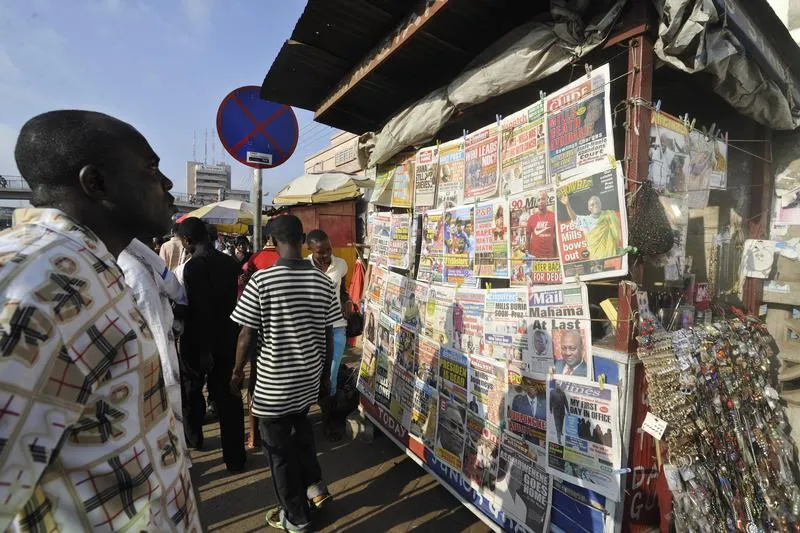
A functioning democracy requires a free press. In November 2026, Minority Leader Alexander Afenyo-Markin used the Ghana Journalists Association awards to call for the repeal of Section 208 of the Criminal Offences Act, which deals with the publication of false news likely to cause fear and panic. He argued that the provision has become a tool for targeting journalists and citizens who criticise public officials .
“When every uncomfortable statement becomes a potential criminal case, the result is not a more truthful society. The result is a more fearful one,” he said .
He also raised concerns about Section 76 of the Electronic Communications Act, which he said threatens freedom of expression on digital platforms, and called on President Mahama to pardon a social media user serving a jail term .
The government has not committed to repealing these laws. But the debate itself is a sign of democratic health. A society where these questions can be asked publicly, and where opposition leaders can challenge the government’s record on press freedom without fear of reprisal, is a society where some democratic space still exists.
Why It Matters to Ordinary Ghanaians
Governance and accountability are not abstract concepts. They determine whether the clinic has medicines, whether the road gets built, whether the school has teachers, and whether the police officer who demands a bribe faces consequences.
When political financing is unregulated, the people who fund campaigns expect something in return. When the Special Prosecutor is weakened, corrupt officials have less to fear. When local executives are accountable to the President rather than to their communities, local needs get ignored. When the press is intimidated, wrongdoing goes unreported.
The Afrobarometer finding that Ghanaians overwhelmingly support democracy is a source of national pride. But it is also a warning. Support for democracy is not unconditional. It depends on democracy delivering results. If it does not, the same citizens who say they prefer democracy today may become disillusioned tomorrow.
Future Outlook
Ghana’s democratic future depends on whether its institutions can be strengthened and protected.
The positive signs: The economy is stabilizing. The passport scandal shows that accountability mechanisms can work when there is will. The debate over political financing is serious and substantive. Civil society is active and vocal. The press, despite legal constraints, continues to hold power to account.
The warning signs: The attack on the OSP is a serious threat to institutional independence. The proposed local governance model may not deliver genuine accountability. Political financing remains unregulated. State-owned enterprises remain a fiscal risk. And the gap between democratic support and democratic satisfaction is a source of instability.
The most likely scenario is continued contestation. The government will push its agenda. The opposition will resist. Civil society will advocate. The courts will decide. Some reforms will pass; others will stall. The system will bend but not break.
The wild card is the 2028 election. If the political financing system remains unregulated, the next election will be even more expensive than the last. If the OSP is permanently weakened, corruption will have less to fear. If local governance reform fails, the disconnect between citizens and the state will deepen. The election will be a test of whether Ghana’s democracy can correct course, or whether it drifts further toward transactional politics.
ASJ Conclusion
Ghana’s democracy is not in crisis. But it is under strain. The institutions that are supposed to hold power accountable are being contested. The rules that are supposed to ensure fair competition are inadequate. And the economic pressures that shape people’s daily lives are testing their patience with the system.
The Afrobarometer finding that Ghanaians prefer democracy is a foundation to build on. But foundations are only useful if something is built on them. The work of building—strengthening institutions, regulating money in politics, making local governance genuinely local, protecting the press—is the work of the next few years. Whether Ghana’s leaders have the will to do it is the question that will determine the country’s future.
Quick Facts
Topic: Democracy, Governance and Accountability in Ghana
Public Support for Democracy: Overwhelming majority (Afrobarometer 2026)
Political Financing Reform: Parliament and accountability institutions calling for contribution limits, disclosure, and independent auditing
Special Prosecutor Crisis: High Court stripped OSP of prosecutorial powers in April 2026
Passport Scandal: 10 service passports cancelled, officials interdicted, police investigating
Local Governance Reform: Government proposal criticised for retaining presidential control over MMDCE candidates
IMF Assessment: Stabilization gains achieved, but SOE risks and quasi-fiscal activities remain governance concerns
Press Freedom Debate: Minority Leader calling for repeal of criminal libel provisions
Key Institutions: Parliament, Judiciary, OSP, CHRAJ, EOCO, CDD-Ghana
Main Challenge: Gap between democratic support and democratic satisfaction
Source: Accra Street Journal
Last Updated on November 27, 2026 by Samuel Kwame Boadu
Disclaimer: Some content on Accra Street Journal may be aggregated, summarized, or edited from third-party sources for informational purposes. Images and media are used under fair use or royalty-free licenses. Accra Street Journal is a subsidiary of SamBoad Publishing Hub under SamBoad Business Group Ltd, registered in Ghana since 2014.
For concerns or inquiries, please visit our Privacy Policy or Contact Page.

Samuel Kwame Boadu is a Ghanaian media entrepreneur and storyteller with a passion for amplifying urban voices and uncovering everyday truths. He is the Editor-in-Chief and Founder of Accra Street Journal, a dynamic digital platform dedicated to capturing the pulse of Ghana’s capital—its people, culture, challenges, business, sports and innovations.
Use the following reference when citing or referencing this article.
Your feedback helps us improve our journalism.
Report an Error
Help us maintain accuracy. Let our editorial team know if you spot an issue in this article.
Report a problem with this article