





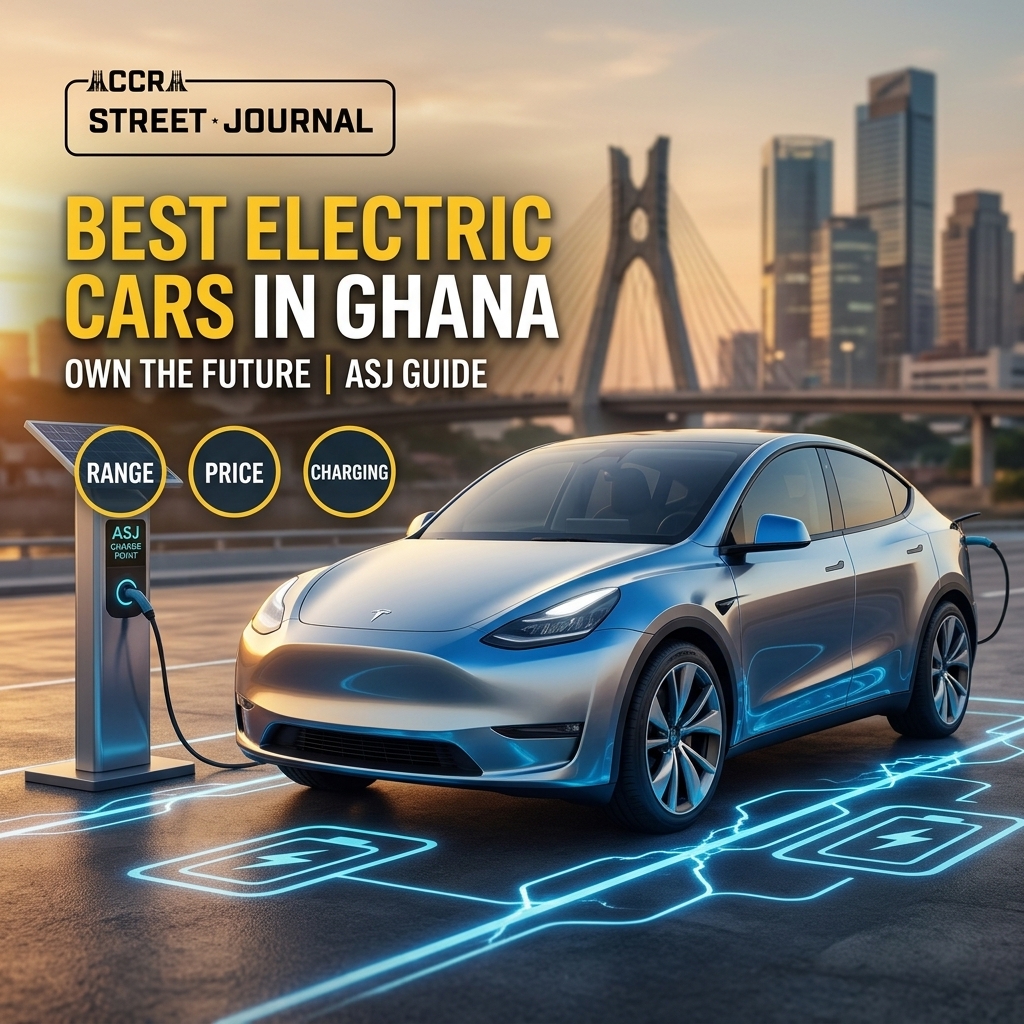
The headlines focus on the global giants. But on the forecourts of Accra and the shipping manifests of Tema, a different reality is taking hold—one defined by Chinese hatchbacks, used Japanese imports, and a government duty waiver that has made electric driving cheaper than petrol for the first time.
The Numbers Behind the Shift
The data tells a story of acceleration from a low base. As of October 2025, Ghana had registered more than 1,200 electric vehicles, up from fewer than 200 in 2022. When hybrids are included, the number of electrified vehicles on Ghanaian roads exceeds 20,000 .

The government’s eight-year waiver on import duty for fully electric vehicles—now extended until 2032—has removed the single largest cost barrier. A private EV still attracts VAT (15%), NHIL, GETFund, and other levies, but the elimination of the 5%–20% import duty band saves thousands of dollars on clearance . For a used EV with a CIF of $20,000, total clearance fees now hover between $4,500 and $5,500—significantly lower than a comparable petrol car .
📢 GET A DETAILED ARTICLES + JOBS
Join ASJ's WhatsApp Channel and never miss a post or opportunity.

The financial logic is compelling. With petrol prices above GH¢15 per litre and the new PURC EV charging tariff set at GH¢2.016 per kWh, the “fuel” cost for an EV is roughly 70% lower than a petrol car . Government research cited by the Energy Minister suggests using EVs could cut fuel expenses by about 40% .
The Budget Leaders: BYD’s Grip on the Entry Level
No brand has done more to make EVs accessible in Ghana than BYD. Two models dominate the affordable segment.

BYD Seagull
The Seagull is the cheapest viable EV entry on Ghanaian forecourts. A 2023 Vitality trim with the 305-km CLTC battery typically lists between GH₵50,000 and GH₵70,000. The Comfort trim, which adds a faster 75-kW motor and leather steering wheel, runs GH₵60,000 to GH₵95,000 .
The Seagull is an A-segment hatchback—3,780 mm long, a four-seater by design, not five. Real-world Accra range is roughly 245–275 km on the 305-km trims, and 325–365 km on the 2024 Flagship’s 405-km battery . For a single driver commuting between home and work, with overnight charging, the Seagull is the value play. It is not a family car. It is a city car that happens to be electric.
BYD Dolphin
The Dolphin is the step up. It is 4,070 mm long—a B-segment hatchback—with genuine rear-seat space and a boot. Pricing is tighter and more predictable than any other Chinese EV in the market: a 2022 Glide with the 300-km battery lists at GH₵70,000–GH₵95,000; a 2023 Free with the 401-km pack, the trim most Ghanaian buyers settle on, lands at GH₵85,000–GH₵115,000; the top-spec 2024 Knight runs GH₵110,000–GH₵145,000 .
The Dolphin’s five-year operating math is what sells it. For roughly 12,000 km per year, electricity, insurance, and routine service over five years total an estimated GH₵27,000–GH₵43,000—about 35% of the five-year operating cost of a petrol Toyota Corolla .
The Trusted Used Import: Nissan Leaf
For buyers who prefer a proven name and a familiar face at the mechanic’s shop, the Nissan Leaf remains the most popular used EV in Ghana. It has been on the global market long enough that dealers and technicians understand it. Used Leaf models typically range from GH₵150,000 to GH₵280,000 .
The caveat is battery health. A used Leaf is only as good as its remaining battery capacity. Buyers must insist on a state-of-health report before paying, because a degraded pack turns a bargain into a liability .
The City Specialists: Wuling and the Mini EVs
Not every buyer needs highway range. For short-distance urban movement, the mini EV segment offers something the established brands do not: very low entry prices and very small footprints.
Wuling Air EV
The Wuling Air EV is built for Accra’s traffic and parking reality. It is not a long-distance car, but for city movement it is easy to drive, simple to park, and cheap to run compared to fuel-powered alternatives. Estimated pricing sits at GH₵180,000–GH₵250,000 .
The Chinese Mini EV Wave
A cluster of Chinese mini EVs sits in the GH₵50,000–GH₵80,000 bracket before shipping and duties. The Zhidou Rainbow starts around GH₵50,000–GH₵52,000 with a claimed 205 km range. The Chery QQ Ice Cream sits at GH₵51,000–GH₵59,000. The Bestune Pony ranges from GH₵56,000 to GH₵74,000, with higher trims claiming up to 222 km. The Geely Panda Mini and Changan Lumin push closer to GH₵66,000–GH₵73,000 .

A critical warning: These are Chinese retail or export prices, not landed Ghanaian prices. Shipping, insurance, import duties (VAT and levies, since the duty waiver applies), clearing, and DVLA registration push the final cost higher. Buyers must also confirm the vehicle is left-hand drive, as many Chinese-market minis are produced in RHD form for other markets .
The Premium and Performance Options
MG4 EV
The MG4 EV is for buyers who want something more than basic transport. It offers better range, better performance, and a more premium feel than the budget hatchbacks. Estimated pricing in Ghana sits at GH₵350,000–GH₵500,000 .
Tesla Model 3 and Model Y
Tesla has a presence in Ghana, but it is a niche one. The Model 3 is the default choice for executive commuters—easier to price, easier to explain, and easier to match with a buyer profile than the larger Model Y . The critical constraint is charging. Tesla ownership works best for buyers who control charging at home or work. Public charging exists in Accra, but it should not be the primary plan for a car needed every morning .
Battery condition decides whether a used Tesla is a real deal. Tesla’s warranty guidance suggests a minimum 70% battery-capacity retention over the warranty period, but Ghanaian buyers should be stricter—a used Tesla near 70% capacity is no longer a normal premium used car .
The Local Contender: Kantanka Mensah EV
Ghana’s own Kantanka Automobile has produced an electric saloon, the Kantanka Mensah EV. It reportedly charges in about 35 minutes and can run for several hours on a full charge . It remains a niche offering, but it represents the first local attempt at EV manufacturing.
The Infrastructure Reality: Charging Is the Bottleneck
The car is only half the equation. Ghana’s charging network is thin.
As of July–August 2026, Ghana had about 10 verified public EV charging stations nationwide, overwhelmingly concentrated in Accra. Outside the capital, only Kumasi, Takoradi, Tema, Cape Coast, and Ablekuma/Adenta had a handful of installations. The Accra–Kumasi corridor still lacks reliable en-route fast chargers, making long-distance EV travel difficult .
The government has announced plans for 100+ rapid chargers nationwide by 2029, including along the planned Accra–Kumasi Expressway . But until then, the EV buyer’s first question should not be “which car?” It should be “where will I charge it every night?”
There is also a grid stability concern. The Energy Minister has noted that clusters of fast-charging stations can strain local transformers, with some transformers tripping immediately after charging stations were connected. A bill before Parliament would require Energy Commission approval before new stations are installed, allowing grid upgrades to be planned before new loads are connected .
ASJ Bottom Line
The Ghanaian EV market in 2026 is not defined by the Tesla Model S or the Lucid Air. It is defined by the BYD Seagull for the city commuter, the BYD Dolphin for the small family, the Nissan Leaf for the budget-conscious used buyer, and the Wuling Air EV for the driver who never leaves the city.
The duty waiver has made the economics work. The charging network has not yet caught up. The buyer who succeeds is the one who can charge at home, understands that range figures are optimistic, and treats the battery state-of-health report as the single most important document in the transaction.

The electric shift in Ghana is not a revolution. It is a quiet, practical migration—one hatchback at a time.
Quick Facts
| Model | Price Range (GH₵) | Best For | Key Note |
|---|---|---|---|
| BYD Seagull | 50,000 – 95,000 | City commuter | Cheapest viable EV; 4-seater |
| BYD Dolphin | 70,000 – 145,000 | Small family | Best value trim: 2023 Free (401 km) |
| Nissan Leaf (used) | 150,000 – 280,000 | Budget used buyer | Check battery health |
| Wuling Air EV | 180,000 – 250,000 | City driving | Compact, easy to park |
| MG4 EV | 350,000 – 500,000 | Performance | Premium feel, longer range |
| Kantanka Mensah EV | On request | Local support | 35-minute charge claim |
Frequently Asked Questions
1. What is the cheapest electric car in Ghana in 2026?
The BYD Seagull is the cheapest viable EV on Ghanaian forecourts, with 2023 Vitality trims listing between GH₵50,000 and GH₵70,000 . Chinese mini EVs like the Zhidou Rainbow can be found at export prices around GH₵50,000, but landed costs will be higher .
2. Do electric cars pay import duty in Ghana?
No. The government’s eight-year waiver, extended until 2032, sets import duty on fully electric vehicles at 0%. However, VAT (15%), NHIL, GETFund, and other levies still apply .
3. How much does it cost to charge an EV in Ghana?
The PURC introduced a dedicated EV charging tariff of GH₵2.016 per kWh as of April 2026. This makes the “fuel” cost roughly 70% lower than petrol .
4. What is the real-world range of a BYD Dolphin in Ghana?
Observed Ghanaian usage suggests a real-world range of 240–270 km on the 300-km trims and 320–360 km on the 401-km trims, depending on driving conditions and air-conditioning use .
5. How many public EV charging stations are there in Ghana?
As of July–August 2026, Ghana had about 10 verified public EV charging stations nationwide, mostly in Accra. The government plans 100+ rapid chargers by 2029 .
6. Is the Nissan Leaf a good used EV for Ghana?
Yes, but with caution. It is the most familiar used EV among Ghanaian mechanics, and prices range from GH₵150,000 to GH₵280,000. The critical check is battery state-of-health—a degraded pack reduces range and value .
7. What should I check before buying a used EV in Ghana?
Battery state-of-health, left-hand drive configuration, charging cable and connector compatibility, and whether the vehicle has a valid UN38.3 battery test report and MSDS, which are required for clearance .
8. Can I drive an EV from Accra to Kumasi?
It is difficult. The Accra–Kumasi corridor lacks reliable en-route fast chargers, making long-distance EV travel challenging. The government plans chargers along the planned Accra–Kumasi Expressway .
9. Are Chinese mini EVs like the Wuling Hongguang Mini EV available in Ghana?
They can be imported, but buyers must confirm the vehicle is left-hand drive, as many Chinese-market minis are produced in RHD form. Landed costs will exceed the Chinese export price due to shipping, VAT, and clearing .
10. What is the Kantanka Mensah EV?
It is an electric saloon produced by Ghana’s Kantanka Automobile. It reportedly charges in about 35 minutes and can run for several hours on a full charge. It remains a niche offering
Source: Accra Street Journal
Last Updated on October 31, 2026 by Samuel Kwame Boadu
Disclaimer: Some content on Accra Street Journal may be aggregated, summarized, or edited from third-party sources for informational purposes. Images and media are used under fair use or royalty-free licenses. Accra Street Journal is a subsidiary of SamBoad Publishing Hub under SamBoad Business Group Ltd, registered in Ghana since 2014.
For concerns or inquiries, please visit our Privacy Policy or Contact Page.

Samuel Kwame Boadu is a Ghanaian media entrepreneur and storyteller with a passion for amplifying urban voices and uncovering everyday truths. He is the Editor-in-Chief and Founder of Accra Street Journal, a dynamic digital platform dedicated to capturing the pulse of Ghana’s capital—its people, culture, challenges, business, sports and innovations.