
2 min read
Accra, Ghana — Ecobank Ghana maintained its position as the largest bank in Ghana in 2024, holding a market share of 14.3%, as reported in the 2025 Ghana Banking Sector Survey by PwC..
GCB Bank followed with a market share of 13.0% in 2024, up from 10.9% in 2023. The report notes that the growth of these two banks reflects the strong trust they have earned among both retail and corporate clients.
Their success in deposit mobilisation can be attributed to a variety of strategic initiatives. These included leveraging an extensive physical branch network, each operating more than 250 outlets nationwide, to improve accessibility in both the urban and rural areas.
Additionally, their sustained investment in digital banking infrastructure significantly enhanced convenience for clients, particularly the younger, tech-oriented demographic. Their rollout of targeted savings and investment products further attracted clients such as SMEs and salaried professionals seeking flexible and secure financial solutions.
Standard Bank and Absa consolidated their standings as the third and fourth largest banks by total deposits, expanding their combined deposit base by GH₵6.9 billion.
In the mid-tier category, banks such as Zenith Bank, Consolidated Bank Ghana and First Atlantic Bank remained steady in the 6th, 8th, and 10th positions, respectively.
Access Bank Ghana rose from ninth to seventh place, while GT Bank improved its standing from 11th to 9th.
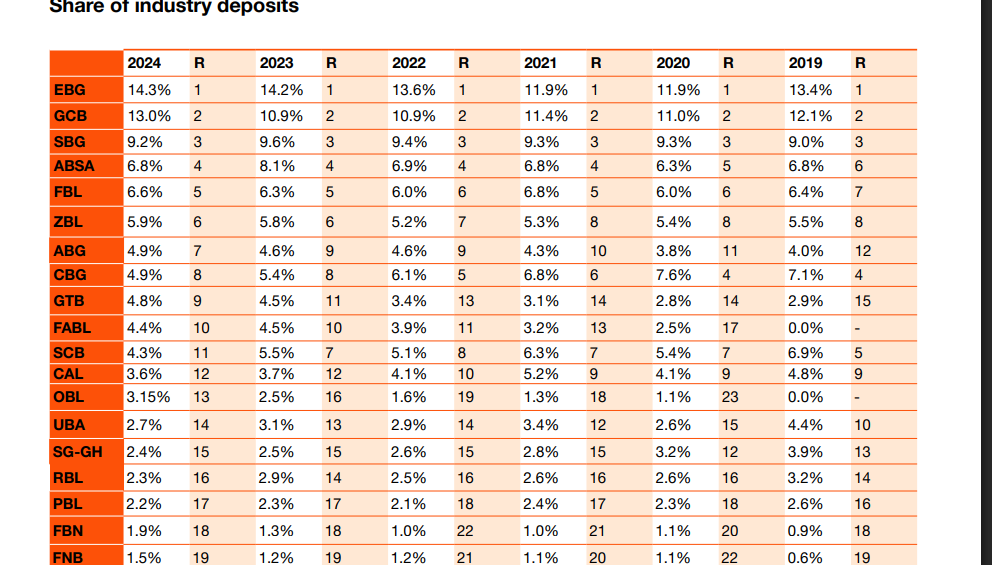

Conversely, Standard Chartered Bank dropped from 7th to 11th, suggesting competitive or operational headwinds.
Overall, the ten leading banks captured over 50% of the industry’s total deposits, affirming their influence in shaping sector dynamics.
Across deposit types, there was broad-based growth: current accounts surged by 37.4%, savings accounts rose by 44.2%, and both certificates of deposit and call deposits showed marked increases.
Deposits from other banks also increased sharply by nearly 50%, indicating a rise in interbank confidence and activities to support the new cost to deposit ratio requirements.
Notably, time and fixed deposits declined by 6.2%, likely driven by changing interest rate expectations and a growing preference for more flexible financial instruments.

Last Updated on August 29, 2025 by Samuel Kwame Boadu
Ghana Market Watch
Track Ghana’s economy and financial markets with exchange rates, bank rates, fuel prices, food and commodity prices, economic indicators and financial market updates.

Disclaimer: Some content on Accra Street Journal may be aggregated, summarized, or edited from third-party sources for informational purposes. Images and media are used under fair use or royalty-free licenses. Accra Street Journal is a subsidiary of SamBoad Publishing Hub under SamBoad Business Group Ltd, registered in Ghana since 2014.
For concerns or inquiries, please visit our Privacy Policy or Contact Page.

Samuel Kwame Boadu is a Ghanaian media entrepreneur and storyteller with a passion for amplifying urban voices and uncovering everyday truths. He is the Editor-in-Chief and Founder of Accra Street Journal, a dynamic digital platform dedicated to capturing the pulse of Ghana’s capital—its people, culture, challenges, business, sports and innovations.
Use the following reference when citing or referencing this article.
Your feedback helps us improve our journalism.
Report an Error
Help us maintain accuracy. Let our editorial team know if you spot an issue in this article.
Report a problem with this article