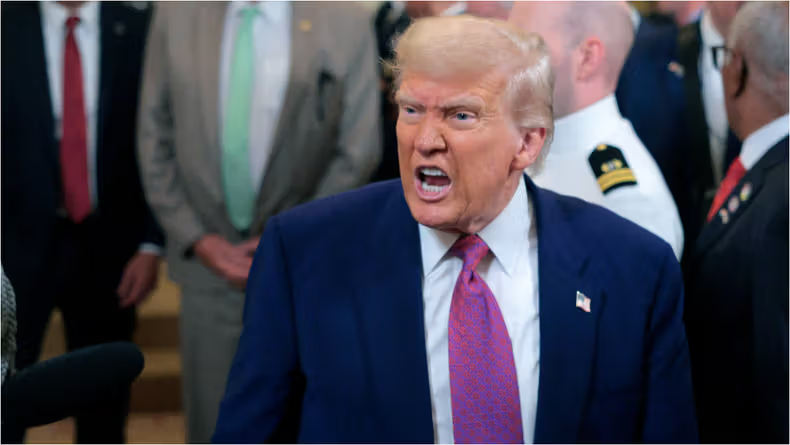
US President Donald Trump has warned that Washington could carry out additional military strikes in Nigeria if killings of Christians continue, reopening a sensitive debate over religion, counterterrorism and foreign intervention in Africa’s most populous country.
The comments, published Thursday in an interview with the New York Times, sighted by Accra Street Journal, followed a US military strike carried out on Christmas Day in northwestern Nigeria. The Pentagon said the operation targeted Islamic State militants and was conducted at the request of the Nigerian government.

Nigerian authorities have since insisted that the strike was a joint counterterrorism operation with no religious motivation. Officials in Abuja have repeatedly rejected claims that Christians are facing systematic persecution, arguing instead that extremist violence has claimed the lives of both Muslims and Christians across the country.
📢 GET A DETAILED ARTICLES + JOBS
Join ASJ's WhatsApp Channel and never miss a post or opportunity.

“I’d love to make it a one-time strike,” Trump said in the interview, adding that if killings of Christians continued, “it will be a many-time strike.”
Pressed on remarks by his own Africa adviser that militant groups such as Boko Haram and Islamic State in West Africa Province have killed more Muslims than Christians, Trump acknowledged that Muslims were also victims but maintained that “it’s mostly Christians.”

The remarks mark a sharpening of Trump’s rhetoric on Nigeria. In late October, he warned that Christianity faced what he described as an existential threat in the country and suggested that the United States could intervene militarily if Nigerian authorities failed to halt violence against Christian communities.
Nigeria, with a population exceeding 230 million, is almost evenly divided between Christians and Muslims. Christians are predominantly concentrated in the south, while Muslims dominate much of the north. For more than a decade, the country has grappled with insurgency, banditry and mass kidnappings, particularly in northern and central regions where state authority is weak.
Nigerian officials have pushed back forcefully against Trump’s framing of the crisis. They argue that reducing the violence to a religious conflict oversimplifies a far more complex security challenge rooted in poverty, local grievances, criminal networks and armed extremism. Abuja has also warned that portraying Nigeria’s conflict through a sectarian lens risks inflaming tensions in an already fragile environment.
While Nigeria has signalled its willingness to work closely with Washington on intelligence sharing and counterterrorism operations, Trump’s warning underscores growing diplomatic friction over how the crisis is interpreted internationally—and how far the United States is willing to go in projecting military power on African soil.
For Abuja, the challenge is twofold: sustaining cooperation with a key security partner while resisting narratives that could undermine national cohesion. For Washington, the comments raise questions about the boundaries of intervention and whether religious framing helps or hinders long-term stability in a country central to West Africa’s security and economic future.
Source: Accra Street Journal
Last Updated on April 26, 2026 by Samuel Kwame Boadu
Disclaimer: Some content on Accra Street Journal may be aggregated, summarized, or edited from third-party sources for informational purposes. Images and media are used under fair use or royalty-free licenses. Accra Street Journal is a subsidiary of SamBoad Publishing Hub under SamBoad Business Group Ltd, registered in Ghana since 2014.

For concerns or inquiries, please visit our Privacy Policy or Contact Page.

Samuel Kwame Boadu is a Ghanaian media entrepreneur and storyteller with a passion for amplifying urban voices and uncovering everyday truths. He is the Editor-in-Chief and Founder of Accra Street Journal, a dynamic digital platform dedicated to capturing the pulse of Ghana’s capital—its people, culture, challenges, business, sports and innovations.