Egypt’s luxury tourism sector is entering a new phase of transformation.
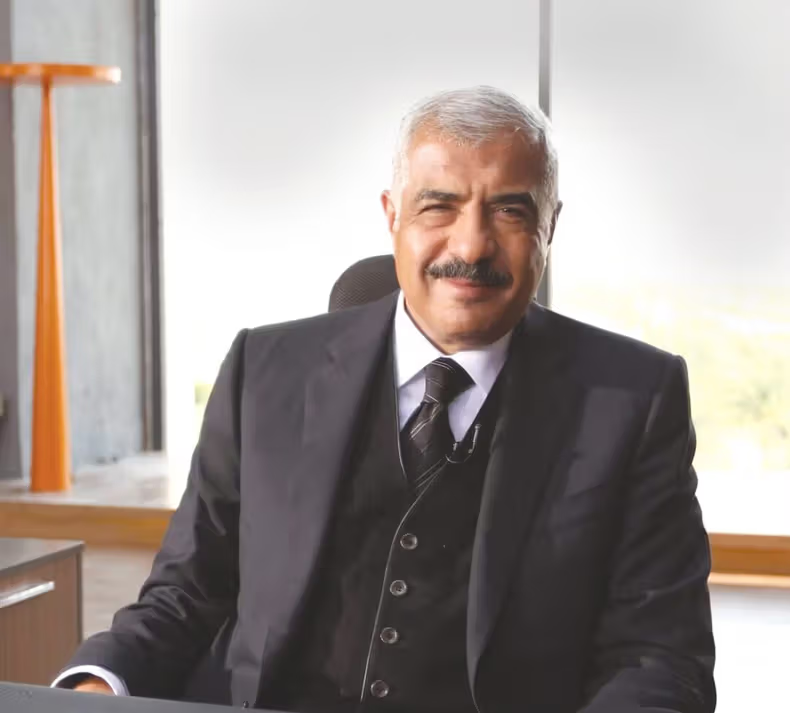
Egyptian billionaire developer Hisham Talaat Moustafa has sealed a landmark agreement with Hong Kong–based hospitality group Mandarin Oriental Hotel Group to manage two of Egypt’s most iconic Nile-side hotels — the Old Cataract in Aswan and the Winter Palace in Luxor.

The partnership signals a renewed push to reposition Egypt as a premier high-end, heritage-driven travel destination, while aligning global luxury standards with locally owned historic assets.
📢 GET A DETAILED ARTICLES + JOBS
Join ASJ's WhatsApp Channel and never miss a post or opportunity.

Under the agreement with Talaat Moustafa Group (TMG), Mandarin Oriental will assume management control of the legendary Old Cataract in Aswan in May 2026, with full relaunch scheduled for July 2027 following restoration works. The Winter Palace in Luxor will undergo comprehensive renovation before reopening in July 2027 under the Mandarin Oriental brand.
Together, the projects mark a strategic pivot toward experiential, heritage-led tourism at a time when global demand for culturally immersive travel is accelerating.

Reviving Iconic Nile Landmarks
The Old Cataract and Winter Palace are not ordinary hotel properties. Both are architectural and historical landmarks overlooking the Nile River and located near some of Egypt’s most significant archaeological treasures.
The Old Cataract sits close to the Temple of Philae and the island-dotted waters of Aswan, while the Winter Palace anchors Luxor’s tourism corridor near the Temple of Luxor and the Valley of the Kings.
Their restoration represents more than a hospitality upgrade — it reflects a broader strategy to convert cultural heritage into premium tourism infrastructure.
The Aswan property will continue operating through its heritage wing during renovations to the Nile Wing, ensuring continuity of operations while modernizing facilities. Meanwhile, the Winter Palace will temporarily close in early 2026 to undergo structural and aesthetic transformation.
When relaunched, both properties will operate as:
-
Mandarin Oriental Old Cataract, Aswan
-
Mandarin Oriental Winter Palace, Luxor
A First for Mandarin: Luxury Nile River Cruise
In a significant brand expansion, Mandarin Oriental will also launch its first luxury Nile river cruise, operating between Luxor and Aswan in partnership with K.G. Company for Real Estate and Tourism Investment, part of the Garranah Group.
The cruise will feature:
-
Multi-night itineraries
-
High-end suites
-
Fine-dining restaurants
-
Wellness and spa facilities
-
Curated cultural excursions
This initiative allows the group to create a seamless hospitality ecosystem — combining land-based luxury with river-based experiential travel.
The integration of Cairo, Luxor, Aswan, and river transit positions Egypt as a cohesive premium journey rather than a fragmented destination.

Strategic Portfolio Expansion
The hotel management deal builds on TMG’s 2024 acquisition of a 51% stake in the seven-hotel Legacy portfolio in an $800 million transaction. That acquisition significantly expanded TMG’s footprint across Cairo, Giza, Alexandria, Luxor, and Aswan.
By combining global luxury management expertise with local ownership and capital investment, the strategy leverages complementary strengths:
-
Mandarin Oriental provides brand equity, service standards, and global marketing reach.
-
TMG contributes asset ownership, local market knowledge, and long-term capital commitment.
Moustafa described the collaboration as a move to elevate historic assets into world-class destinations while reinforcing Egypt’s hospitality platform.
Backed by a Global Conglomerate
Mandarin Oriental operates 45 hotels, 15 branded residences, and 36 luxury homes across 28 countries and territories.
The group is majority owned by Jardine Matheson, the 19th-century trading house turned multinational conglomerate with diversified interests spanning property, retail, automotive, and hospitality.
Jardine Matheson is effectively controlled by the Keswick family, whose long-term investment approach has shaped the group’s global expansion strategy.
The Egypt initiative aligns with Mandarin Oriental’s focus on high-growth, culturally rich destinations where heritage can be combined with ultra-luxury positioning.
Egypt’s Tourism Boom
Egypt welcomed approximately 19 million tourists in 2025 — a 21% year-on-year increase. The government is targeting 21 million visitors in 2026 and 30 million annually by 2030.
Key drivers include:
-
Expanded airport capacity
-
Improved international air connectivity
-
Increased hotel inventory
-
Restoration of heritage sites
-
Aggressive tourism marketing campaigns
Luxury tourism is a critical pillar of this growth strategy. High-end travellers typically spend more per visit, boosting foreign exchange earnings and employment across service sectors.
By restoring heritage landmarks under a globally recognized luxury brand, Egypt aims to capture a larger share of affluent global travelers seeking immersive cultural experiences.
The Cairo Anchor: Shepheard Hotel
The Nile expansion complements Mandarin Oriental’s plans to reopen the historic Shepheard Hotel in Cairo in 2027 under a separate agreement with Saudi Arabia’s Al Sharif Group.
Once completed, the portfolio would enable a structured tourism journey:
-
Arrival and stay in Cairo
-
Transfer to Luxor’s restored Winter Palace
-
Luxury Nile cruise to Aswan
-
Stay at the revitalized Old Cataract
This integrated approach strengthens Egypt’s competitive positioning against other luxury destinations in the Mediterranean, Middle East, and North Africa.
Why Heritage Luxury Is Growing
Global tourism trends show increasing demand for:
-
Cultural authenticity
-
Story-driven hospitality
-
Experiential travel
-
Boutique heritage restoration
-
Sustainable tourism models
Rather than building entirely new resorts, investors are increasingly restoring historic properties and repositioning them within the premium segment.
The Old Cataract and Winter Palace embody this model — historic architecture combined with modern luxury infrastructure.
Economic and Strategic Impact
The deal carries broader economic implications:
1. Foreign Investment Signaling
Partnership with a globally recognized brand signals confidence in Egypt’s tourism recovery and stability.
2. Job Creation
Renovations and expanded operations will create employment in construction, hospitality, logistics, and ancillary services.
3. Heritage Preservation
Private capital supports restoration and maintenance of culturally significant assets.
4. Tourism Revenue Diversification
Luxury tourism generates higher per-capita spending, boosting foreign currency inflows.
Risks and Considerations
Despite strong growth projections, tourism remains sensitive to:
-
Regional geopolitical stability
-
Global economic cycles
-
Currency volatility
-
Aviation capacity
However, positioning at the ultra-luxury end of the market can provide resilience, as affluent travelers are often less price-sensitive and more experience-driven.
A Long-Term Bet on Africa’s Luxury Tourism
The Nile partnership underscores a broader corporate thesis: Africa’s tourism market is evolving from volume-driven mass travel to experience-driven premium positioning.
By combining restored heritage landmarks with modern hospitality excellence, TMG and Mandarin Oriental are betting on long-term demand for curated, culturally immersive travel.
If successful, the venture could redefine Egypt’s luxury tourism model and reinforce its status as North Africa’s leading hospitality market.
The Nile has always been central to Egypt’s history. This latest partnership aims to ensure it remains central to its economic future.
FAQs
What does the new agreement involve?
Mandarin Oriental will manage and restore the Old Cataract in Aswan and the Winter Palace in Luxor, alongside launching a luxury Nile cruise.
When will the hotels reopen?
Both properties are scheduled to fully reopen in July 2027 following renovation works.
What is unique about this expansion?
It combines heritage hotel restoration with Mandarin Oriental’s first luxury river cruise, creating an integrated land-and-water experience.
How is Egypt’s tourism sector performing?
Egypt welcomed around 19 million visitors in 2025 and is targeting 21 million in 2026 and 30 million by 2030.
Who owns Mandarin Oriental?
The group is majority owned by Jardine Matheson, a Hong Kong-based multinational conglomerate.
Source: Accra Street Journal
Last Updated on March 9, 2026 by Samuel Kwame Boadu
Disclaimer: Some content on Accra Street Journal may be aggregated, summarized, or edited from third-party sources for informational purposes. Images and media are used under fair use or royalty-free licenses. Accra Street Journal is a subsidiary of SamBoad Publishing Hub under SamBoad Business Group Ltd, registered in Ghana since 2014.
For concerns or inquiries, please visit our Privacy Policy or Contact Page.

Samuel Kwame Boadu is a Ghanaian media entrepreneur and storyteller with a passion for amplifying urban voices and uncovering everyday truths. He is the Editor-in-Chief and Founder of Accra Street Journal, a dynamic digital platform dedicated to capturing the pulse of Ghana’s capital—its people, culture, challenges, business, sports and innovations.